


I. Schenck, Nuremberg
I. Schenck, Nuremberg, late XVIIIth century
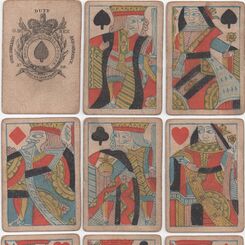
Playing cards printed from woodblocks by I. Schenck*, Nuremberg, late 18th century. The deck is a fine example of German standard cards derived from the Paris pattern but without the traditional names on the court cards. The cards are hand coloured with stencils in five colours but the black stencilling is a little messy in places. The king of diamonds has the maker’s name I. Schenck. Also, the jack of diamonds has a lettter ‘S’ on the halberd. The queen of clubs indicates the city where the cards were made, Nuremberg (German: Nürnberg), and the king of hearts features a Nuremberg coat-of-arms.
* There were three makers in Nürnberg that used “I. Schenck” on their cards, the father and his two sons. The father’s name was actually Johann Heinrich Schenck, but he sometimes used only the “I” on his cards. He is mentioned in Nürnberg as a journeyman in 1742 and 1751. Between 1755 and 1759 he became a master, and probably worked until 1787 when he died. The sons are Johann and Johannes, which may sound strange but is correct. Johannes became a master in 1772. He died in the same year as his father, 1787. Johann became a master in 1784, and died in 1839. The cards may have been made by any of them, but I guess that it was one of the sons. The cards were most probably made before 1800, as Johann Schenck produced similar double-headed cards later. Cards like these were first imported from France and then produced almost everywhere in Germany for local use. Notes courtesy Peter Endebrock.
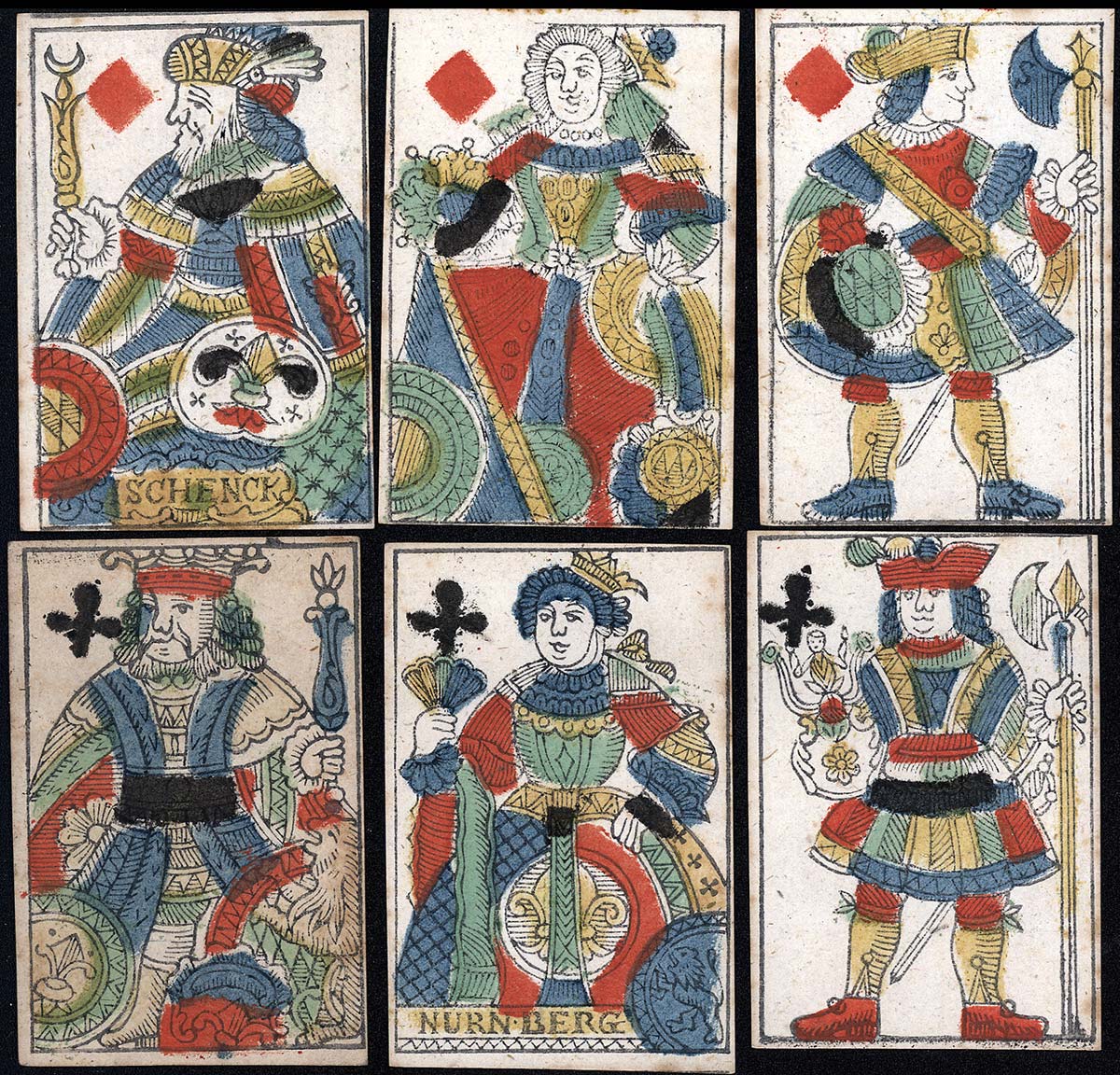
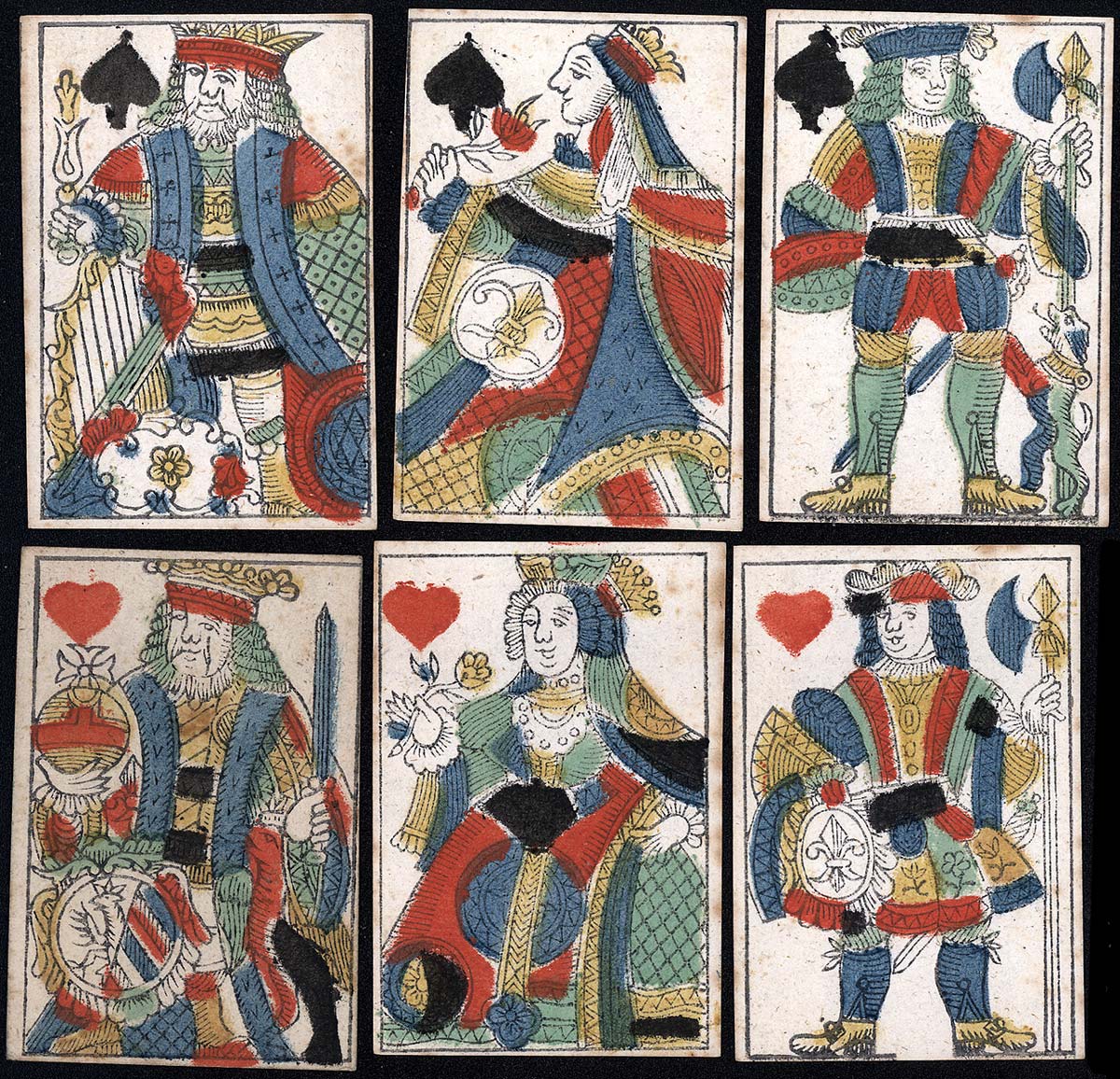
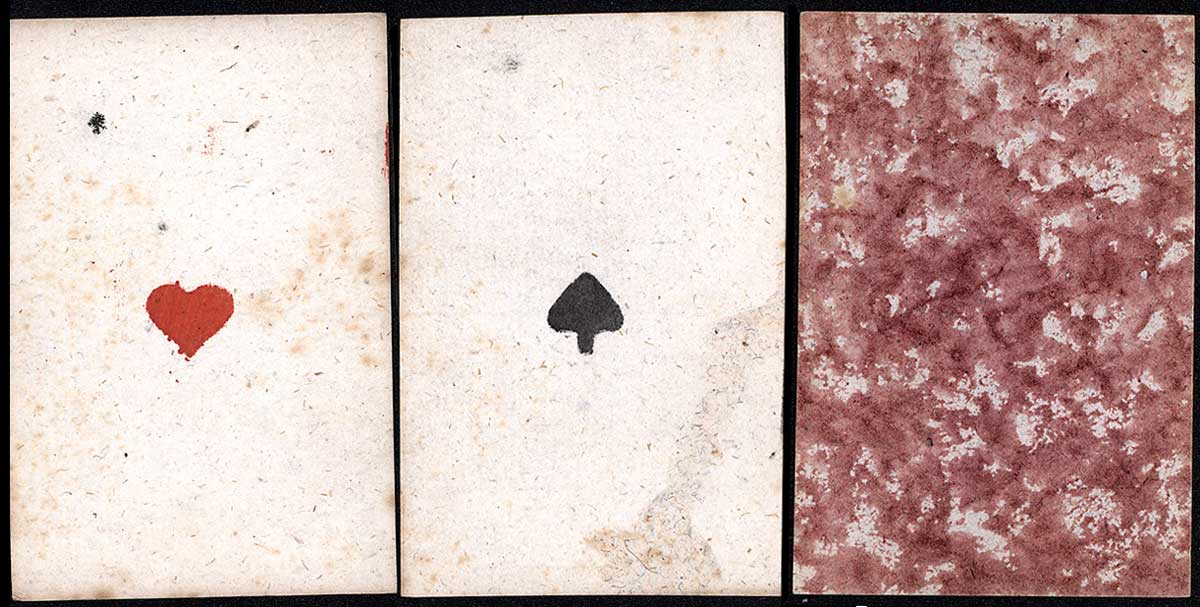
Above: woodblock & stencil playing cards manufactured by I. Schenck, Nuremberg, late 18th century. The cards measure approximately 3” x 2” (78mm x 51mm), all with the same type of mottled back design. Images courtesy Steven & Marsha Goldblatt.

By Simon Wintle
Spain • Member since February 01, 1996
I am the founder of The World of Playing Cards (est. 1996), a website dedicated to the history, artistry and cultural significance of playing cards and tarot. Over the years I have researched various areas of the subject, acquired and traded collections and contributed as a committee member of the IPCS and graphics editor of The Playing-Card journal. Having lived in Chile, England, Wales, and now Spain, these experiences have shaped my work and passion for playing cards. Amongst my achievements is producing a limited-edition replica of a 17th-century English pack using woodblocks and stencils—a labour of love. Today, the World of Playing Cards is a global collaborative project, with my son Adam serving as the technical driving force behind its development. His innovative efforts have helped shape the site into the thriving hub it is today. You are warmly invited to become a contributor and share your enthusiasm.

Activity for I. Schenck, Nuremberg
Sign in to comment or save this article.

Related Articles
La baraja de Almagro
De la chimenea al monumento nacional: la baraja de Almagro y el renacer del corral de comedias.
History of Tarot and Playing Cards: Timeline & Origins
An alternative history of tarot and playing cards – from Mamluk Egypt to the invention of tarot in R...
Early German playing cards
Some early examples of popular German playing cards from the XV and XVI centuries.
History of Playing Cards explained in 5 Minutes
Video by Art of Impossible. In this video you will get a short overview of the most important histor...
“Deck with French suits”
A facsimile of an early 19th century French-suited deck from the collection of F.X. Schmid.
71: Woodblock and stencil: the hearts
A presentation of the main characteristics of the wood-block courts of the heart suit.
70: Woodblock and stencil : the spade courts
This is a presentation in a more straight forward fashion of the work done by Paul Bostock and me in...
64: The descendants of the French regional patterns: 2
A continuation oF the development of the off-spring of the Paris patterns and a few examples of how ...
Trentine Pattern
Trentine Pattern
XVII Century Engraved Animal Cards
Anonymous French-suited German engraved cards c1610 to 1650.
Joseph Losch
French-suited pack with full-length courts by Joseph Losch, c.1800.
Old Bavarian pattern
Uncut sheets of playing cards of the Old Bavarian pattern by Michael Schatzberger, Passau, c.1780.
Cotta Transformation playing cards
In 1804, J.G. Cotta, a publisher and bookseller in Tübingen, Germany, produced the first set of tran...
German Saxon Pattern
The German Saxon Pattern or “Schwerdter Karte”.
Suicide King
The King of Hearts, holding a sword behind his head, is sometimes nicknamed the “Suicide King”. He c...
Das Kupferstichspiel des I.M.F. von 1617
Playing cards had been made as precious objects for wealthy clients since the late 14th century. The...
1: Playing Cards and their History: An Introduction and some links to other sites
What was considered the first mention of playing cards in England is in 1463 when Edward I banned th...
Playing cards in the Upper Rhine region
Documentary evidence suggests that card playing established itself in Italy in 1376, and then spread...
The History of Playing Cards
Playing cards appear in European records in the late 14th century, but their earlier history lies fu...
Early History of Playing Cards & Timeline
Out of an apparent void, a constellation of references in early literature emerge pointing to the su...
Most Popular
Our top articles from the past 60 days


