


XV Century Italian Playing Cards
Cards from a pack of an early form of north Italian playing cards, with the swords back-to-back and curved outwards. Believed to be Venetian, dated 1462.
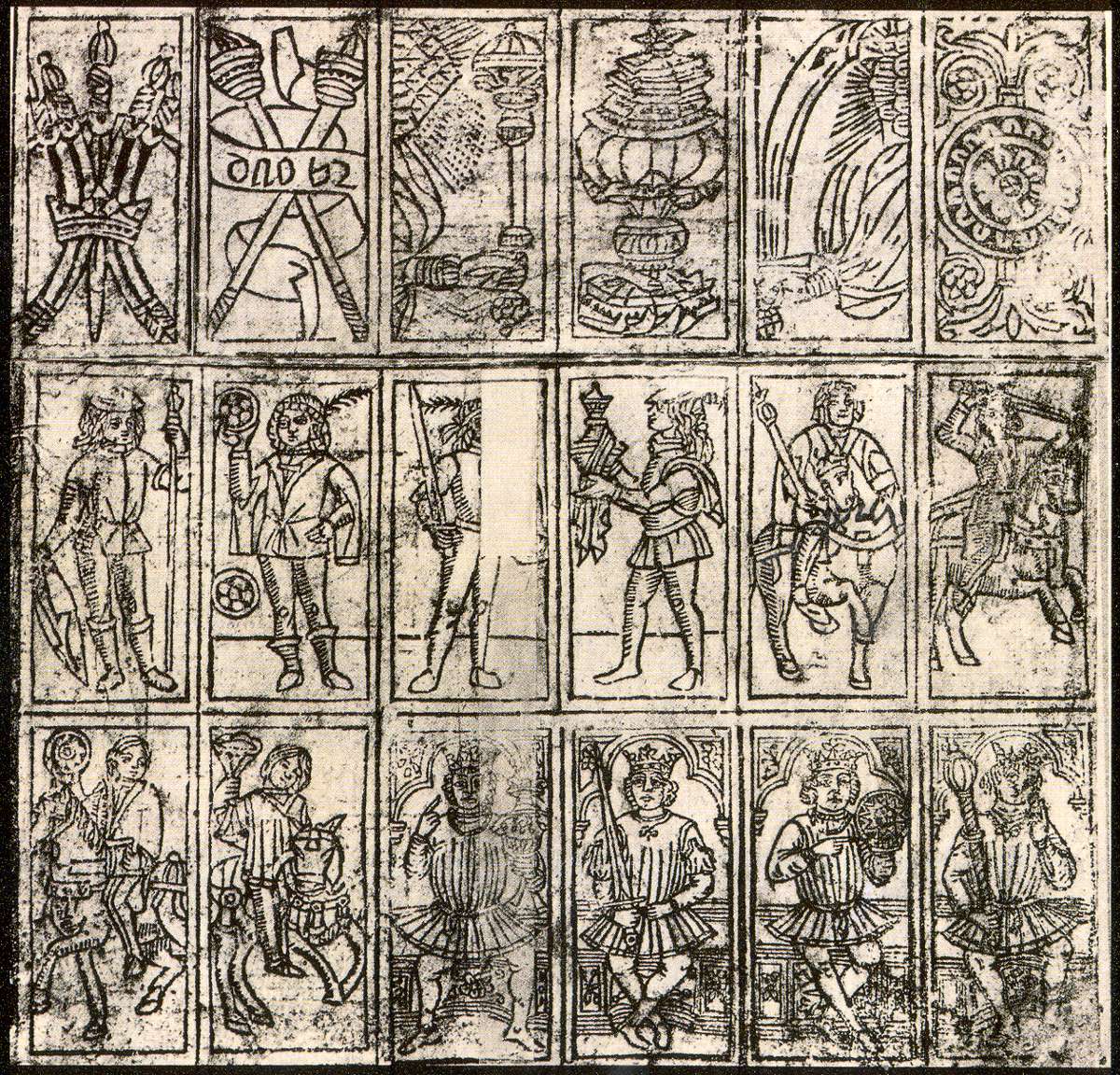
Above: eighteen cards from a pack of an early form of north Italian playing cards, printed from woodblocks, with the swords back-to-back and curved outwards. Believed to be Venetian, late 15th century. The inscription on the two of batons, whilst at first glance resembling “ano 62”, may in fact be an inscription reading “duos” as the numeral cards in the batons suit have inscriptions giving their values written in what appears to be Venetian dialect. Kings seated on thrones is a format found in other early Italian cards, as well as early Swiss and German cards.
By the 15th century there was interchange of Italian and Spanish suited cards across the Alps.
Images on this page of cards from the Museo "Fournier" de Naipes de Alava (Diputación Foral de Alava, Cuchillería 54, 01001 Vitoria-Gasteiz, Spain) are taken from Suarez Alba (1991) and used with permission.
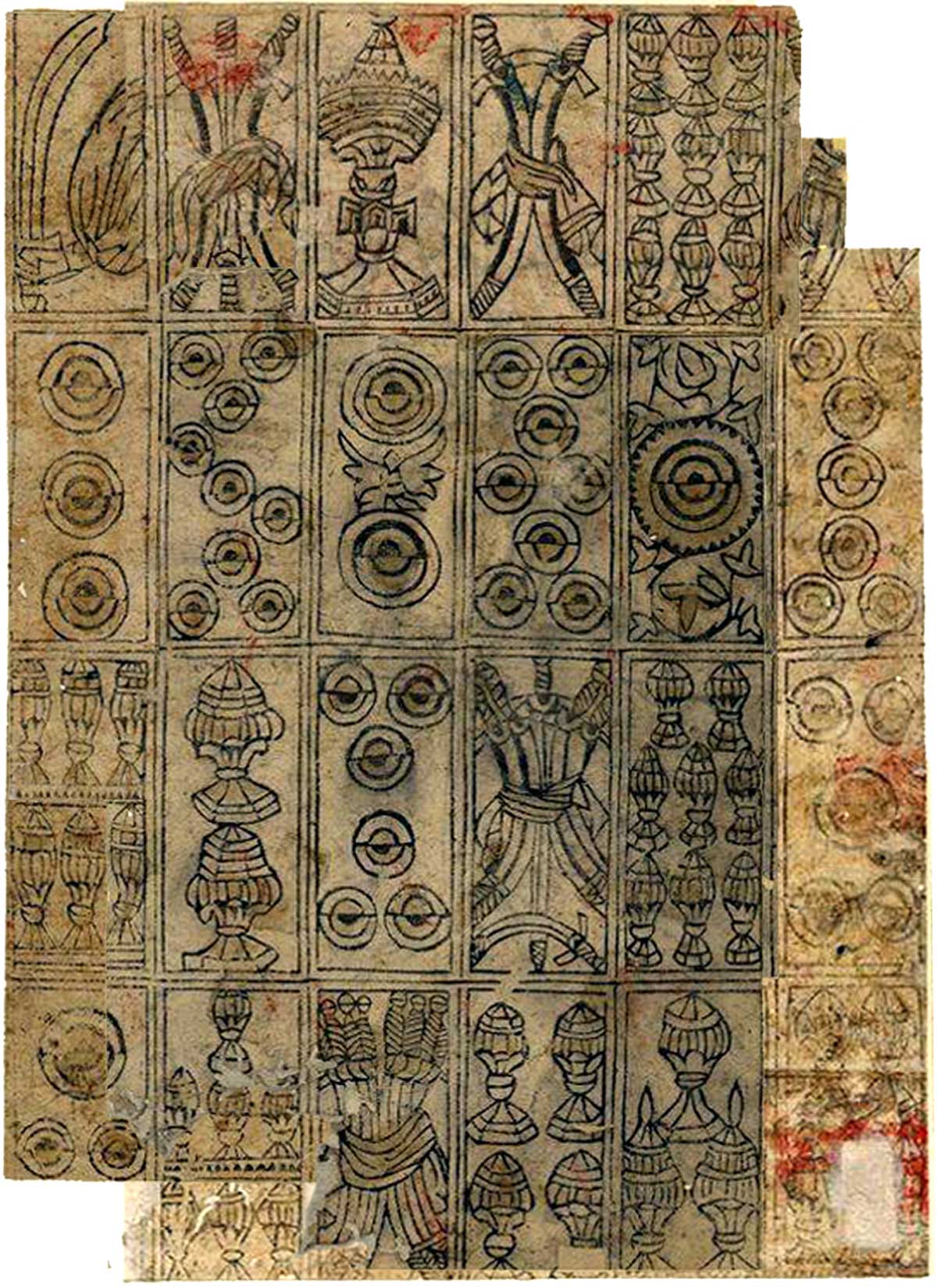
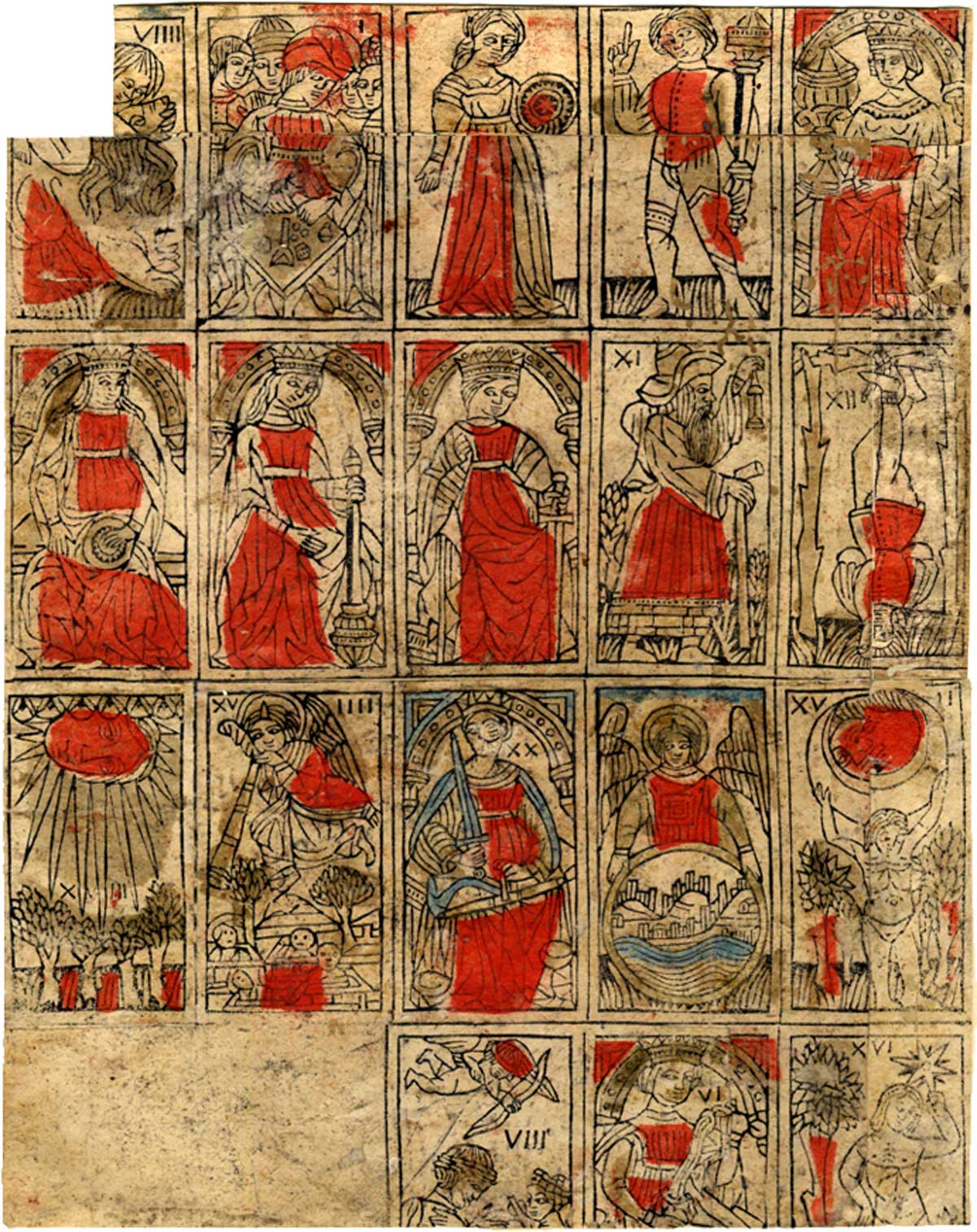
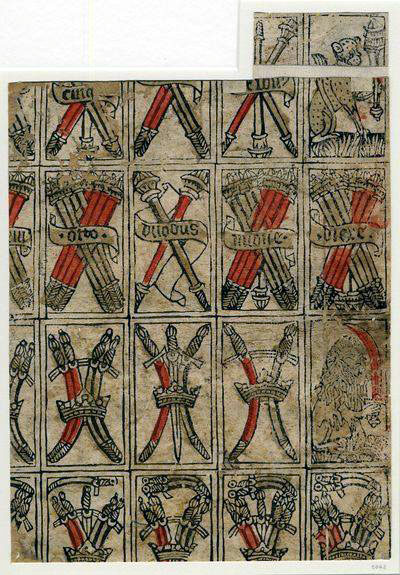
Above: reconstruction from several 16th or late 15th century north Italian fragments of partially coloured uncut sheets of cards. The swords and batons suit symbols are curved outwards in the same way as seen in early Spanish-Portuguese cards. The arrangement of the suit symbols and accompanying decorations are also reminiscent of the Mamluk Playing Cards from the Topkapu Museum in Istanbul. The original cards are located in Szépművészeti Múzeum (Museum of Fine Arts), Budapest.
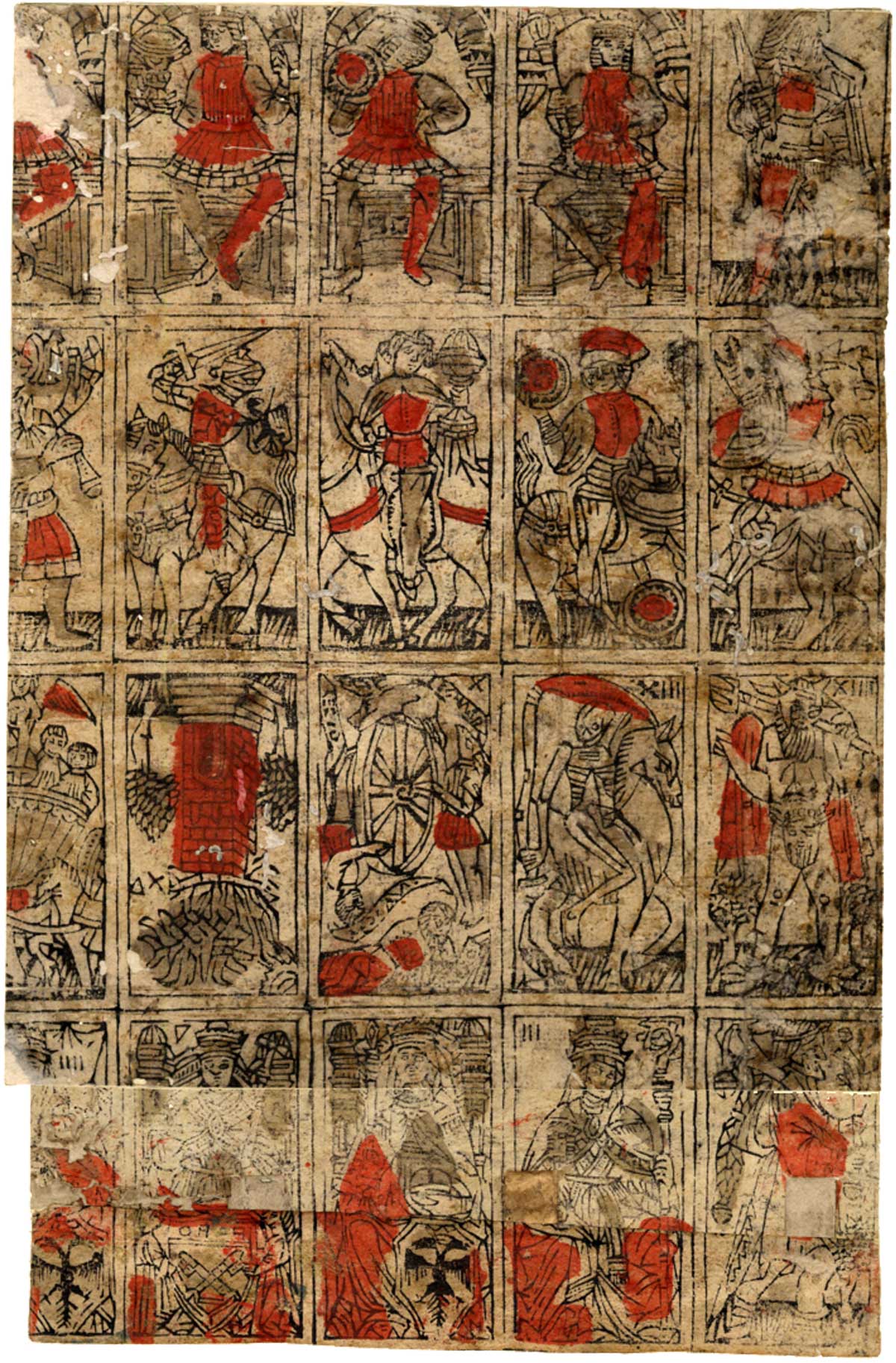
Below: more examples of the same style of cards, printed from woodblocks, are shown below which in these cases are very early tarot packs.
REFERENCES
Private correspondence from Michael Dummett to Dalu Jones, 1973.

By Simon Wintle
Spain • Member since February 01, 1996
I am the founder of The World of Playing Cards (est. 1996), a website dedicated to the history, artistry and cultural significance of playing cards and tarot. Over the years I have researched various areas of the subject, acquired and traded collections and contributed as a committee member of the IPCS and graphics editor of The Playing-Card journal. Having lived in Chile, England, Wales, and now Spain, these experiences have shaped my work and passion for playing cards. Amongst my achievements is producing a limited-edition replica of a 17th-century English pack using woodblocks and stencils—a labour of love. Today, the World of Playing Cards is a global collaborative project, with my son Adam serving as the technical driving force behind its development. His innovative efforts have helped shape the site into the thriving hub it is today. You are warmly invited to become a contributor and share your enthusiasm.

Activity for XV Century Italian Playing Cards
Sign in to comment or save this article.

Related Articles
Luigi Del Pieve Minchiate
Luigi Del Pieve and the “Alli Sorte” Minchiate of Florence.
Austrian Tarock by S.D. Modiano
Modiano’s Austrian Tarock with country scenes has been in production for over 100 years.
Il Tarocco del Mondo Nuovo
Imaginative Tarot card designs by Amerigo Folchi relating to Columbus and the New World.
Il Tarocco Mitologico
Fully pictorial Tarot designed by Amerigo Folchi with figures mainly from Greek mythology.
Le Monde Primitif Tarot
Facsimile edition produced by Morena Poltronieri & Ernesto Fazioli of Museo Internazionale dei Taroc...
I Gatti Originali di Evelyne Nicod
Etchings of cats on a set of major arcana created by Evelyne Nicod.
The Parisian Tarot
The “Parisian Tarot”, early 1600s, with imagery and design synthesizing several influences.
Venetian Tarot
Scenes from the history of Venice on a set of the major arcana.
Portuguese-suited cards
Portuguese-suited cards with dragon aces, made in Italy, 1613.
Trentine Pattern
Trentine Pattern
Primiera Bolognese
Primiera Bolognese by Modiano, c.1975
Hermanos Solesio
“Money Bag” pattern by Hermanos Solesi, late 18th c.
V. F. Solesio Tarot
V. F. Solesio Tarot, Genoa, mid-late 19th century.
Sola-Busca Tarocchi
The Sola-Busca Tarocchi, c.1491
Stairs of Gold Tarot
Whilst the titles of the cards are in Italian, the Hebrew and Sanskrit letters on the Trump cards de...
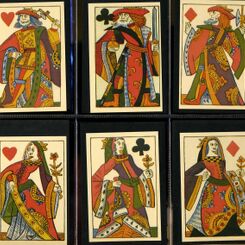
1: Playing Cards and their History: An Introduction and some links to other sites
What was considered the first mention of playing cards in England is in 1463 when Edward I banned th...
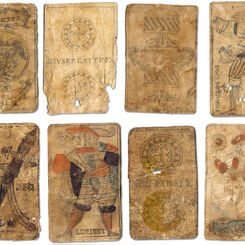
Giuseppe Cattino
Playing cards manufactured in Italy by Giuseppe Cattino and Paolo Montanar for Spanish markets.
Tarocco Bolognese
Tarocco Bolognese
Italian Playing Cards
The first reliable evidence that playing cards were being used in Italy is from 1376, when a game ca...
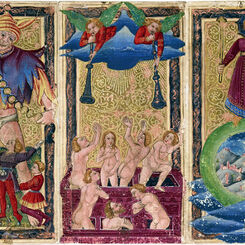
Hand-Painted Tarocchi Cards
Hand-painted Tarocchi cards sometimes known as ‘Charles VI tarot’, North Italy, 1475-1500.
Most Popular
Our top articles from the past 60 days


Paola Benzoni
12 July 2026, 13:29SavedSaved this article to Mazzi