


Lenormand Wahrsage-Karten No. 55
Conventional Lenormand designs on a pack from Piatnik but with unconventional numbering.
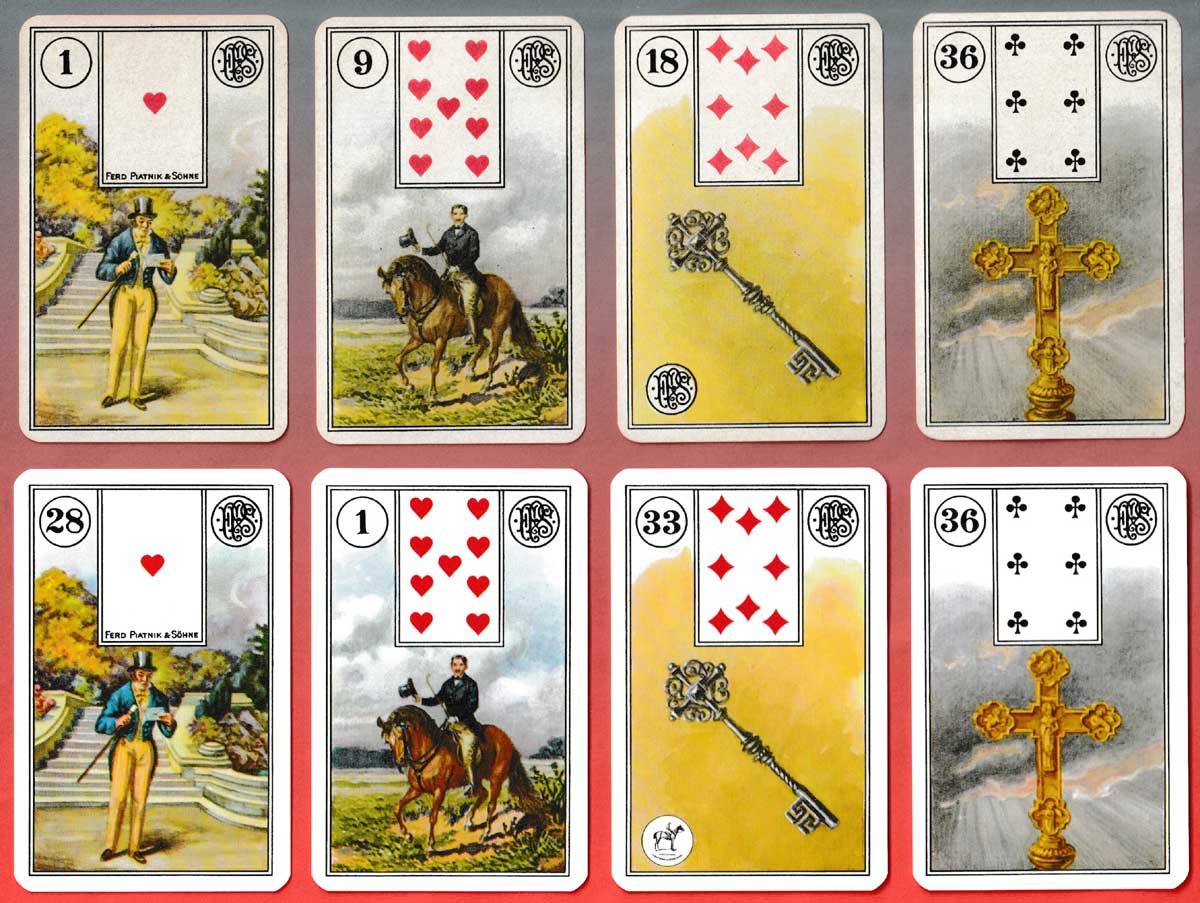
There is a traditional order for the designs in a standard Lenormand fortune-telling pack, starting with a male rider on card 1. However, in this pack from Piatnik dating from c1960 according to Jensen¹, the order is different, with a man in a top hat and carrying a cane on card 1 – the same image as appears on card 28 in a modern pack. Cards 1 to 4 are the four Aces, followed by the remaining cards in strict order (K, Q, J, 10, 9, 8, 7, 6 on cards 5 to 12, etc.), whereas in a modern pack the suits are jumbled up. The maker’s name appears in full on cards 1 and 3, as it does on cards 25 and 28 in a modern pack. The maker’s initials (FPS) appear in the top right-hand corner of every card (as they do in a modern pack), and twice on cards 3 and 18.
What is curious is that, when one opens a modern pack from Piatnik, one finds that the card designs are in exactly the same order as in the older pack. This suggests that the layout of the designs on the sheet prior to cutting is exactly the same as it was when the older pack was being produced. The back design in dark blue – brown in a modern pack – features two birds with outstretched wings. The booklet is in German only, whereas in a modern pack it is in German, English and French. The tuck box gives the appearance of being older than Jensen¹ suggests. See the box & booklet►
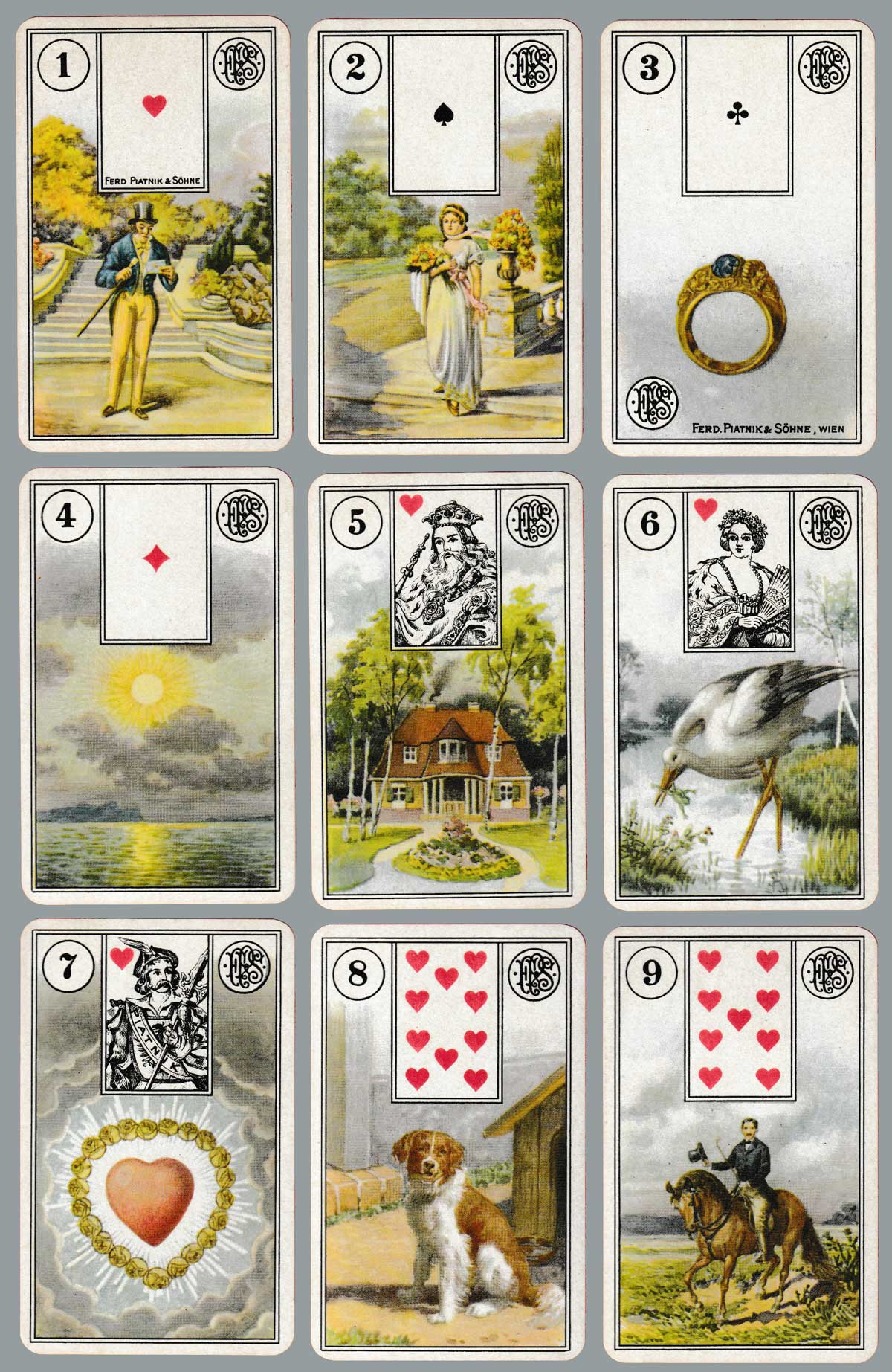
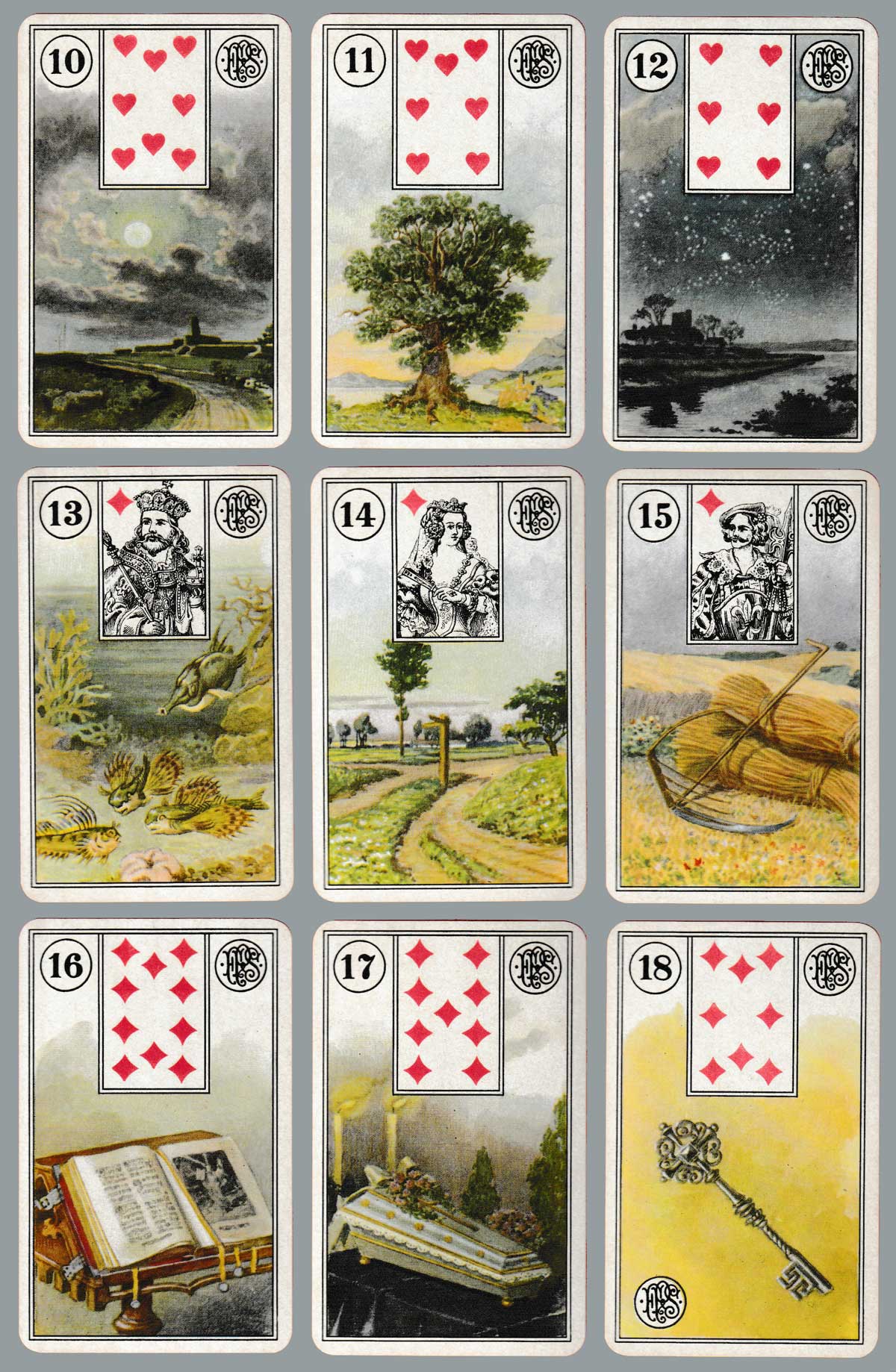
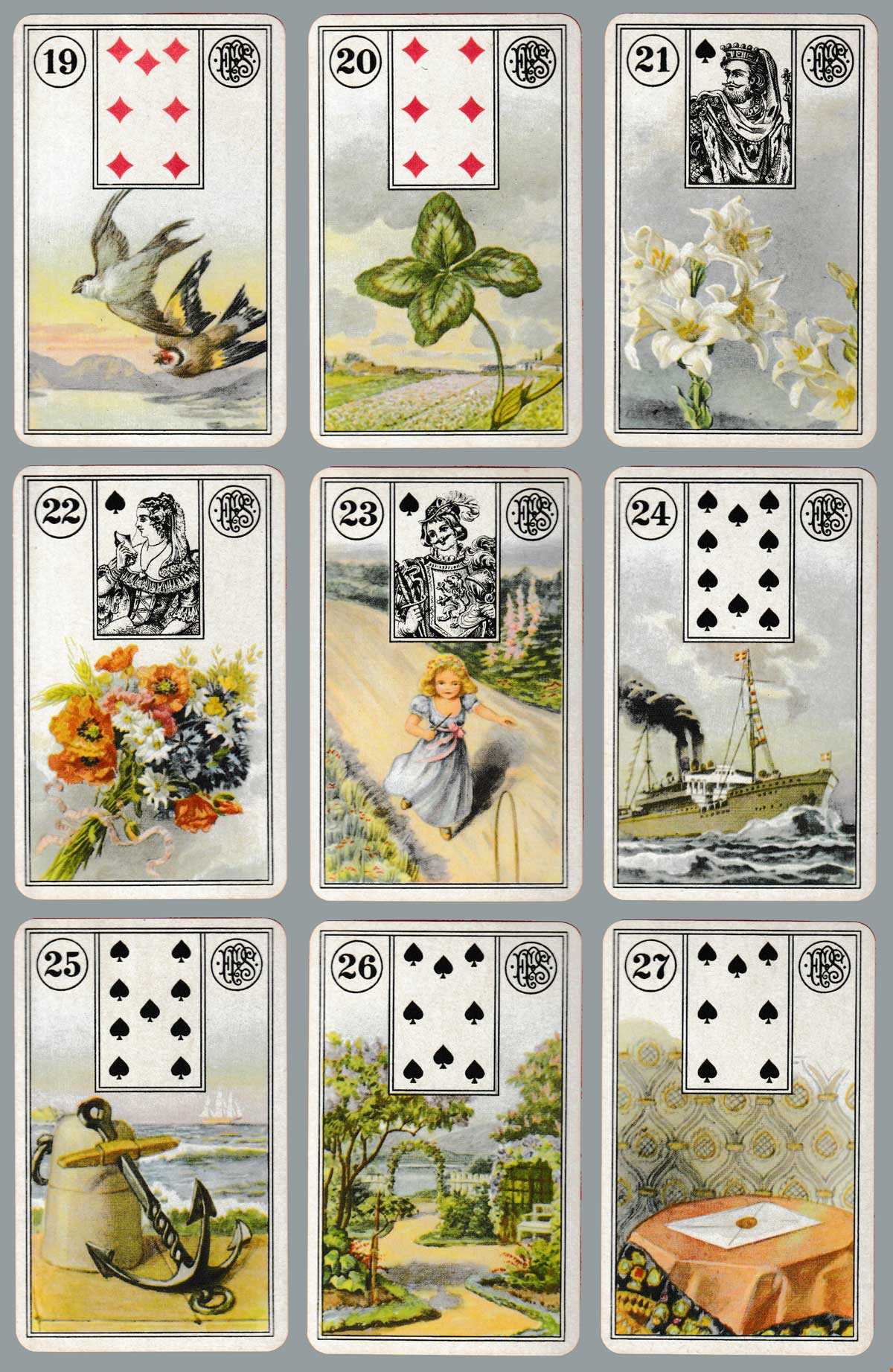
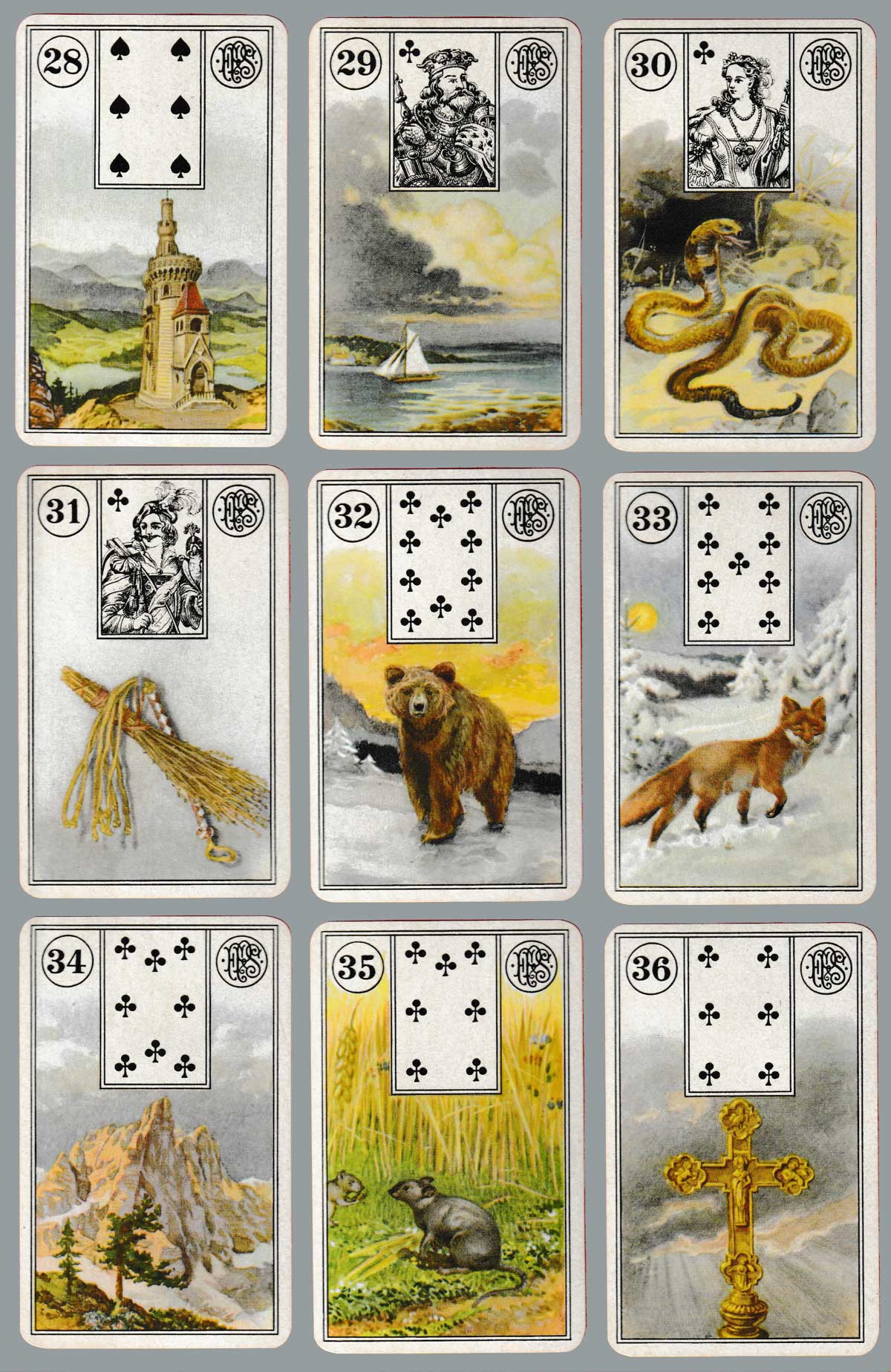
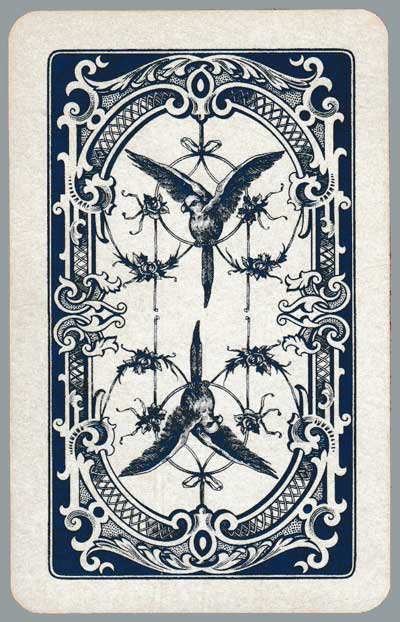
Above: Lenormand Wahrsage-Karten No. 55 made by Ferd. Piatnik & Söhne, Vienna, Austria, c1960. 36 cards + 16-page booklet in German, in tuck box. Size: 57 x 89.5 mm. The number 55 appears on the sides of the box and the back design is reproduced (in red) on the back of the box.
Comparison of 1960 pack (top row) with traditional order (below)
Reference
1 Jensen, K. Frank: The Prophetic Cards. Roskilde, Denmark; 1985. Cat. no. 1.20.

By Roddy Somerville
France • Member since May 31, 2022
Roddy started collecting stamps on his 8th birthday. In 1977 he joined the newly formed playing-card department at Stanley Gibbons in London before setting up his own business in Edinburgh four years later. His collecting interests include playing cards, postcards, stamps (especially playing cards on stamps) and sugar wrappers. He is a Past President of the Scottish Philatelic Society, a former Chairman of the IPCS, a Past Master of the Worshipful Company of Makers of Playing Cards and Curator of the WCMPC’s collection of playing cards. He lives near Toulouse in France.

Activity for Lenormand Wahrsage-Karten No. 55
Sign in to comment or save this article.

Related Articles
Luxury No. 2167
A Piatnik classic that lives up to its title.
Art pack I
Art pack featuring Old Masters, including Bruegel, Vermeer, Titian, Raphael, Caravaggio, Canaletto, ...

Austria Ski Team playing cards
Photos of members of the Austrian skiing team replace the normal courts on two different packs.
Romania playing cards
Romanian voivodes and their wives from the 15th and 16th centuries.
Rika playing cards
Playing cards depicting famous Austrian skiers of the 1970s.
Piatnik No.97
Non-standard French-suited cards published by Ferd Piatnik & Sõhne, Vienna, c.1940s.
Vienna (ex-Lyon) pattern
‘Vienna pattern’ derived from archaic Lyon pattern by Ferd Piatnik & Söhne A.G., c.1926-1934.
48: Ferdinand Piatnik & Sons
Ferd. Piatnik produced a very large range of cards with many different standard and non-standard pat...
Popular No.257
Piatnik’s “Popular Playing Cards” No.257
Salzburger Pattern
Salzburger pattern by Ferd. Piatnik & Söhne, Vienna
Die Neue ÖVP
Promotional deck for the Austrian People’s Party (ÖVP) printed by Piatnik, 1996.
El Jokey by Piatnik, 1990s
‘El Jokey’ Spanish-suited pack by Piatnik & Sons, Vienna, 1990s
Vienna Melange
“Vienna Melange” Playing Cards by Piatnik with a historical feel representing the four races that ma...
Austrian Cartomancy Cards
During the 19th century a system of fortune telling arose in Europe using unnumbered, pictorial card...
Art Deco Gypsy Oracle
Art Deco fortune telling deck published by Piatnik, 1936.
Ferd. Piatnik & Söhne
Ferdinand Piatnik was born in Ofen on October 14, 1819.
Piatnik Tarock
Deck of "Industrie und Glück" or "Rural Scenes" tarock cards manufactured by Ferd Piatnik & Söhne, V...
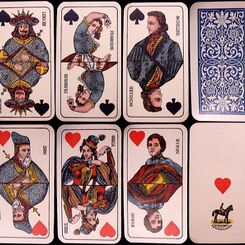
Literary Figures
Non-Standard Literary Figures playing cards manufactured by Ferd. Piatnik & Söhne A.G., Vienna, 1924...
Piatnik & Sons for the“Estanco de Naipes del Perú”
Playing Cards made by Piatnik & Sons for the“Estanco de Naipes del Perú”, c.1960.
Significado de los Naipes Españoles
Cartomantic meanings of Spanish playing cards by Benita the Witch (XVI century), published by Chocol...
Most Popular
Our top articles from the past 60 days


Jordan Hauser
21 June 2026, 01:59SavedSaved this article to Lenormand