


50: Joseph Reynolds
A presentation of my database of Reynolds cards.
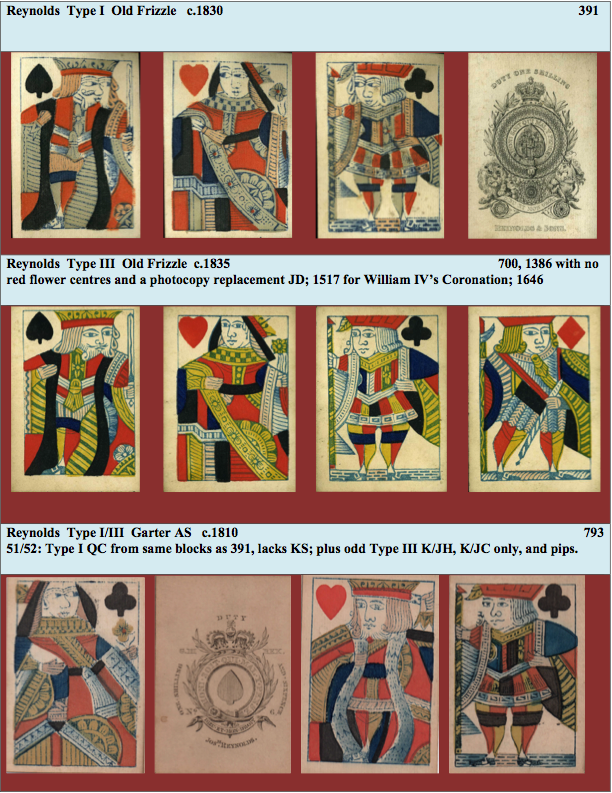
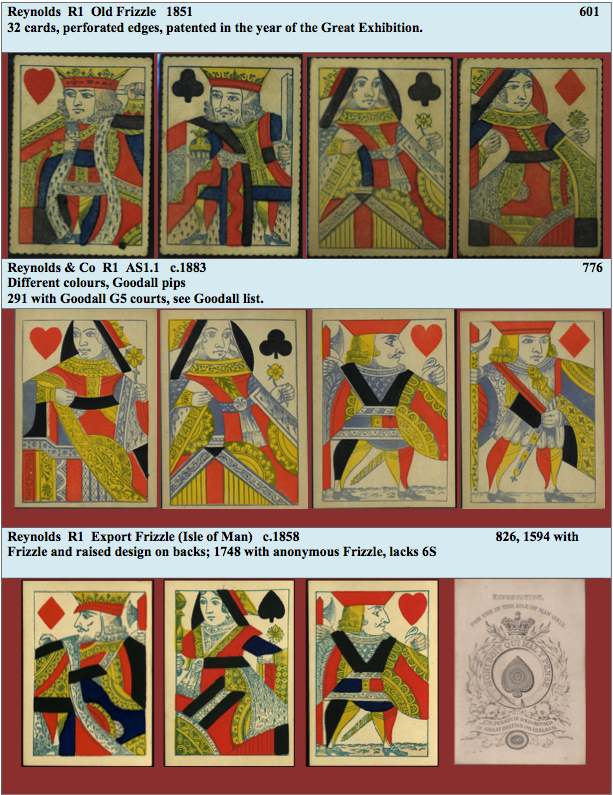
Joseph Reynolds was apprenticed to Hunt in 1804; his first AS was registered in 1809 when he set up as a separate business. In 1828 he was joined by his two sons, so all Old Frizzle aces have Reynolds & Sons on them. Although his firm fell behind many of the others in the 1870s (perhaps having something to do with Joseph's old age and then death), he seems to have been an innovator in many ways. He claimed to have been the first to produce decorative back designs, aside from the overall patterns that a number of makers used, when in 1831 he produced a pack commemorating the coronation of William IV. The decoration was in gold on white or pink and predates Thomas de la Rue's experiments with gold by a few months. He also experimented with rounding the corners of the cards as early as 1848 and in 1851 took out a patent for his designs with two different solutions, one with edges like a series of semicircular indentations, which look rather like stamp perforations) and the other with concave sides, which he referred to as lozenge-shaped. He was one of the earliest makers to introduce bézique in c.1865, which was always spelled bésique on his boxes, markers and booklets. By the 1880s the ailing company went into administration and was bought by Goodall in or before 1884. By then the firm was renamed Reynolds & Co. and packs can be found with either Reynolds or Goodall courts. Any indexed packs had Goodall courts; I know of no Reynolds courts with indices.
Hardly surprisingly, since he was apprenticed to Hunt, his first courts were of wood-block Type I; by the Old Frizzle period he had redrawn his courts in the style of Type III, though the old Type I courts were still being used up in the early Frizzle period.
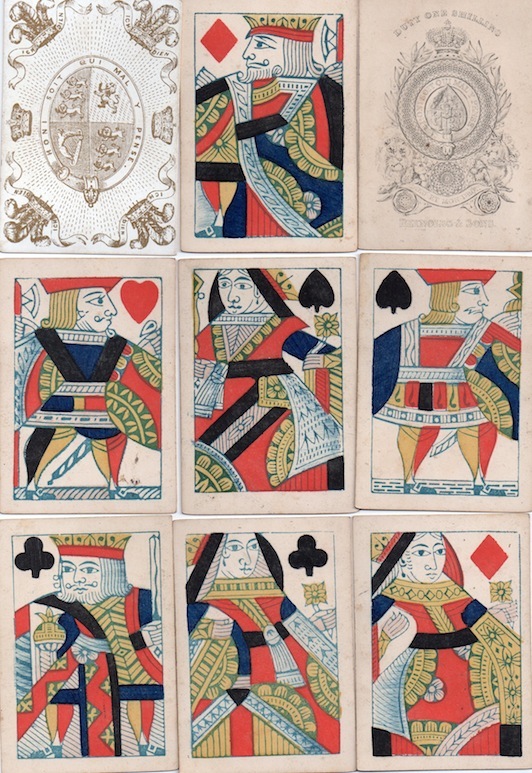 For William IV [1517]
Double-ending was applied to the Type III courts, possibly as early as 1850, but the designs were recut, not stuck together from two existing head ends. In the Old Frizzle period, too, the single-figure courts were redesigned into a house style, R1, which were used into the 1880s, as there are packs with a Reynolds & Co. AS.
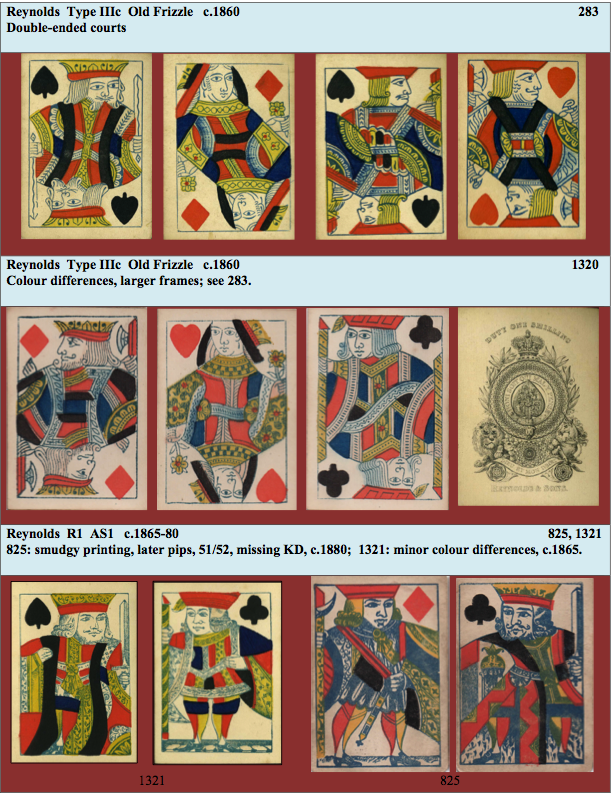
The double-ended wood-block courts were designated Type IIIc, but since they are specific to Reynolds, it might be better to reclassify them as R3. They were used in the early post-Frizzle period, too, as evidenced by the pack below with their own AS. This was a re-issue of the Prince of Wales pack originally designed in c.1831 for William IV (see [1517] above), in this case for Victoria's eldest son, Bertie, the then Prince of Wales, who became Edward VII. This pack was advertised from 1862-64 (at least).
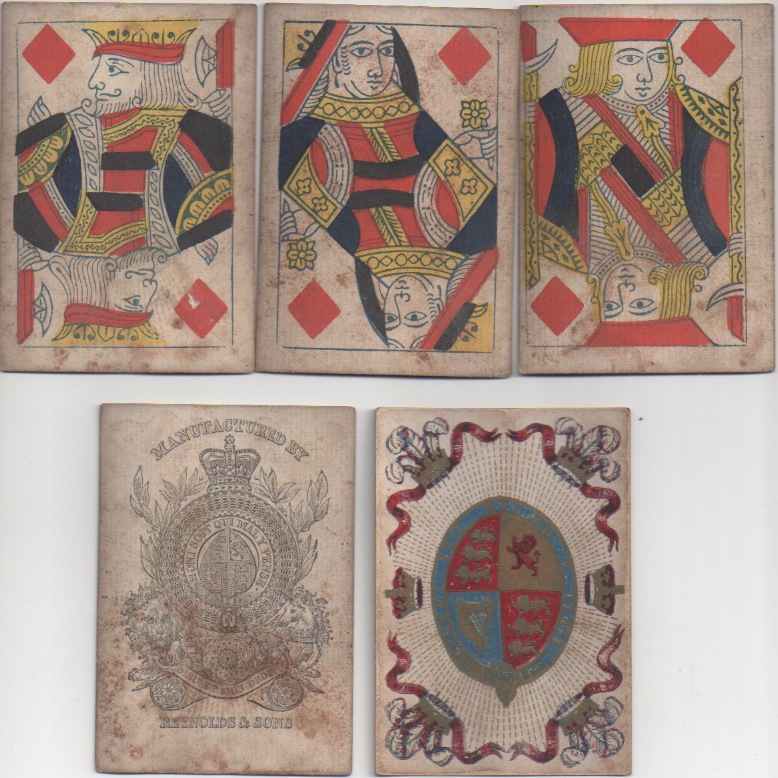 For Prince Edward, c.1863 [1838]
Reynolds is one of the makers who used the Isle of Man Export Frizzle and even anonymous Frizzles.
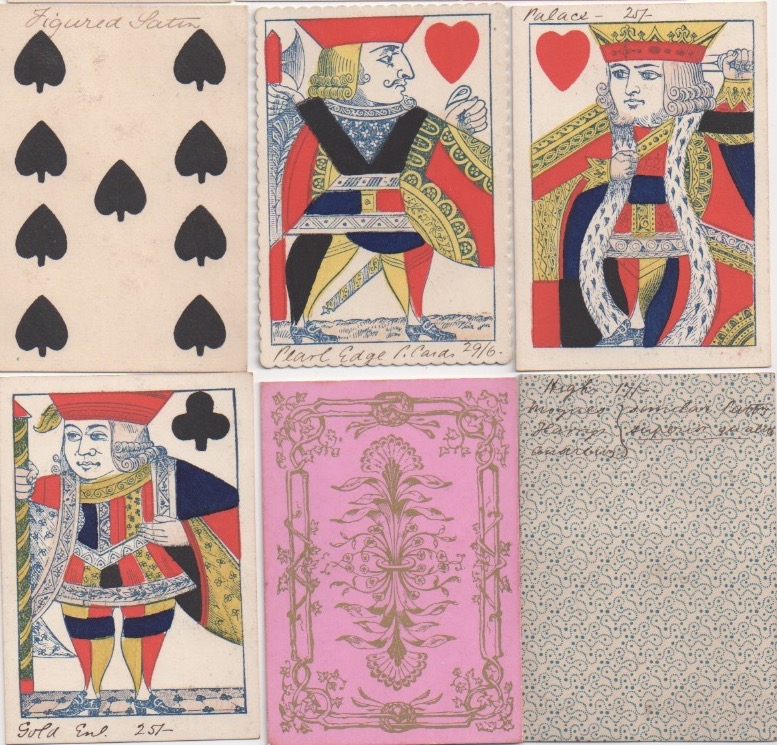
The raised back design on 1594 was called Figured Satin (see below) and is also found with Type III courts.
Here's an interesting glimpse into the prices and trade-names of their cards in the 1850s. The pink and gold back is for the Gold Enamelled series; the bottom right card tells us that High Moguls, Harrys and Andrews have similar patterns, are of superior quality and cost 17/- per dozen packs.
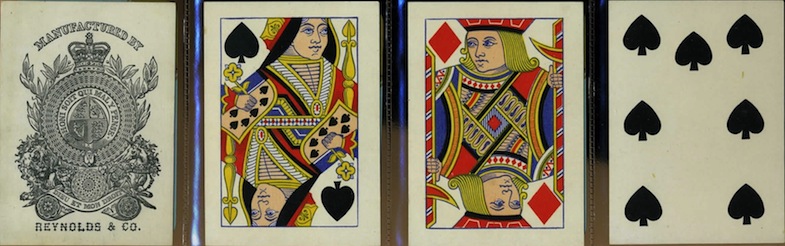 [291] Reynolds & Co. with Goodall G5 courts, c.1885
Double-ended courts were introduced by 1863 (I've never seen a double-ended Reynolds pack with R2 courts and an Old Frizzle AS), and a toy pack was introduced in 1862.
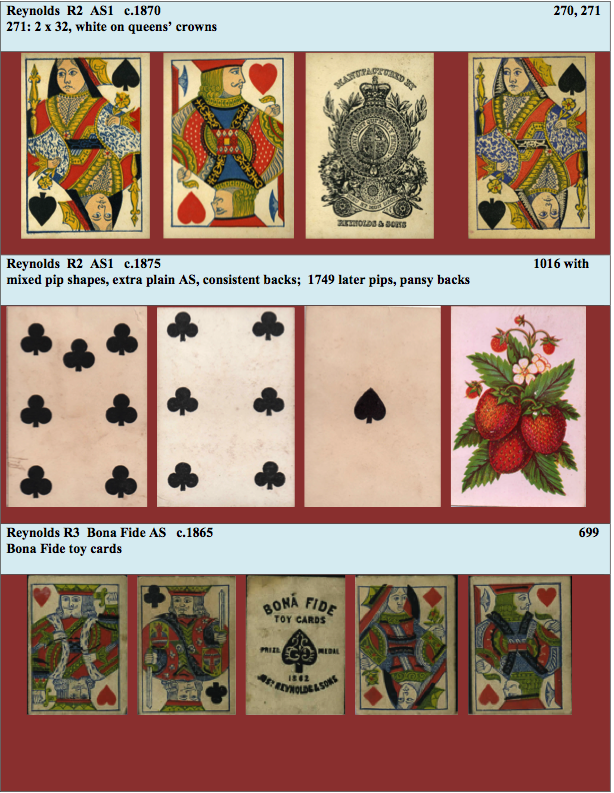
For a list of my Reynolds packs, which is slightly revised from the illustrations above, click this link►
For further information on Reynolds, see pages 20, 30, 32 or WoPC.

By Ken Lodge
United Kingdom • Member since May 14, 2012
I'm Ken Lodge and have been collecting playing cards since I was about eighteen months old (1945). I am also a trained academic, so I can observe and analyze reasonably well. I've applied these analytical techniques over a long period of time to the study of playing cards and have managed to assemble a large amount of information about them, especially those of the standard English pattern. About Ken Lodge →

Activity for 50: Joseph Reynolds
Sign in to comment or save this article.

Related Articles
Portrait Playing Cards
Portrait playing cards, featuring realistic drawings of people on the court cards instead of traditi...
Great Mogul Playing Cards
The origins of the 'Great Mogul' brand playing cards.
Bezique Markers, 1860-1960
Bezique is a two-player melding and trick-taking game. Dr. Pole introduced Bezique to England in 186...
Fortune-Telling Cards
Comic Fortune-Telling Cards published by Reynolds & Sons, c.1850.
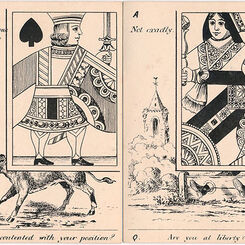
Comic Question & Answer cards
Comic Question & Answer cards by Josh. Reynolds & Sons, circa 1850.
Wrappers
Playing cards were traditionally sold inside paper wrappers, which were usually thrown away.
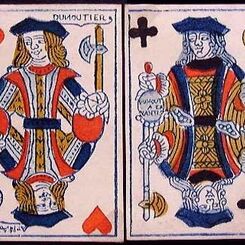
32: The Not-So-Minor Cardmakers of the 19th Century - Part 3
A survey of the cards made by Creswick and Hardy, with a brief mention of De La Rue, Goodall and Rey...
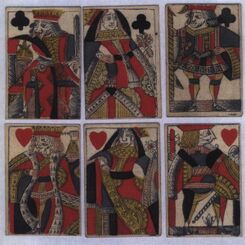
30: The Not-So-Minor Cardmakers of the 19th Century - Gibson, Hunt & Bancks
A preliminary look at the card-makers operating in the 19th century.
27: Cards at Strangers’ Hall, Norwich
There is a very interesting collection of playing cards held at the Strangers' Hall Museum in Norwic...
Crowquill Transformation
Transformation playing cards designed by the illustrator, comic artist and stage designer ‘Alfred Cr...
20: English Card-Makers 1761-1905
An initial survey of 19th century playing-card production. More detailed information appears on othe...
Reynolds c.1830
Woodblock and stencil playing cards, produced by Reynolds & Sons c.1830-1850.
Reynolds non-standard
Sometime around c.1850 Reynolds & Sons produced this non-standard or variant pack with courts inspir...
Reynolds c.1809-1885
Joseph Reynolds had been producing playing cards in the traditional method since c.1809.
Playing Card Design
The playing card calls for artistic treatment and although the constrained size imposes some limitat...
Most Popular
Our top articles from the past 60 days


