Cartas Portuguezas

Published June 08, 2022 Updated October 15, 2024

Portuguese pattern playing cards published in Rio de Janeiro, Brazil, late 19th century.

BrazilPortuguese Pattern

The Portuguese introduced their cards to Brazil but the use of the old Portuguese pattern died out towards the end of the 19th century. This is a late example of the Portuguese pattern. After this Belgian and German exports took over the market. Court cards are king, knight and maid. The maid of clubs no longer has a small dog at her feet but the maid of coins still holds a coffer or jewel case. The coin suit-marks have the form of rosettes, and the swords and clubs are arranged as trophies with shields. A cross-legged manikin sits behind the two of clubs. On the aces the suit-mark is held by a dragon.
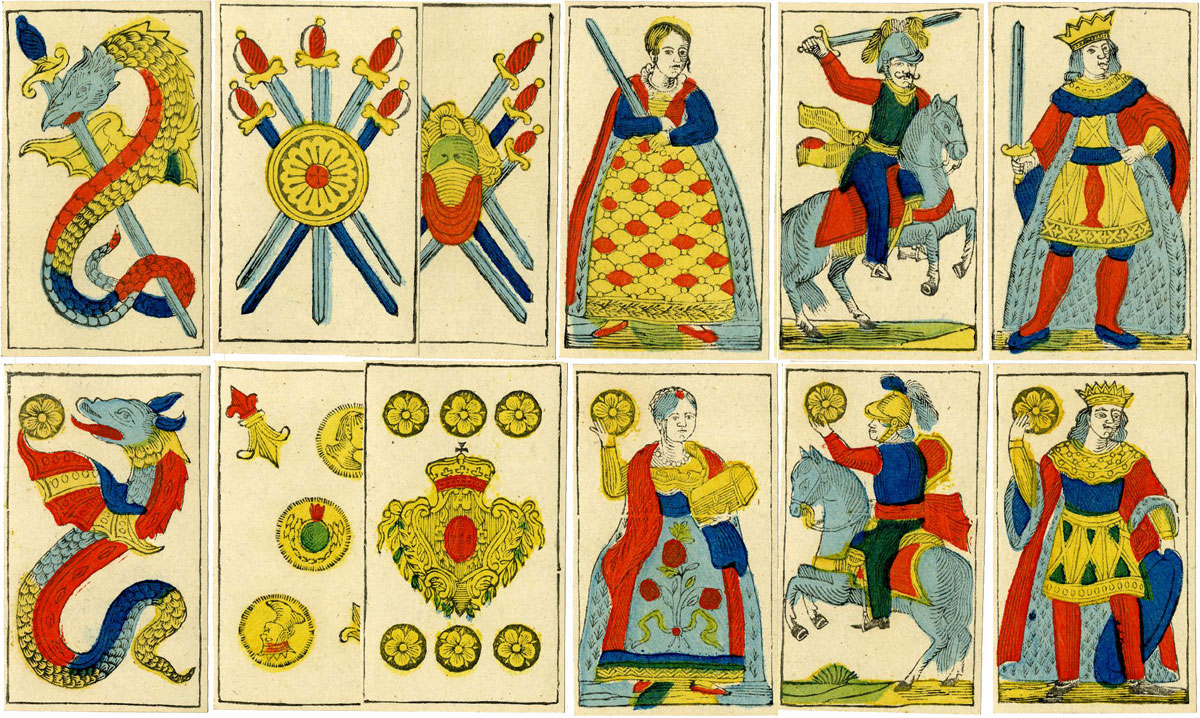
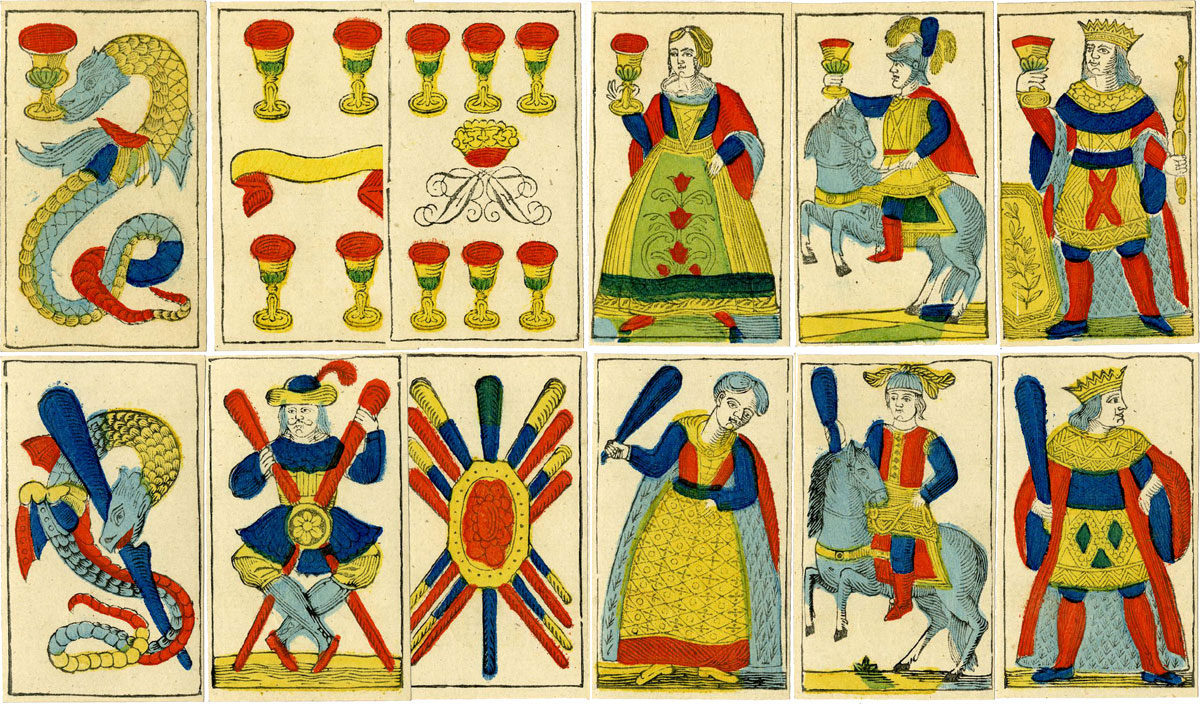
Portuguese pattern playing cards published in Rio de Janeiro, Brazil, late 19th century. © The Trustees of the British Museum Portuguese pattern playing cards published in Rio de Janeiro, Brazil, late 19th century. © The Trustees of the British Museum

Above: Portuguese pattern playing cards produced by woodblock and stencil in (or in Lisbon for) Rio de Janeiro, Brazil, late 19th century. 48 cards, in original wrapper lettered “Cartas Portuguezas, Da R. F. do R_o de Janr_o”. The 6 of cups bears a cipher, "R.F" but the banners on the fours of coins and cups are empty. The monogram on the six of cups is made to resemble that of the Real Fábrica de Lisboa, but it is possible that this example was actually manufactured anonymously in Belgium. Backs printed in blue with a pattern of stars. © The Trustees of the British Museum • Cartas Portuguezas

References

O’Donoghue, Freeman M: Catalogue of the collection of playing cards bequeathed by Lady Charlotte Schreiber, Trustees of the British Museum, London, 1901 (Portuguese 1) [digital version here]

See also Bibliothèque nationale de France: Cartes de tête d'un jeu au portrait portugais

avatar
1,487 Articles

By Simon Wintle

Spain • Member since February 01, 1996 • Contact

I am the founder of The World of Playing Cards (est. 1996), a website dedicated to the history, artistry and cultural significance of playing cards and tarot. Over the years I have researched various areas of the subject, acquired and traded collections and contributed as a committee member of the IPCS and graphics editor of The Playing-Card journal. Having lived in Chile, England, Wales, and now Spain, these experiences have shaped my work and passion for playing cards. Amongst my achievements is producing a limited-edition replica of a 17th-century English pack using woodblocks and stencils—a labour of love. Today, the World of Playing Cards is a global collaborative project, with my son Adam serving as the technical driving force behind its development. His innovative efforts have helped shape the site into the thriving hub it is today. You are warmly invited to become a contributor and share your enthusiasm.

Related Articles

1820 Portuguese pattern by Real Fábrica

Portuguese pattern by Real Fábrica

Later Portuguese pattern by Impressão Règia, Real Fábrica de Lisboa.

1883 Jeu Quatre Empereurs

Jeu Quatre Empereurs

Brazilian scenic aces with emperors of Brazil, Austria and France and other dignitaries on the court...

1693 Infirrera

Infirrera

Italo-Portuguese-suited cards by Andrea Infirrera with the arms of Malta, 1693.

1890 Portuguese cards for Brazil

Portuguese cards for Brazil

Portuguese-type cards made in or for Brazil, c.1890.

1613 Portuguese-suited cards

Portuguese-suited cards

Portuguese-suited cards with dragon aces, made in Italy, 1613.

1988 4C Gemstone playing cards for De Beers

4C Gemstone playing cards for De Beers

4C Gemstone playing cards for De Beers, 1988.

Elephante No.50

Elephante No.50

‘Elephante No.50’ Cadiz pattern produced in Brazil, probably by Azevedo & Cia, Recife, c.1920.

Malta

Malta

The so-called ‘Dragon Cards’, with winged monsters on the four Aces, are an enigmatic aspect of earl...

Copag Baralho Espanhol

Copag Baralho Espanhol

Copag Baralho Espanhol / Naipes Español.

SOIMCA

SOIMCA

SOIMCA - Sociedade Impressora Caxiense - is an important playing card manufacturer in Brazil. It was...

Cartográfica Industrial, Curitiba, Brazil

Cartográfica Industrial, Curitiba, Brazil

Double advertising pack made by Cartográfica Industrial for Refrigeração Parana S.A. The extra card ...

Vale Tudo - Cartas para Jogar

Vale Tudo - Cartas para Jogar

Vale Tudo - Cartas para Jogar, manufactured in Sao Paulo, Brazil. The courts are standard English pa...

2009 Schincariol Beer, Nossagraf, Brazil

Schincariol Beer, Nossagraf, Brazil

Schincariol Cerveja Pilsen brewery playing cards manufactured by Gráfica Nossa Senhora Aparecida Ltd...

1770 Brazil

Brazil

Playing card production in Brazil was officially sanctioned by royal decree in 1770.

1580 Francisco Flores

Francisco Flores

Playing cards in this style have been discovered in various parts of the world, suggesting that they...

1880 Portuguese Type Playing Cards made in Belgium

Portuguese Type Playing Cards made in Belgium

Portuguese type pack with ‘dragon’ aces made in Belgium by Mesmaekers Frères, Turnhout, c.1875-1900....

Early Spanish/Portuguese type

Early Spanish/Portuguese type

Fragment of a sheet of archaic Spanish-suited 'Dragon' playing cards found during restoration of a h...

1860 Portuguese Type Playing Cards c.1860

Portuguese Type Playing Cards c.1860

10 cards from a pack of later Portuguese ‘Dragon’ type cards from c.1860, with the Maid of batons ab...

16<sup>th</sup> century cards discovered in Peru

16th century cards discovered in Peru

Fragments of playing cards and 2 dice were unearthed in a 16th century rubbish tip adjace...

2003 Tensho Mekuri - Japan

Tensho Mekuri - Japan

Tensho Mekuri cards hand-made by Patricia Kirk, 2003.