


Vergnano Tarot 1826-1851
Stefano Vergnano’s Tarot and playing card factory holds a special place in the history of the Tarot.
The Story of a Piedmontese Tarot
© Giordano Berti, historian of esotericism in art.
Article published by courtesy of the Author. Translation by Vic Berti.
Stefano Vergnano’s Tarot and playing card factory holds a special place in the history of the Tarot. In fact, it was even thanks to Vergnano that in Piedmont (Northwest of Italy), around 1826, a veritable “Golden Age” began for Piedmontese Tarot manufacturers.
The history of the Tarot in Piedmont was studied in depth some years ago by two respected scholars, Thierry Depaulis and Franco Pratesi. Both were responsible for the identification of the main individuals who in the eighteenth century moved from France to Piedmont to start local production of Tarot and playing cards.
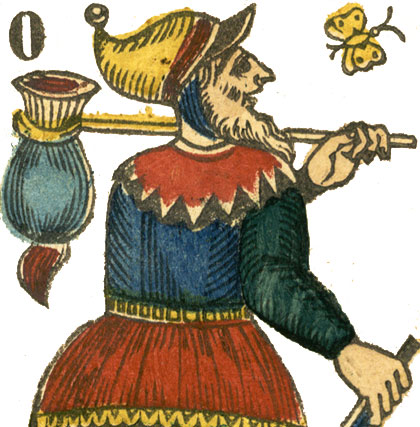
Above: The Fool chasing a butterfly from the Vergnano Tarot in the Piedmontese style, c.1835
A Crucial Step
The transition of Tarot cards from “Marseillais” to “Piedmontese” did not happen overnight, but was the result of an evolution whose steps are defined by specialists in two early prototypes: the “early Piedmontese Tarot” (substantially identical to Marseille), and the “early changed Piedmontese” (showing some characteristics of the new tradition).
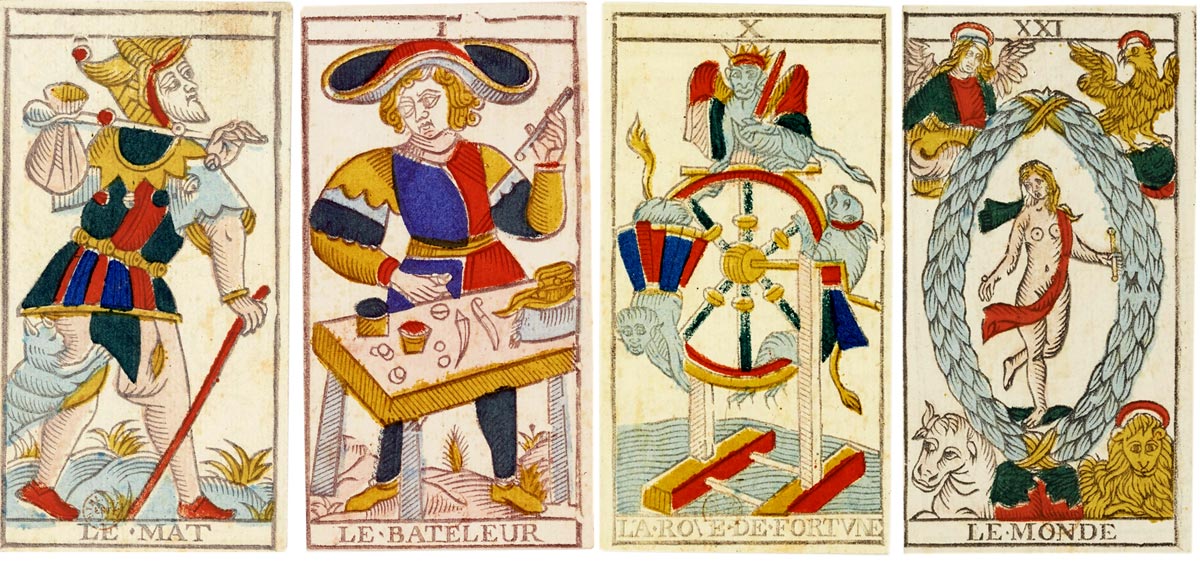
Above: standard “Marseillais” Tarot cards with inscriptions in French made by N. Conver (1809-1833). Bibliothèque Nationale de France.
Who were the pioneers of the new tradition? Among the most interesting documents, I discovered two quotes from the “Gazzetta Piemontese”. In 1826, this newspaper mentions the disassociation of two partners from the “Guglielmo Marengo and Co” playing card factory in Turin. The new company was registered to Stefano Vergnano. In 1828 the same newspaper mentions Giorgio e Stefano Vergnano (father and son), as manufacturers of “so-called castrated (i.e. some cards eliminated) Tarot and double-headed cards, at moderate prices”.
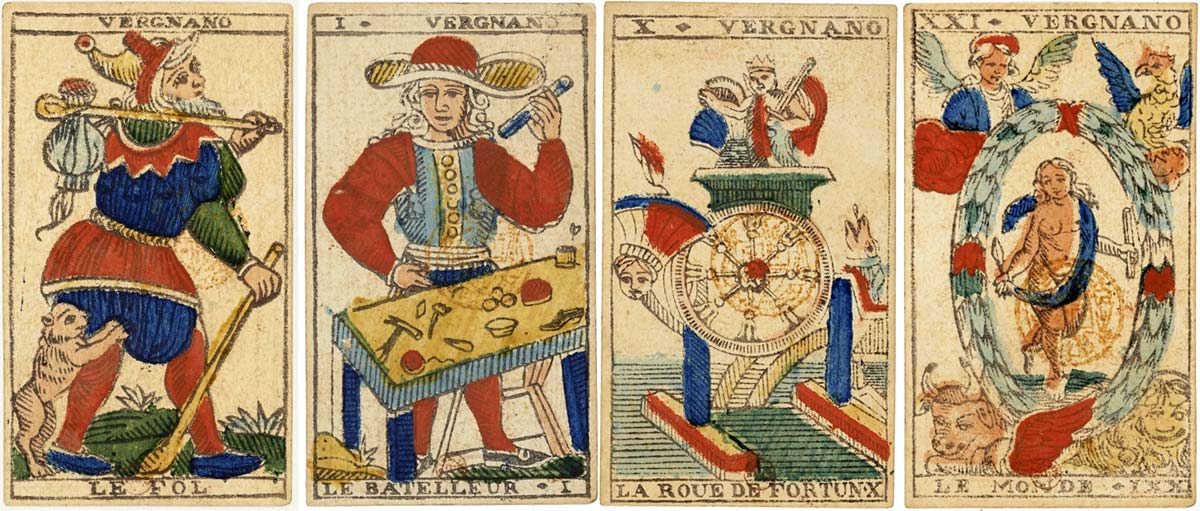
Above: early Piedmontese Tarot cards by Vergnano with French inscriptions, substantially identical to Marseille Tarot, c.1827. Bibliothèque Nationale de France.
Another interesting event dates from 1832. In that year Turin hosted the second Trade Fair of the Reign of Savoia. Both the factories of Guglielmo Marengo and Stefano Vergnano received an “honourable mention” by the Royal Chamber of Commerce for the quality of their decks. At the same time Giovan Battista Guala of Ghemme, another Piedmontese Tarot manufacturer, was also mentioned. It is doubtful that an award would have been bestowed to those tarot decks unless, when compared to their French counterparts, they showed some innovative design.
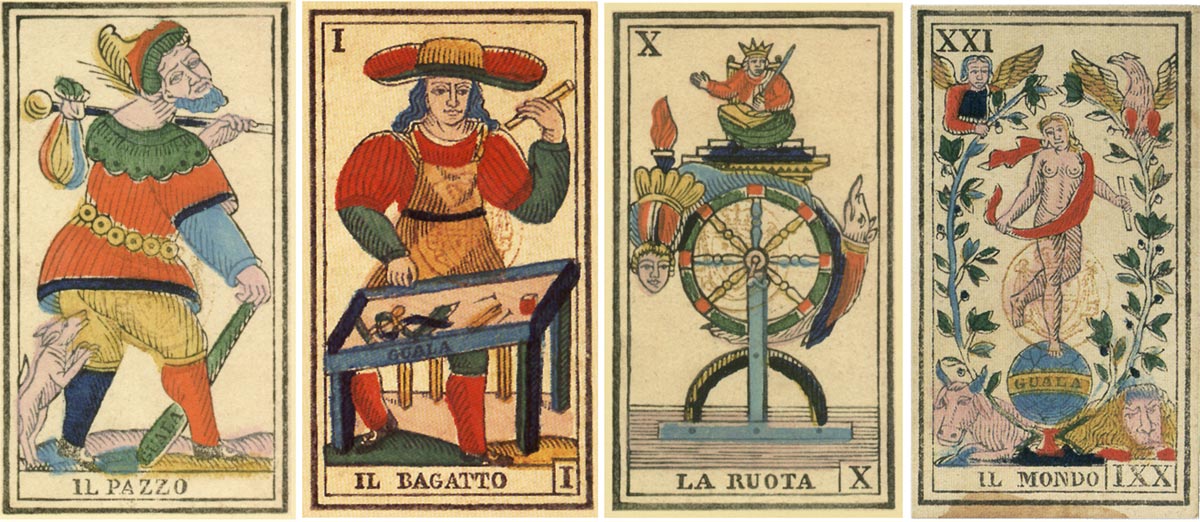
Above: early prototype Piedmontese Tarot cards by Giovan Battista Guala of Ghemme, with Italian inscriptions and Roman numerals. Bibliothèque Nationale de France.
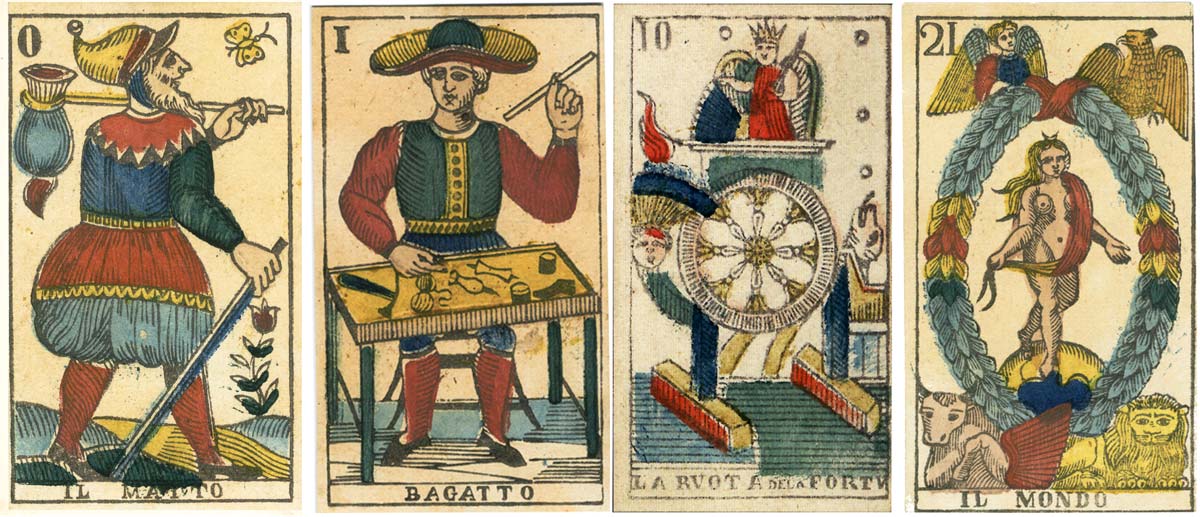
Above: early changed Piedmontese Tarot cards by Vergnano with Italian inscriptions and Arabic numerals, c.1835-45. The Fool chases a butterfly, instead of being chased by a dog. Bibliothèque Nationale de France.
A Trove of the Piedmontese Tarot
At this point a question arises: what were the Tarot images that Marengo and Vergnano produced? To discover this, we must examine those decks in public and private collections, and documents recently rediscovered by an Italian researcher, Nicola De Giorgio, at the Academy of Sciences of Turin. The Academy is a “treasure-trove” that preserves the Tarot history in the Kingdom of Savoy before the unification of Italy.
To this day the Academy holds many uncut sheets printed with woodcut technique which, by Royal Decree, had to be lodged by the manufacturers at the Royal Offices of Commerce. These sheets are the earliest evidence relating to the birth of the authentic Piedmontese tradition of Tarot.
Unfortunately, some sheets have been lost, so we cannot have a detailed view of the iconographic evolution. However we can say that, in general terms, that the factory of Guglielmo Marengo produced, since the early nineteenth century, the “early” piedmontese Tarot cards (ie: almost identical to those of Marseilles, with captions in French). But between 1826 and 1832 Stefano Vergnano deposited an innovative model (called “an early changed Piedmontese”) which was used - with some variations - in the following decades.
I shall not describe all the peculiarities of the Vergnano Tarot. It is sufficient to say that as well as captions in Italian, Arabic numerals instead of Roman, and new drawings of many Court cards, Vergnano introduced a totally new image: The Fool chasing a butterfly, instead of being chased by a dog or wild cat. Also, The Ace of Cups is a large jar filled with fruits and flowers. The Knight of Coins has an Arabic hat. The Knight of Swords has a Hussar helmet.
According to Franco Pratesi, the Vergnano factory went out of business around 1851, as demonstrated by some documents kept at the Archivio di Stato of Turin. The last Tarot produced by Vergnano was not an original design, but a review of the masterpiece engraved in Milan by Carlo Dellarocca for the printer Ferdinando Gumppenberg.
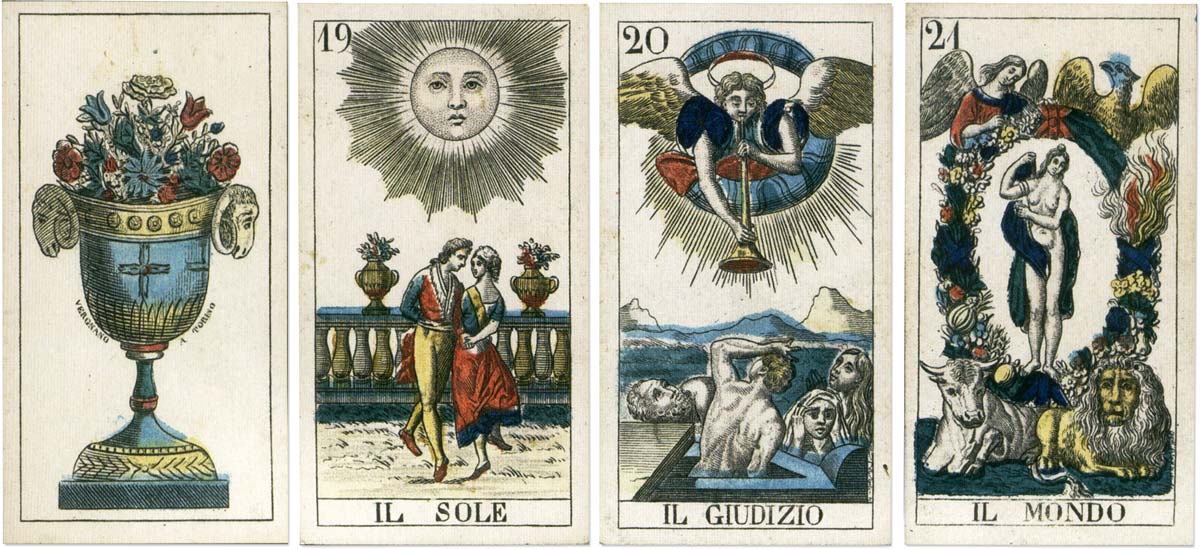
Above: Tarot cards produced by Vergnano based on model by Carlo Dellarocca, c.1850. The inscription on the ace of cups reads: "Vergnano a Torino".
A Precious Reprint
In 2014 I personally supervised the faithful reprint of a Stefano Vergnano Tarot deck dated around 1845-50, but clearly based on a model made around the 1830. This reprint gives to all Tarot lovers of today the opportunity to observe in detail the features of the first true Piedmontese Tarot, and to highlight similarities and differences with “Marseilles” decks.
The “Vergnano Tarot 1830” was published by Araba Fenice in collaboration with Renaissance - Italian Style Art. It is a limited edition of 500 copies, numbered and signed by the editor, Giordano Berti, who is also the author of the historical booklet that accompanies the deck, available in Italian, English and Portuguese. The deck and booklet come in a wonderful book-shaped presentation box- created by art designer Letizia Rivetti.
WEBSITE: VERGNANO TAROT 1830►
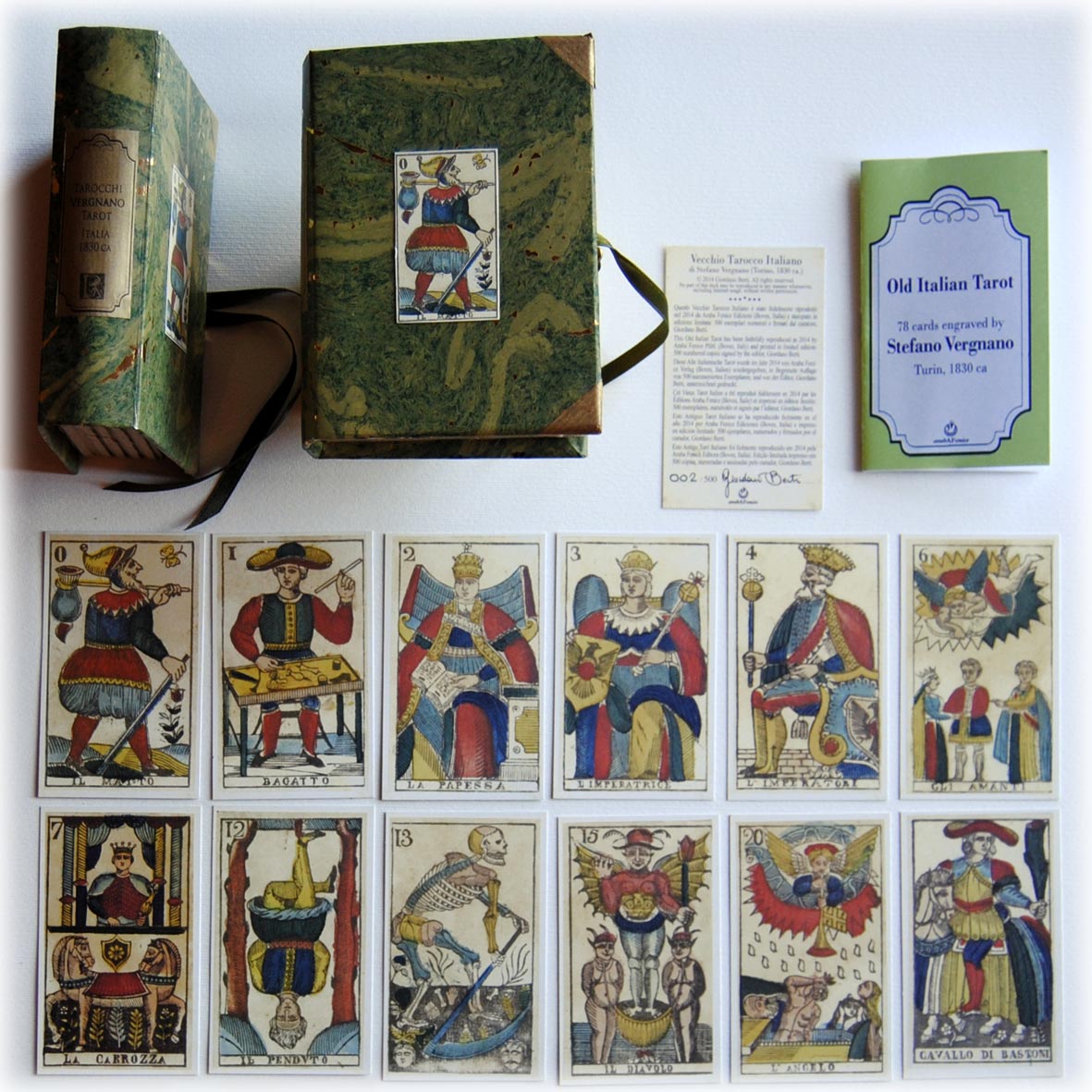
Above: Stefano Vergnano Tarot reprint, 2015, available here►
BIBLIOGRAPHY & CREDITS
Berti, Giordano: Old Italian Tarot. 78 cards engraved by Stefano Vergnano, Turin c.1830, Araba Fenice, Boves 2015
Depaulis, Thierry: Antichi Tarocchi Liguri-piemontesi, Lo Scarabeo, Torino 1995, p. 8-22
Pratesi, Franco: Documents on Playing-Cards in Piedmont, The Playing-Card, 25 (1997) p. 122-135, p. 166-175.
De Giorgio, Nicola: I Tarocchi nel Regno Sabaudo, dal 1815 all'Unità d'Italia (part 1), The Playing-Card, 42.3 (2014) p. 163-191.
De Giorgio, Nicola: I Tarocchi nel Regno Sabaudo, dal 1815 all'Unità d'Italia (part 2), The Playing-Card, 42.4 (2014) p. 237-258.
Illustrations of cards by Conver 1809-1833, Giovan Battista Guala and Vergnano c.1827 are from the Bibliothèque Nationale de France.

By Simon Wintle
Spain • Member since February 01, 1996
I am the founder of The World of Playing Cards (est. 1996), a website dedicated to the history, artistry and cultural significance of playing cards and tarot. Over the years I have researched various areas of the subject, acquired and traded collections and contributed as a committee member of the IPCS and graphics editor of The Playing-Card journal. Having lived in Chile, England, Wales, and now Spain, these experiences have shaped my work and passion for playing cards. Amongst my achievements is producing a limited-edition replica of a 17th-century English pack using woodblocks and stencils—a labour of love. Today, the World of Playing Cards is a global collaborative project, with my son Adam serving as the technical driving force behind its development. His innovative efforts have helped shape the site into the thriving hub it is today. You are warmly invited to become a contributor and share your enthusiasm.

Activity for Vergnano Tarot 1826-1851
Sign in to comment or save this article.

Related Articles
Murder of Crows Tarot
Corrado Roi’s 2020 tarot pack presents a dark, watchful world of crows and ritual figures.
History of Tarot and Playing Cards: Timeline & Origins
An alternative history of tarot and playing cards – from Mamluk Egypt to the invention of tarot in R...
Austrian Tarock by S.D. Modiano
Modiano’s Austrian Tarock with country scenes has been in production for over 100 years.
Il Tarocco Mitologico
Fully pictorial Tarot designed by Amerigo Folchi with figures mainly from Greek mythology.
I Gatti Originali di Evelyne Nicod
Etchings of cats on a set of major arcana created by Evelyne Nicod.
Natural History Tarocchi
Natural History Tarocchi by Ferdinando Gumppenberg, Milan.

Tarocco Piemontese by Giovanni Rossi
18th c. Piedmont Tarocchi by Giovanni Rossi, Turin.
Venetian Tarot
Scenes from the history of Venice on a set of the major arcana.
Jean Noblet Tarot de Marseille
Jean Noblet: the oldest known ‘Tarot de Marseille’ deck, Paris, c.1650.
V. F. Solesio Tarot
V. F. Solesio Tarot, Genoa, mid-late 19th century.
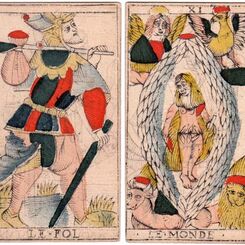
Charles Cheminade Tarot
Marseille Tarot cards by Charles Cheminade of Grenoble, France, early 18th century.
Rider Waite Tarot early editions
Rider Waite Tarot early editions
Serravalle-Sesia Tarot
Serravalle-Sesia Tarot published by Fratelli Avondo, c.1880.
Stairs of Gold Tarot
Whilst the titles of the cards are in Italian, the Hebrew and Sanskrit letters on the Trump cards de...
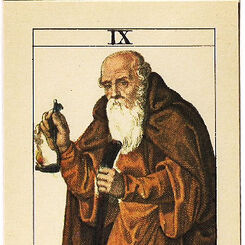
Tarocchino Lombardo, c.1835
“Tarocchino Lombardo c.1835”, a facsimile edition of 2500 by Edizione del Solleone, Italy, 1981.
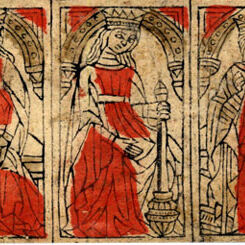
XV Century Italian Playing Cards
Cards from a pack of an early form of north Italian playing cards, with the swords back-to-back and ...
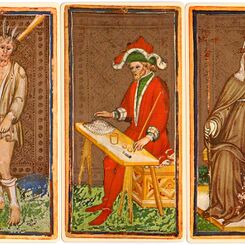
The Visconti-Sforza Tarot, c.1460
This pack of tarot cards appears to have have been made in the Bembo workshop in Cremona for Bianca ...
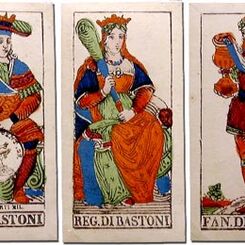
Tarocco Milanesi by Lamperti (Milan) c.1850
Tarocco Milanesi by Lamperti (Milan) c.1850
Tarocco Bolognese
Tarocco Bolognese
Hand-Painted Tarocchi Cards
Hand-painted Tarocchi cards sometimes known as ‘Charles VI tarot’, North Italy, 1475-1500.
Most Popular
Our top articles from the past 60 days


Maria Nick
21 February 2026, 11:01SavedSaved this article to Maria Nick's Collection