


Pedro Varangot, 1786
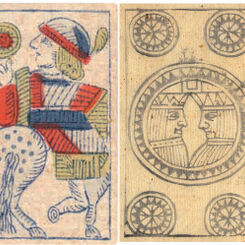
Archaic Navarra pattern produced for the Pamplona General Hospital Monopoly by Pedro Varangot in 1786.
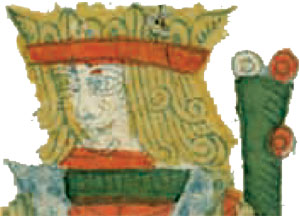
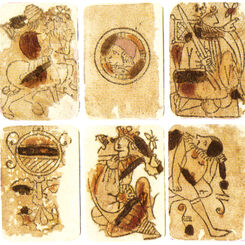
Navarra pattern produced for the Pamplona General Hospital Monopoly by Pedro Varangot, whose name or initials appear on several cards, dated 1786. The ace and two of coins, and the four of cups, feature the coat of arms of the kingdom of Navarra (not that of Spain) whilst the ace has the inscription: CON LICENCIA DEL REINO. The designs are archaic, having been imitated by the woodcutter from earlier specimens rather than drawn afresh, possibly due to the requirements of the contractual agreement with the Hospital. The ace of swords sports a naked figure, which according to the poet Francisco de Luque Fajardo, is an admonishment against immorality and gaming!
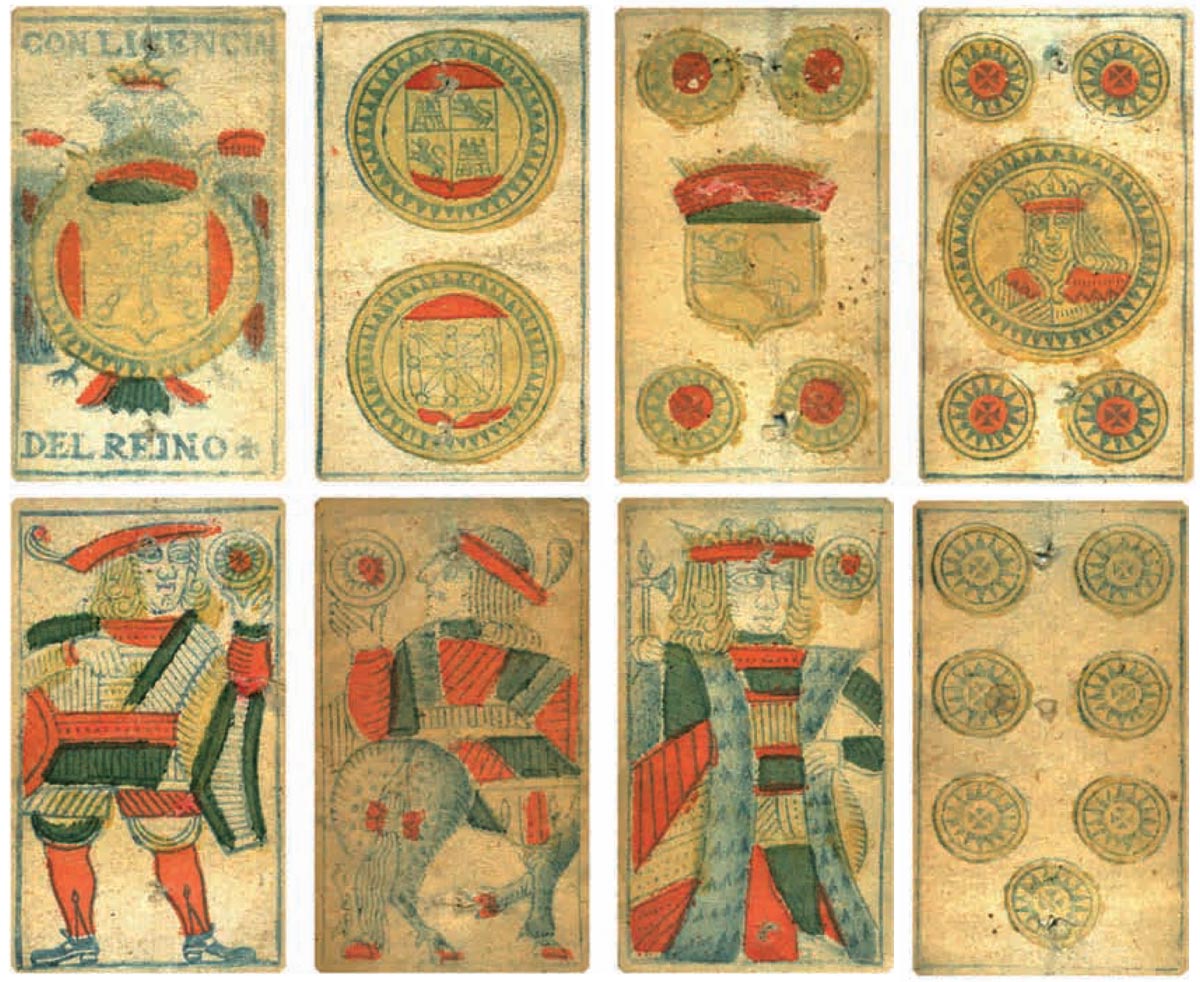
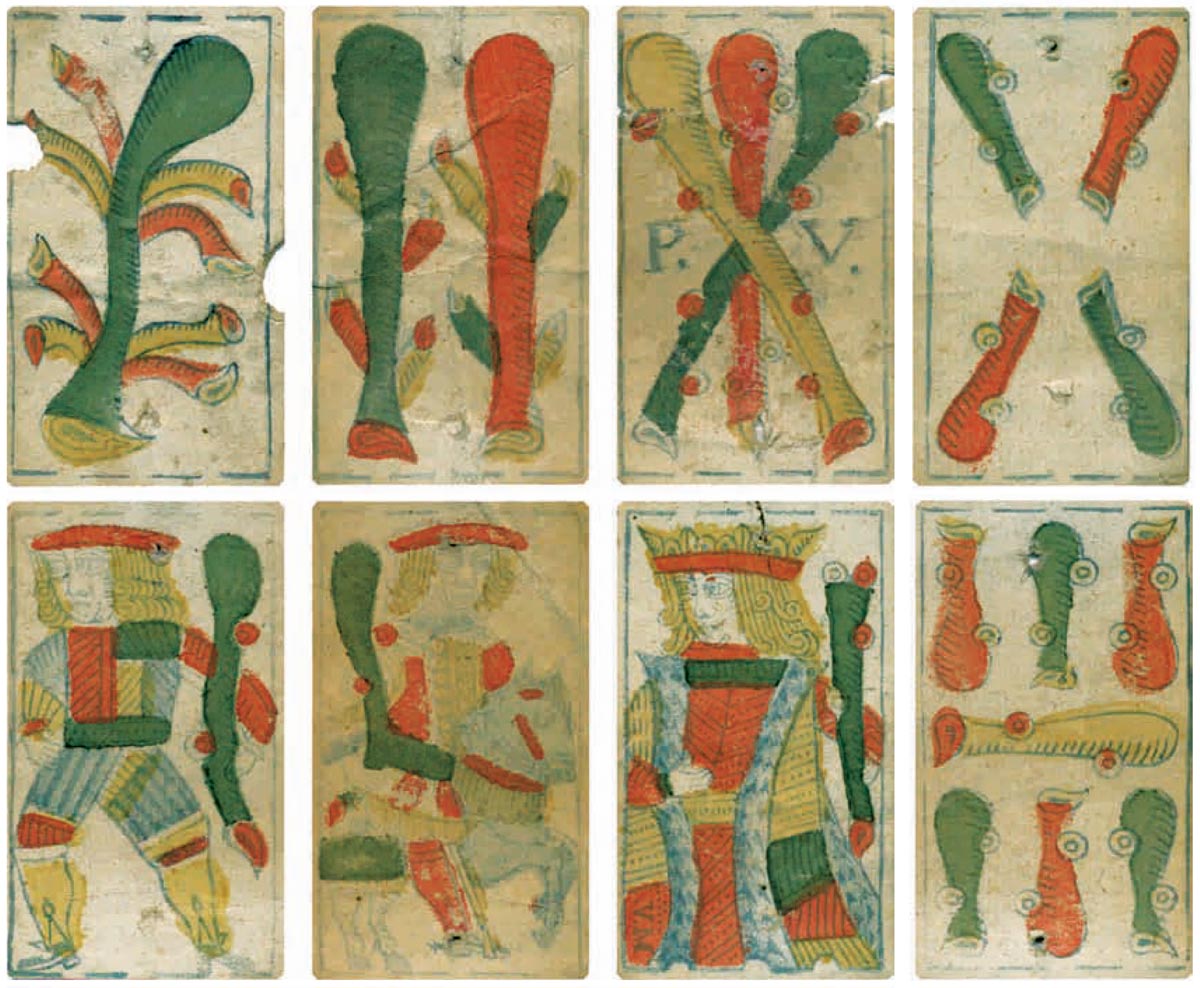
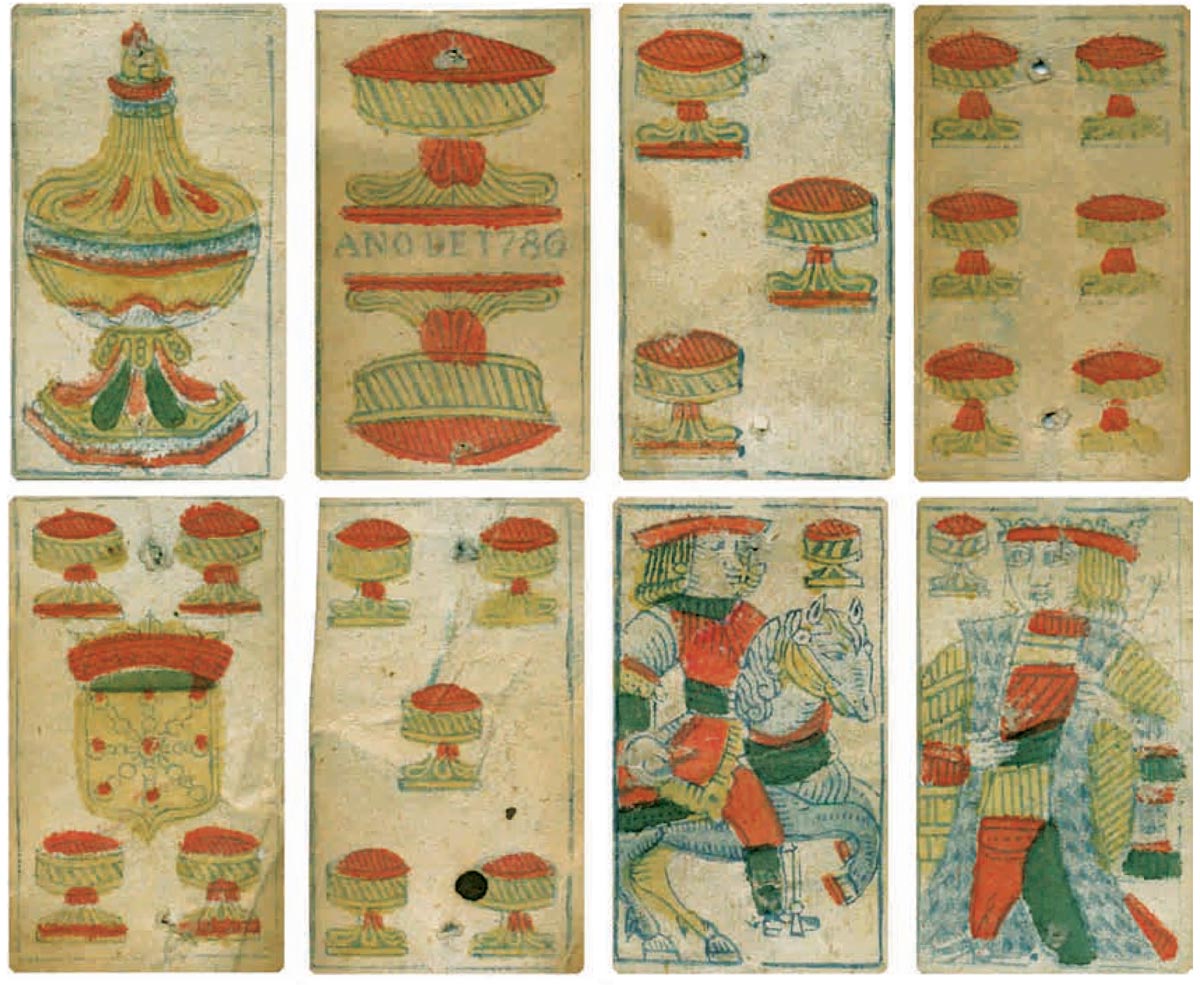
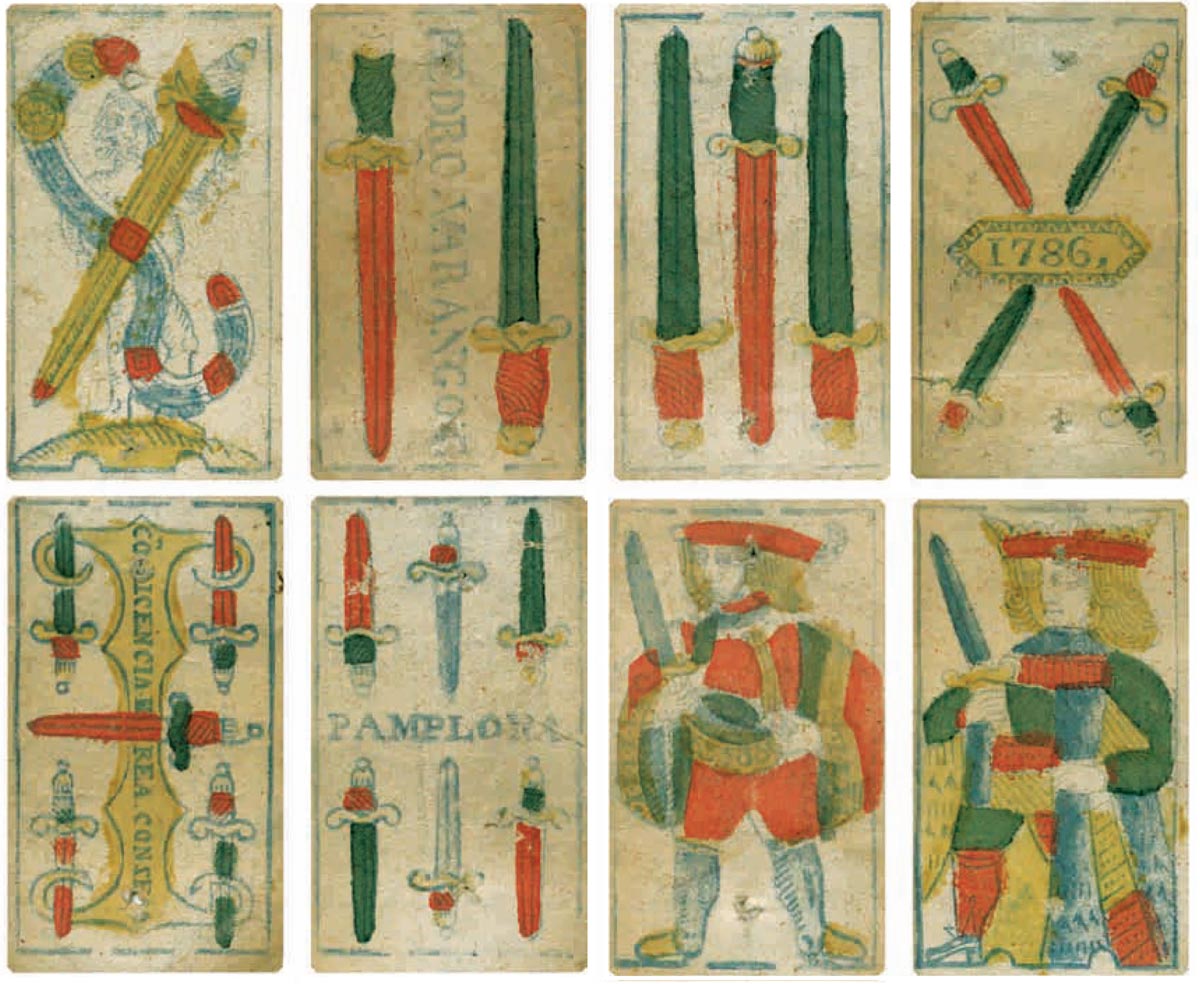
Above: Navarra Pattern produced for the Pamplona General Hospital Monopoly by Pedro Varangot in 1786, possibly made in France (Bayonne). Woodblock prints in blue ink with stencil colouring in red, blue, yellow and green. The cards have the ‘pintas’ (border breaks) usually found in Spanish playing cards. The king of clubs has the initials V.M. which may be those of the woodcutter. The backs are plain (uncoloured). 48 cards, size: 49 x 80 mm. The cards have been re-used for a secondary purpose and contain handwritten text on the reverse. From the collection of Martín Pedro Marcos González.
CREDITS & REFERENCES
Ferro Torrelles, Víctor: Unos Naipes para el Reino de Navarra, in “La Sota” Nº44, Asescoin, Madrid.
A wrapper possibly by Pierre Verangot can be viewed on the British Museum website►
Additional research by Alberto Pérez González.
By Alberto Pérez González
Spain • Member since December 21, 2016
I am a researcher and my primary interest lies in playing cards manufactured in Cádiz (not the 'Cádiz' type in general). I have authored several articles in the annual Asescoin magazine 'La Sota'. Among them are: “Madrid’s Playing Cards from the 17th to the 20th Century”; “New Contributions to the Study of Playing Cards in the Valencian Country”; “The Fouquets: 'Navarra pattern' in the Netherlands”; “Divided Playing Cards: Combining Ingenuity with Skill”; “Here Be Dragons: Speculations on the Evolution of the so-called 'Portuguese' Pattern”; “Playing Cards in Chile: News and Chronicles from the Viceroyalty Era”...
I have written and designed the book “Los Naipes de Cádiz” (296 pp). Additionally, I have contributed to the design, layout, and collaboration in Enrique García Martín’s book “Naipes, Arte y Fantasía” (444 pp).

Activity for Pedro Varangot, 1786
Sign in to comment or save this article.

Related Articles
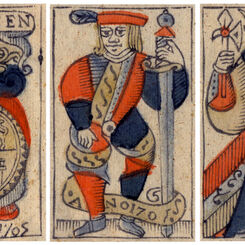
The archaic “Classic Madrid” Pattern
Centralisation, standardisation and consolidation of the Spanish card tradition.
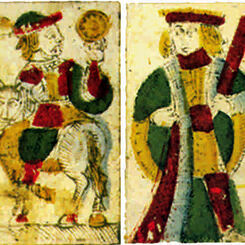
La baraja de Almagro
De la chimenea al monumento nacional: la baraja de Almagro y el renacer del corral de comedias.
Pierre Varangot
Tracing the origins, legality and legacy of Pierre Varangot’s San Sebastián deck.
Sevilla 1647 reproduction
Facsimile of Spanish-suited pack produced in Sevilla, Spain, 1647.
The Parisian Tarot
The “Parisian Tarot”, early 1600s, with imagery and design synthesizing several influences.
Antoine de Logiriera
Archaic Spanish-suited playing cards published in Toulouse by Antoine de Logiriera (1495-1518).
J. Deluy c.1490s
Archaic Spanish-suited cards produced by J. Deluy c.1490s.
Toledo, 1584
Archaic Spanish-suited deck with 48 cards made in Toledo in 1584.
64: The descendants of the French regional patterns: 2
A continuation oF the development of the off-spring of the Paris patterns and a few examples of how ...
Navarra Pattern, 1682
Navarra pattern produced for the Pamplona General Hospital Monopoly in 1682.
Navarra Pattern
Navarra Pattern produced for the Pamplona General Hospital Monopoly.
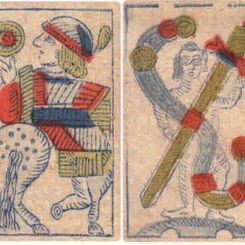
Navarra Pattern, 1793
Navarra pattern by an unknown cardmaker with initials I. I., 1793.
Benoist Laius
Spanish playing cards such as these were used in those parts of France where certain games were enjo...
Lyon Pattern type iii
This pattern was used in various parts of eastern France but was ultimately replaced by the official...
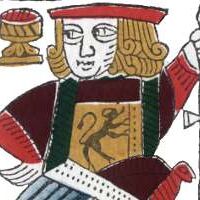
Navarra, XVII Century
Facsimile of 17th century Spanish-suited playing cards produced by Erregeak, Sormen S.A., Vitoria-Ga...
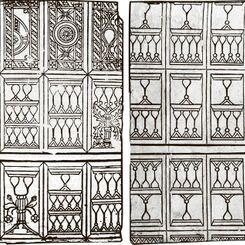
Moorish playing cards
These two uncoloured, uncut sheets of early Moorish playing cards were formerly preserved in the Ins...
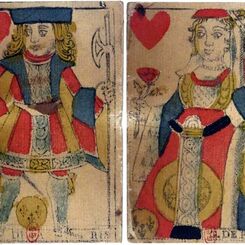
Paris Pattern
The Paris pattern was established as such around the middle of the seventeenth century (based, perha...
The History of Playing Cards
Playing cards appear in European records in the late 14th century, but their earlier history lies fu...
Baraja Morisca — Early XV century playing cards
Primitive Latin suited pack, dated by paper analysis as early XV century, which makes this one of th...
History of Court Cards
The court cards in English packs of playing cards derive from models produced by Pierre Marechal in ...
Most Popular
Our top articles from the past 60 days


