


Burgundy pattern - portrait bourguignon

Published March 10, 2024 Updated August 25, 2024

The old Burgundy (or Burgundian) pattern by Nicolas Chenevet, Dijon.

1745 FranceChenevetMessentArchaic PatternsBurgundy Pattern

The old (now obsolete) Burgundy pattern originated with late XV century Lyon cardmakers for export to Burgundy, Flanders and Lorraine, and was adapted by cardmakers in those areas. Sometimes the suit signs changed, or the images were turned to face the other way due to the process of copying. In this fine example the woodcutting is intricate and the court cards have been coloured in strong shades of yellow, terracotta, two tones of blue and black, and they are also unnamed.

The jack of clubs wears a helmet with a long plume, and the maker’s name and address appears by his feet. The queen of diamonds, looking leftwards without a flower, has rather square sleeves tipped with ermine and the words «mais bien vous» down one side. Each of the four jacks has an escutcheon or heraldic shield somewhere in the design. On closer inspection several cards can be seen to have been badly cut in the workshop, perhaps because of mis-aligned cutting apparatus or an inattentive worker.
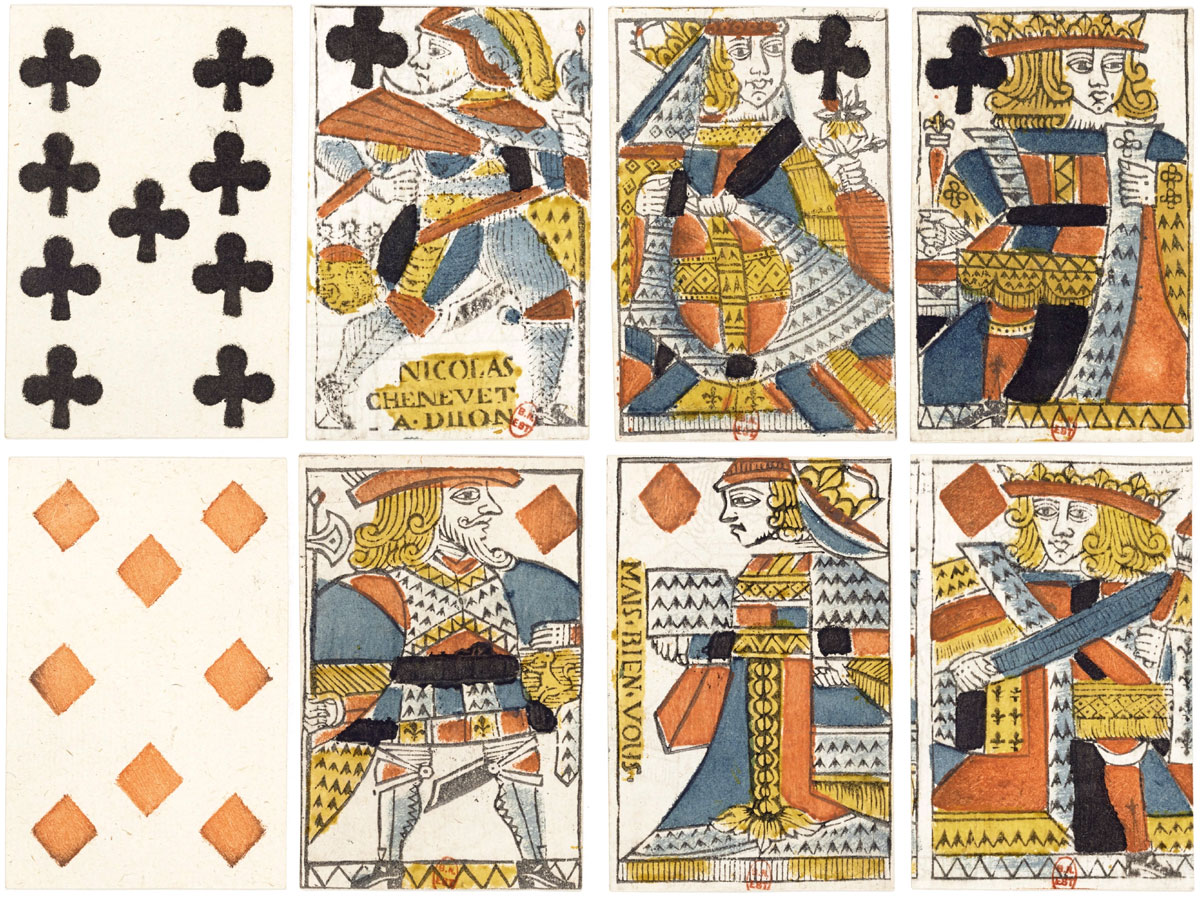
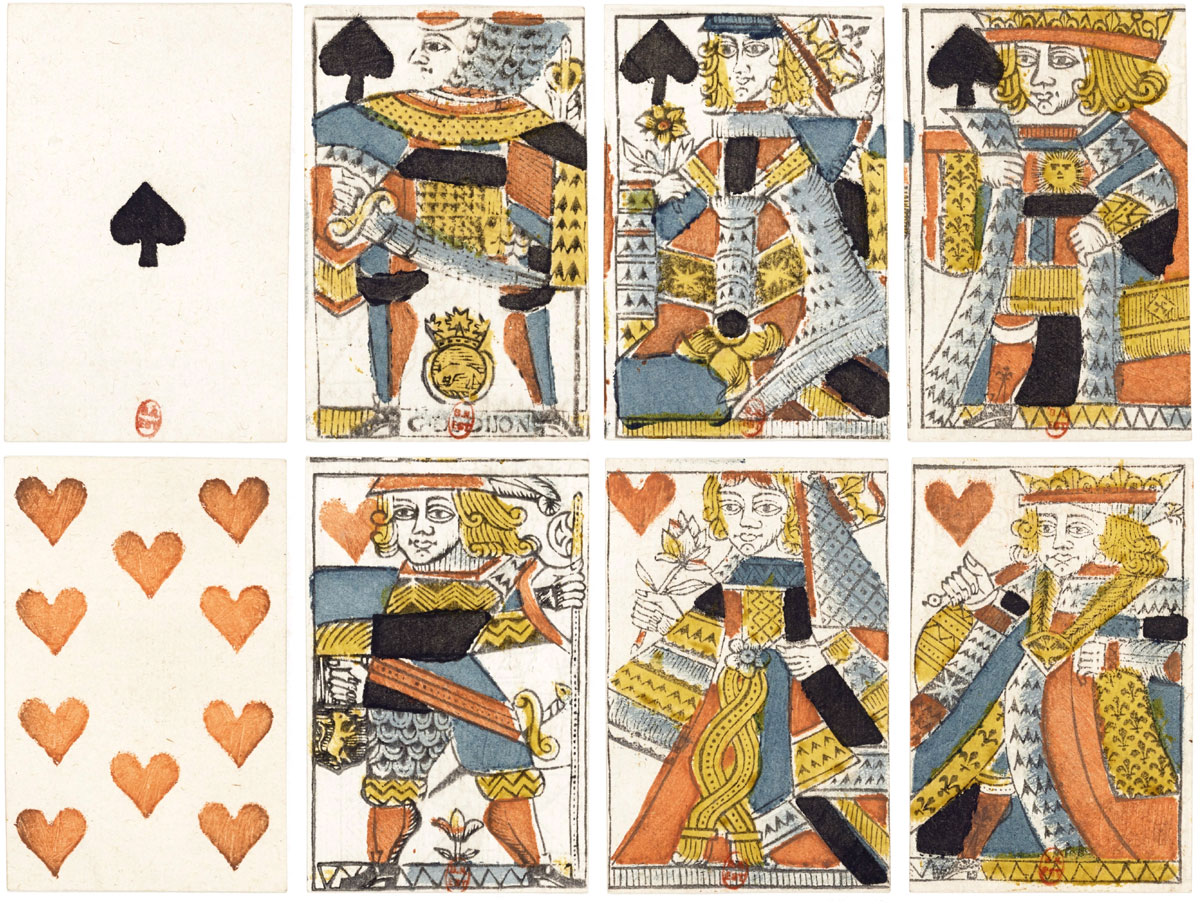
portrait bourguignon by Nicolas Chenevet (Dijon), 1728-1745, Source gallica.bnf.fr portrait bourguignon by Nicolas Chenevet (Dijon), 1728-1745, Source gallica.bnf.fr

Above: portrait bourguignon by Nicolas Chenevet (Dijon), betwwen 1728-1745. 32 card piquet deck. Stencil coloured woodcuts. Source gallica.bnf.fr • portrait bourguignon by Nicolas Chenevet (Dijon)

The four kings wear ermine-trimmed robes and large crowns topped with fleurs-de-lys; the king of hearts has a medallion. Three of the queens hold flowers and wear ample, embroidered robes; the queen of diamonds has rather rectangular shoulder pads. The jack (valet) of hearts stands facing forwards. The valet of clubs usually holds a shield displaying the cardmaker's emblem. The valet of spades names the place of manufacture.
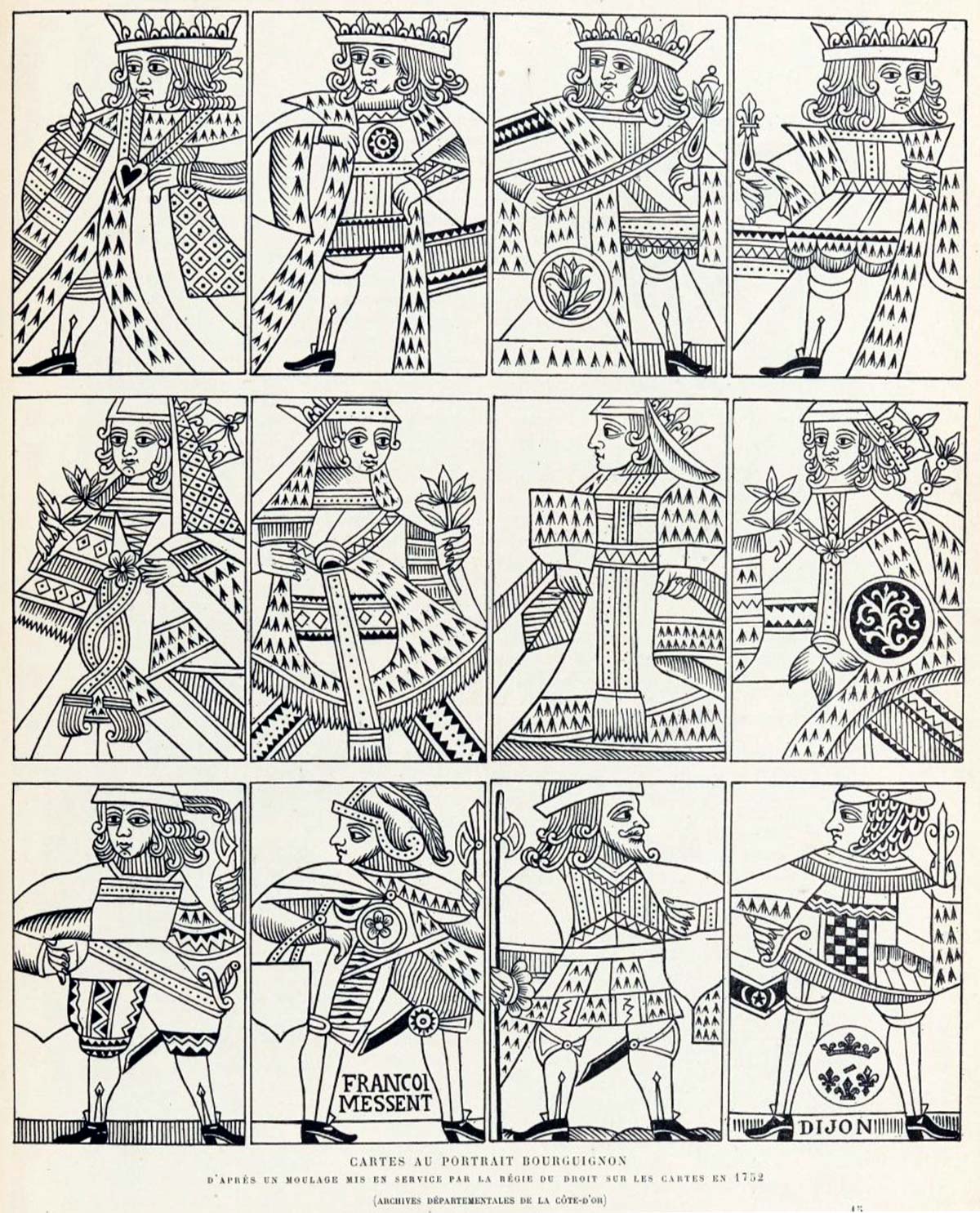
portrait bourguignon by François Messent (Dijon)

References

d'Allemagne, Henry-René : Les cartes à jouer du XIVe au XXe siècle, Hachette et Cie, Paris, 1906. vol 1, p.112 ff.

Paul Bostock's blog: Card Design: French playing cards

Ken Lodge's blog: French regional patterns: the kingsthe queens and jacks

avatar
1,487 Articles

By Simon Wintle

Spain • Member since February 01, 1996 • Contact

I am the founder of The World of Playing Cards (est. 1996), a website dedicated to the history, artistry and cultural significance of playing cards and tarot. Over the years I have researched various areas of the subject, acquired and traded collections and contributed as a committee member of the IPCS and graphics editor of The Playing-Card journal. Having lived in Chile, England, Wales, and now Spain, these experiences have shaped my work and passion for playing cards. Amongst my achievements is producing a limited-edition replica of a 17th-century English pack using woodblocks and stencils—a labour of love. Today, the World of Playing Cards is a global collaborative project, with my son Adam serving as the technical driving force behind its development. His innovative efforts have helped shape the site into the thriving hub it is today. You are warmly invited to become a contributor and share your enthusiasm.

Related Articles

1708 Archaic Spanish proof sheets

Archaic Spanish proof sheets

2 x uncoloured proof sheets of archaic Spanish-suited playing cards produced for “New Spain”, possib...

1760 Lyon pattern by Michel Ressy

Lyon pattern by Michel Ressy

Lyon pattern by Michel Ressy, c.1760.

1750 Guyenne Pattern - Portrait de Guyenne

Guyenne Pattern - Portrait de Guyenne

The Guyenne pattern emerged from the earlier Languedoc pattern.

1695 Dreveton - Provence pattern

Dreveton - Provence pattern

French cardmakers Jean and François Dreveton lived in Aix-en-Provence.

1690 Auvergne Pattern - Portrait d'Auvergne

Auvergne Pattern - Portrait d'Auvergne

The Auvergne pattern is one of the oldest in France.

Languedoc pattern - Portrait de Languedoc

Languedoc pattern - Portrait de Languedoc

The old Languedoc pattern was known at the beginning of the seventeenth century, if not before.

1785 Pierre Roiné Aluette

Pierre Roiné Aluette

Archaic form of Aluette published by Pierre Roiné, Nantes, c.1785.

Antoine de Logiriera

Antoine de Logiriera

Archaic Spanish-suited playing cards published in Toulouse by Antoine de Logiriera (1495-1518).

1490 J. Deluy  c.1490s

J. Deluy c.1490s

Archaic Spanish-suited cards produced by J. Deluy c.1490s.

61: French regional patterns: the kings

61: French regional patterns: the kings

On page 11 I illustrated several examples of the regional French patterns from Sylvia Mann's collect...

Provence Pattern - Portrait de Provence

Provence Pattern - Portrait de Provence

The 'Provence' pattern contains figures which go back to the fifteenth century.

Richard Bouvier

Richard Bouvier

The assorted antique playing cards shown below are examples of the French 'Paris' pattern from the s...

Dauphiné Pattern - Portrait du Dauphiné

Dauphiné Pattern - Portrait du Dauphiné

The Dauphiné pattern is an archaic French pattern which was manufactured in the Lyon region from the...

French Playing Cards

French Playing Cards

Some of the oldest cards still in existence come from France. During the 16th and 17th centuries Fra...

Early Anglo-French Cards

Early Anglo-French Cards

Cards produced in Rouen during the sixteenth century. It was cards like these which were imported to...

Translucent Erotic Playing Cards, page 2

Translucent Erotic Playing Cards, page 2

Translucent Erotic Playing Cards, page 2

1850 Translucent Playing Cards, c.1850

Translucent Playing Cards, c.1850

Cards from a translucent pack. Erotic images are concealed in the middle layer of the card and becom...

1574 Phelippe Ayet, 1574

Phelippe Ayet, 1574

49 assorted cards were found hidden in the lintel of a doorway, in an old building in Toledo, during...

1840 O. Gibert, Paris c.1840-60

O. Gibert, Paris c.1840-60

Gibert was a master card-maker whose fashionable playing cards were of a very high standard.

Polaires - Foreign Legion Playing Cards

Polaires - Foreign Legion Playing Cards

A Bridge-style deck featuring Foreign Legion paintings by Maitre Rosenberg.

