


Besançon Tarot by Jacob Jerger
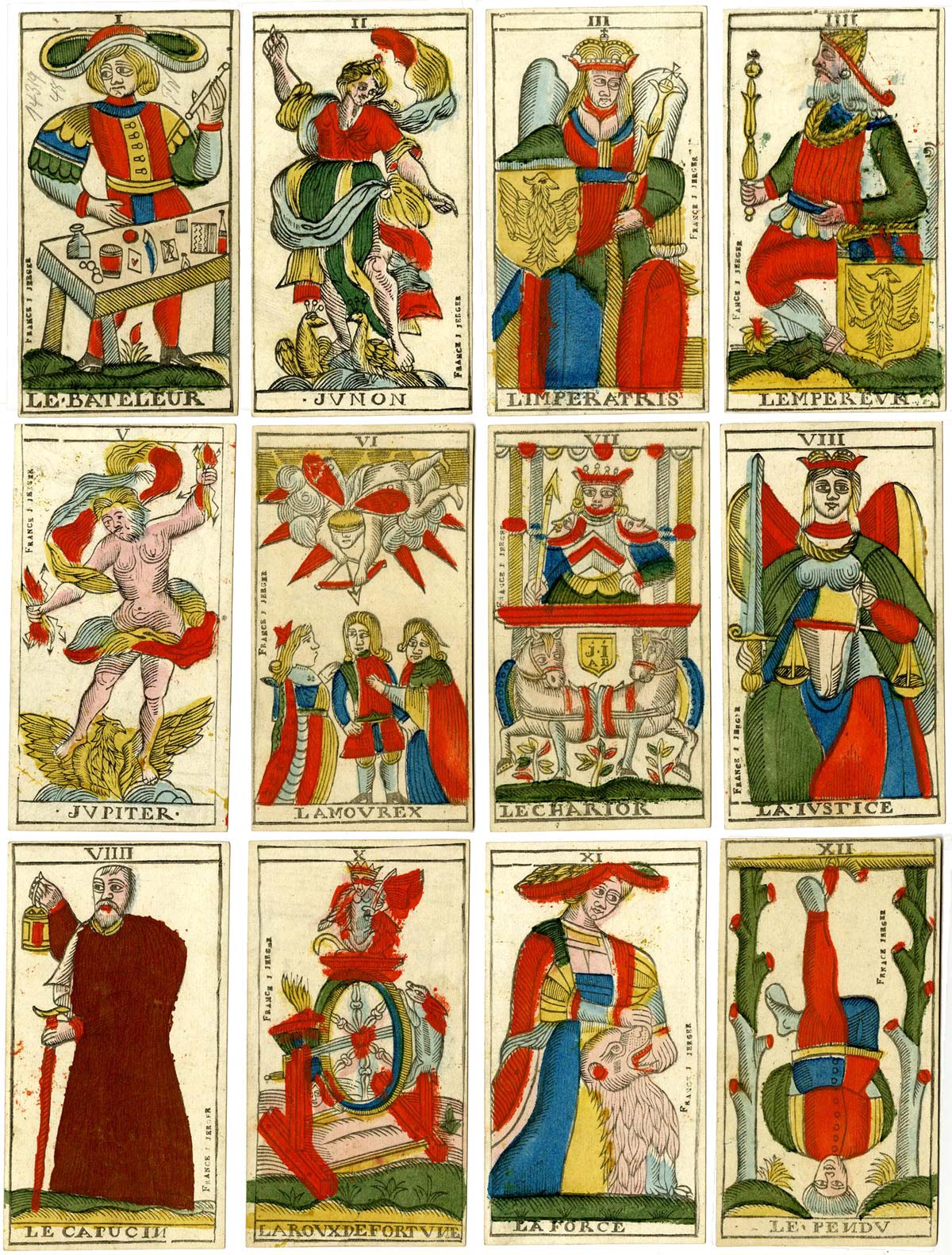
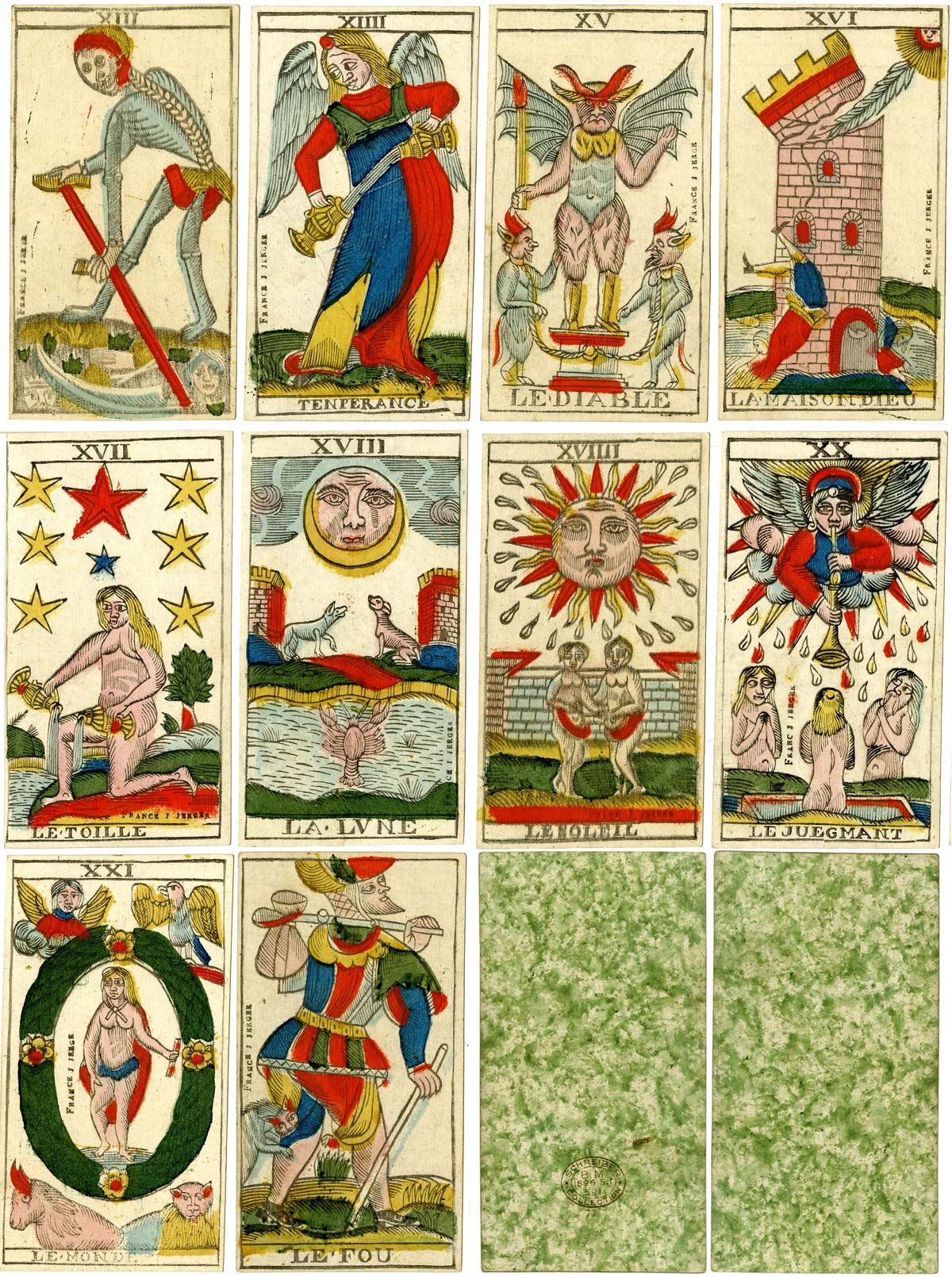
Besançon tarot published by Jacob Jerger, 18th century.
The Tarot de Besançon is a variant of the Tarot de Marseille and thus probably had early origins in France, possibly also Swiss influence, and from there spread to German-speaking regions in the early 18th century. This edition published by the German playing-card maker Jacob Jerger working in Besançon contains Italian suit symbols and allegorical trumps with French titles on all court cards and trumps. Juno and Jupiter replace the more usual figures of Popess and Pope, and who in the Roman pantheon were the emperor and empress of the gods. This feature originated during earlier religious wars between Catholics and Protestants.
The court and number cards
On the 2 of cups is “Tarots Fins faites par J. Jerger Fabriquant Carts a Besancon”, and on every court card and trump is the legend “France J. Jerger”. On Trump No. VII are the initials “J.I.A.B.” on a small shield. Nos. III and IV of trumps have a shield charged with an eagle. A number of variant spellings of the titles in French can be seen on the courts and trumps.
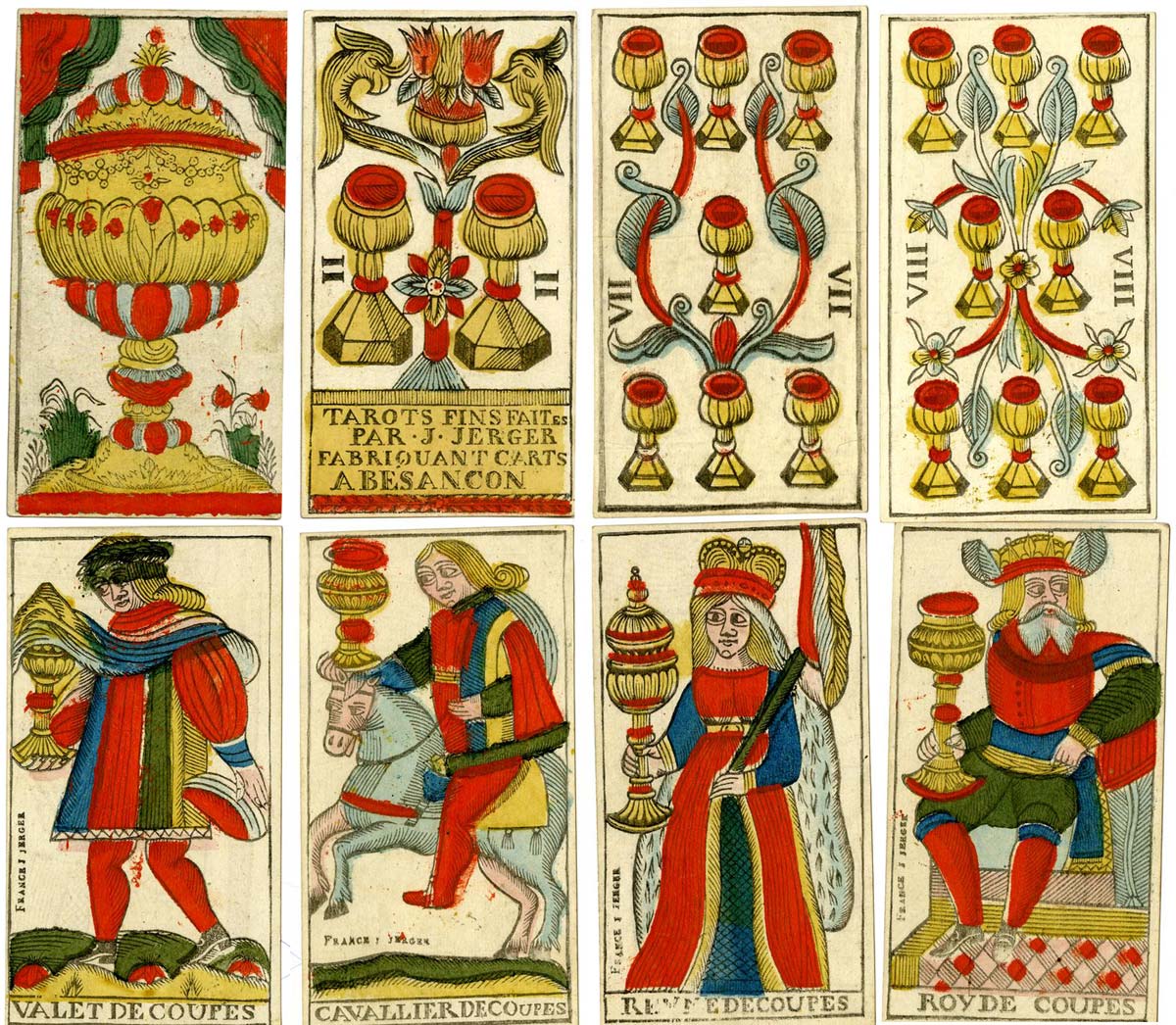
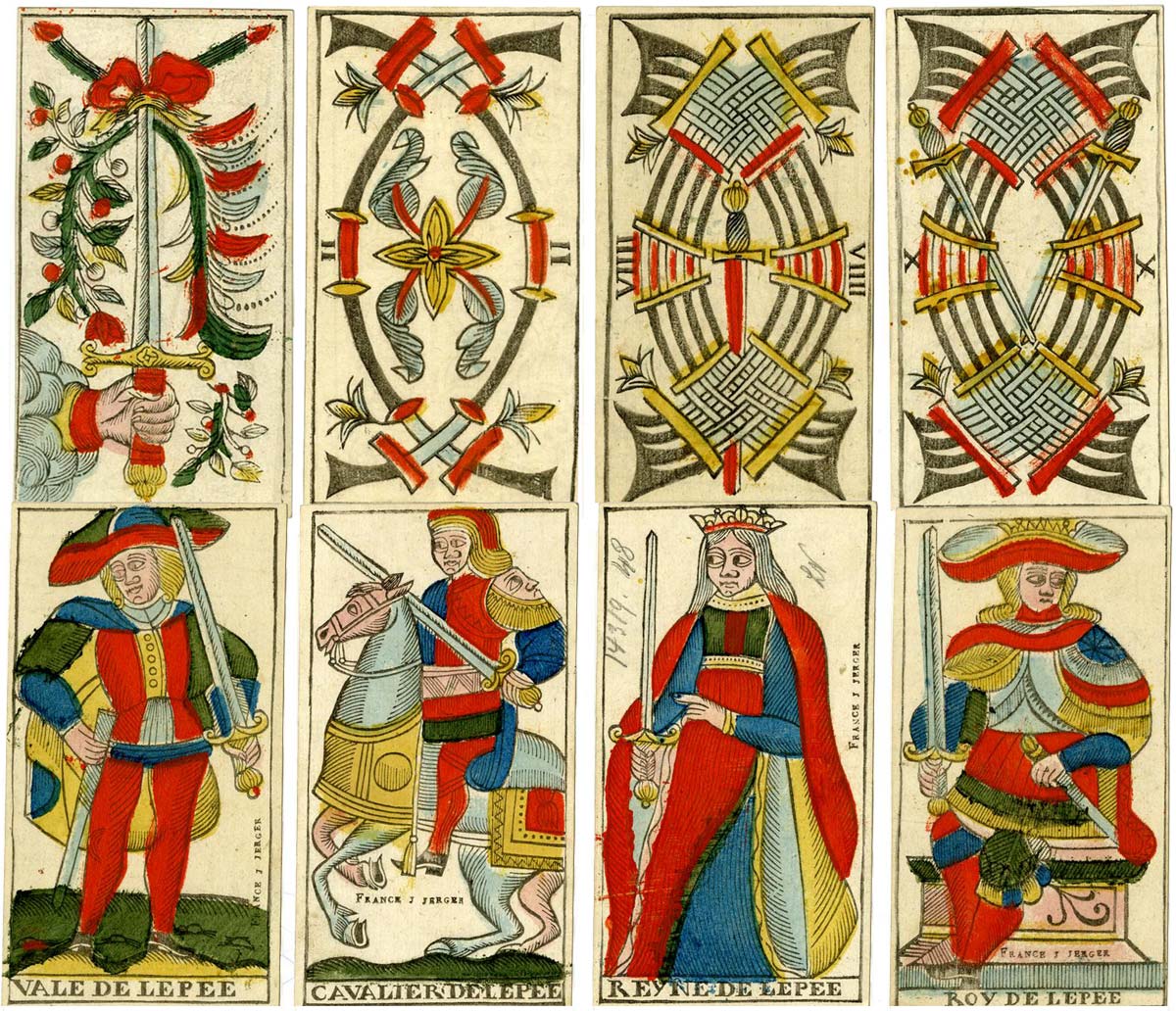
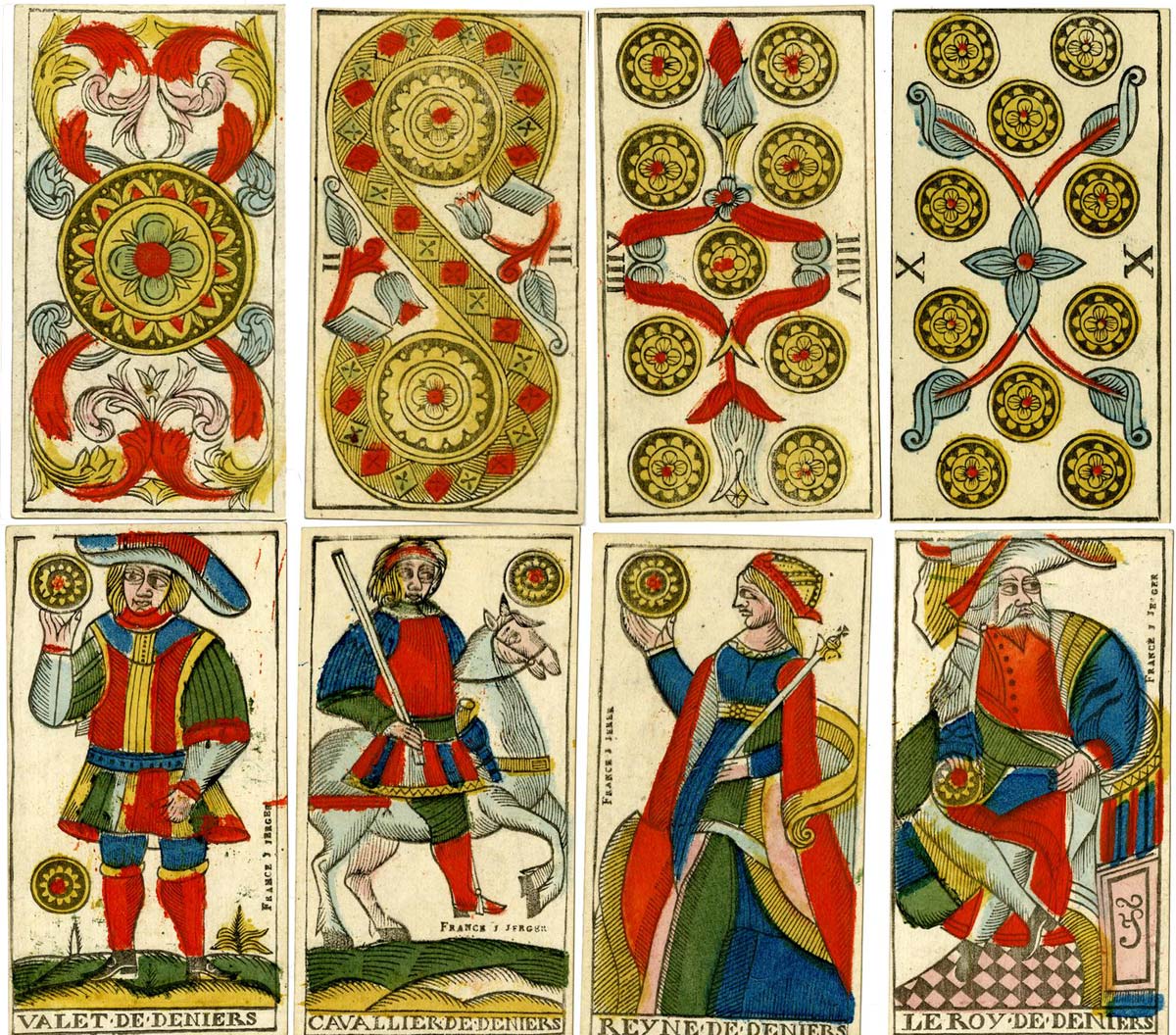
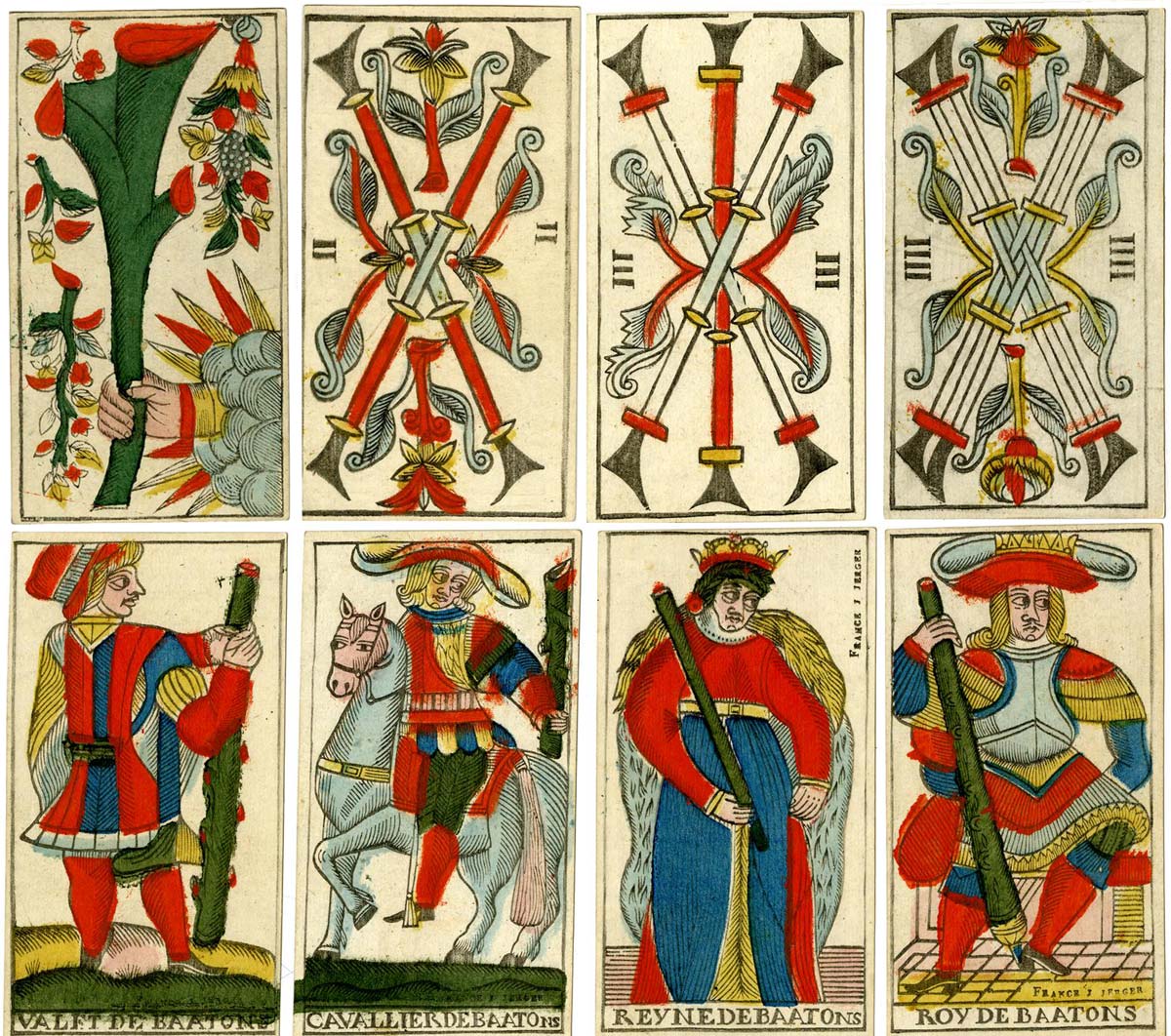
Above: Besançon tarot published by Jacob Jerger, 18th century. 78 cards, hand-coloured woodcut, backs mottled green. © The Trustees of the British Museum • Museum number 1896,0501.591►
NOTES: in the 17th and 18th centuries, Central and South Germany adopted Italian-suited cards in the French or Swiss format of Besançon. This ‘Tarot de Besançon’ was closely related to the Tarot de Marseille but showed variations such as the jack of batons having both hands below the top of the club, and distinct details like standing Queens and the replacement of the Pope and Popess by Jupiter and Juno. The Ace of Cups shows a rounded cup with a lid in place of the Gothic chalice of the Tarot de Marseille. The furry trousers worn by the Devil are shared with the Lombard variant. Other minor idiosyncrasies are shared with the Piedrnontese variant, such as the full face on the Moon (XVIII), the droplets on the judgment (trump XX) and the use of the term Le Fou instead of Le Mat for the Fool. Produced in various German towns and in Switzerland in the 18th century, the Tarot de Besançon likely had its roots in French-speaking Swiss cantons, later spreading to German-speaking ones and, for export, in Strasbourg. By the mid-19th century, the Besançon tarot gave way to the “J.J.” pattern in Switzerland, probably originated by J Müller of Diessenhofen.
References
British Museum website • J Jerger Besançon Tarot►
Dummett, Michael: The Game of Tarot: From Ferrara to Salt Lake City, Duckworth, 1980
Mann, Sylvia: All Cards on the Table, Jonas Verlag/Deutsches Spielkarten-Museum, Leinfelden-Echterdingen, 1990
O’Donoghue, Freeman M: Catalogue of the collection of playing cards bequeathed by Lady Charlotte Schreiber, (French 2), Trustees of the British Museum, London, 1901 [digital version here]

By Simon Wintle
Spain • Member since February 01, 1996
I am the founder of The World of Playing Cards (est. 1996), a website dedicated to the history, artistry and cultural significance of playing cards and tarot. Over the years I have researched various areas of the subject, acquired and traded collections and contributed as a committee member of the IPCS and graphics editor of The Playing-Card journal. Having lived in Chile, England, Wales, and now Spain, these experiences have shaped my work and passion for playing cards. Amongst my achievements is producing a limited-edition replica of a 17th-century English pack using woodblocks and stencils—a labour of love. Today, the World of Playing Cards is a global collaborative project, with my son Adam serving as the technical driving force behind its development. His innovative efforts have helped shape the site into the thriving hub it is today. You are warmly invited to become a contributor and share your enthusiasm.

Activity for Besançon Tarot by Jacob Jerger
Sign in to comment or save this article.

Related Articles
Tarot hiéroglyphique égyptien
The design of the cards draws inspiration from various religious and philosophical traditions merged...
Le Tarot de Sète
Reinterpretation of the Tarot de Marseille by Julien Labat, an artist from Sète.
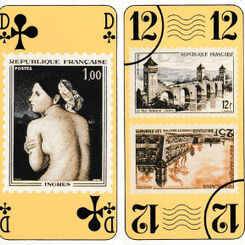
Tarot Philatélique
Tarot game pack with French postage stamps on all the courts, aces and trumps.
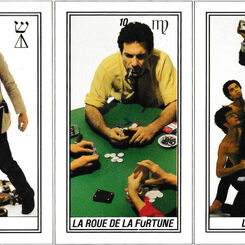
Tarot Actuel 1984
Major arcana to cut out, issued with the French magazine Actuel, using photographic images.
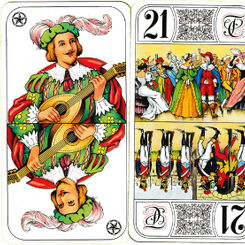
Jeu de Tarot (Catel & Farcy)
Colourful version of a standard French (‘Bourgeois’) Tarot.
Paris 2024 Olympics 2
A standard French Tarot game pack with passing references to the Paris 2024 Summer Olympic Games.
Tarot – Images du Pays Basque
Seventy-eight photographic images of the French Basque Country on a pack for playing the game of Tar...
The Parisian Tarot
The “Parisian Tarot”, early 1600s, with imagery and design synthesizing several influences.
Jeu de Cartomancie pour l’amusement des Dames
Early French Cartomancy deck "for the amusement of Ladies" but also referred to as "Jeu divinatoire ...
Jeu de Tarot Astérix
A French Tarot game pack with Astérix and friends on all the trump cards.
Oriental Scenes tarock
Trumps have oriental scenes on one end of the card, and mermaids, mermen, assorted sea serpents and ...
Ergomia
Complete re-design of traditional pack and a tarot deck into what the publishers considered to be er...
Jean Noblet Tarot de Marseille
Jean Noblet: the oldest known ‘Tarot de Marseille’ deck, Paris, c.1650.
Le Grand Tarot Belline
“Le Grand Tarot Belline” after drawings by Edmond Billaudot (1829-1881).
Lilian Cailleaud’s Tarot Project
Lilian Caillaeud lino-cuts his version of the tarot by Nicolas Rolichon of Lyon c.1600
Héron French tarot
French edition of the ‘Bourgeois’ Tarot by Héron.
Tarot des Sapeurs-Pompiers de Paris
Tarot des Sapeurs-Pompiers de Paris, a French Fire Brigade tarot deck published by Éditions Dusserre...
Charles Cheminade Tarot
Marseille Tarot cards by Charles Cheminade of Grenoble, France, early 18th century.
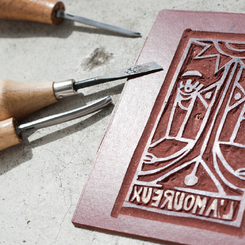
Linocut Printed Tarot Cards
Linocut is a printing technique similar to woodblock printing where a design is cut into linoleum (a...
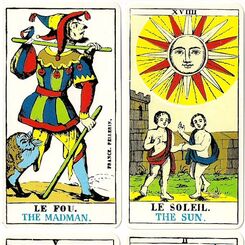
Épinal Tarot
The woodcuts were produced by Francois Georgin (1801-1863), a famous engraver during the Napoleonic ...
Most Popular
Our top articles from the past 60 days


