


Lilian Cailleaud’s Tarot Project
Lilian Caillaeud lino-cuts his version of the tarot by Nicolas Rolichon of Lyon c.1600
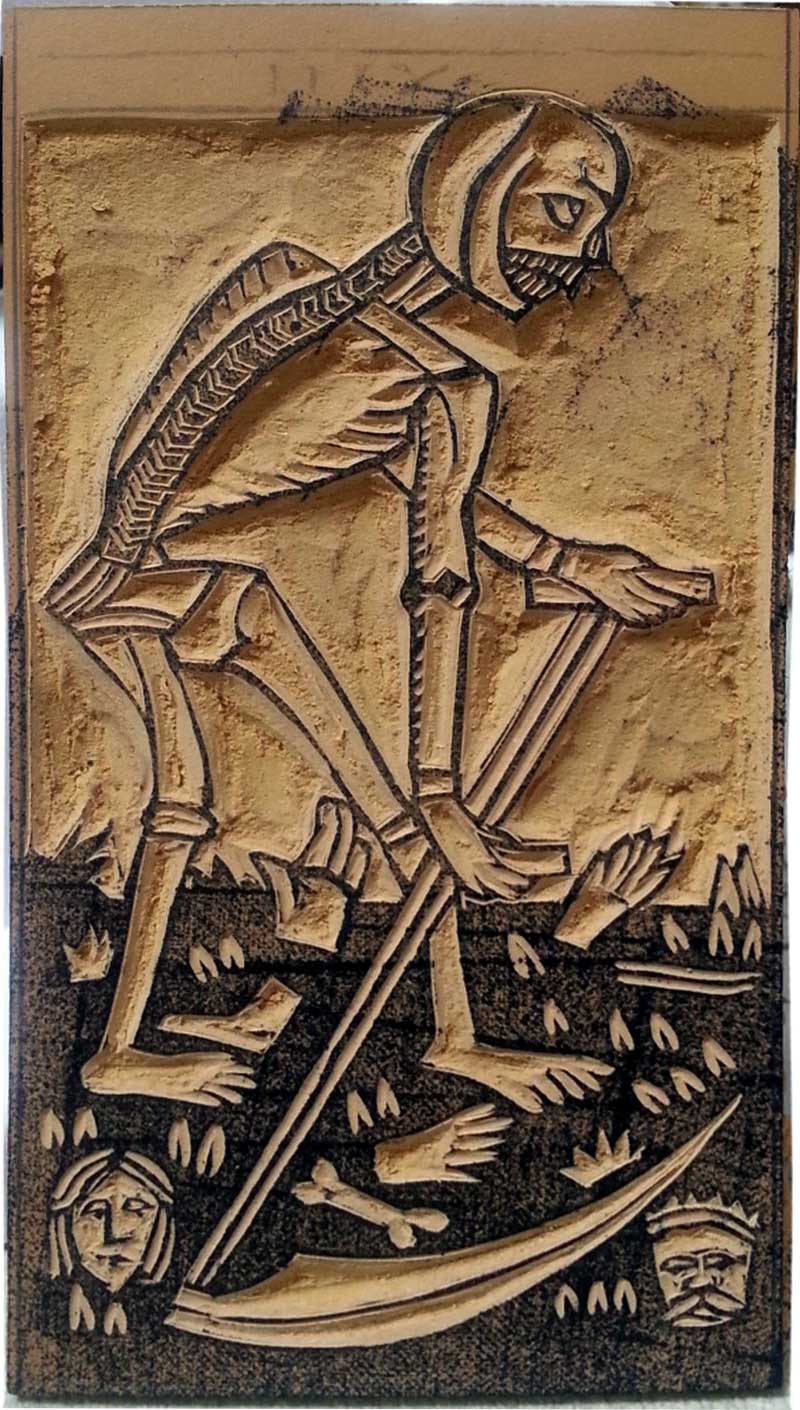
Lilian Caillaeud carves lino in his spare time. So in the spirit of sharing here is the first card of his version of the tarot by Nicolas Rolichon of Lyon c.1600►
“My plan is to carve 1 card a week possibly two. The carving is the easy part it's the printing that gives me chills. I decided to add a few personnal touches. For example, I removed the shading lines and added decoration of my own. Each card measures 10.9 x 6 cm. If you’re interested I’ll keep you up to date with the project.”
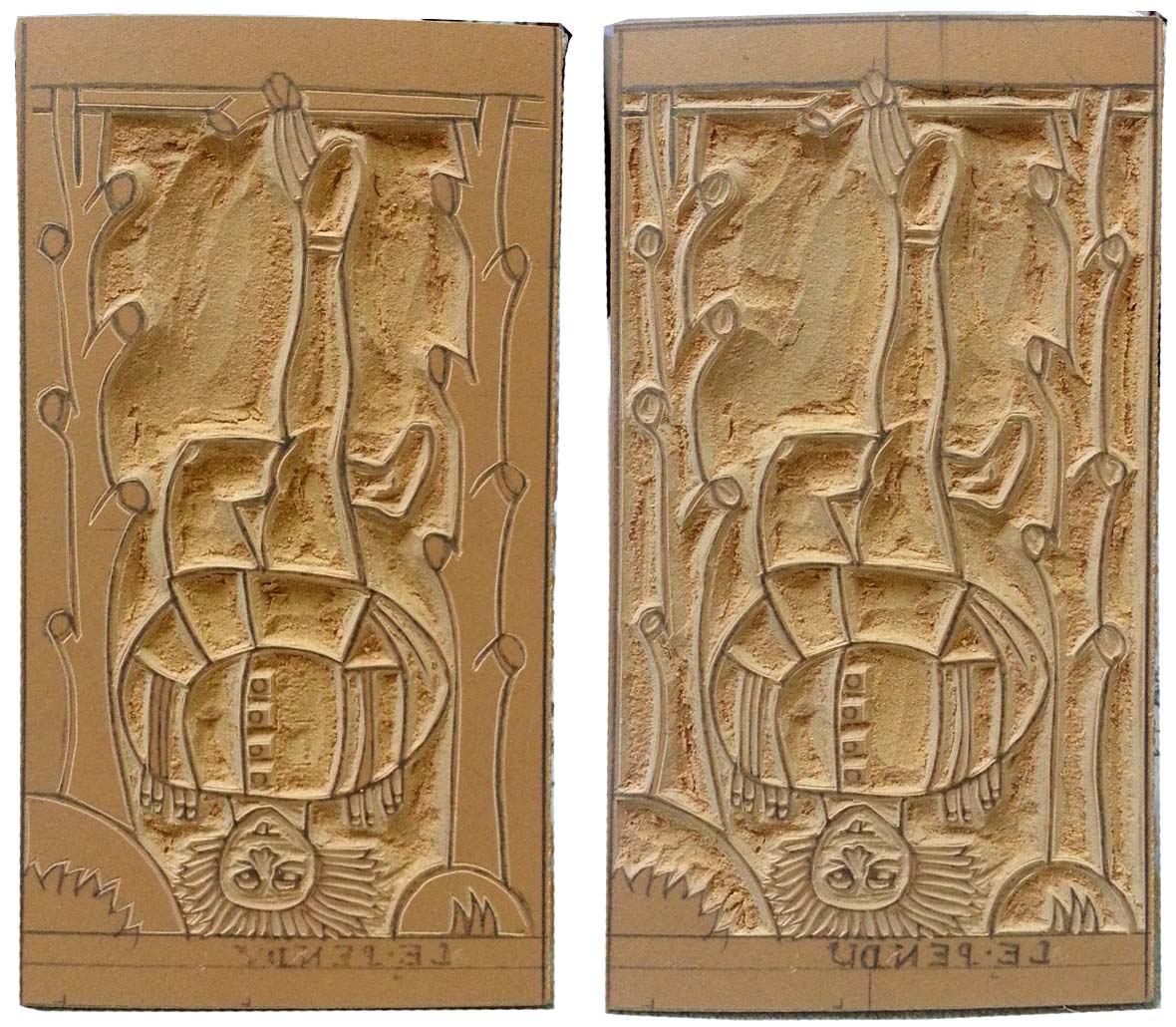
Above: the Hanged Man in progress.
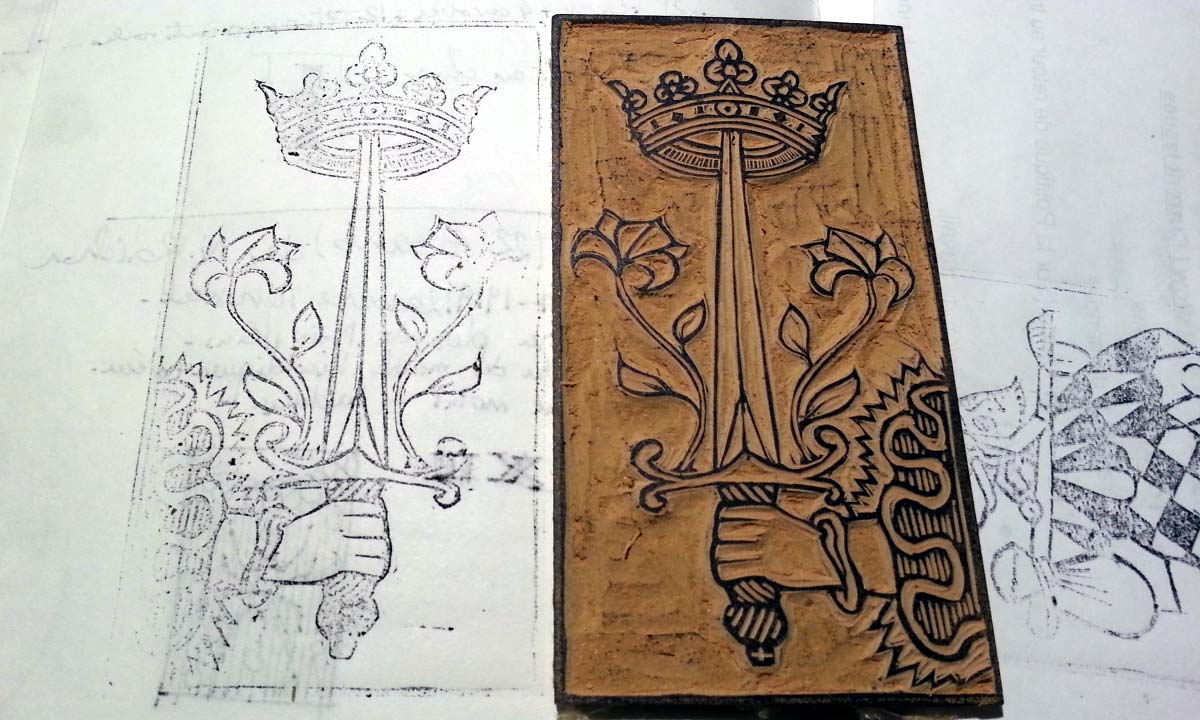
Above: I had planned to do work on the ace of sword right after the fool. It was fun to do. You will notice that i made a few modifications to the design. I added garden lilies instead of the olive and laurel. My reasons for the design modifications are as follows : 1) my name comes from the lily... 2) being French I could not help remembering the arms of Joan of Arc. I replaced the fleur de lys by garden lilies.
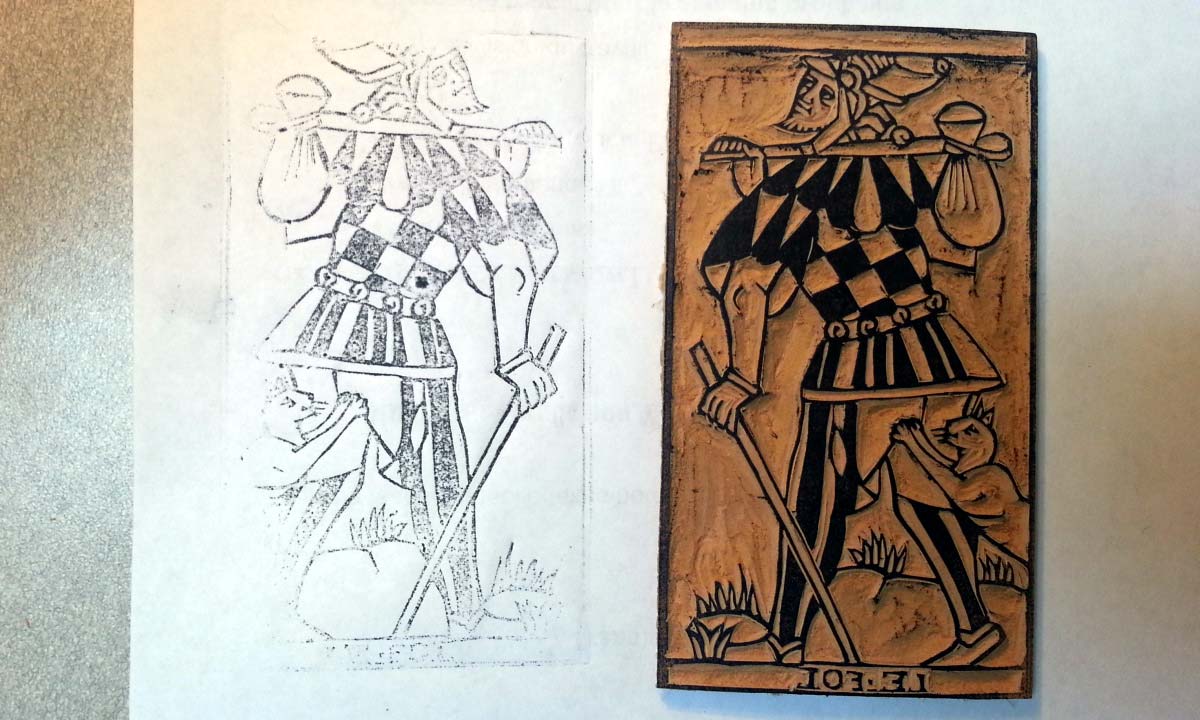
Above: and voilà the first test. I am finishing the lines. Thinning here and there. Letters are always a nightmare especially when they are small.
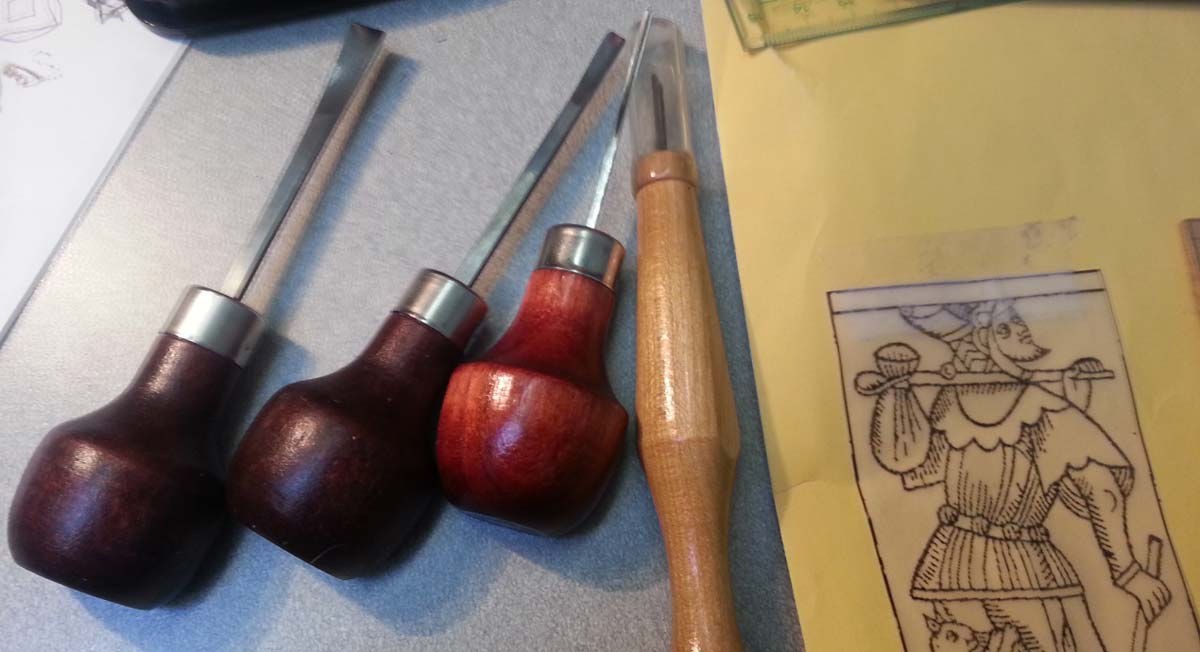
Above: my tools. I cannot do better proof work because I bring just the most essential tools to the office to work on my carving during my break.
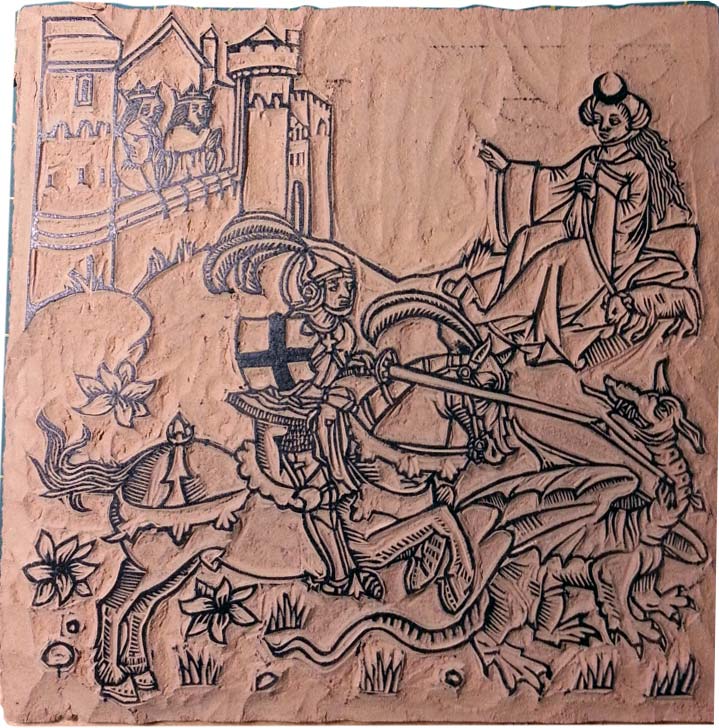
Above: When I am not carving tarot cards I usually try my hand at other images from the 15th and 16th century. Here is Saint George slaying the dragon. All design taken from the incunabula era.

By Simon Wintle
Spain • Member since February 01, 1996
I am the founder of The World of Playing Cards (est. 1996), a website dedicated to the history, artistry and cultural significance of playing cards and tarot. Over the years I have researched various areas of the subject, acquired and traded collections and contributed as a committee member of the IPCS and graphics editor of The Playing-Card journal. Having lived in Chile, England, Wales, and now Spain, these experiences have shaped my work and passion for playing cards. Amongst my achievements is producing a limited-edition replica of a 17th-century English pack using woodblocks and stencils—a labour of love. Today, the World of Playing Cards is a global collaborative project, with my son Adam serving as the technical driving force behind its development. His innovative efforts have helped shape the site into the thriving hub it is today. You are warmly invited to become a contributor and share your enthusiasm.

Activity for Lilian Cailleaud’s Tarot Project
Sign in to comment or save this article.

Related Articles
Buffy the Vampire Slayer Tarot
A Buffy the Vampire Slayer tarot pack that replaces Swords with scythes and Wands with stakes.
Tarot hiéroglyphique égyptien
The design of the cards draws inspiration from various religious and philosophical traditions merged...
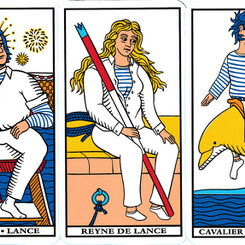
Le Tarot de Sète
Reinterpretation of the Tarot de Marseille by Julien Labat, an artist from Sète.
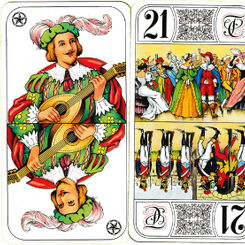
Jeu de Tarot (Catel & Farcy)
Colourful version of a standard French (‘Bourgeois’) Tarot.
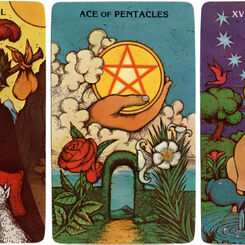
Morgan-Greer Tarot
Based on the knowledge, wisdom and interpretation of Paul Foster Case and Arthur Edward Waite.
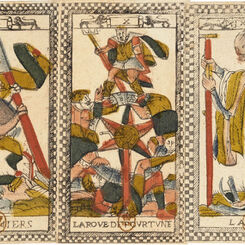
The Parisian Tarot
The “Parisian Tarot”, early 1600s, with imagery and design synthesizing several influences.
Jeu de Cartomancie pour l’amusement des Dames
Early French Cartomancy deck "for the amusement of Ladies" but also referred to as "Jeu divinatoire ...
Jeu de Tarot Astérix
A French Tarot game pack with Astérix and friends on all the trump cards.
Dungeons and Dragons Tarot
This 78-card officially licensed Dungeons & Dragons (D&D) tarot deck offers a visually appealing var...
Besançon Tarot by Jacob Jerger
Besançon tarot published by Jacob Jerger, 18th century.
Ergomia
Complete re-design of traditional pack and a tarot deck into what the publishers considered to be er...
Jean Noblet Tarot de Marseille
Jean Noblet: the oldest known ‘Tarot de Marseille’ deck, Paris, c.1650.
Héron French tarot
French edition of the ‘Bourgeois’ Tarot by Héron.
Tarot des Sapeurs-Pompiers de Paris
Tarot des Sapeurs-Pompiers de Paris, a French Fire Brigade tarot deck published by Éditions Dusserre...
Charles Cheminade Tarot
Marseille Tarot cards by Charles Cheminade of Grenoble, France, early 18th century.
Linocut Printed Tarot Cards
Linocut is a printing technique similar to woodblock printing where a design is cut into linoleum (a...
Rider Waite Tarot early editions
Rider Waite Tarot early editions
Early Anglo-French Cards
Cards produced in Rouen during the sixteenth century. It was cards like these which were imported to...
Regarding the designs of playing cards
The quality of playing card designs often deteriorates with time…
Most Popular
Our top articles from the past 60 days


