


Martin Sharp’s Psychedelic Tarot
Psychedelic Tarot by Martin Sharp issued in poster form with an issue of OZ magazine.
Martin Sharp (1942-2013) was an Australian artist who moved to London in 1966 and who began working for the London version of the underground magazine OZ, edited by Richard Neville. His Tarot card designs appeared in poster form on the rear cover of #4 of OZ magazine in June 1967. Most striking are the colours used – black, gold and dayglow pink. The traditional card titles form part of each design, though not always easy to see at first glance. The psychedelic designs include references to William Blake (trump 1), Mary Poppins (trump 2), Timothy Leary (trump 4), Monty Python (trump 10), and Oscar Wilde and Sigmund Freud (trump 11). Unusually, trump 21 is The Fool, while trump 22 is The World. Titles and descriptive meanings appear in small type at the top or bottom of each card, with Martin Sharp’s name located at the foot of trump 22. Nowadays considered rare.


Psychedelic Tarot cards designed by Martin Sharp for OZ Magazine, London, 1967. 22 cards (originally issued in poster form), here mounted on board. Size: 63 x 147 mm approx.
The Guardian : Martin Sharp obituary ►
Wikipedia : Martin Sharp ►

By Roddy Somerville
France • Member since May 31, 2022
Roddy started collecting stamps on his 8th birthday. In 1977 he joined the newly formed playing-card department at Stanley Gibbons in London before setting up his own business in Edinburgh four years later. His collecting interests include playing cards, postcards, stamps (especially playing cards on stamps) and sugar wrappers. He is a Past President of the Scottish Philatelic Society, a former Chairman of the IPCS, a Past Master of the Worshipful Company of Makers of Playing Cards and Curator of the WCMPC’s collection of playing cards. He lives near Toulouse in France.

Activity for Martin Sharp’s Psychedelic Tarot
Sign in to comment or save this article.

Related Articles
Murder of Crows Tarot
Corrado Roi’s 2020 tarot pack presents a dark, watchful world of crows and ritual figures.
Tarot Familiars
Lisa Parker’s Tarot Familiars gives the traditional 78-card tarot a distinctly gothic world of cats,...

The Wildwood Tarot
The Wildwood Tarot replaces the familiar suits and Major Arcana with a woodland world of animals, to...
Tattoo Tarot: Ink & Intuition
A 2018 tarot pack featuring Megamunden’s bold, vintage tattoo-inspired artwork.
Crowley Thoth Review
An intriguing study of Aleister Crowley's Thoth Tarot¹, painted by Lady Frieda Harris during WW2.
Morgan-Greer Tarot
Based on the knowledge, wisdom and interpretation of Paul Foster Case and Arthur Edward Waite.
English (or Rigel) Tarot Cards
‘Authentic English fortune telling’ Tarot cards said to be based on a 15th century original found in...
Dungeons and Dragons Tarot
This 78-card officially licensed Dungeons & Dragons (D&D) tarot deck offers a visually appealing var...

Hip Hop Tarot
Hip Hop Tarot designed by Ben Gore and produced by Blue Monday Press brings a rap twist to a deck of...
Rolla Nordic Tarot
Rolla Nordic Tarot was drawn by Paul Mathison.
Oliver Mundy tarot
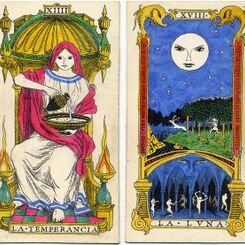
Original Tarot designs in Italian Renaissance style by Oliver Mundy.
OCCO Game of Tarot
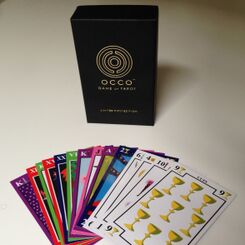
Scott Hill has been working on a tarot pack which can also be used to play card games, the pack has ...
Rider Waite Tarot - details compared
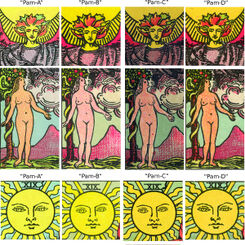
After the first edition of the Rider-Waite tarot in 1909 four further editions were published till a...
Rider Waite Tarot early editions
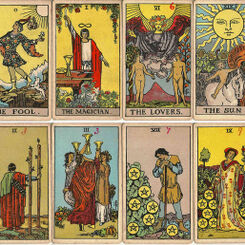
Rider Waite Tarot early editions
Rider-Waite Tarot
The Rider Waite Tarot was created at the beginning of the 20th century by Arthur Edward Waite and Pa...
Insight Institute Tarot
During the late 1940s and 1950s The Insight Institute, of New Malden in Surrey, ran correspondence c...
Russell Grant tarot
Russell Grant astro-tarot with optimistic and motivational illustrations by Kay Smith.
The Llewellyn Tarot - Welsh tarot cards
The Llewellyn Tarot - Welsh tarot cards
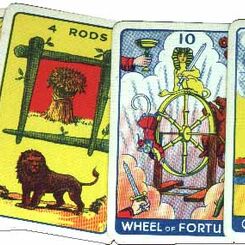
Thomson-Leng Tarot
The Thomson-Leng Tarot Cards were issued by the publishers of women's magazines during the 1930s. Th...
English Tarot Cards
The game of tarot was not widely accepted in England until the 1870s when a number of English occult...
Most Popular
Our top articles from the past 60 days


