


Cartes à Rire
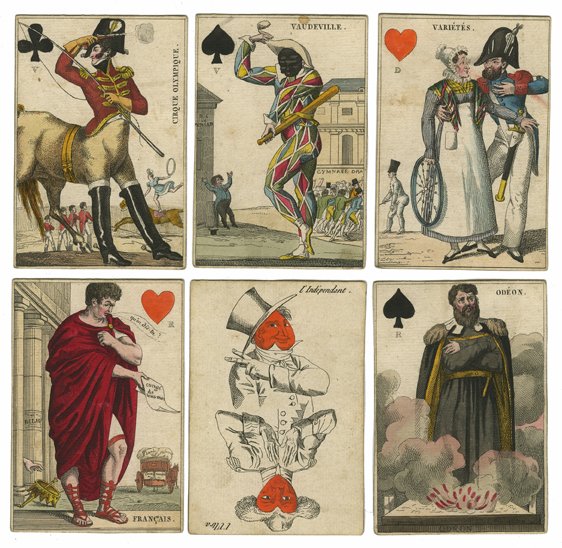
Transformed playing cards featuring satirical caricatures of political figures then in the ascendant, Paris, c.1819.
Cartes à rire transformed playing cards subtitled “des journaux”
This deck has 52 etched and hand-coloured cards with full-length court cards featuring satirical caricatures of political figures then in the ascendant. For example, the knave of spades features the politician and historian Vicomte de Chateaubriand dressed in clerical costume (see caption below). A second set of court cards was published relating to the major theatres in Paris but having the same number cards.
Original cards can be viewed on the Bibliothèque Nationale de France website here and here►

Above: the suit of spades represents a figure of Chateaubriand as Bazile in clerical costume as the knave, concealing a Jesuit's cap under his robe and with a braying ass beside him; the queen of spades is Quotidienne, an old woman holding a book inscribed “Pensée Chrétienne quotidienne” ready to clap an extinguisher on truth emerging from the well; the king of spades is depicted as Conservateur, a Jesuit with a sword in one hand and a torch in the other. The suit of diamonds features Don Quichotte as the knave with a lance and shield attacking a windmill; the Queen is Lettres Normandes and the king is a brazen head on a pedestal with flags of various political parties and the title ‘Moniteur’.

Above: “Cartes à Rire”, Paris, 1819, Subtitled “des théâtres et des journaux”. The knave of clubs depicts Talleyrand as ‘Clopineau’ with political zodiac signs at the top; the queen is ‘Gazette’ and the King of clubs is ‘Débats’ showing the editor carrying two large bags inscribed Débats and Empire with two asses in the background. The court cards from the suit of hearts are figures representing three popular journals: ‘Figaro’, ‘Minerve’ and ‘Constitutionnel’. Minerva is shown subduing certain evil spirits. The column which the king is defending is inscribed “Charte constitutionnel. Liberté de la Presse. Liberté Individuelle. Loi des Elections. Tolérance.” Cards from the facsimile edition using the journalism courts, originally titled "Jeu des Journaux", made in Italy by Il Meneghello and distributed/published in the United States by Cavallini & Co. Images courtesy Rex Pitts.
REFERENCES
Chatto, William Andrew: Facts and Speculations on the Origin and History of Playing Cards, J R Smith, London, 1848 [online here]
Original cards can be viewed on the Bibliothèque Nationale de France website here and here.

By Rex Pitts (1940-2021)
United Kingdom • Member since January 30, 2009
Rex's main interest was in card games, because, he said, they were cheap and easy to get hold of in his early days of collecting. He is well known for his extensive knowledge of Pepys games and his book is on the bookshelves of many. His other interest was non-standard playing cards. He also had collections of sheet music, music CDs, models of London buses, London Transport timetables and maps and other objects that intrigued him.
Rex had a chequered career at school. He was expelled twice, on one occasion for smoking! Despite this he trained as a radio engineer and worked for the BBC in the World Service. Later he moved into sales and worked for a firm that made all kinds of packaging, a job he enjoyed until his retirement. He became an expert on boxes and would always investigate those that held his cards. He could always recognize a box made for Pepys, which were the same as those of Alf Cooke’s Universal Playing Card Company, who printed the card games. This interest changed into an ability to make and mend boxes, which he did with great dexterity. He loved this kind of handicraft work.
His dexterity of hand and eye soon led to his making card games of his own design. He spent hours and hours carefully cutting them out and colouring them by hand.

Activity for Cartes à Rire
Sign in to comment or save this article.

Related Articles
Early nineteenth-century Transformation cards
Vernacular hand-painted Transformation cards, probably early 19th century.
Le Geant, or Second Empire pack
Transformation cards issued during the Second Empire under Napoleon III.
Hand-drawn transformation cards, c1870
Whimsical pen-and-ink drawings copied from the Maclure, Macdonald & Macgregor transformation pack.
Victor Hugo “L’homme qui rit”
Two different packs with costume designs for Victor Hugo plays, issued on the centenary of his deat...
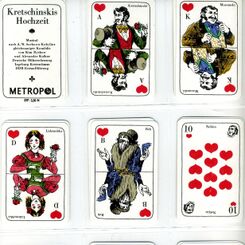
Wedding of Krechinsky • Свадьба Кречинского
A pack of cards depicting characters from the famous play "The Wedding of Krechinsky" by Sukhovo-Kob...
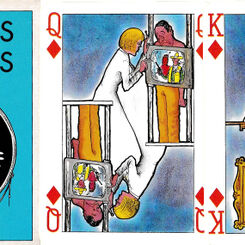
Jeu des Médecins
Cartoons of doctors and nurses by Pino Zac, published by B.P. Grimaud in 1983.
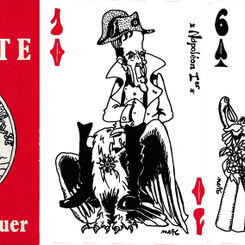
Le Giscarte
Le Giscarte political playing cards designed by Eddy Munerol, France, 1976.
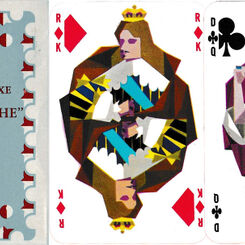
Scaramouche
Scaramouche cartes à jouer with designs by Henri Favre, published by Le Triboulet, France.
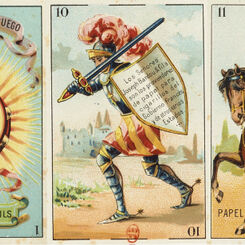
Joseph Bardou & Fils cigarette papers
Delightful pack advertising Joseph Bardou & Fils cigarette papers for the Philippines.
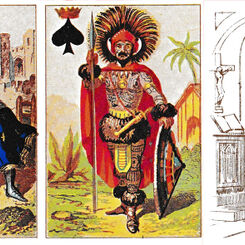
Jeanne l’Hachette
Jeanne l’Hachette reprint of 19th century transformation deck, Denmark, 1976.
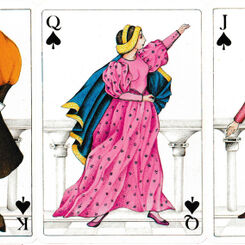
Le Jeu des 4 Opéras
Characters from five famous operas brought alive in artist Silvia Maddonni’s inimitable style.
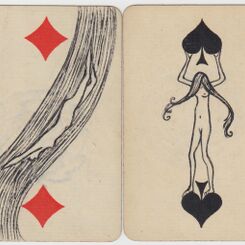
Nine art-nouveau transformation playing cards
by an unknown artist
Molière par Dubout
Characters and scenes from plays by Molière as drawn by the cartoonist Albert Dubout.
Baron Louis Atthalin’s Transformation Playing Cards, 1817
Baron Louis Atthalin (1784-1856) designed these cards whilst on a sea crossing from Palermo to Marse...
Eroticartes
Eroticartes with drawings by Pino Zac, 1983.
Tarot de l’An 2000
“Tarot de l’An 2000” designed by Pino Zac, 1981, satirising 20th century life.
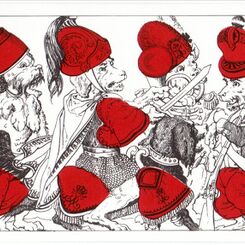
Cartes Comiques du Colonel Atthalin
“Jeu de cartes comiques” transformation cards designed by Louis Atthalin (1784-1856) and published i...
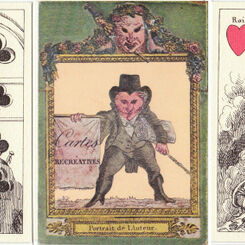
Cartes Recréatives
Cartes Recréatives is a set of Transformed playing cards designed by Armand-Gustave Houbigant (1790-...
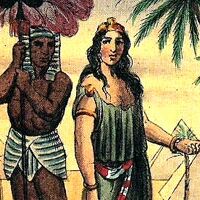
Adolfo Matarelli Transformation
Matarelli was a well known caricaturist who first illustrated Carlo Collodi's famous Pinocchio story...
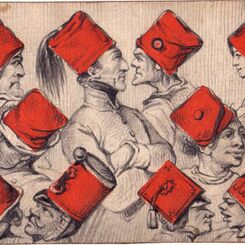
Transformation of Playing Cards
The best-known fantasy playing cards are Transformation cards, in which figurative scenes are drawn ...
Most Popular
Our top articles from the past 60 days


madeline g
01 April 2026, 04:20SavedSaved this article to madeline's Collection