


Rowley & Co - “Monarchs of Europe”
In around 1775 Rowley & Co attempted to reform the traditional court cards to portraits of the kings and queens of England, France, Spain and Russia.
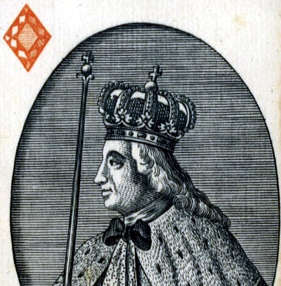
a pack of cards in which the antiquated and grotesque are rejected...
Perhaps following trends on the Continent, between 1774 and 1776 Rowley & Co. of London endeavoured to reform the traditional court cards in English playing cards with portraits of the kings and queens of England, France, Spain and Russia with their attendants as Knaves, and with the customary suit symbols changed to spearheads, chalices, trefoils, and topaz, coloured black, red, green and orange. Additional allegorical imagery on the Aces suggests “the four classes of men into which every kingdom is divided: the Nobles, the Clergy, the Citizens and the Peasantry”.
The Ace of Spades on English playing cards usually carried the maker's name, but did not carry the treasury duty until 1765. After this it also had a die number. In this example of Rowley & Co's pack the Ace of Spades is nameless and with no duty or die number, which is unusual. One explanation is that early editions may have had a nameless Ace of Spades; or it may have been a proof submitted to the Stamp Office for the real Ace to be made. Alternatively it may have been an attempt to evade paying the official duty. The rest of the pack appears to be perfectly legitimate.
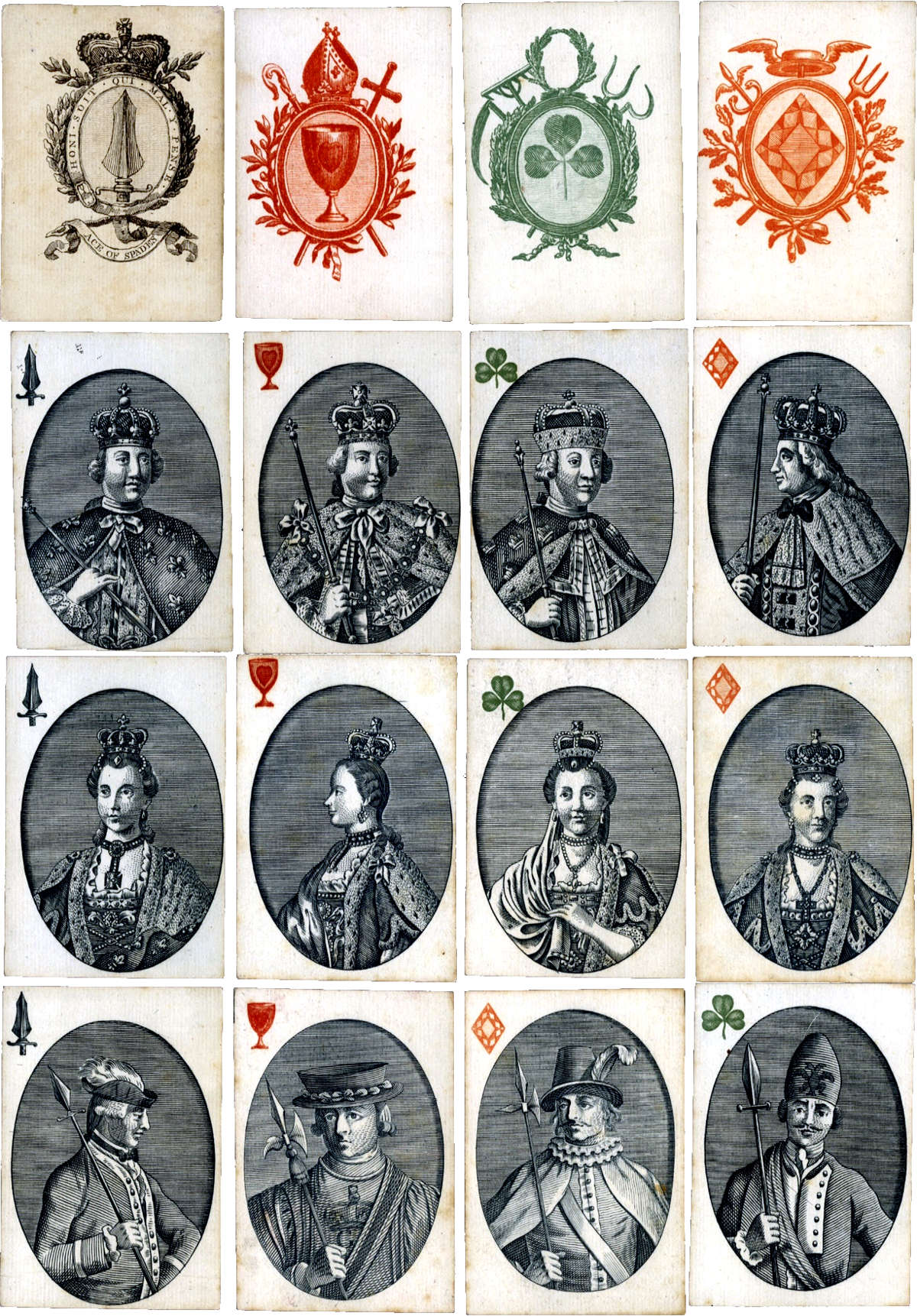
Above: Rowley & Co's copper-engraved “Monarchs of Europe” non-standard playing cards published c.1774-1776. Rowley & Co operated at No.6 in the Old Bailey, London. Images courtesy Dan Dragojevich. Additional research courtesy John Sings and Ken Lodge.
“The designs are entirely new, the joint endeavour of several respectable artists, studious to please, and emulous to outvie everything of this kind which has appeared before. Upon the whole, they are submitted to the public as a pack of cards, in which the antiquated and grotesque are rejected, the misnomers explained and removed, and much of the original meaning of the inventor revived...”
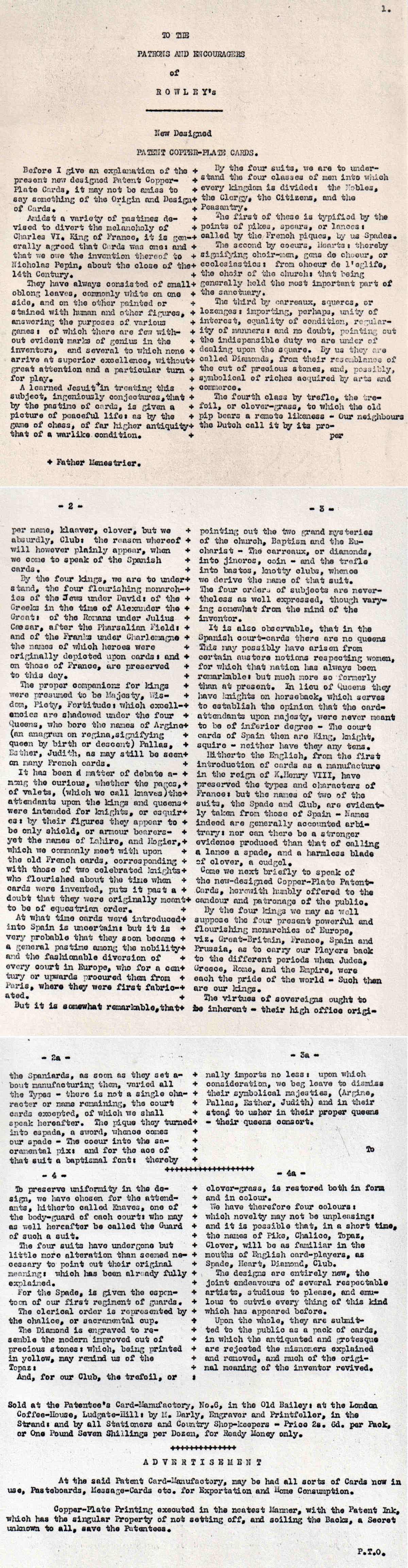
Full explanation for the design of the pack...
Below is a typescript of an advertisement for Rowley's cards which contains a rationale for the design of the pack:

By Simon Wintle
Spain • Member since February 01, 1996
I am the founder of The World of Playing Cards (est. 1996), a website dedicated to the history, artistry and cultural significance of playing cards and tarot. Over the years I have researched various areas of the subject, acquired and traded collections and contributed as a committee member of the IPCS and graphics editor of The Playing-Card journal. Having lived in Chile, England, Wales, and now Spain, these experiences have shaped my work and passion for playing cards. Amongst my achievements is producing a limited-edition replica of a 17th-century English pack using woodblocks and stencils—a labour of love. Today, the World of Playing Cards is a global collaborative project, with my son Adam serving as the technical driving force behind its development. His innovative efforts have helped shape the site into the thriving hub it is today. You are warmly invited to become a contributor and share your enthusiasm.

Activity for Rowley & Co - “Monarchs of Europe”
Sign in to comment or save this article.

Related Articles
Zewd Historical Deck
Ethiopian imperial history, from Tewodros II to Haile Selassie.
Tudor Rose No. 2137
A bizarrely misnamed deck.
78: The Standard English pattern - Part 2, the tricky bits
There are many less straightforward aspects to the designs of the English pattern, which need carefu...
Polish Kings and Queens – red deck
Polish kings and queens plus the court jester, illustrated in a distinctive style inspired by histor...
Victorian grocer’s scale plate
Large flat plate decorated with highly coloured English cards and royal arms.
Gibson’s History of England
History without tears for young and old, 1920s.
English cards from the reign of Charles II
This article explores a historic pack of English playing cards from circa 1675, likely used by King ...
British Monarchs
Commemorating the royal wedding of Charles, Prince of Wales to Lady Diana Spencer on the 29th
Dutch Court playing cards
Games & Print Services’ version of the Dutch pattern.
The Fat Pack
A vastly expanded pack with 8 suits for playing traditional or new games, devised by Roger Howard Bu...
71: Woodblock and stencil: the hearts
A presentation of the main characteristics of the wood-block courts of the heart suit.
Modern English Court
Modern English court style by Games & Print Services Limited, c.1997.
Sovereigns of England
Sovereigns of England published by Jaques & Son, c.1875.
49: De La Rue in detail
A detailed presentation of the variants of De La Rue's standard cards.
Historical Characters
“Historical Characters” playing cards printed by Waddington’s for Thermawear Ltd, 1994.
Royal Old Maid Game
This antique card game features English kings and queens from William the Conqueror to Queen Victori...
Suicide King
The King of Hearts, holding a sword behind his head, is sometimes nicknamed the “Suicide King”. He c...
Traditional English Court
Games & Print Services Ltd traditional English courts.
The History of Playing Cards
Playing cards appear in European records in the late 14th century, but their earlier history lies fu...
History of Court Cards
The court cards in English packs of playing cards derive from models produced by Pierre Marechal in ...
Most Popular
Our top articles from the past 60 days


DJ .Pigott
17 November 2023, 02:42The patent James Rowley used was granted in 1772, patent number 1012 granted on April 7th. It lists him as a wine merchant, which leads to the speculation as to whether the driving force was to make better cards for playing, rather than a printer advancing the art.
In the absence of a picture, here is the text of the patent:
"A grant unto James Rowley, of the parish of Saint Martin Ludgate, in the city of London, wine merchant, of his new invented method of making playing cards, printed from engravings on copper, after entire new designs, in oil colours, with a peculiar kind of ink which will bear the leesing or polish necessary to be given to playing cards, which no other ink known to the printers or card makers is capable of; to hold to him, his executors, admors, & asss, within England, Wales, & town of Berwick-upon-Tweed for the term of 14 years pursuant to the statute; with a clause to inroll the same within four calendar months from the date hereof. W. H. M. at Westmr, the 7th day of April, in the year above. By writ, &c."
it's in the Internet Archive here https://archive.org/details/chronologicalin1617grea_0/page/182/mode/1up