


Ivorette
Dougherty was at the forefront of innovation, adding Best Bowers and then Jokers, rounded corners and various types of indices, or indicators, to his cards.
A. Dougherty: “Ivorette”
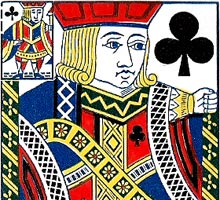
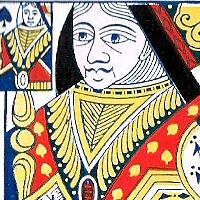
Right: “Triplicates”, the miniature cards in the corners, with little breaks in the border →
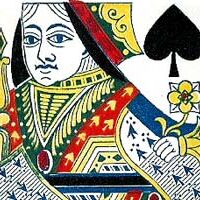
Dougherty was at the forefront of innovation, adding Best Bowers and then Jokers, rounded corners and introducing various types of indices to his cards. In 1883 he was granted a patent for “Indicator” cards. Dougherty's “Ivorette No.70” deck incorporates the first use of these numbered indices, or “Indicators”, printed outside the border, along with the earlier form of “Triplicates”, the miniature cards in the corners. It also has small breaks in the borders, as in Spanish cards, and all these innovations helped players distinguish cards from only seeing the corners. It only ran for a year or less and was followed in 1894 by “Indicators No.50”. These “Indicators”, printed outside the border, soon became standard. The Ace of Spades mentions two patents, the earlier date being for the first “Triplicate” format and the second date being for the addition of the indicator number.
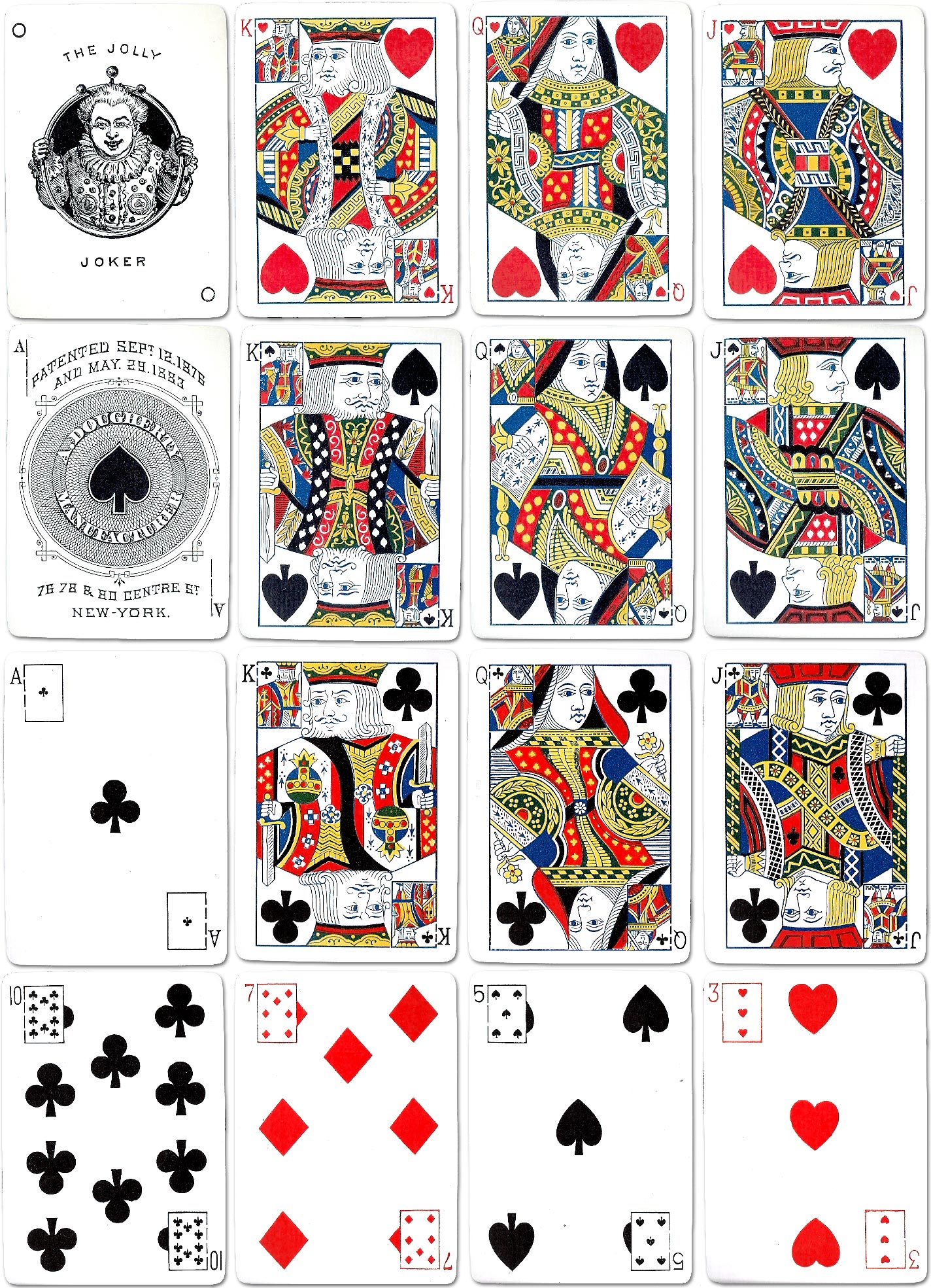
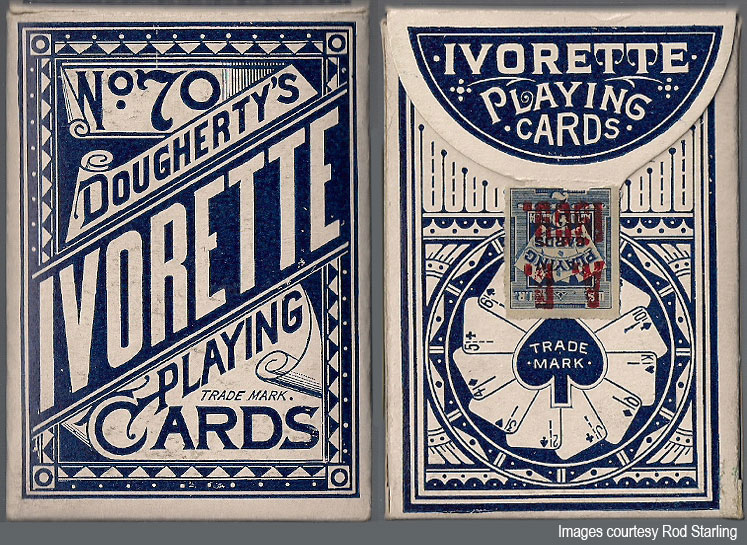
Above: Dougherty's “Ivorette No.70” deck has the “Indicator” Ace of Spades and a Jolly Joker. It was the last of the Triplicate series and incorporated the first use of numbered indices. The small margin breaks in the miniature playing cards differentiate the suits. It only ran for a year or less and was followed in 1894 by Indicators No.50. Image courtesy Rod Starling.
Right: click the box to zoom →
Many brands were issued featuring these new “Indicators”. The main distinguishing feature was the different box. Brands include “Ivorette”, “Tudor”, “Tandem”, “Mogul”, “Sunset” etc. Similar new ideas were being introduced or imitated simultaneously by other manufacturers both in USA and elsewhere, with various different patented brand names, such as “Squeezers”, “Dexters”, “Eureka”, etc. so that the corner indices we now take for granted were born from these competing innovations.
Regarding Dougherty's “Indicator” indices that were patented in 1883, that would have been just six years after NYCCC obtained its own patent for “Squeezers”, which are more or less the same idea. It is difficult to understand what difference there was between NYCCC's “Squeezers” and Dougherty's “Indicators” that would warrant each company being granted patent rights at about the same time.
REFERENCES
Dawson, Tom & Judy: The Hochman Encyclopedia of American Playing Cards, U.S. Games Systems Inc., 2000
All images from the collection of Rod Starling.

By Rod Starling (1936-2023)
United States • Member since January 09, 2013
Rod Starling was one of the founding members of the 52 Plus Joker card collectors club. He authored many articles for the club's quarterly newsletter, Clear the Decks. His collection encompasses both foreign and American decks. Rod also authored a book titled The Art and Pleasures of Playing Cards.

Activity for Ivorette
Sign in to comment or save this article.

Related Articles
Foster’s Self-Playing Whist Cards
In 1890 R. F. Foster published the first edition of “Foster’s Whist Manual” which was to become the ...
A. Dougherty’s Triplicate Recreation
A recreated of the original 1876, No. 18, Triplicate deck by A. Dougherty by Michael Scott in 2014. ...
Corner Indices
Corner Indices were a major innovation in playing card production.
Zum
Zum card game published by Milton Bradley Co., c.1905.
Parker Brothers
Parker Brothers, Salem, Mass., USA.
42: Andrew Dougherty
Andrew Dougherty was one of the biggest American card-makers in the 19th century
33: Functional Changes to Playing Cards
The emphasis throughout my collecting has been on the design of the courts cards, and it should be p...
Tally-Ho
The earliest Ace of Spades had the Centre Street address and the Jolly Joker was used until the “Tal...
Indicator No.50
No.50 appears at the bottom of the Ace of Spades and the cards have corner indices and miniature sui...
Triplicate No.18
Dougherty first secured a patent for “Triplicates” in 1876, a novel type of indices with a miniature...
Andrew Dougherty c.1850
The idiosyncratic courts used in this deck were used by several other U.S. manufacturers, including ...
Cruiser Playing Cards
Dougherty's ‘Cruiser No.96’, first published c.1897, was dedicated to the U.S. Navy..
13: Some North American Cards
I deal with some of the US makers in more detail on other pages, but here is a brief introduction.
Amos Whitney Inventory
Amos Whitney Factory Inventory. What it was like inside an 18th century playing card factory...
Pneumatic Playing Cards
The surface of the cards was slightly grooved by being rolled on prepared plates, so that there were...
Excelsior
Excelsior by A. Dougherty, c.1870.
Illuminated Playing Cards, c.1865
Facsimile edition of Andrew Dougherty's Illuminated deck, c.1865, published by U.S. Games Systems, I...
Lewis I. Cohen
Lewis I. Cohen made his first deck of cards in 1832. In 1835 Mr Cohen invented a new machine to prin...
Samuel Hart, 1846-1871
Samuel Hart was a prolific manufacturer of playing cards who commenced business sometime around 1845...
Andrew Dougherty 1848-1930
Andrew Dougherty was born in Donegal in Northern Ireland in 1827. He started his playing card busine...
Most Popular
Our top articles from the past 60 days


