


Phelippe Ayet, c.1574
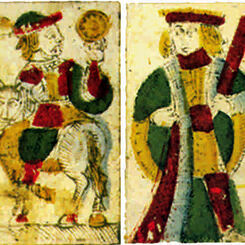
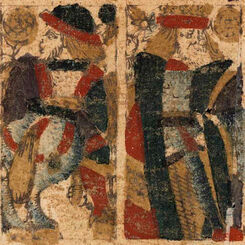
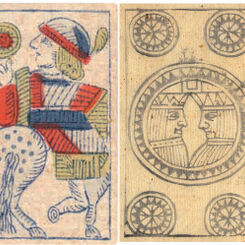
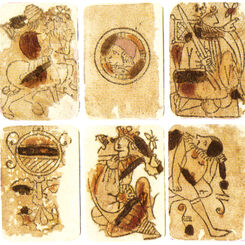
Archaic, late medieval Spanish-suited playing cards printed by Phelippe Ayet, c.1574.


Archaic, late medieval Spanish-suited designs
Cards from a Spanish-suited pack made by Phelippe Ayet, c. 1574 were found in the Torre de los Lujanes in Madrid during demolition, and are now in the collection of the Gabinete de Antiguedades Real Academia de la Historia, Madrid. 44 cards were found in total, derived from possibly three separate packs; approximate size: 11.5 x 8 cms. Opinion is divided over whether the cards were made in France, possibly Thiers, and imported into Spain, or else made in Catalonia by a French or Flemish card maker. The style is an archaic, late medieval type, which pre-dates the Spanish National pattern. The King of Coins wields a battle axe over his shoulder and can be found in later cards from Provence and also as the King of Hearts in English packs ('Suicide King'). The inscription on the Five of Coins reads: “Grossus vs novvs imperatoris romanorum”.
NOTE: an early account of these discoveries can be found in ‘La Alhambra’, 10 March, 1885, page 2r: here►

Above: the small figures on some of the numeral cards is a feature also seen in late XV century Catalan cards which persists into the sixteenth and seventeenth centuries in cards made in Seville. Cards with similar designs were produced by Jean Pouns (see below), Joan de Santillana and Jehan Prou. Another similar pack has been discovered in Toledo. Cards from facsimile edition by the Real Academia de la Historia, 2001.
Eight of Clubs: It would be thought hardly possible for cards to have survived from the wrecks of the Spanish Armada. However, one card, the Eight of Clubs, was found in a metal box embedded at the bottom of Tobermory Bay.
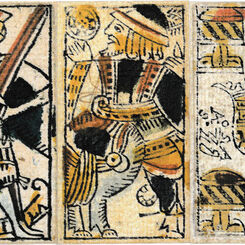
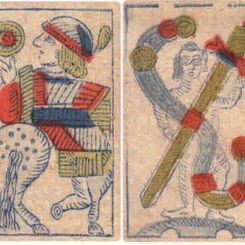
Cards with similar designs were produced by Jean Pouns S.S. (possibly of San Sebastian). The Five of Coins shows the portraits of the Catholic monarchs, whilst the Four of Coins has a six-pointed star with a shield in the centre. The Ace of Swords has a small person in the background.
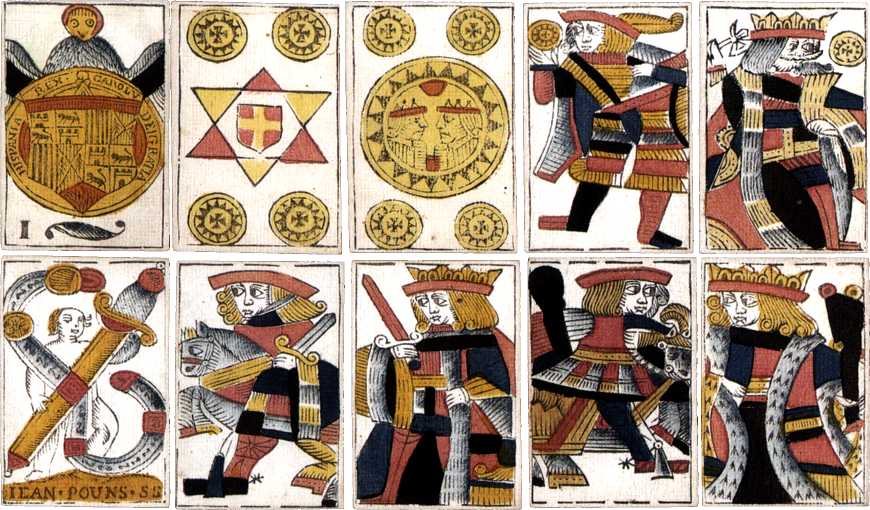
Above: cards from a woodblock and stencilled Spanish-suited pack, of similar design to the example by Phelippe Ayet, made by Jean Pouns S.S. (possibly of San Sebastian).
Image of cards in the Fournier Museum, Alava, taken from: Agudo Ruiz, Juan de Dios: Los Naipes en España, Diputación Foral de Álava, 2000.


By Simon Wintle
Spain • Member since February 01, 1996
I am the founder of The World of Playing Cards (est. 1996), a website dedicated to the history, artistry and cultural significance of playing cards and tarot. Over the years I have researched various areas of the subject, acquired and traded collections and contributed as a committee member of the IPCS and graphics editor of The Playing-Card journal. Having lived in Chile, England, Wales, and now Spain, these experiences have shaped my work and passion for playing cards. Amongst my achievements is producing a limited-edition replica of a 17th-century English pack using woodblocks and stencils—a labour of love. Today, the World of Playing Cards is a global collaborative project, with my son Adam serving as the technical driving force behind its development. His innovative efforts have helped shape the site into the thriving hub it is today. You are warmly invited to become a contributor and share your enthusiasm.

Activity for Phelippe Ayet, c.1574
Sign in to comment or save this article.

Related Articles
Oxygène
Armenian miniatures were Stepan Kiourktchian’s inspiration for this pack for a Franco-Armenian assoc...
The archaic “Classic Madrid” Pattern
Centralisation, standardisation and consolidation of the Spanish card tradition.
Les Chevaliers de la Toison d’Or
Medieval manuscript art at its finest.
La baraja de Almagro
De la chimenea al monumento nacional: la baraja de Almagro y el renacer del corral de comedias.
History of Tarot and Playing Cards: Timeline & Origins
An alternative history of tarot and playing cards – from Mamluk Egypt to the invention of tarot in R...
Sevilla 1647 reproduction
Facsimile of Spanish-suited pack produced in Sevilla, Spain, 1647.
Medieval Life playing cards
‘Medium Aevum’ (Medieval Life) playing cards designed by Violeta Monreal, published by Heraclio Four...
Toledo, 1584
Archaic Spanish-suited deck with 48 cards made in Toledo in 1584.
Baraja Carlos IV by Félix Solesio, 1800
Baraja Carlos IV, Félix Solesio en la Real Fábrica de Macharaviaya, 1800.
Pedro Varangot, 1786
Archaic Navarra pattern produced for the Pamplona General Hospital Monopoly by Pedro Varangot in 178...
Navarra Pattern, 1682
Navarra pattern produced for the Pamplona General Hospital Monopoly in 1682.
Navarra Pattern
Navarra Pattern produced for the Pamplona General Hospital Monopoly.
Navarra Pattern, 1793
Navarra pattern by an unknown cardmaker with initials I. I., 1793.
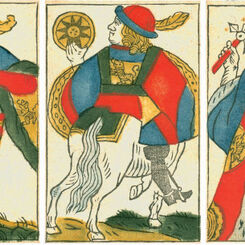
Anonymous Spanish Suited pack, c.1760
Anonymous archaic Spanish suited pack, c.1760.
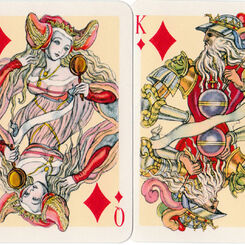
Romance Español
“Romance Español” designed by Carlos Sáenz de Tejada and published by Heraclio Fournier in various e...
Europe
“Europe” designed by Teodoro N. Miciano and printed by Heraclio Fournier in 1962, portraying XIV cen...
1: Playing Cards and their History: An Introduction and some links to other sites
What was considered the first mention of playing cards in England is in 1463 when Edward I banned th...
Navarra, XVII Century
Facsimile of 17th century Spanish-suited playing cards produced by Erregeak, Sormen S.A., Vitoria-Ga...
The History of Playing Cards
Playing cards appear in European records in the late 14th century, but their earlier history lies fu...
Baraja Morisca — Early XV century playing cards
Primitive Latin suited pack, dated by paper analysis as early XV century, which makes this one of th...
Most Popular
Our top articles from the past 60 days


