


Archaic Franco-Spanish pattern
Archaic Franco-Spanish pattern by Guillaume & Jean Grossard (Bordeaux).
These XVI century Spanish-suited cards by Grossard represent an archaic pattern which was widely produced in France as well as Spain. Many early examples come from France.¹ In these early days card designs were being exported via trade routes and copied between different areas. By the late 16th century overregulation and a high demand for affordable products led to a growing black market in smuggled packs in which the maker's name was not identified and inscriptions on the cards tended to become nonsense and not traceable back to a specific maker.
The woodcut outlines and stencil colouring in this example are clearly defined. The ace of coins features a Spanish coat-of-arms with the inscription “Histania Rex Carolv Dei Gratia”, and the name I. Grossard appears in a scroll. The eagle looks more like an owl. The king holds a small axe and the cavalier of coins is seen from behind. The two of swords has a partly illegible inscription “Fecha en Bordaux” probably reflecting the regional dialect of the time. The ace of swords, with its ornamental strap and characteristically accompanied by a naked person, has the name Guillaume Grossard, suggesting that these cards come from two incomplete packs. The ‘sota’ of cups displays a heraldic lion. There are no line-breaks, or ‘pintas’, as these didn't appear until the mid-eighteenth century. Three of the jacks have additional decorative flowers.
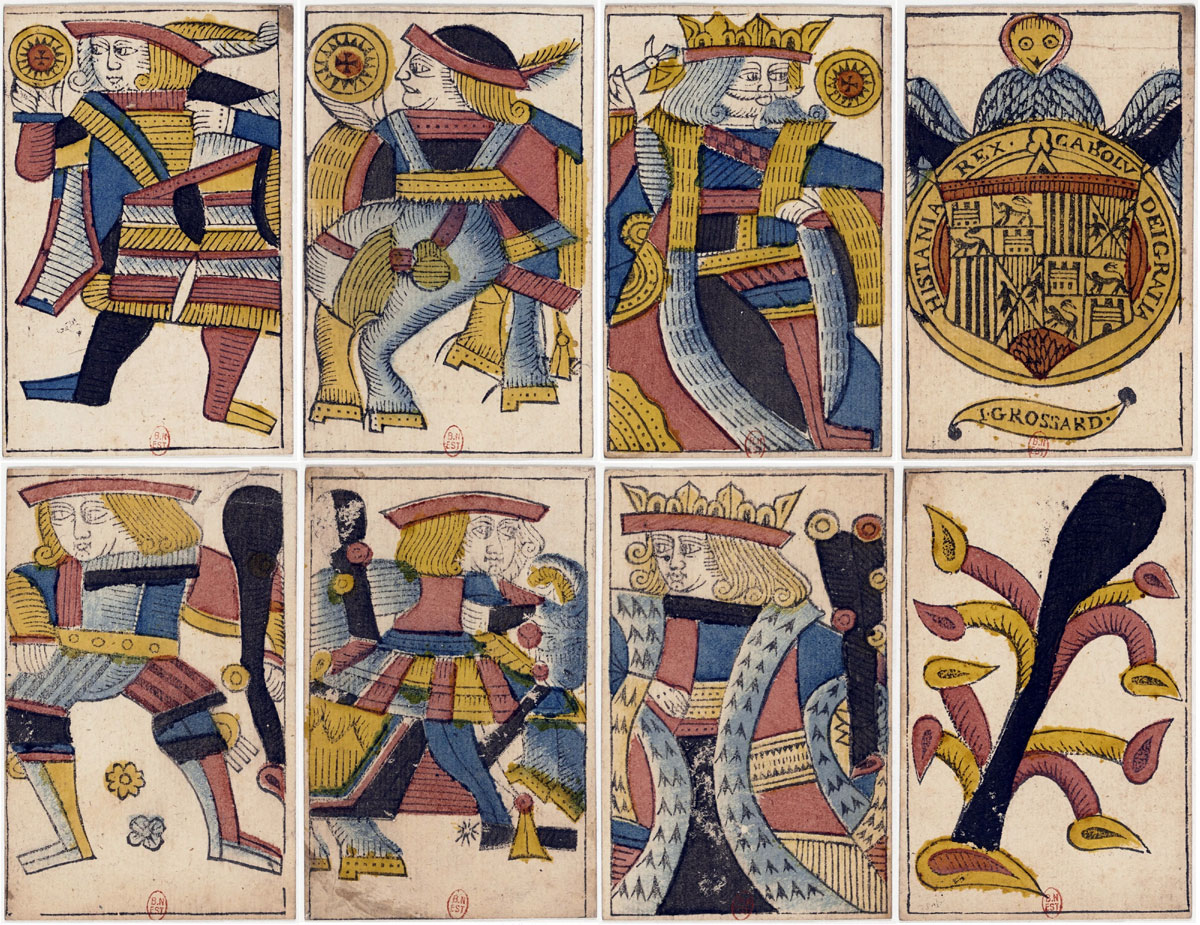
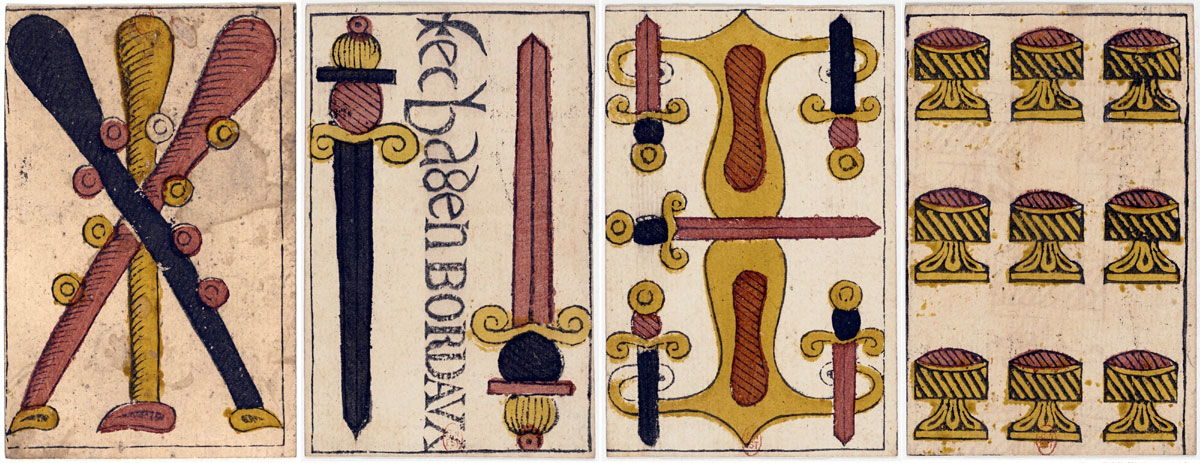
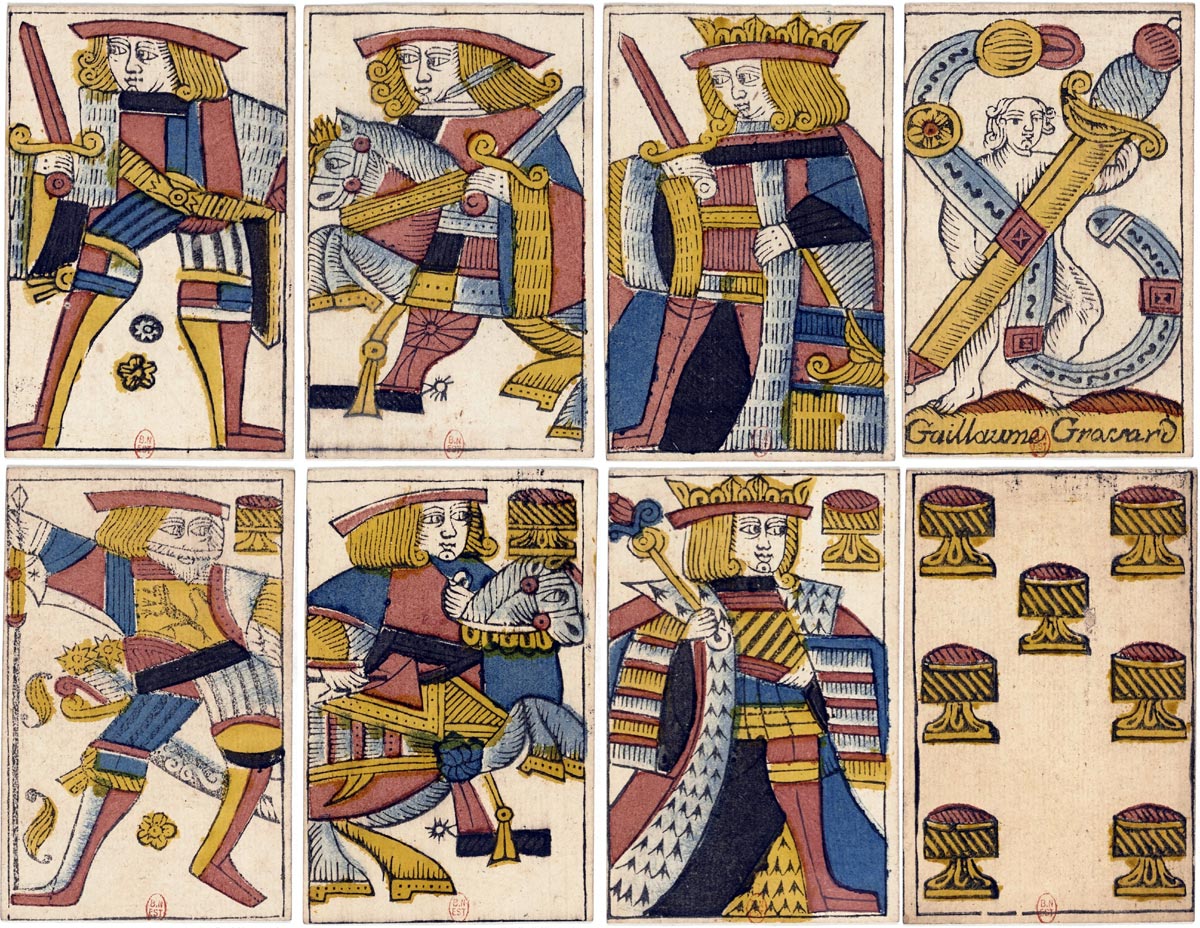
Above: Franco-Spanish pattern by Jean Grossard & Guillaume Grossard, Bordeaux, 16th century. Woodblock & stencil, mixed packs. Source gallica.bnf.fr / BnF.
Cards with similar designs were produced by Jean Pouns S.S. (possibly of San Sebastian). The Five of Coins shows the portraits of the Catholic monarchs, whilst the Four of Coins has a six-pointed star with a shield in the centre. The Ace of Swords has a small person in the background.
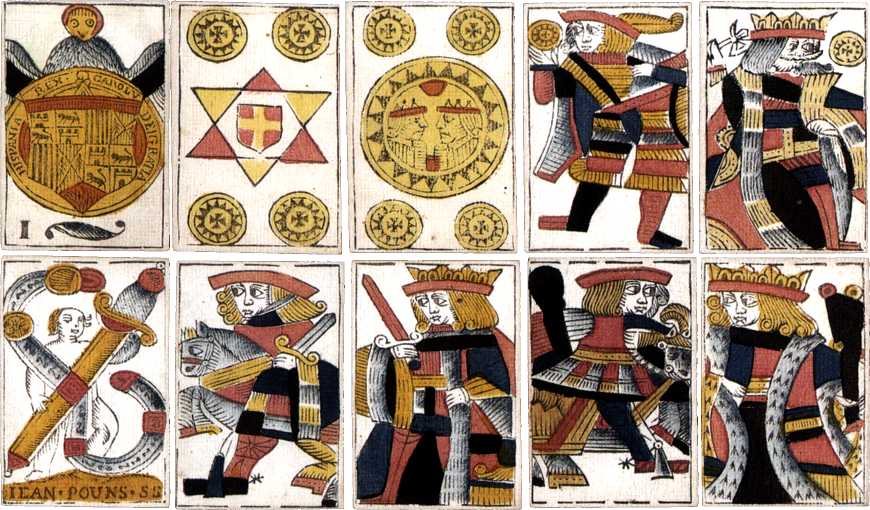
Above: cards from a woodblock and stencilled Spanish-suited pack, of similar design, made by Jean Pouns S.S. (possibly of San Sebastian), c.1680.
The Franco-Spanish pattern is known from before the Spanish National pattern emerged, which was an entirely new design probably originating in 17th century Catalonia. Prior to all this, the so-called ‘dragon cards’ were used in Spain, also in Italy, Sicily and Malta, as well as several earlier Gothic Spanish-suited patterns. Earlier still, of course, cards first arrived from the Islamic world to Spain and Italy in c.1370.
Notes and References
¹ Examples include packs by Diego del Campo (Toledo, c.1540), Pierre Pepin (Seville) and Phelippe Ayet (Valencia, 1574), François Gaben, Jehan Person, Jean Pouns, Guillaume Grossard (Bordeaux) and Jehan Volay. Examples made in Spain were often by French immigrant card makers. Examples from Toledo dated 1584 are also known.
Bibliothèque nationale de France: Cartes d'un jeu au portrait espagnol►
Denning, Trevor: The Playing-Cards of Spain, Cygnus Arts, London, 1996
Mann, Sylvia: All Cards on the Table, Jonas Verlag/Deutsches Spielkarten-Museum, Leinfelden-Echterdingen, 1990

By Simon Wintle
Spain • Member since February 01, 1996
I am the founder of The World of Playing Cards (est. 1996), a website dedicated to the history, artistry and cultural significance of playing cards and tarot. Over the years I have researched various areas of the subject, acquired and traded collections and contributed as a committee member of the IPCS and graphics editor of The Playing-Card journal. Having lived in Chile, England, Wales, and now Spain, these experiences have shaped my work and passion for playing cards. Amongst my achievements is producing a limited-edition replica of a 17th-century English pack using woodblocks and stencils—a labour of love. Today, the World of Playing Cards is a global collaborative project, with my son Adam serving as the technical driving force behind its development. His innovative efforts have helped shape the site into the thriving hub it is today. You are warmly invited to become a contributor and share your enthusiasm.

Activity for Archaic Franco-Spanish pattern
Sign in to comment or save this article.

Related Articles
Premio para los ninõs
Antique fantasy Spanish-style children's card game making a map, published in France.
Archaic Spanish-suited pattern from Bayonne
Archaic Franco-Spanish pattern from Bayonne by a manufacturer with the initals M.V.
Archaic Spanish proof sheets
2 x uncoloured proof sheets of archaic Spanish-suited playing cards produced for “New Spain”, possib...
Jeu des 7 familles basques
A Happy Families-type game from the Basque country, with designs by Soledad Bravi and Agathe de Las...
Monuments de Paris
‘Monuments de Paris’ souvenir playing cards produced by Heraclio Fournier, c.1964.
Guyenne Pattern - Portrait de Guyenne
The Guyenne pattern emerged from the earlier Languedoc pattern.
Aluette by Dieudonné Jeune, Orléans, c.1850
Aluette game by Fabrique Dieudonné Jeune, Orléans, c.1850.
The New Game of Tarot (or Tarock)
Regional costumes and alpine flora on a French Tarot game pack marking 600 years of playing cards in...
Histoire de France
“Histoire de France” facsimile of French historical deck of 1820.
Languedoc pattern - Portrait de Languedoc
The old Languedoc pattern was known at the beginning of the seventeenth century, if not before.
J. Deluy c.1490s
Archaic Spanish-suited cards produced by J. Deluy c.1490s.
El Gato con Botas
Puss in Boots card game manufactured by H. Fournier, 1981.
Gambling and Vice in the Middle Ages
Gambling and Vice in the Hours of Charles V: card-playing in the local tavern
Pedro Varangot, 1786
Archaic Navarra pattern produced for the Pamplona General Hospital Monopoly by Pedro Varangot in 178...
Phelippe Ayet, c.1574
Archaic, late medieval Spanish-suited playing cards printed by Phelippe Ayet, c.1574.
Phelippe Ayet, 1574
49 assorted cards were found hidden in the lintel of a doorway, in an old building in Toledo, during...
Most Popular
Our top articles from the past 60 days


