


Pierre Roiné Aluette
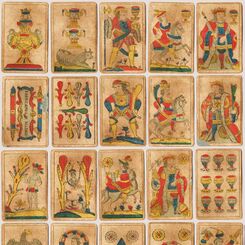
Archaic form of Aluette published by Pierre Roiné, Nantes, c.1785.
The ace of cups, which is a chalice, has the maker’s name, Pierre Roiné, who was active in Nantes c.1783-1806. His initials also appear on the four of cups. The ace of coins has a Spanish coat-of-arms and the legend “Hispania • Rex Caroui Dei • Gratia” beneath a royal crown. Instead of human figures appearing inside the suit symbols on some of the numeral cards (as in later Aluette cards), we have what resemble heraldic devices. The three of cups is a completely standard Spanish card, with no female figure or birds sitting in the cups. The court cards have a close resemblance to the archaic Franco-Spanish pattern. Also surprising are the four cavaliers, which are named as 'Dame' even though they have not yet been transformed from the Spanish male figures into females (as far as we can tell). The batons are adorned with fleurs-de-lys instead of arrows as in later versions. Various other archaic features can be observed, or the lack of features seen in more modern Aluette decks. The two of swords has a mis-spelt inscription ‘Fechas a Nantes’ (Made in Nantes) as was customary in archaic Spanish-suited cards.
Similar ‘heraldic devices’ can be seen inside the coins in a much older fragmentary sheet by J Deluy (Source gallica.bnf.fr / Bibliothèque nationale de France • Planches de cartes d'un jeu à enseignes latines, J. Deluy) It is noteworthy that in the Spanish-suited Deluy sheets the cavaliers have been replaced by queens, which may have a bearing on the cavaliers named as Dames in these Aluette cards, in terms of a common ancestry.
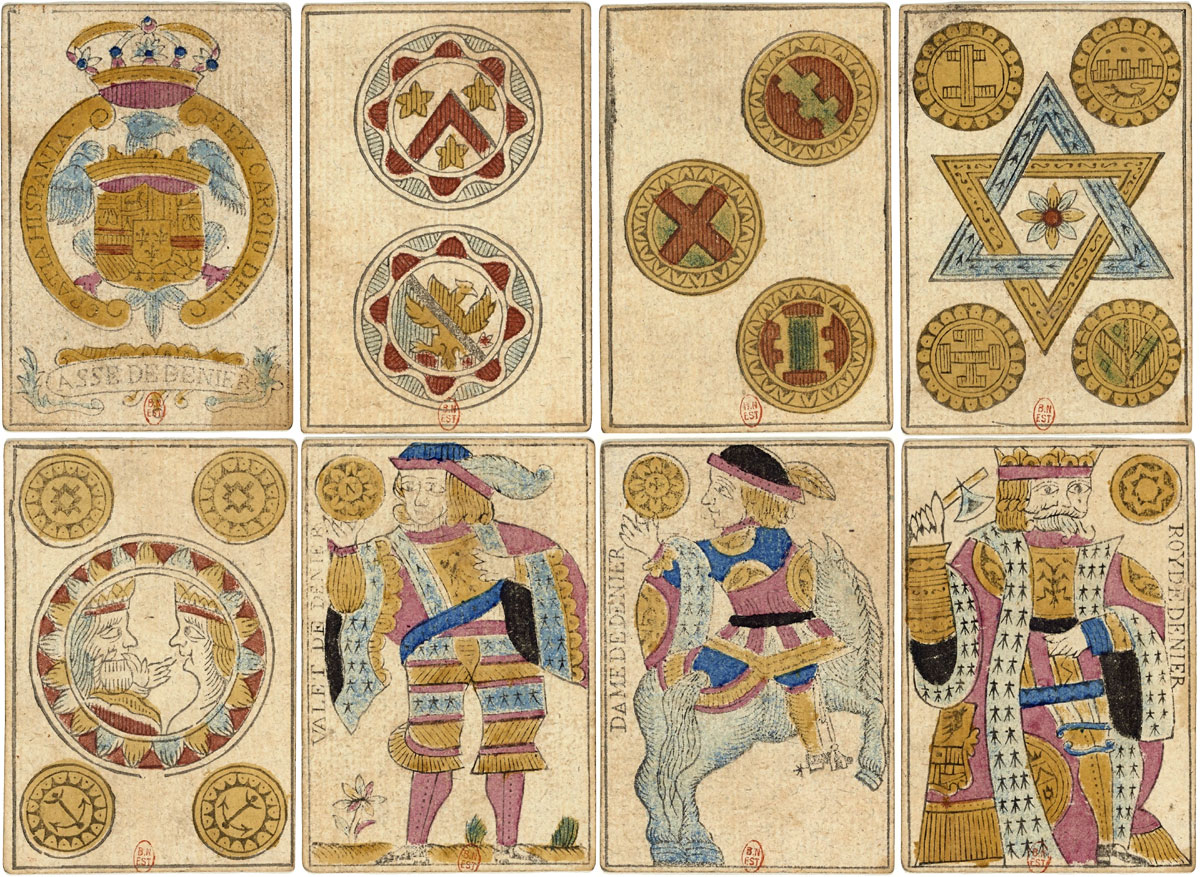
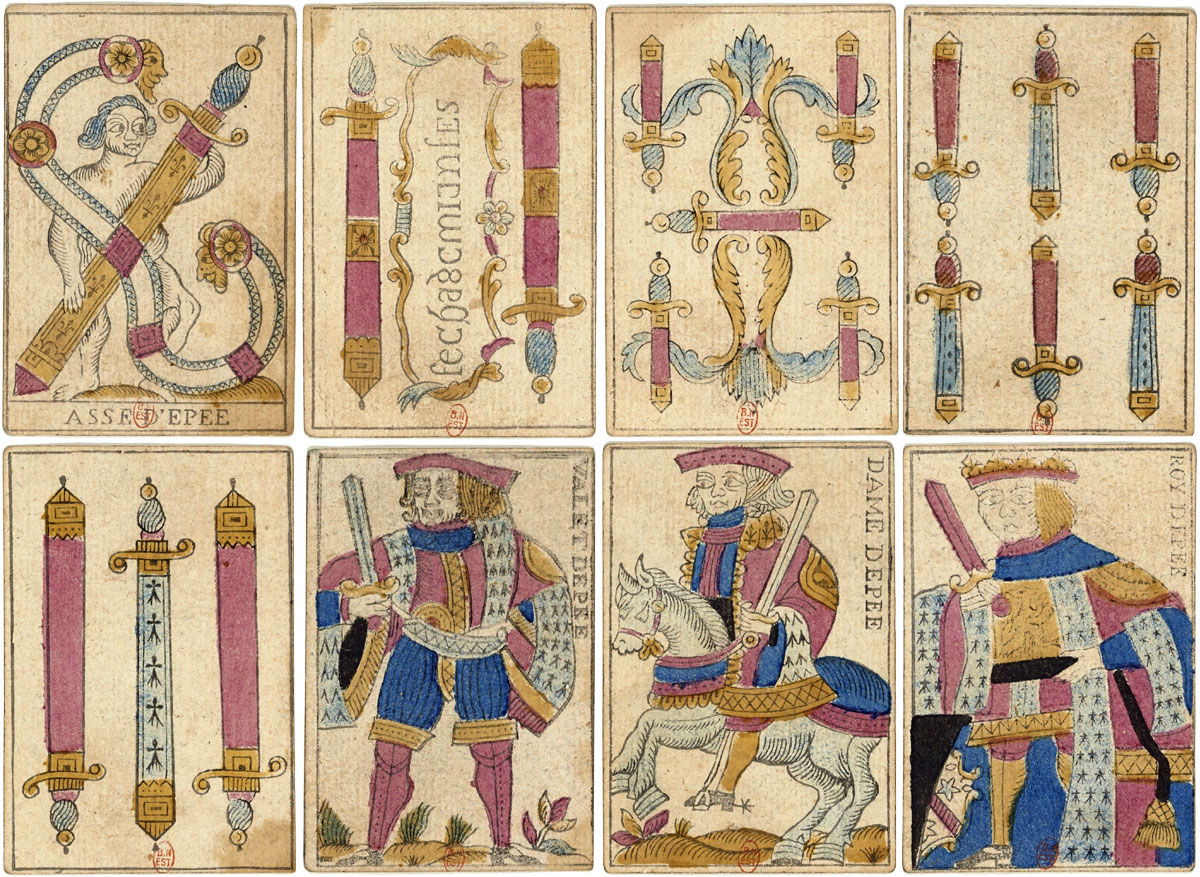
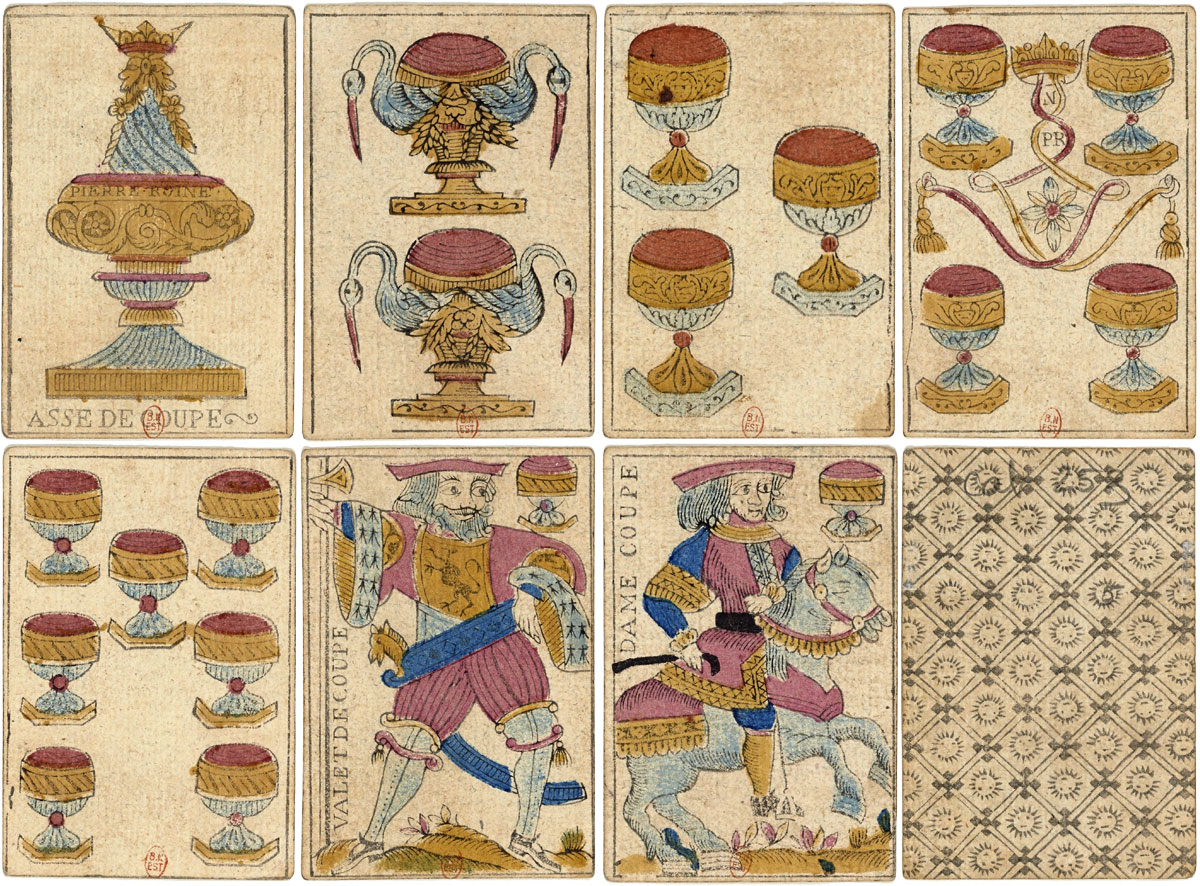
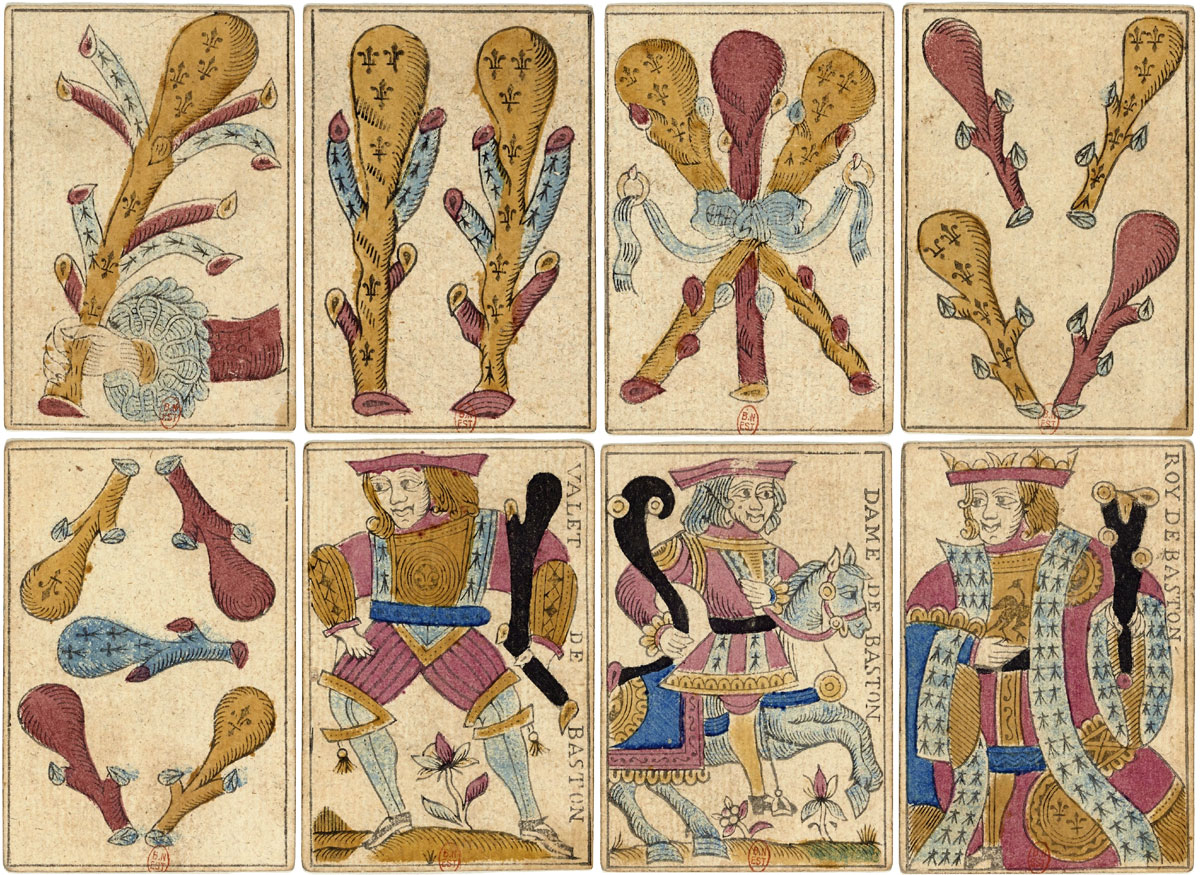
Above: Archaic form of Aluette published by Pierre Roiné, Nantes, c.1785. 48 cards, no index numbers or 'pintas', stencil-coloured woodblock. Source gallica.bnf.fr / Bibliothèque nationale de France • Jeu d'aluette, Pierre Roiné, Nantes►

By Simon Wintle
Spain • Member since February 01, 1996
I am the founder of The World of Playing Cards (est. 1996), a website dedicated to the history, artistry and cultural significance of playing cards and tarot. Over the years I have researched various areas of the subject, acquired and traded collections and contributed as a committee member of the IPCS and graphics editor of The Playing-Card journal. Having lived in Chile, England, Wales, and now Spain, these experiences have shaped my work and passion for playing cards. Amongst my achievements is producing a limited-edition replica of a 17th-century English pack using woodblocks and stencils—a labour of love. Today, the World of Playing Cards is a global collaborative project, with my son Adam serving as the technical driving force behind its development. His innovative efforts have helped shape the site into the thriving hub it is today. You are warmly invited to become a contributor and share your enthusiasm.

Activity for Pierre Roiné Aluette
Sign in to comment or save this article.

Related Articles
Les Chevaliers de la Toison d’Or
Medieval manuscript art at its finest.
French Revolutionary cards by Pinaut
Seven cards from a French Revolutionary pack by Pinaut featuring characters from classical antiquity...
The Parisian Tarot
The “Parisian Tarot”, early 1600s, with imagery and design synthesizing several influences.
Antoine de Logiriera
Archaic Spanish-suited playing cards published in Toulouse by Antoine de Logiriera (1495-1518).
A. Camoin & Cie
This deck was inherited from ancestors, it has has a family history surrounding it. Details of the l...
“Deck with French suits”
A facsimile of an early 19th century French-suited deck from the collection of F.X. Schmid.
Jeu Mythologique
“Jeu Mythologique” facsimile 18th century pack by J M Simon, 1983.
64: The descendants of the French regional patterns: 2
A continuation oF the development of the off-spring of the Paris patterns and a few examples of how ...
63: The descendants of the French regional patterns: 1
A great many regional patterns were exported from France and subsequently copied elsewhere. Some of ...
62: French regional patterns: the queens and jacks
Continuing our look at the figures from the regional patterns of France.
61: French regional patterns: the kings
On page 11 I illustrated several examples of the regional French patterns from Sylvia Mann's collect...
Pedro Varangot, 1786
Archaic Navarra pattern produced for the Pamplona General Hospital Monopoly by Pedro Varangot in 178...
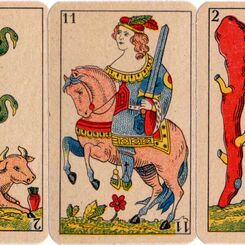
Jeu D’Aluettes - Boéchat Frères c.1950
Jeu D’Aluettes manufactured by Boéchat Frères, Bordeaux, c.1950 with archaic Spanish features mixed ...
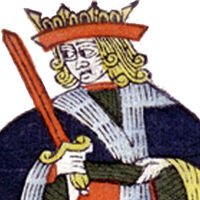
Benoist Laius
Spanish playing cards such as these were used in those parts of France where certain games were enjo...
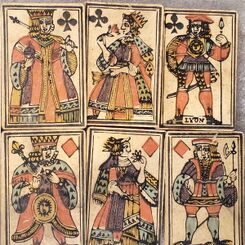
Lyon Pattern type iii
This pattern was used in various parts of eastern France but was ultimately replaced by the official...
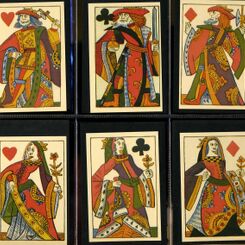
1: Playing Cards and their History: An Introduction and some links to other sites
What was considered the first mention of playing cards in England is in 1463 when Edward I banned th...
Lequart Aluette
Spanish-suited Aluette pack with 'FABRICANDO IN MADRID' printed on the Two of Swords and the legend ...
Paris Pattern
The Paris pattern was established as such around the middle of the seventeenth century (based, perha...
16th Century French Playing Cards based on Illustrations by Gurney Benham
This pack of cards by Rose & Pentagram is said to be based off Pierre Marechal, Rouen pack from the ...
The History of Playing Cards
Playing cards appear in European records in the late 14th century, but their earlier history lies fu...
Most Popular
Our top articles from the past 60 days


