


Trappola Pack by Johann Nejedly
An example of Viennese innovation in card production from the mid-19th century.
The use of Trappola cards is now a closed chapter of history. The origin of this special, reduced deck of 36 cards in Italian suits is documented in Venice around 1500, and the last industrially produced decks come from Prague, stamped in 1944. Throughout the 18th and especially the 19th century, playing with Trappola cards was widespread in Central Europe, and the cards were part of the standard offering. This sample from the workshop of Johann Nejedly in Vienna is one of many period designs.
The deck features a standard pattern registered by the IPCS as The 19th-century Empire Trappola, in a double-headed variant. The cards measure 59 x 127 mm; the reverse side features a typical pattern of overlapping red and black zigzag lines known as the older type of Viennese lightning. The Ace of Clubs bears the inscription “Johann Nejedly, inventor and patent holder”; the text on the Two of Swords can be translated as “Newly invented, imperial patent-protected, washable cards manufactured in Vienna.” The remnants of the tax stamp on the ten of coins can be identified as Austro-Hungarian, used between 1882 and 1899. Despite the relatively late dating indicated by the tax stamp, the cards appear to have been produced from woodcuts and coloured using stencils. One of the minor peculiarities of Trappola cards is the frequent writing of the Roman numeral IX in the form VIIII. On Nejedly’s cards, this anomaly is used only on the Nine of Cups.


Above: 36-card Trappola pack by Johann Nejedly, Vienna, 1882. 59 x 127 mm. The text on the Two of Swords can be translated as “Newly invented, imperial patent-protected, washable cards manufactured in Vienna”.
The information provided about the invention and the patent can be traced back to a record from the Austrian Patent Office. On January 10, 1859, Johann Nejedly was granted a two-year patent titled “Surface Treatment of Playing Cards.” In the surviving text, he discusses the treatment of the card surface to improve colour durability and the use of shellac to improve the cards’ glide and washability. In the patent application, Nejedly identifies himself as a chemist . The signature can also be interpreted as another indication (besides his name) of Joh. Nejedly’s Czech origins. He used a diaeresis (ý) above the “y”, which is commonly omitted in the German-speaking Viennese environment.
This deck of cards may also demonstrate the success of the technological process. Despite clear signs of significant wear, the face side exhibits smoothness and gloss, and the colours have lost none of their original richness. The back side lacks the glossy finish, yet the coloration remains uniform without any widespread defects. The playing card stock itself is very thick and gives the impression of small boards rather than paper. It is clear that Johann Nejedly’s aim was to create a product with a long lifespan and maximum user comfort. (An interesting minor detail regarding the deck’s durability is the secondary repair of the Ace of Cups - a local patch with paper tape and colour restoration using crayons.)
After Nejedly’s patent expired, the well-known Viennese card manufacturer Ferdinand Piatnik filed a significantly simpler patent on November 1, 1861, for “Lacquered playing cards,” valid for one year and subsequently extended to seven years.
At the World’s Fair in Vienna in 1873 (Wiener Weltausstellung 1873), Johann Nejedly received a Medal of Merit for his washable playing cards.
For the sake of completeness, it should be noted that on December 31, 1879, another patent by Johann Nejedly titled “Improvements to Playing Cards” was also registered; unfortunately, the text is not available. Here, Nejedly is already described as a Factory owner in Vienna. The patent can almost certainly be linked to his Tarock cards, though it is unclear what exactly the innovation entails. I am inclined to believe that it might involve the addition of indices in the right corner of the cards.
References
On the history of Trappola game: David Sidney Parlett - Oxford Guide to Card Games, 1990
Empire Trappola pattern by IPCS: pattern sheet 43
Manufacturer Johann Nejedly in the database of the Austrian company Talon (in German)
Patents related to playing cards in the 19th century from the archives of the Austrian Patent Office (database of the Austrian company Talon, in German)
By Marek Brejcha
Czech Republic • Member since June 13, 2024
My relationship with cards grew from playing to collecting and transformed into publishing as well. I am part of the team at Counter Clockwise, a small company that publishes traditional card games.

Activity for Trappola Pack by Johann Nejedly
Sign in to comment or save this article.

Related Articles
Wiener Pattern – Nuremberg Version
A classic deck in a new illustrative style, with notable variations in line work, detail, and colour...
76: Transitions: Hunt & Sons
Styles change and technology develops. This means that it's possible to see transition periods in th...
English Pattern by B.P. Grimaud
Standard English pattern published by B.P. Grimaud with engraving by F. Simon, c.1880.
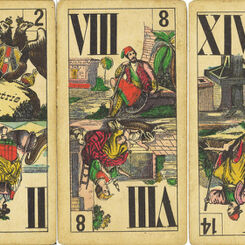
Johann Nejedly Tarok Cards
Johann Nejedly, a 19th-century Viennese card maker, produced Tarock cards featuring modern scenes th...
Managing cards without corner indices
For many hundreds of years cards had no corner indices, were square cut and mostly made from card wi...
Great inventions playing cards
Great inventions playing cards designed by Gary Wyatt, United Kingdom, 2011.
Foster’s Self-Playing Whist Cards
In 1890 R. F. Foster published the first edition of “Foster’s Whist Manual” which was to become the ...
Lecardo
‘Lecardo’ playing cards, dominos & word building game invented by Stanley Kermode, United Kingdom, c...
Il Quinto Seme
An Italian pack with a fifth suit of “amici” (“friends”).
Pentacards
A five-suited set of playing cards published by Fleet and Case Games Ltd., Rainham, Kent, UK, c.1980...
A. Dougherty’s Triplicate Recreation
A recreated of the original 1876, No. 18, Triplicate deck by A. Dougherty by Michael Scott in 2014. ...
Cartomancy, Oracle and Divination Cards
Playing cards are used for fortune-telling - turning another card illumines the moment and a new per...
Leather Card Case Patent Application
In 1932, a patent was granted to Colin Hart and George Franklin for a leather case in the form of a ...
Lincard
“Lincard” card game invented by John William Wolf and patented in 1937.
Triplicate No.18
Dougherty first secured a patent for “Triplicates” in 1876, a novel type of indices with a miniature...
Ivorette
Dougherty was at the forefront of innovation, adding Best Bowers and then Jokers, rounded corners an...
15: Perforated Cards, Metal finish and Other Oddities
There are some unusual designs in playing cards, even the shape of the card.
Pneumatic Playing Cards
The surface of the cards was slightly grooved by being rolled on prepared plates, so that there were...
De La Rue
De La Rue introduced letter-press printing into playing card production and his patent was granted i...
John Newman’s Colour Cards
John Newman’s Colour Cards
Most Popular
Our top articles from the past 60 days


