


Wiener Pattern – Nuremberg Version
A classic deck in a new illustrative style, with notable variations in line work, detail, and colour palette
This 24-card deck by Nürnberger Spielkarten Verlag (NSV) is identical or nearly identical to a version published by Berliner Spielkarten (BS) in 1998, which itself was a modernized reissue of BS’s Wiener Bild I from 1983. The striking similarity strongly suggests that NSV reused or reprinted the BS design after BS ceased operations in 2000. While the design remained the same, the card size differs: BS’s updated format measured 65 × 100 mm, whereas the NSV edition is slightly narrower.
The deck follows the Austrian large-crown Wiener pattern, beginning at the 9s. The Jack of Clubs in this edition includes NSV’s logo, full company name, and article number, clearly identifying it as an NSV production.
The election-themed packaging confirms a production date of 2014. By this time, NSV was already transitioning away from traditional playing card production in favor of modern tabletop game development, making such traditional issues increasingly rare and poorly documented.
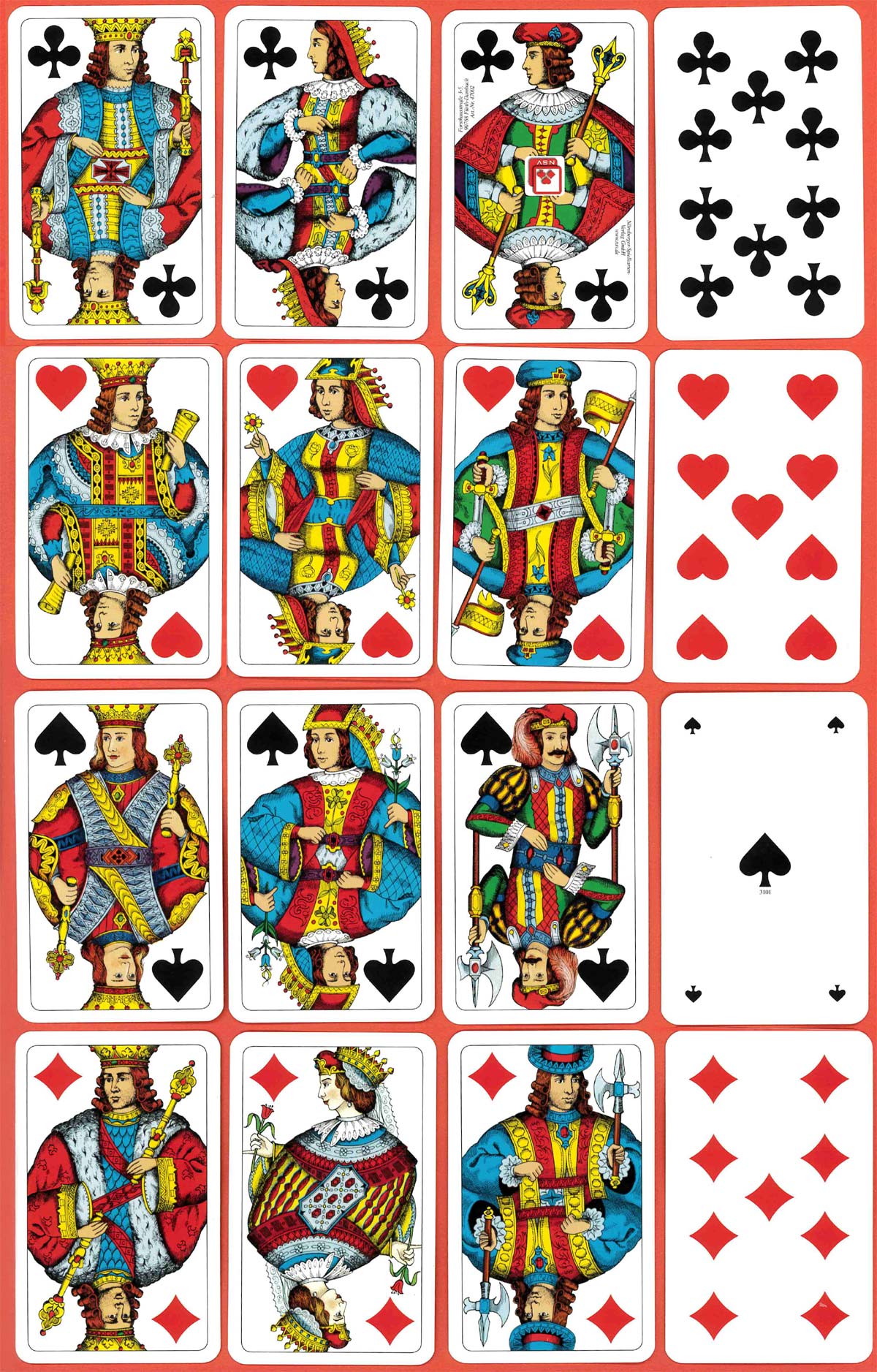
Above: Wiener Pattern manufactured by Nürnberger Spielkarten Verlag, 2014. 24 cards.
Note from Roddy Somerville
Berliner Spielkarten (BS) issued an almost identical pack in 1998 (only two years before they ceased production) which was an updated version of their Wiener Bild I dating from 1983.¹
To me the most striking differences between old and new are on the Jack of Spades (in the new version he sports a moustache) and on the Queen of Diamonds (whose garment has a completely new pattern). In fact, when one looks closely at the new BS version, only three of the cards have been 'modernised' or made to look more youthful: the King of Spades, the Jack of Spades and the Queen of Diamonds. The same is true of the NSV version.
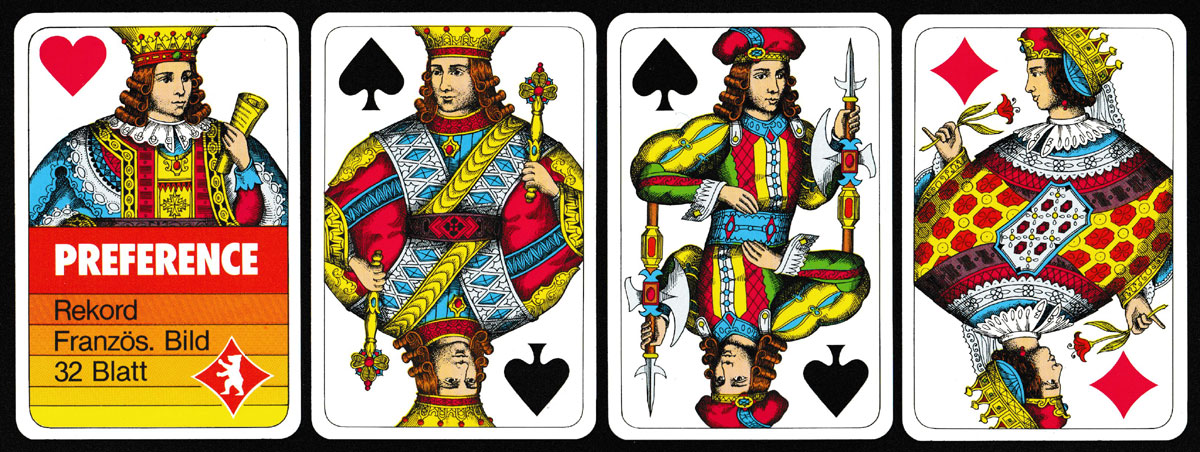
Above: Berliner Spielkarten Wiener Bild I dating from 1983.
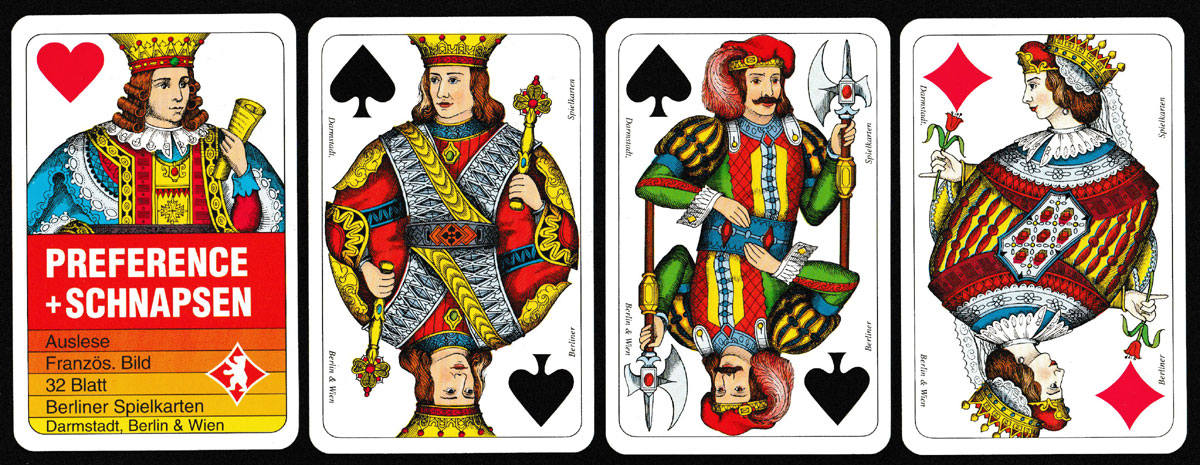
Above: Berliner Spielkarten Wiener new version dating from 1998.
From the look of the NSV version, the cards are narrower than the BS ones which measure 65 x 98 mm (old) or 65 x 100 mm (new).
Did NSV adopt the BS designs when Berliner ceased production or were they simply copying each other? Without knowing the exact date of the Nuremberg version, it is difficult to say whether the BS or the NSV version came first.
References
1. Petri, Dr. Thomas. Braun Band 13: Die Berliner Spielkarten GmbH; 2002. pp48-49, BS 1983/4.

By Konrad Hämmerle
Austria • Member since December 04, 2024
Konrad Hämmerle is a student and card artist from Vorarlberg, the westernmost region of Austria. He founded his own company with his deck Vorarlberger Büschel: a unique reinterpretation of traditional Jass cards. His deck showcases Vorarlberg’s rich cultural heritage, featuring detailed illustrations of traditional clothing, mythical creatures, and real historical figures from the region. Through this project, Konrad has become a true card enthusiast, particularly fascinated by playing cards that represent countries, regions, or historical themes. His passion lies in blending storytelling with design to keep cultural heritage and identity alive in the world of playing cards.

Activity for Wiener Pattern – Nuremberg Version
Sign in to comment or save this article.

Related Articles
Trappola Pack by Johann Nejedly
An example of Viennese innovation in card production from the mid-19th century.
The New Deal Playing Card Company
Publishers of a range of ergocards intended to be easy to hold and easy to shuffle.
Burghausen
Historical figures and buildings to promote the town of Burghausen, with designs by Jonny Petri.
76: Transitions: Hunt & Sons
Styles change and technology develops. This means that it's possible to see transition periods in th...
English Pattern by B.P. Grimaud
Standard English pattern published by B.P. Grimaud with engraving by F. Simon, c.1880.
Printing Presses
Antique printing presses from the Turnhout Playing Card Museum collection.
Classification of Numeral Card Designs in French-suited packs
The classification of numeral cards in French-suited packs, covering various pip designs in over 400...
Managing cards without corner indices
For many hundreds of years cards had no corner indices, were square cut and mostly made from card wi...
Cartes à Jouer Fluorescentes
Standard French cards but printed with fluorescent inks on a black background.
Great inventions playing cards
Great inventions playing cards designed by Gary Wyatt, United Kingdom, 2011.
Foster’s Self-Playing Whist Cards
In 1890 R. F. Foster published the first edition of “Foster’s Whist Manual” which was to become the ...
Skyline cards: London edition
Skyline cards: London edition, featuring iconic architecture, United Kingdom, c. 2018.
Il Quinto Seme
An Italian pack with a fifth suit of “amici” (“friends”).
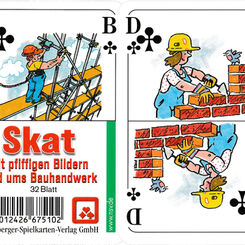
Bau-Skat playing cards
Comic illustrations of people working in the building trade.
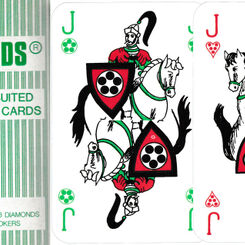
Pentacards
A five-suited set of playing cards published by Fleet and Case Games Ltd., Rainham, Kent, UK, c.1980...
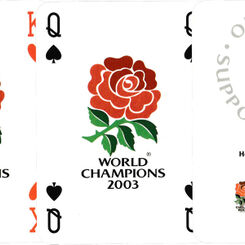
Official England Rugby Playing Cards
Pack celebrating the rugby world champions of 2003. Produced by MMcardz.
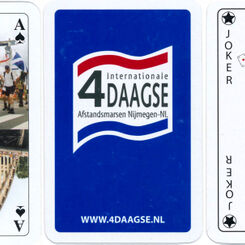
Four Days of Walking Event
Dutch playing cards promoting the annual International Four Days of Walking Event held in Holland, 2...
Secondary Uses of Playing Cards
The unprinted backs of playing cards have led people to use them for secondary purposes such as memo...
Lewis I. Cohen
Lewis I. Cohen made his first deck of cards in 1832. In 1835 Mr Cohen invented a new machine to prin...

De La Rue
De La Rue introduced letter-press printing into playing card production and his patent was granted i...
Most Popular
Our top articles from the past 60 days


