Carta Mundi
Carta Mundi was founded in Turnhout on 27 June 1970 by pooling the production and sales facilities of the three surviving companies: Brepols, Van Genechten and Leonard Biermans.
Carta Mundi - dating early packs

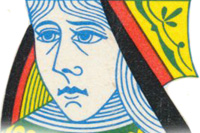
Carta Mundi was founded in Turnhout on 27 June 1970 by pooling the production and sales facilities of the three surviving companies: Fabrique Brepols, Van Genechten and Léonard Biermans. It printed its first playing cards on August 2nd 1971. Thus early Carta Mundi packs have features inherited from each of the earlier companies, such as the Mesmaekers Joker and court cards, indices, etc. Early examples of the standard English pattern Queen of Hearts use a colour scheme of red, black, blue, yellow and green. In many cases the green is replaced by the blue used elsewhere in the cards and at the same time the index font becomes bolder and the suit indicator becomes less curvaceous. The main picture, however, remains constant.
Earlier legacy designs
Mesmaekers was taken over by Van Genechten in 1968. The “Little Joker” was subsequently adopted by Carta Mundi as their standard joker when Van Genechten, Brepols and Léonard Biermans were in turn merged to become Carta Mundi in 1970.
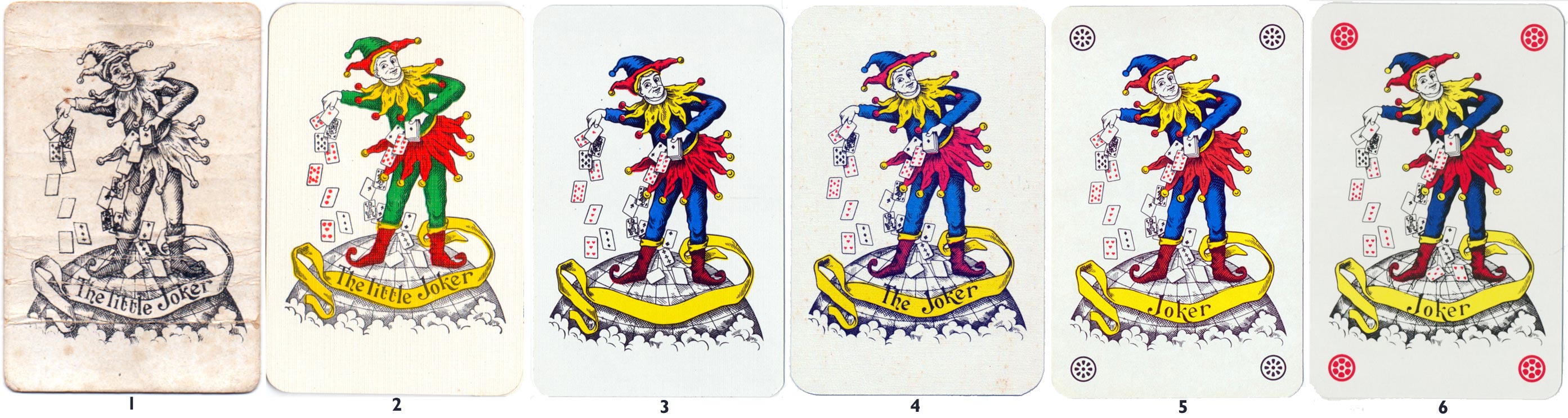
Above: 1. Mesmaekers b/w “The Little Joker” 1920s. 2. Mesmaekers coloured “The Little Joker” c.1960. 3. Van Genechten no legend in banderole c.1969. 4. Carta Mundi “The Joker” c.1971-74. 5. Carta Mundi “Joker” 1975-77. 6. Carta Mundi 1980s.
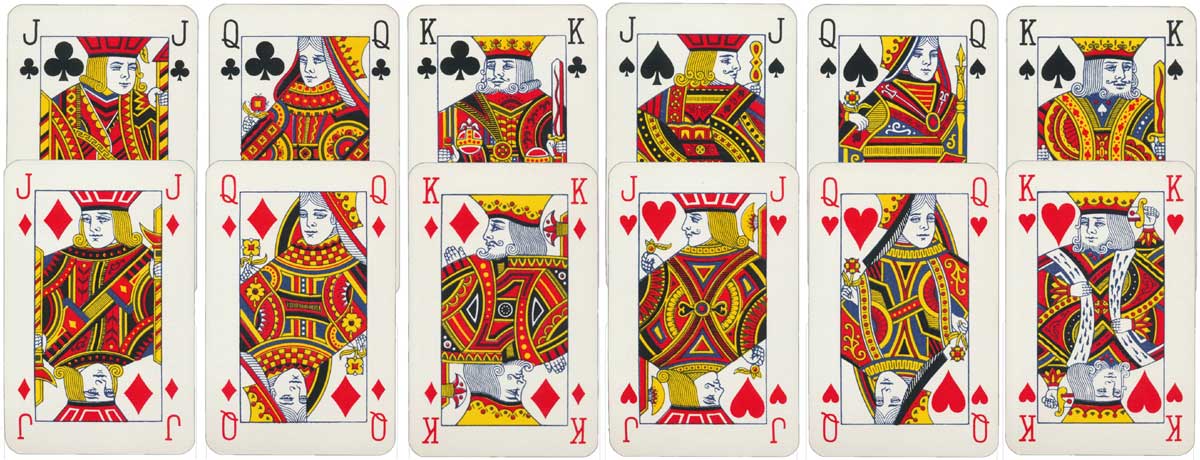
Above: Van Genechten’s standard English style courts, 1960s.
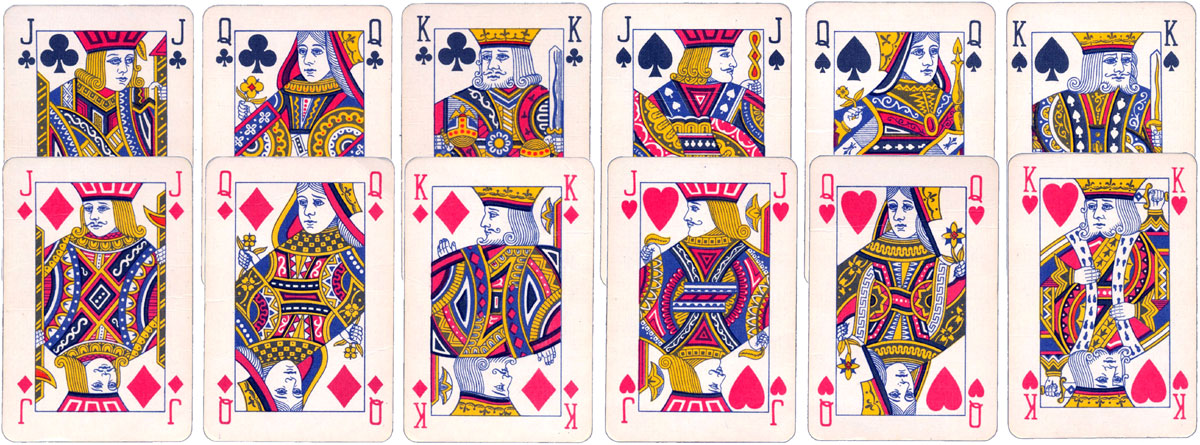
Above: standard English pattern manufactured by Biermans, 1960s, clearly a forerunner of Carta Mundi’s designs.
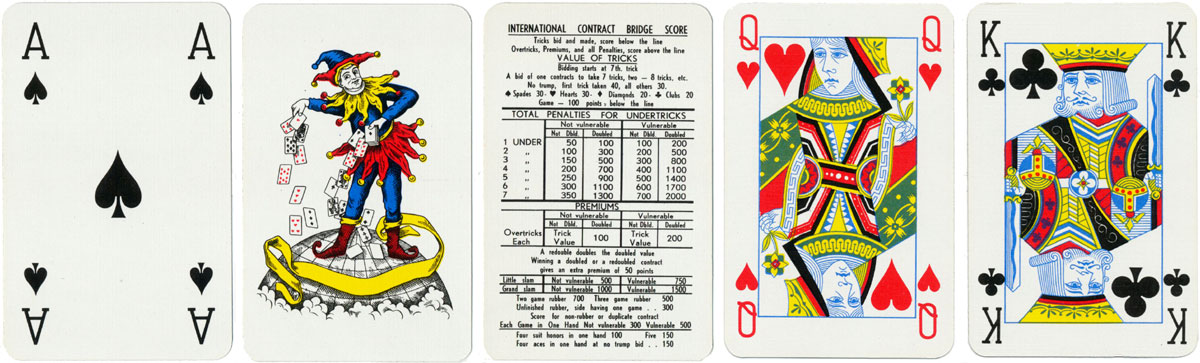
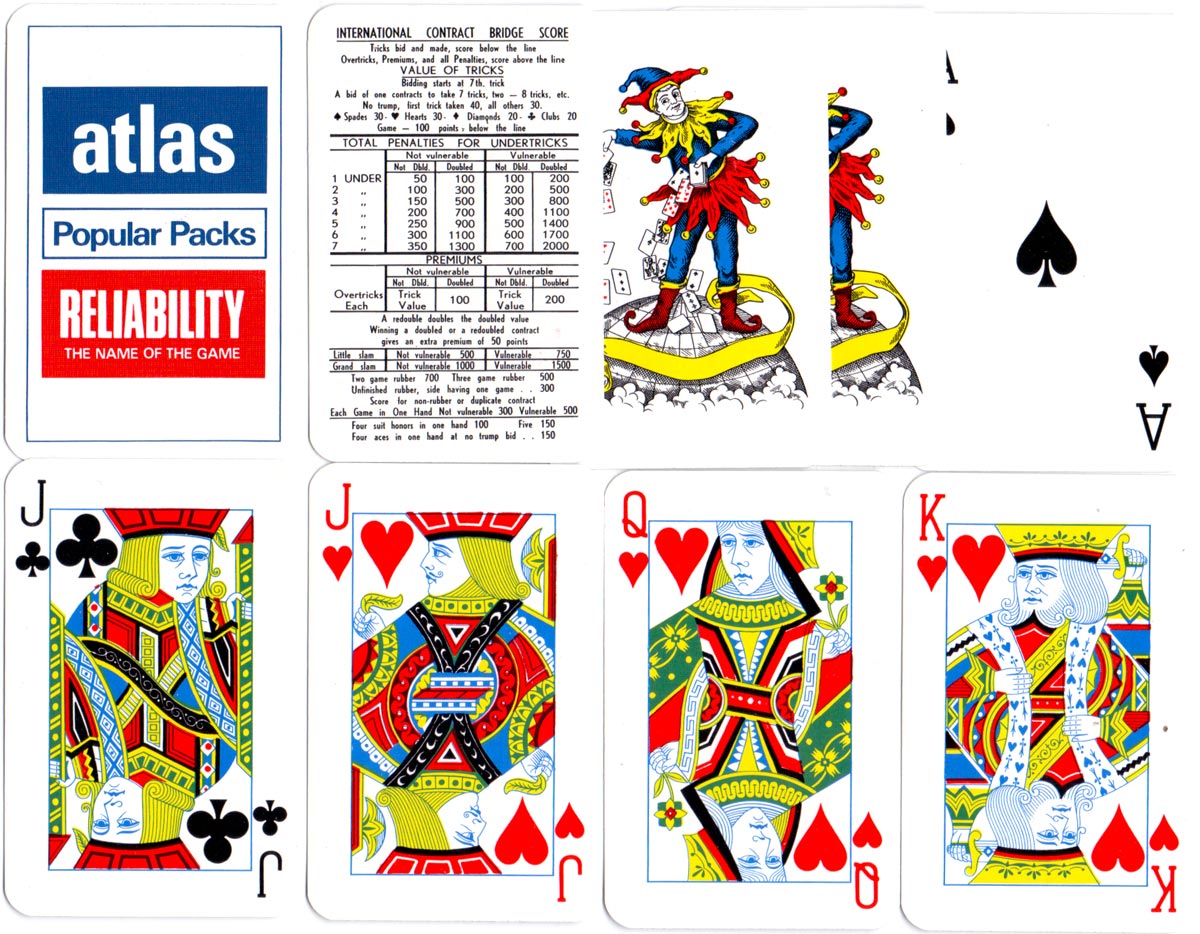
Above: the joker is unnamed and without corner pips, an early Carta Mundi deck c.1971. See also: Atlas Lighting►
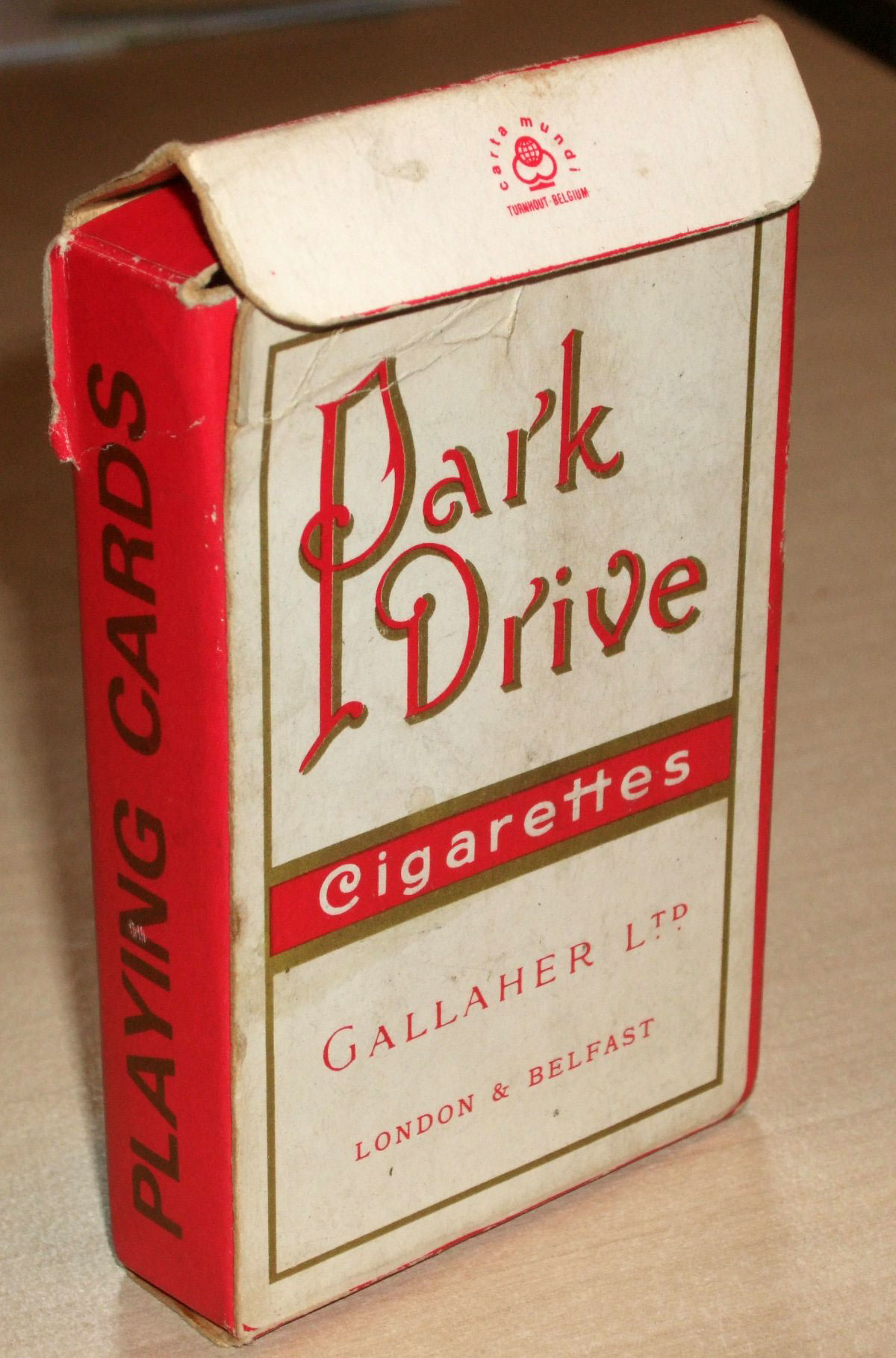
Above: early Carta Mundi pack, virtually identical to above example, with Carta Mundi logo and company name on the box flap (click image to zoom). The two identical jokers have no legends on the banderole and no corner pips, c.1971-2.
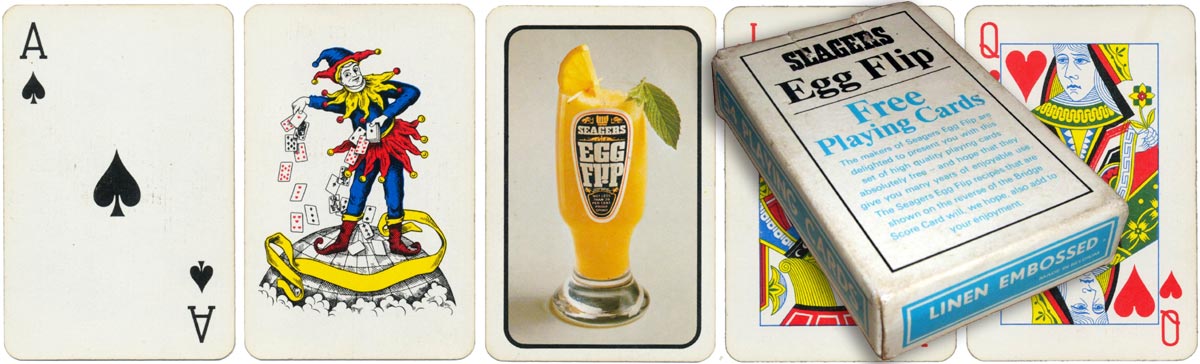
Above: early Carta Mundi pack, with Carta Mundi company name on the box flap, early 1970s.
Other early examples
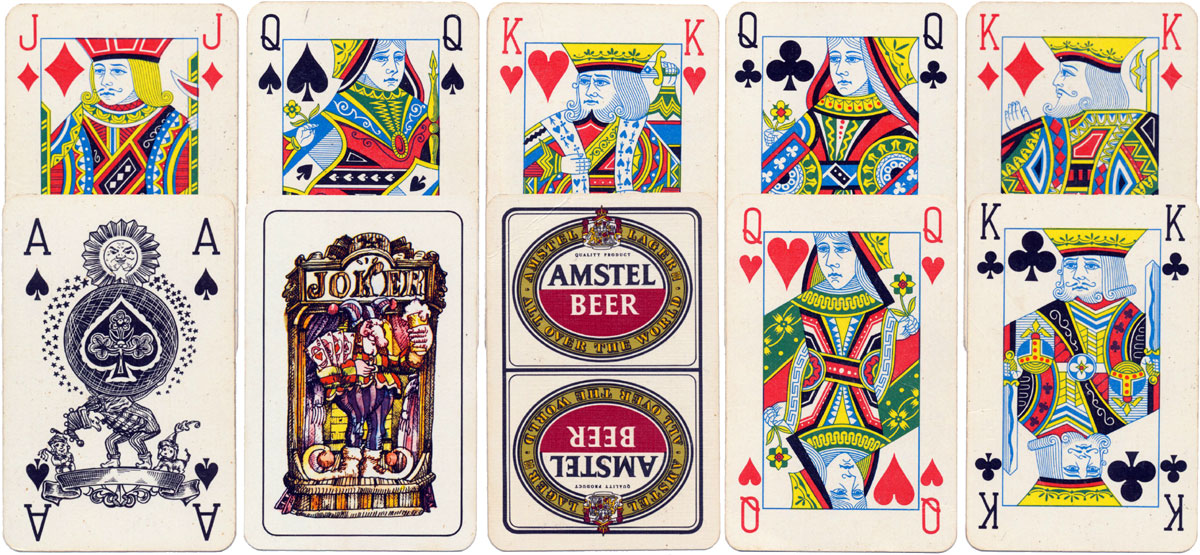
Above: probably a very early Carta Mundi deck, as it includes characteristics of Carta Mundi, Biermans and Van Genechten - the jokers are custom, the ace of spades is a redrawing of Biermans ‘Punch & World’ design with Van Genechten indices; the court cards are of the same design found in early Carta Mundi decks, that is pre-1975.
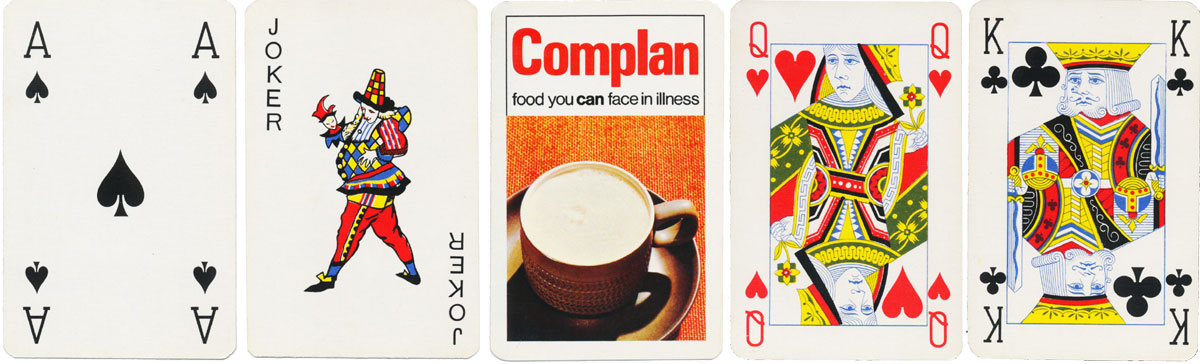
Above: a rather unusual early Carta Mundi deck produced to advertise ‘Complan’. The ace of spades and courts are the curvaceous style used by Van Genechten and adopted by Carta Mundi in the early days of its formation, but less commonly this deck includes a different Van Genechten joker. It is estimated that this deck originates from about 1970-1974.
Carta Mundi have such consistent print runs that no variations can be detected. However, the following observations may help to assign approximate dates to some earlier decks.
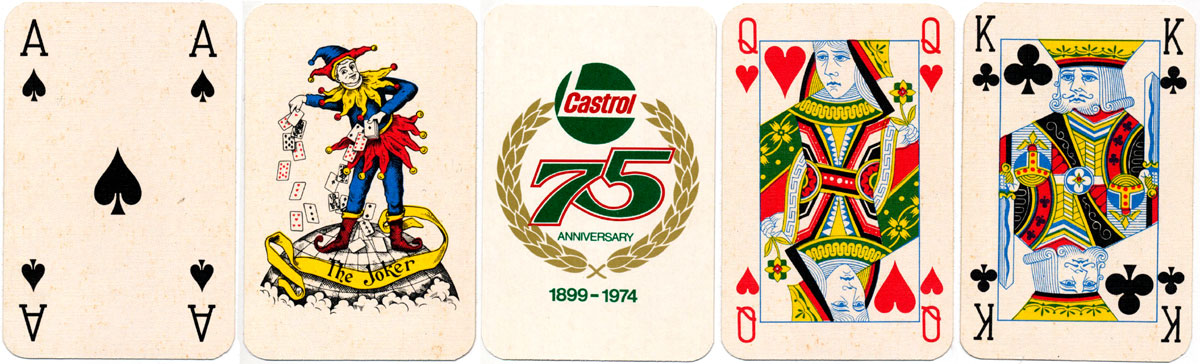
Above: Castrol 75th Anniversary advertising deck from 1974. The Joker is named with the legend 'The Joker’ but has no corner pips.
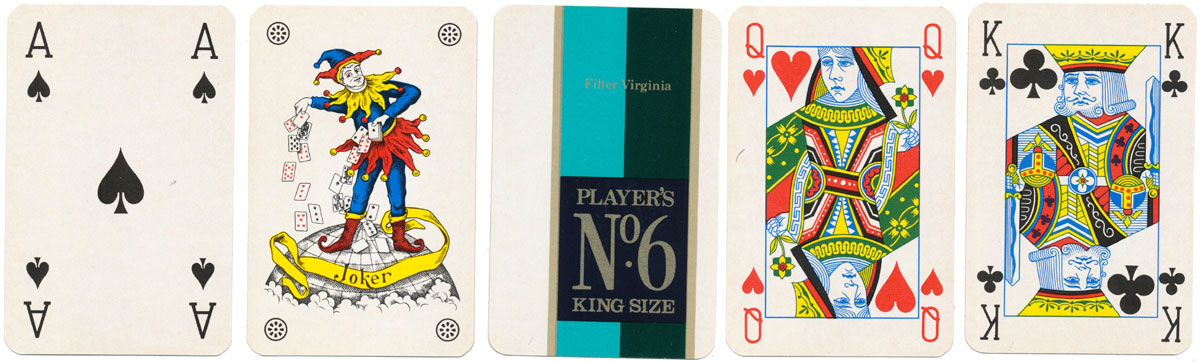
Above: Players No 6 advertising deck from the mid-1970s. The Joker is now named with the legend 'Joker’ and has four corner pips.
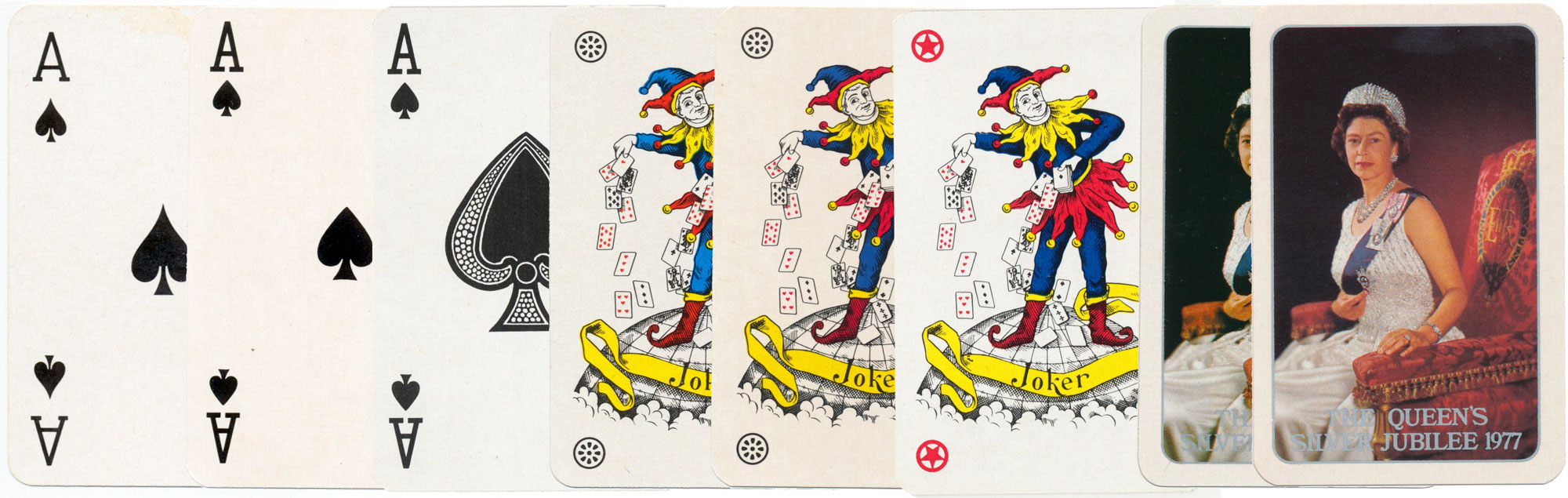
Above: Queen's Silver Jubilee 1977. Three almost identical packs from around the same date, in separate boxes, but with three styles of Ace of Spades and also two styles of joker indices and queen of hearts (click image to zoom).
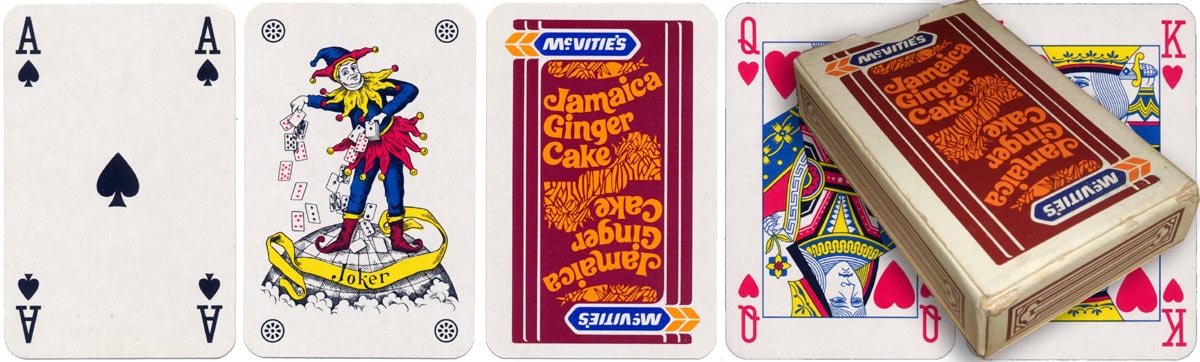
Above: advertising pack for McVitie's Jamaica Ginger Cake, anonymous except for 'Playing Card Publicity Co' printed on the inside of the top flap of the box. The bridge score card enclosed in the pack is quite anonymous, but of an early Carta Mundi style.
In around 1977 the the index font becomes bolder and the hearts & spades suit symbols become less curvaceous. Around this time packs were produced with three jokers, the third one showing a jester standing on top of the world, holding a king of hearts. Also, there appears to be a small change in some of the pip colours of the tiny cards falling from the joker's hand.
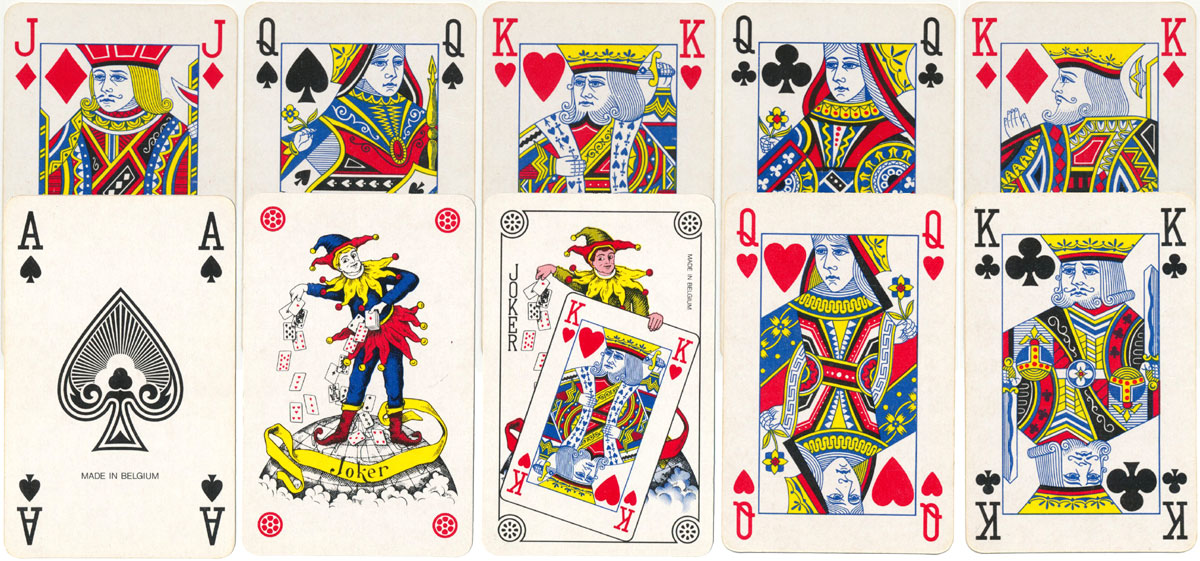
Above: this style of ace of spades, index typeface and extra third joker were in use from c.1980. The legends ‘Made in Belgium’ and ‘Carta Mundi’ on the ace and third joker vary in different examples, and in some cases are omitted altogether.
More...
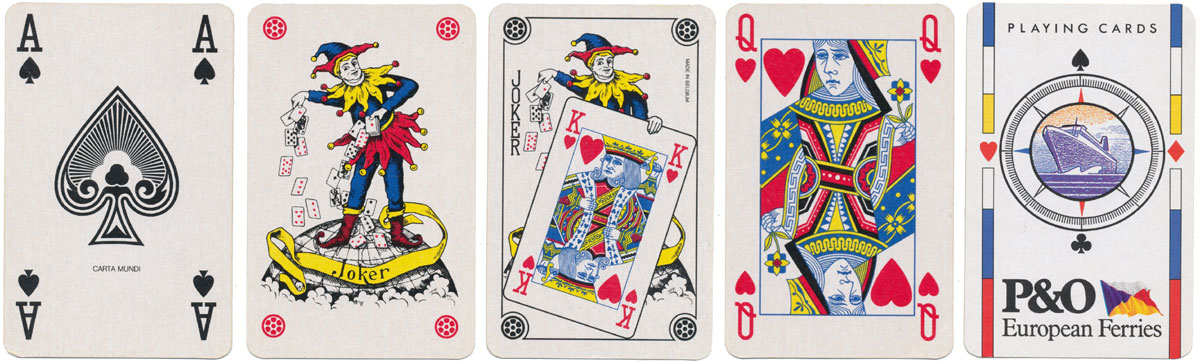
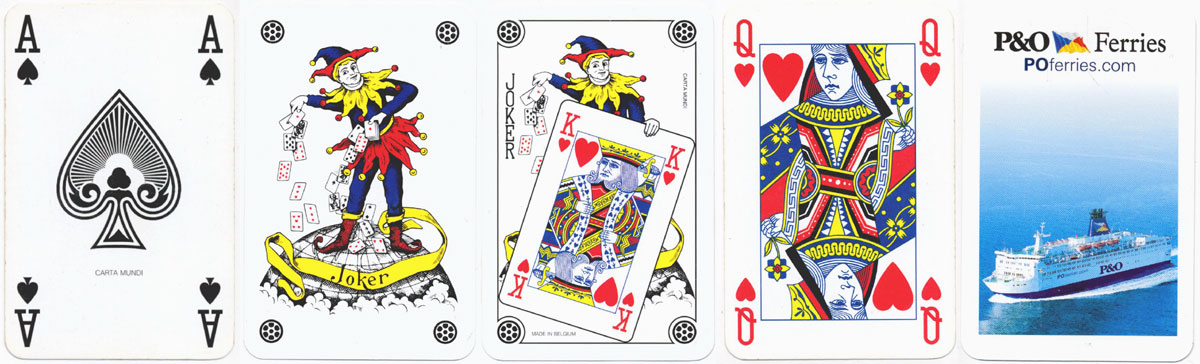
Above: packs made for P&O Ferries, c.1995 - 2000. The legend ‘Made in Belgium’ on the ace and third joker changes to ‘Carta Mundi’ and the extra joker's shirt has changed to blue.
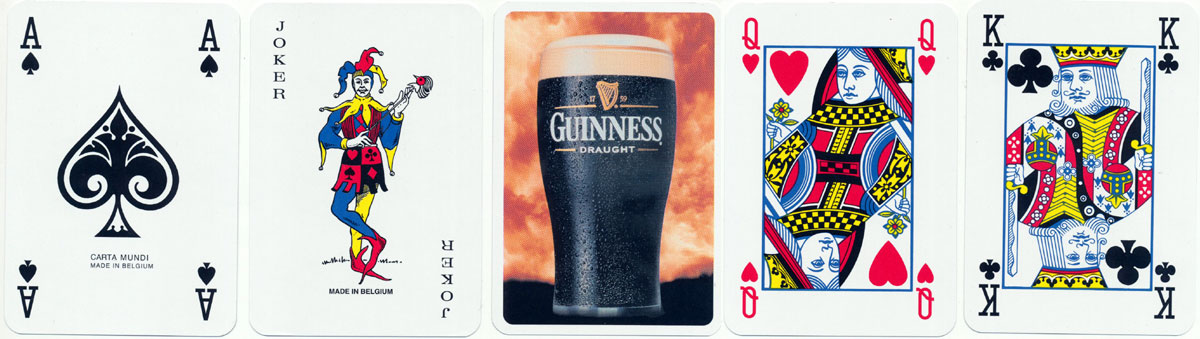
Above: pack made by Carta Mundi for Guinness using the former Biermans joker and different courts, c.2002.
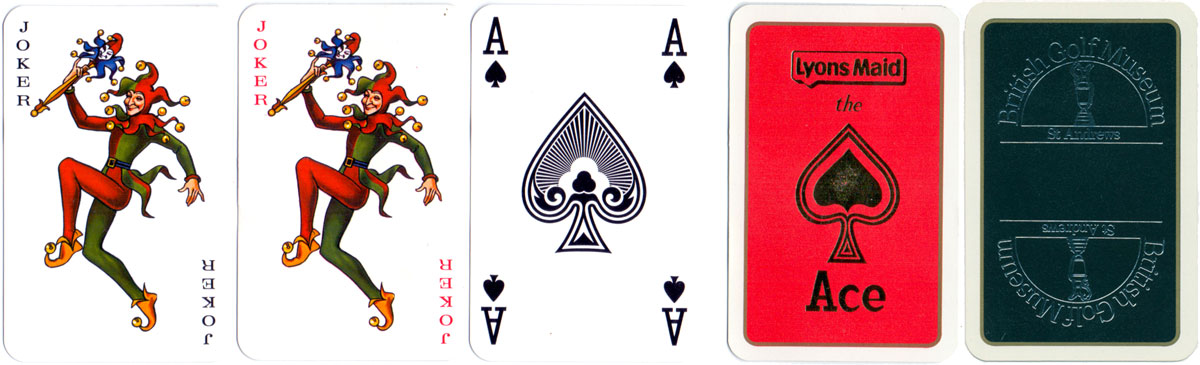
Above: packs made by Carta Mundi using a former Brepols joker.
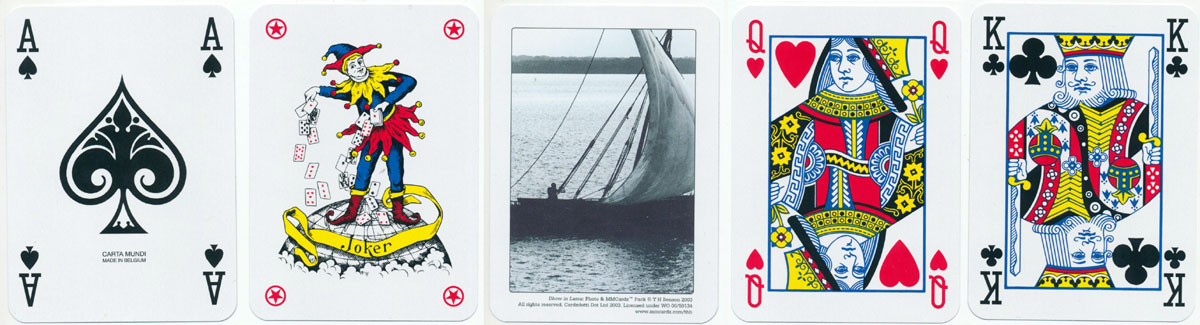
Above: pack made by Carta Mundi for MMCardz™ with a different image on the back of each card, c.2003. The joker has stars in the corners.
Large index cards are also found with two indices and flesh coloured faces (as distinct to the white of other designs), but otherwise using the same picture as the standard bridge-size cards. Carta Mundi produce their 'casino' style in two widths, bridge and poker.
REFERENCES & CREDITS
Van Autenboer, Dr Eugeen: The Turnhout Playing Card Industry 1826-1976, Aurelia Books, Brussels 1976
Lodge, Ken: The Standard English Pattern (second revised and enlarged edition), Bungay, Suffolk, 2010
Tilman, E and Van Autenboer, E.: Trade Marks, Industrial Designs and Models (of Belgian card manufacturers), Nationaal Museum van de Speelkaart, Drukkerij Matthys-Beccu p.v.b.a., Turnhout, 1983
Thanks to Matt Probert for assiduous research and all the images shown on the page.

By Simon Wintle
Spain • Member since February 01, 1996 • Contact
I am the founder of The World of Playing Cards (est. 1996), a website dedicated to the history, artistry and cultural significance of playing cards and tarot. Over the years I have researched various areas of the subject, acquired and traded collections and contributed as a committee member of the IPCS and graphics editor of The Playing-Card journal. Having lived in Chile, England, Wales, and now Spain, these experiences have shaped my work and passion for playing cards. Amongst my achievements is producing a limited-edition replica of a 17th-century English pack using woodblocks and stencils—a labour of love. Today, the World of Playing Cards is a global collaborative project, with my son Adam serving as the technical driving force behind its development. His innovative efforts have helped shape the site into the thriving hub it is today. You are warmly invited to become a contributor and share your enthusiasm.

Leave a Reply

Your Name
Just now Your comment here. Your comment here. Your comment here. Your comment here. Your comment here. Your comment here. Your comment here. Your comment here. Your comment here. Your comment here. Your comment here. Your comment here. Your comment here. Your comment here. Your comment here. Your comment here. Your comment here. Your comment here. Your comment here. Your comment here. Your comment here. Your comment here. Your comment here. Your comment here. Your comment here. Your comment here. Your comment here. Your comment here. Your comment here. Your comment here. Your comment here. Your comment here.
Related Articles

Het Nest Brouwerij
Het Nest Brouwerij playing cards from Turnhout, Belgium.
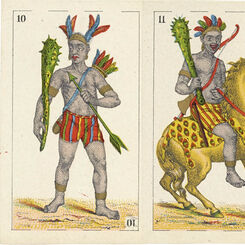
Cartes Universelles
Four Continents fantasy playing cards by Daveluy, Bruges, Belgium, 1860-1885.
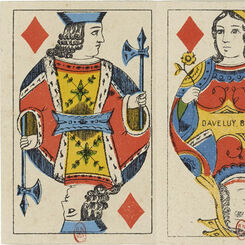
Cartes Marbrées
A provincial variant of the French ‘Paris’ pattern produced by Daveluy c.1850-1895.
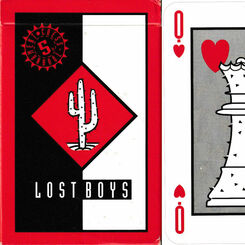
Lost Boys
Designs created on the occasion of a chess tournament in Antwerp, 1997.
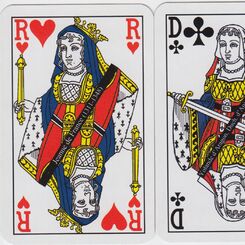
Les Cartes pour l'Égalité
Playing cards for gender equality, created on the 500th anniversary of classic French cards
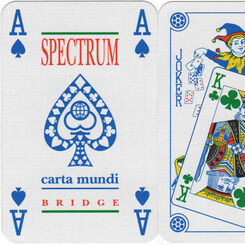
Spectrum Bridge by Cartamundi
Spectrum Bridge by Cartamundi
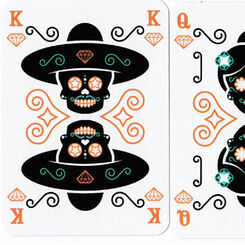
Calavera Playing Cards
Calavera playing cards designed by Jirs Huygen for Cartamundi, 2015
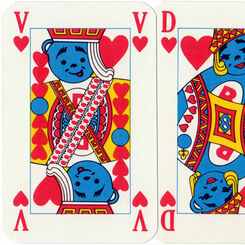
Butagaz
“Butagaz” playing cards for the French gas company, c.1976
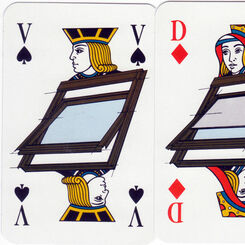
Velux
Velux - la fenêtre de toit de qualité, c.1990.
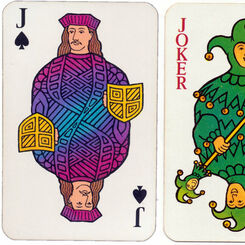
British Airways Concorde
British Airways Concorde playing cards made in Belgium by Carta Mundi, before 2003.
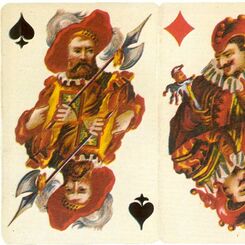
Cartes de Luxe (1877) facsimile
‘Cartes de Luxe’ first published by Biermans in 1877 was reproduced in facsimile by Amstel Beer in c...
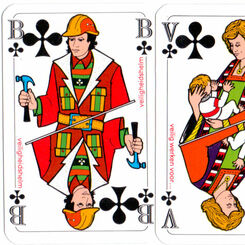
BG Bouw Building Company
BG Bouw Dutch Building Company publicity deck manufactured by Carta Mundi, c.1980.
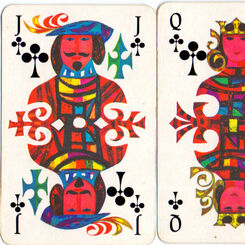
Max Velthuijs for KLM
Playing cards designed by Max Velthuijs for KLM airlines first published c.1964
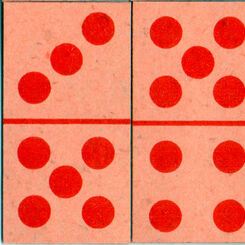
Domino Cards, c.1890
Domino Cards by Mesmaekers Frères, c.1890
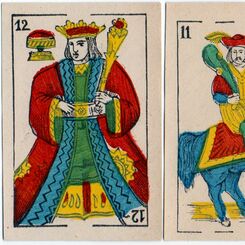
Anon Spanish Cards c.1875
Spanish-suited playing cards made in Belgium by Mesmaekers Frères, c.1875.

Manuf’d for L.N. Mann
Standard English pattern manuf’d for L.N. Mann by Van Genechten, c.1890.
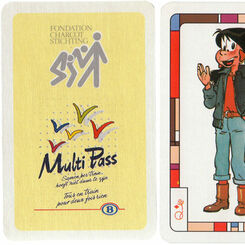
Fondation Charcot Stichting
Multi-artist promotion deck for Le Fondation Charcot, a Multiple Sclerosis charity in Belgium, c.199...
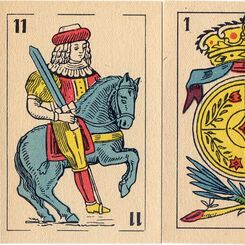
Spanish Cards c.1920
Spanish-suited Playing Cards manufactured by Van Genechten, c.1920.
Advertising deck for Carta Mundi
Advertising deck for Carta Mundi produced by Carta Mundi, 2001
Belgian Playing Cards
Belgian cardmakers have been actively designing and exporting playing cards since the 14th century. ...
Most Popular
Our top articles from the past 60 days