


Cartes Marbrées
A provincial variant of the French ‘Paris’ pattern produced by Daveluy c.1850-1895.
This early deck by Daveluy, of homely design, is a local variant of the French ‘Paris’ pattern, produced in Bruges, c.1850-1895. The queen of diamonds has the maker’s name. The court cards aren’t named after historical personalities. All the jacks hold axes in the left hand; the queens wear crowns and hold flowers. The king of hearts holds an orb and a sword; the other kings just hold ceremonial sceptres. The king of spades’ hands emerge at an unusual angle from his cloak.
Some versions have coloured faces. It was known as “Cartes Marbrées” because of a marble-like back pattern sometimes found, although this example has dots.
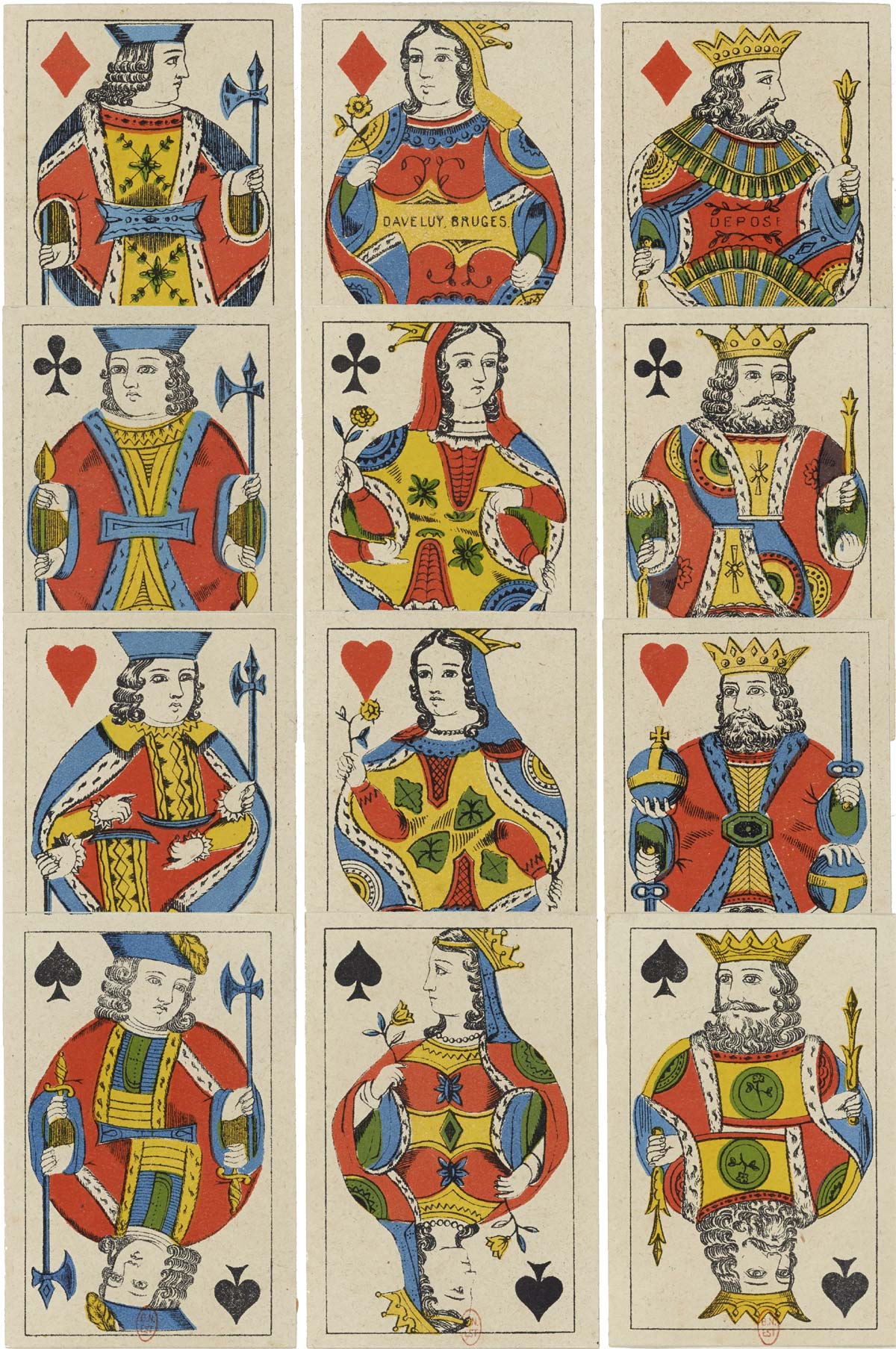
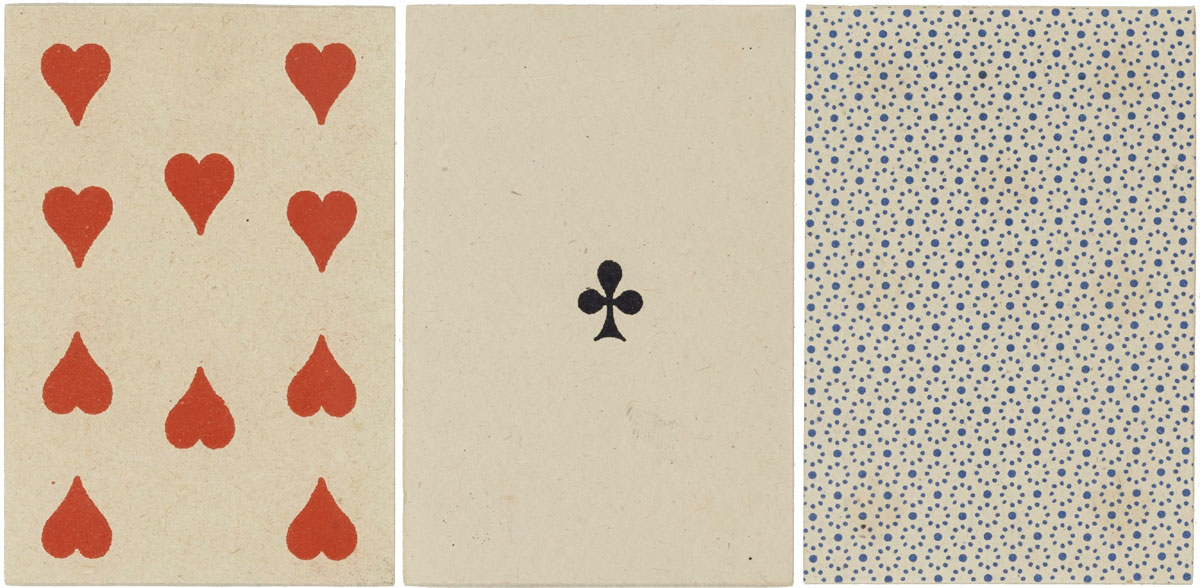
Above: a provincial variant of the French ‘Paris’ pattern produced by Daveluy c.1850-1895. 36 or 52 cards, chromolithography in golden yellow, blue, terracotta and green, square corners, 8,8 x 6 cm. Source Bibliothèque nationale de France
FURTHER REFERENCES
Bibliothèque nationale de France: Jeu de cartes belge au portrait à deux têtes►
Biebouw, Luc; Clays, Alex; Cremers, Filip; D'Hondt, Jan & Smet, Yvette: Daveluy, Brugge's Trots en Koninklijke Troef, Brussels Euro Joker Club, 2004.

By Simon Wintle
Spain • Member since February 01, 1996
I am the founder of The World of Playing Cards (est. 1996), a website dedicated to the history, artistry and cultural significance of playing cards and tarot. Over the years I have researched various areas of the subject, acquired and traded collections and contributed as a committee member of the IPCS and graphics editor of The Playing-Card journal. Having lived in Chile, England, Wales, and now Spain, these experiences have shaped my work and passion for playing cards. Amongst my achievements is producing a limited-edition replica of a 17th-century English pack using woodblocks and stencils—a labour of love. Today, the World of Playing Cards is a global collaborative project, with my son Adam serving as the technical driving force behind its development. His innovative efforts have helped shape the site into the thriving hub it is today. You are warmly invited to become a contributor and share your enthusiasm.

Activity for Cartes Marbrées
Sign in to comment or save this article.

Related Articles
An Anonymous Belgian Transformation Pack
Anonymous Belgian transformation pack borrowing many images from earlier designs by Braun & Schneide...
Historical Characters
Double-ended deck with historical characters and jacks as jesters by Daveluy, c.1850.
Mademoiselle Lenormand
XIX century ‘Mlle Lenormand’ cartomancy deck by Daveluy, Bruges.
Questions et réponses
Questions and answers card game by Devaluy, Bruges, c.1880.
Historical Patience
Patience game with fantasy historical figures by Daveluy, Bruges, c.1875.
Cartes de Conversation
Question and answer game printed by Daveluy, Bruges. Each card contains a question (Q.) and an answe...
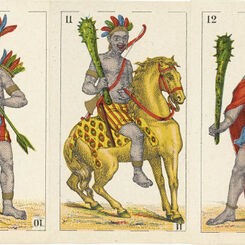
Cartes Universelles
Four Continents fantasy playing cards by Daveluy, Bruges, Belgium, 1860-1885.
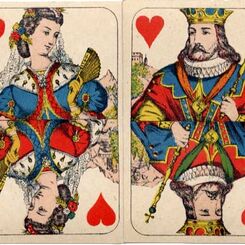
Daveluy
Daveluy produced card games between c.1840 and 1890. Many of his playing cards are in neo-medieval s...
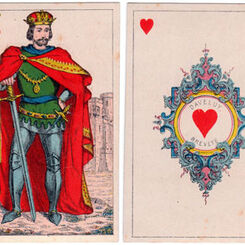
Première Croisade
Deck evoking the ‘Première Croisade’ with single-ended courts by Daveluy, Bruges, c.1850.
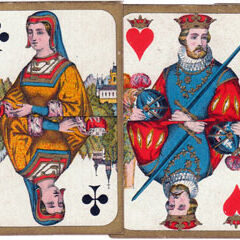
Moyen-Age by Daveluy
Cartes Moyen-Age by Daveluy, Bruges, c.1875.
Most Popular
Our top articles from the past 60 days


