


Moguls, Highlanders and Merry Andrews
Discover the historic origins and evolution of card naming and quality designations like ‘Moguls’ and ‘Highlanders’ in playing cards.
If you have seen a few older sets of playing cards, you may well have come across some odd names that are used on the wrappers and boxes: ‘Moguls’, ‘Harrys’, ‘Highlanders’ and ‘Merry Andrews’ were names used in England from the 1700s (and possibly earlier) until the early 1900s. In the USA these were adopted by the early makers, who also added their own American descriptions: ‘Eagle’ and later ‘Steamboats’.
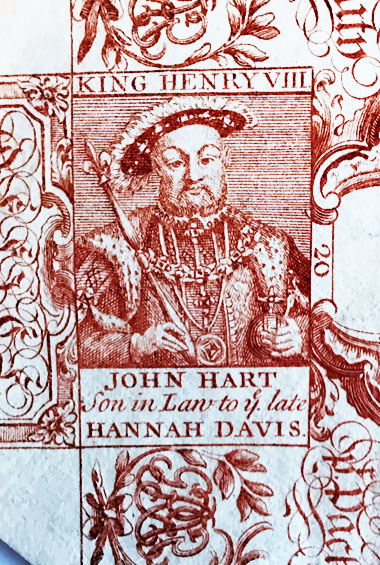
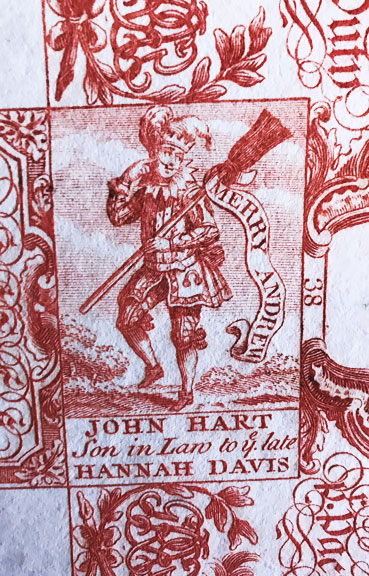
Above: Printing-proofs for tax wrappers, 1746. Henry VIII and Merry Andrew both by John Hart.
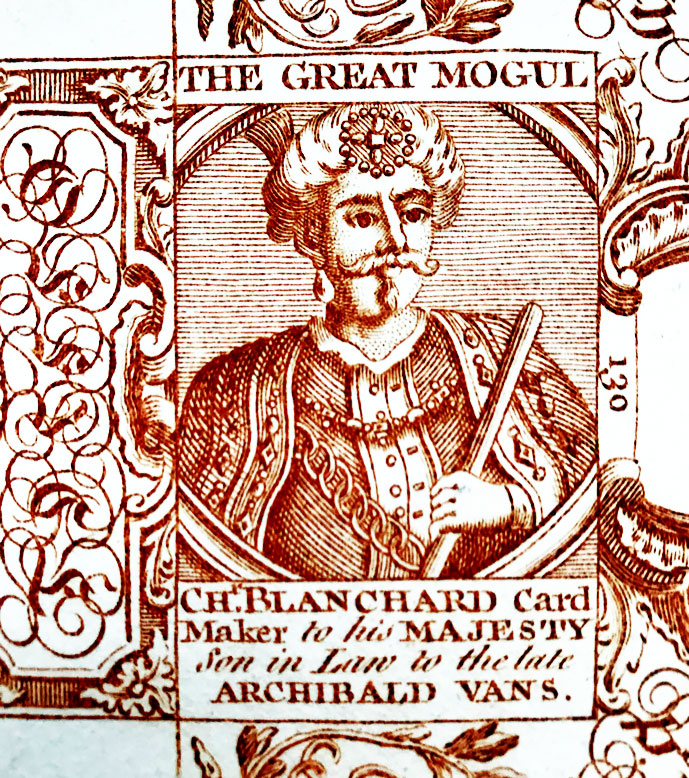
Above: The original Great Mogul, a wrapper made for Christopher Blanchard. Printing-proof, 1746.
By the late 1800s in England, these names were used to show card quality: Moguls or Great Moguls were the highest quality that the maker could offer, then Harrys (actually a nickname - these started as Henry VIII), Highlanders and Merry Andrews. In the United States, the Eagle took top place, as Englishness was highly unfashionable in the decades after independence. Steamboats have typically been a cheaper offering.
“How did this really strange naming get started?” is a good question, and it has an ancient answer: as we will discover, this relates to the historic regulation of playing card making in London.
In 1628 the Worshipful Company of Makers of Playing Cards was created by a Charter from King Charles I. French makers (those in Rouen in particular) had a lot more experience than the makers in London, who therefore struggled to compete against imported cards in terms of both quality and price (don’t quote me on this it would not sound good in London).
A deal was struck whereby the King would agree legislation banning imported cards and in return there would be a new tax on playing cards that the playing card makers agreed to collect.
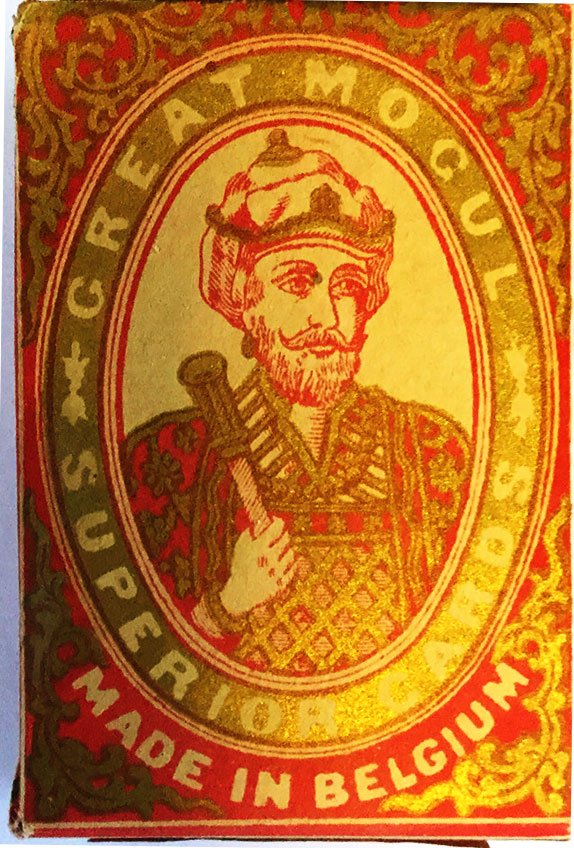
Above: Great Mogul wrappers by Biermans c.1880.
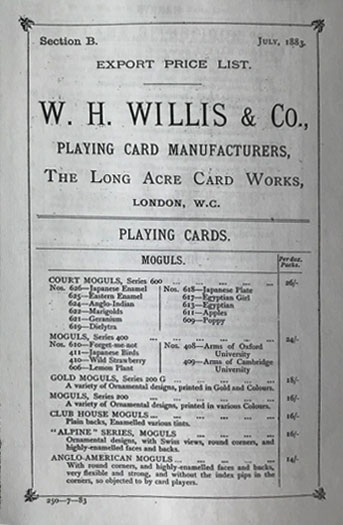
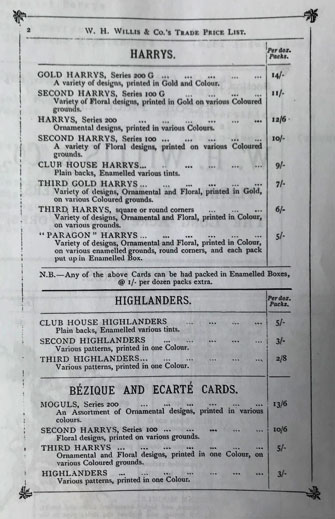
Above: Moguls, Harrys and Highlanders in a W H Willis advertisement 1883 (from M H Goodall’s book).
Because of the taxation responsibilities, the Worshipful Company had to administer card production closely. Each maker was asked to register one or more distinctive names and markings for use on their card wrappers - effectively an early kind of trademark. This is how The Great Mogul, Henry VIII, the Valiant Highlander, Merry Andrew and many many other characters began their lives.
In London, in most eras there has been one maker who was notably more successful than the others. In the 1700s the leading maker was Philip Blanchard, followed by his son Christopher. The principal sign used by Christopher Blanchard was the Great Mogul shown above.
While the term ‘marketing’ would have meant little to these makers, the idea that a special sign added value was certainly understood and by 1743 Thomas Hill was also making cards carrying the sign of the Great Mogul.
As noted, Blanchard was the most popular of the contemporary makers, so his sign was the obvious one to copy.
Blanchard took his case to Court. Blanchard v Hill 1743 was heard by Lord Hardwicke and astonishingly by modern standards, the ruling went in Hill’s favor. While the idea of a brand was known (from its original use, branding with fire) this had yet to be enshrined in law.
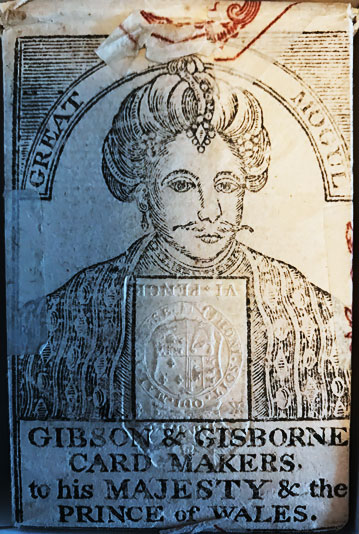
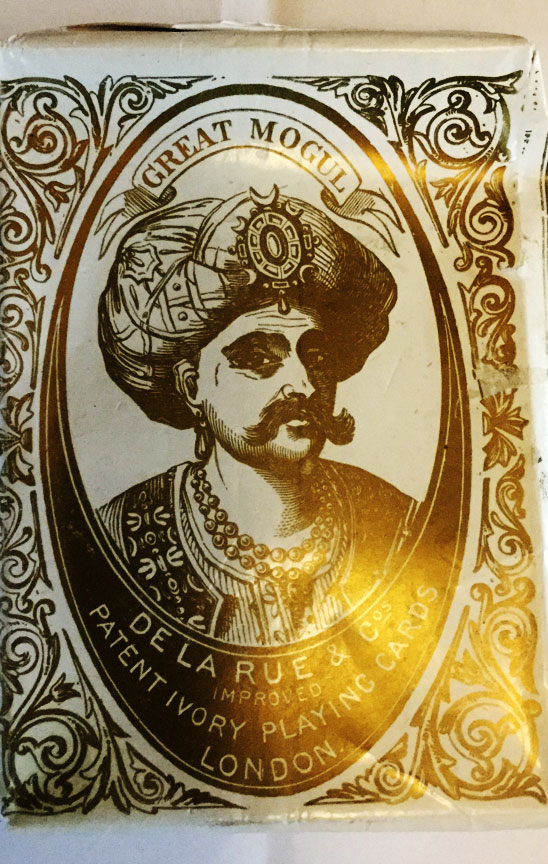
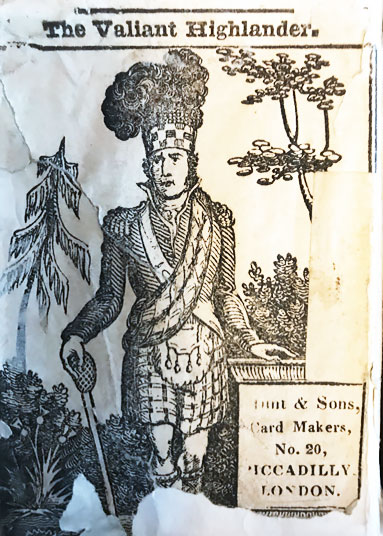
Above Left: English tax wrappers: 'Great Mogul' by Gibson & Gisborne, c1795. Above Center: Great Mogul wrappers by De La Rue c.1880. Above Right: 'The Valiant Highlander' by Hunt & Sons, c1850.
The result undermined the WCMPC, because it established that the system of makers’ marks that is ruled over was effectively worthless.
The most popular of the makers’ signs saw widespread adoption and evolved to show higher and lower levels of quality and price. We show examples above by Gibson & Gisborne and by Hunt – both of whom were legitimate successors to Christopher Blanchard, having bought the business after his death in 1769.
During the 1800s through to the 1860s, playing cards were making a transition from gambling clubs (including the less official ones) to social and family games. In recognition of this, in 1868 the English tax on playing cards was reduced from a shilling (12 old pennies) to 3d (three old pennies). Makers absolutely thrived (production went up three to fourfold) and soon there were a wide variety of qualities to suit every level of this new market.
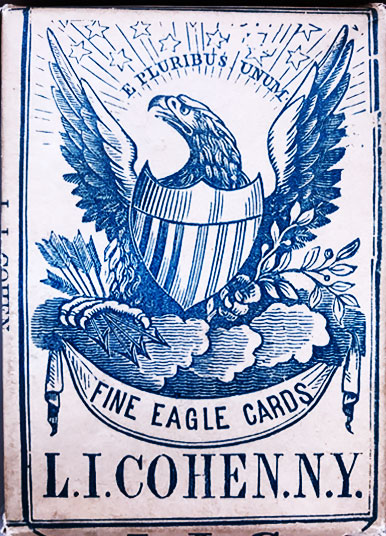
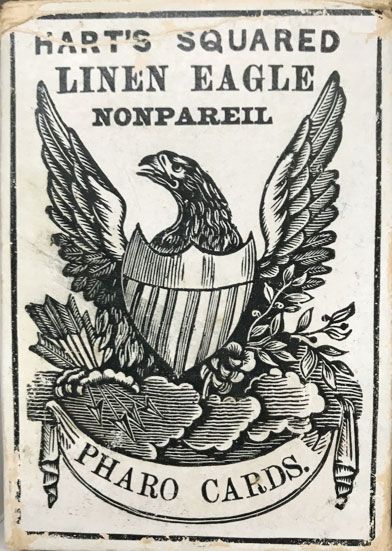
Above: The Eagle, an American designation. L I Cohen c1863 (NY9) and Hart c1885 (NY42).
As we see in the images above, more than 100 years after the Blanchard versus Hill case, the Great Mogul was widely used as an advertising device on wrappers. Incidentally, Biermans (maker of the wrapper on the right above) was lone of several Belgian playing card makers that joined to create Carta Mundi (now Cartamundi).
In the USA, the more successful of the early makers were well aware of these various standard names, and in Hochman (page 11, see references) we read that Amos Whitney (1795-1804) used Merry Andrew and Harry the Eighth (among other names).
Crehore and the Ford family also used these names and one of them probably introduced a new ‘Eagle’ designation as the highest quality – this being a natural addition given the eagle added to the ‘American Manufacture’ ace.
The English makers added two US-related names – Club House (originally from Hart?) and Anglo-American. Both can be seen in Willis list, if your eyesight is perfect!
References
- “Blanchard v Hill” is a paper by N M Dawson, reproduced in “Early Playing Card Makers in London and Ireland 1600-1850”, M H Goodall.
- The history and the rights of the WCMPC are described in “The makers of Playing Cards of London” by John H Thorpe, latest edition 2017.
- The Willis price list is from “Minor British Playing Card Makers of the Nineteenth Century, Vol 1 W H Willis and Co”, by M H Goodall.
- US naming information is from “The Hochman Encyclopedia of American Playing Cards”, Tom and Judy Dawson, print edition 2000.

By Paul Bostock
United Kingdom • Member since May 07, 2024
Paul has been a collector of playing cards since his early teenage years, the mid 1970s. In the last 20 years or so he has specialised in standard English cards and their story. His collection, including many other English Standards, are featured on his website plainbacks.com. Paul is currently editor of Clear the Decks, the Journal of 52 Plus Joker, the American club for playing card collectors, and is a member of the IPCS Council, an EPCS member and a Past Master of the Worshipful Company of Makers of Playing cards, a City of London livery company.

Activity for Moguls, Highlanders and Merry Andrews
Sign in to comment or save this article.

Related Articles
The Henry Hart Puzzle
Explore the intricate history and unique design variations of Henry Hart's playing cards, tracing th...
Why our playing-cards look the way they do
Analysis of early playing card designs: origins, suit differences, standardization, technological ad...
The Evolution of Bezique boxed sets, 1869 to 1990
The first company to register Bezique materials with Stationers’ Hall was Josh Reynolds & Son in Sep...
Goodall 1879-1880 Sample Book
Complete contents of a sample book by Goodall & Sons
Great Mogul Playing Cards
The origins of the 'Great Mogul' brand playing cards.
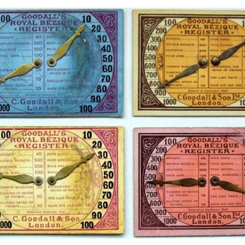
Bezique Markers, 1860-1960
Bezique is a two-player melding and trick-taking game. Dr. Pole introduced Bezique to England in 186...
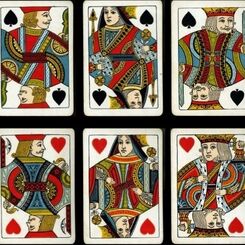
66: Adverts and related material 1862-1900
Some further material relating to cards from nineteenth and twentieth century periodicals.
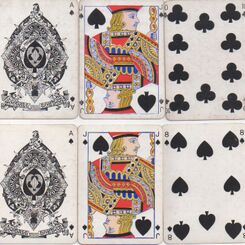
60: Some less common Goodall packs, 1875-95
There are some interesting packs from Goodall in the last quarter of the 19th century.
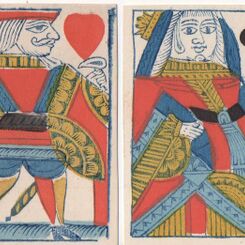
53: Some recent acquisitions and corrections
The following items are additions and alterations to my collection, the rest of which is listed on p...
41: A Guide to Dating Playing Cards
Dating is a particularly tricky but very interesting problem to tackle and there are many pitfalls. ...
30: The Not-So-Minor Cardmakers of the 19th Century - Gibson, Hunt & Bancks
A preliminary look at the card-makers operating in the 19th century.
14: Back Designs
A few examples of the many interesting back designs.
7: Brands and Packs
The introduction of brands commenced during the late 19th century as a development of the old qualit...
5: De La Rue
In December 1831 Thomas de la Rue was granted his patent for printing playing cards by letterpress.
Gibson, Hunt & Son
Gibson originally took over the business of Blanchard in 1769. Gibson & Hunt operated briefly and we...
Tunisia
Playing Cards in Tunisia. Chkobba is one of the most popular card games in Tunisia, mainly played by...
Léonard Biermans, Turnhout
Léonard Biermans had been employed by Brepols from 1871-1874 before opening his own playing card fac...
De La Rue
De La Rue introduced letter-press printing into playing card production and his patent was granted i...
W. H. Willis & Co
Willis & Company was formed in 1869, having been preceded by Charles Steer at the same address (80 L...
United Kingdom
Playing cards first arrived in England during the 15th century, but none have survived from such an ...
Most Popular
Our top articles from the past 60 days


