Igraće karte Triestine

Published July 29, 2025 Updated July 29, 2025

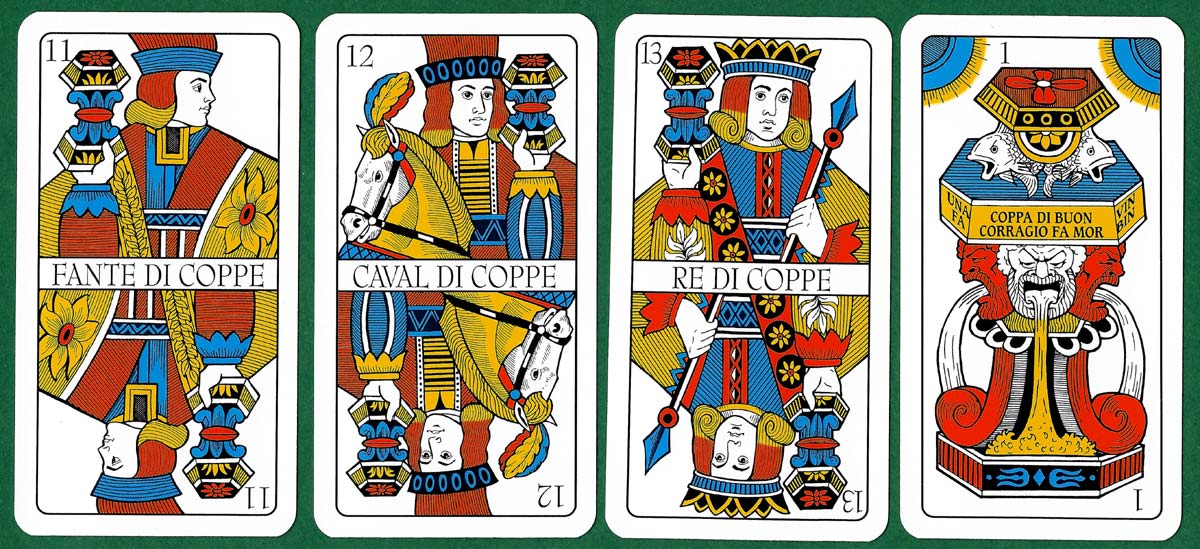
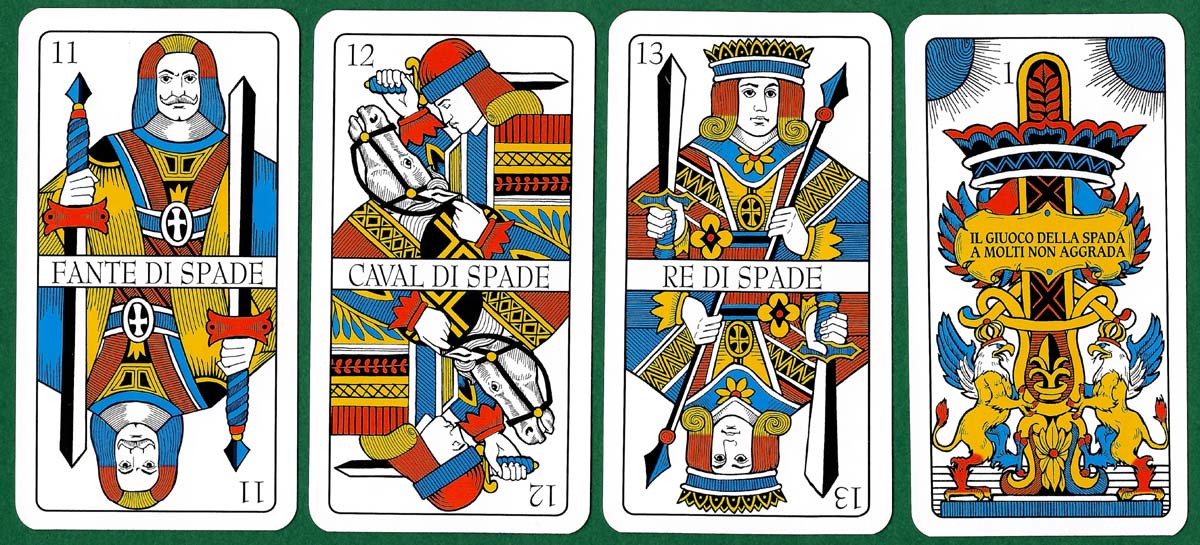
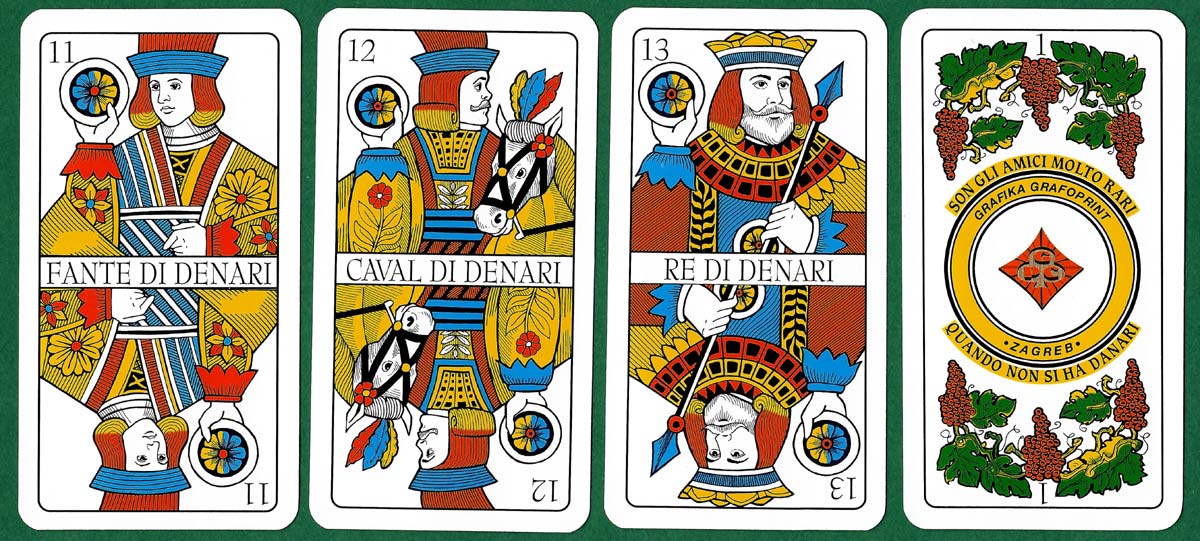
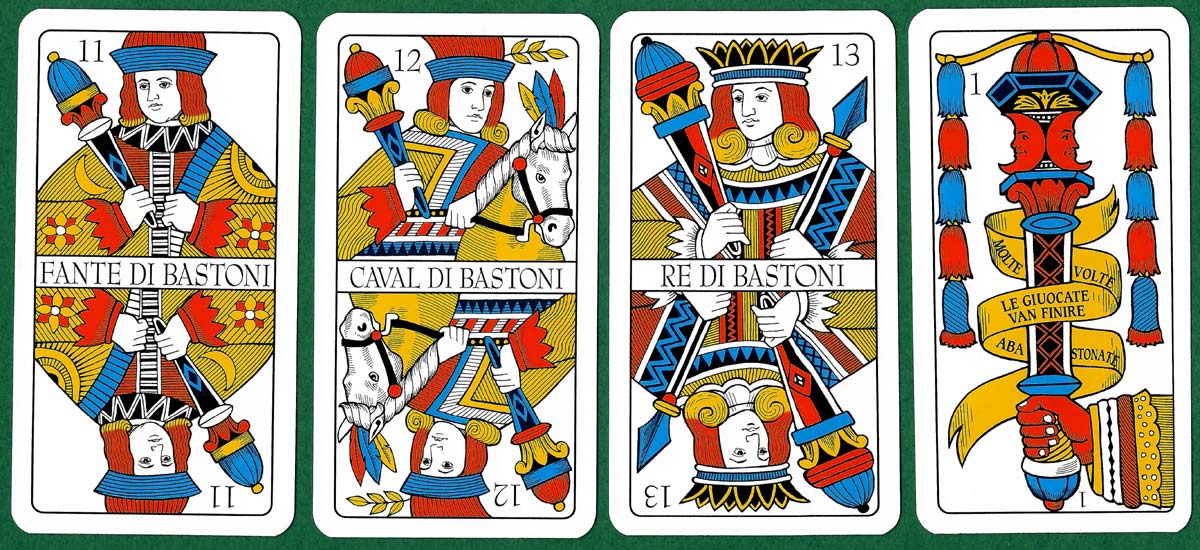
Trieste pattern cards from Croatia produced by Grafika-Grafoprint.

2000 CroatiaGrafika-GrafoprintStandard PatternTriestineBriscola

Grafika-Grafoprint, as the "first card manufacturer in the Balkans", is based on the outskirts of Zagreb. In its relatively narrow scope of production it offers a deck of traditional Trieste pattern. The cardboard box contains 40 cards measuring 53 x 98 mm and is primarily likely intended for the game briškula - the Croatian variant of the widespread Italian game briscola.

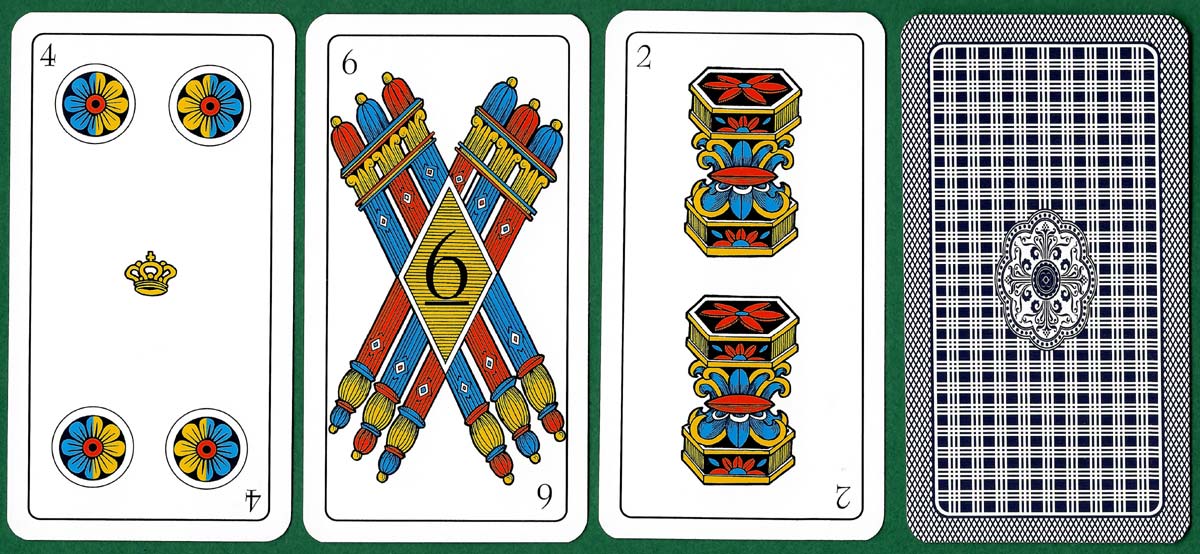
The careful graphic design with a combination of three complementary colours is a conservative solution that corresponds to the historical design. And of course also to the requirements of the user community, which does not like to see any changes in these cases. The basic three-colour scheme is violated only on the ace of coins, where the green colour on the vine leaves is added. This ace also contains the manufacturer's logo in the place originally intended for the tax stamp. The reverse side pattern is also designed traditionally, in dark blue.

The small crown on the four of coins may indicate the use of Dal Negro cards as a starting model or a main competitor's product. Otherwise, this is another traditional spot where the manufacturer's identification is placed. • See the box
Trieste pattern produced by Grafika-Grafoprint, Croatia, 2000 Trieste pattern produced by Grafika-Grafoprint, Croatia, 2000 Trieste pattern produced by Grafika-Grafoprint, Croatia, 2000 Trieste pattern produced by Grafika-Grafoprint, Croatia, 2000 Trieste pattern produced by Grafika-Grafoprint, Croatia, 2000

Above: Trieste pattern produced by Grafika-Grafoprint, Croatia, 2000. 40 cards measuring 53 x 98 mm in box.

The Trieste pattern was created around 1850 by modifying the older Venetian one, probably in the local workshop of Giovanni Batista Marcovich. It is registered by The International Playing-Card Society under number 36. The court cards are without exception designed as double-headed and all cards have indices indicating the value (not always located in the upper left corner).

I like the connection between the simplistic colour scheme of yellow-red-blue and the tricolour of the flag of the Austrian Littoral, to which the Imperial Free City of Trieste belonged at the time. This fact could offer interesting political and social associations.

References

WoPC : Playing Cards in Croatia

IPCS : Trieste pattern

Pagat.com : Briškula

avatar
26 Articles

By Marek Brejcha

Czech Republic • Member since June 13, 2024 • Contact

My relationship with cards grew from playing to collecting and transformed into publishing as well. I am part of the team at Counter Clockwise, a small company that publishes traditional card games.

Related Articles

1935 Bayerisches Einfachbild

Bayerisches Einfachbild

Sample of production by the Munich branch of VASS.

1855 Giovanni Battista Marcovich

Giovanni Battista Marcovich

An early example of the Triestine pattern.

1881 Luditz Pattern by Georg Geiselreiter

Luditz Pattern by Georg Geiselreiter

The discovery of 2024 changes the current state of knowledge of the history of this pattern.

1914 Czech National Patterns by S.D. Modiano

Czech National Patterns by S.D. Modiano

Modiano produced cards with the Prague and Trappola patterns in the early 20th century.

1940 Doppel-Deutsche Karten by Bratří Willnerové, Teplice

Doppel-Deutsche Karten by Bratří Willnerové, Teplice

This deck from local manufacturer Bratří Willnerová offers a standard version of the popular Central...

1920 Prager Pattern by Bratří Willnerové, Teplice

Prager Pattern by Bratří Willnerové, Teplice

Traditional single-ended Prager pattern by Willner Brothers from northern Bohemia.

1970 English pattern from Nigeria

English pattern from Nigeria

A standard pack from the most populous country in Africa.

1966 English pattern by Bielefelder Spielkarten

English pattern by Bielefelder Spielkarten

Standard designs by Bielefelder Spielkarten GmbH, Bielefeld, Germany, c1966.

2000 Bohemian pattern by Bonaparte

Bohemian pattern by Bonaparte

Standard Bohemian pattern designs by Bonaparte, Plzeň, Czech Republic, c.2000.

Jeu de 54 cartes

Jeu de 54 cartes

Jeu de 54 cartes, completely anonymous, designed to resemble locally produced French packs.

1960 London Bridge NR.18

London Bridge NR.18

A brand name used in Norway over a number of years.

1970 Naipe de Bridge

Naipe de Bridge

Standard English pattern pack made in Ecuador, c.1970.

1875 Epokha vozrozhdeniya (Age of Enlightenment)

Epokha vozrozhdeniya (Age of Enlightenment)

Epokha vozrozhdeniya (Age of Enlightenment): this pack has effectively become the Russian standard. ...

Popular No.257

Popular No.257

Piatnik’s “Popular Playing Cards” No.257

16: European Standard Playing Cards

16: European Standard Playing Cards

A brief survey of the different types of standard cards to be found in Continental Europe.

Playing Cards in Croatia

Playing Cards in Croatia

Playing Cards in Croatia. Grafika-Grafoprint was founded in 1989 and is the Croatia’s first playing ...

1830 Reynolds c.1830

Reynolds c.1830

Woodblock and stencil playing cards, produced by Reynolds & Sons c.1830-1850.

Standard and Non-standard Playing Cards

Standard and Non-standard Playing Cards

Standard playing cards are based upon traditional designs and are used for card games.

1820 Russian Standard Playing Cards

Russian Standard Playing Cards

Cards from an early version of a Russian standard woodblock and stencil pack of circa 1820.

1950 Naipes ‘American’

Naipes ‘American’

Naipes ‘American’ by M.C. de CASABÓ Ltda, Montevideo, c.1950.