


Luditz Pattern by Georg Geiselreiter
The discovery of 2024 changes the current state of knowledge of the history of this pattern.
The Luditz/Luditzer Pattern (German: Luditzer Bild) is one of the historical patterns registered by The International Playing-Card Society¹. The pattern gained this autonomy, despite its rather minor historical significance, thanks to the interest of such experts as Klaus Reisinger and Sylvia Mann.
It is documented that the pattern developed in the area of northwestern Bohemia in the Sudetenland² - a historical German-speaking area. The name of the pattern is derived from the town of Žlutice³, German: Luditz. The expansion of local cards, which led to their codification as a separate pattern, was only contributed to by a subsequent development episode, when they appeared in the production of Viennese companies. Based on the originally available preserved cards, Reisinger frames this period roughly between 1892 and 1914⁴. He considers the edition of the Österreichischen Spielkartenfabriks-Gesellschaft to be the original⁵. It is their designation LUDITZER on the acorn ace that gives the name to this pattern. The motto is subsequently copied on subsequent editions by Josef Glanz / Piatnik and S.D. Modiano, and is a typical part of the Austrian development phase of the pattern.
A new discovery of 2024 is a deck by the manufacturer Georg Geiselreiter from Wiener Neustadt. His activity is documented there between 1854-1882⁶. This deck is thus the new oldest link in the Austrian development phase. From a comparison⁷ with the cards of the Österreichischen Spielkartenfabriks-Gesellschaft⁸, it is clear that their edition uses the Georg Geiselreiter’s matrix only with minor changes of a reductive nature and the addition of the manufacturer's own identification.
Geiselreiter’s cards are made as a woodcut with stencil coloring. The deck contains 32 cards measuring 56 x 93 mm, the reverse side is the wienerblitz (Vienna lightning) of the older development phase. I estimate the remains of the tax stamp on the seven of hearts as a variant used in the years 1877 - 1881, which would also correspond to the manufacturer's activity.
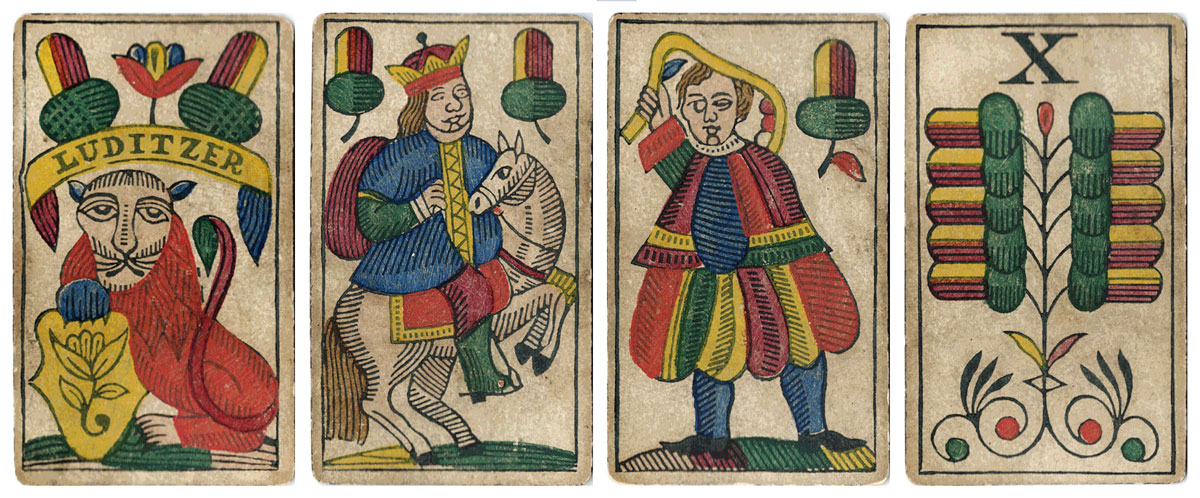
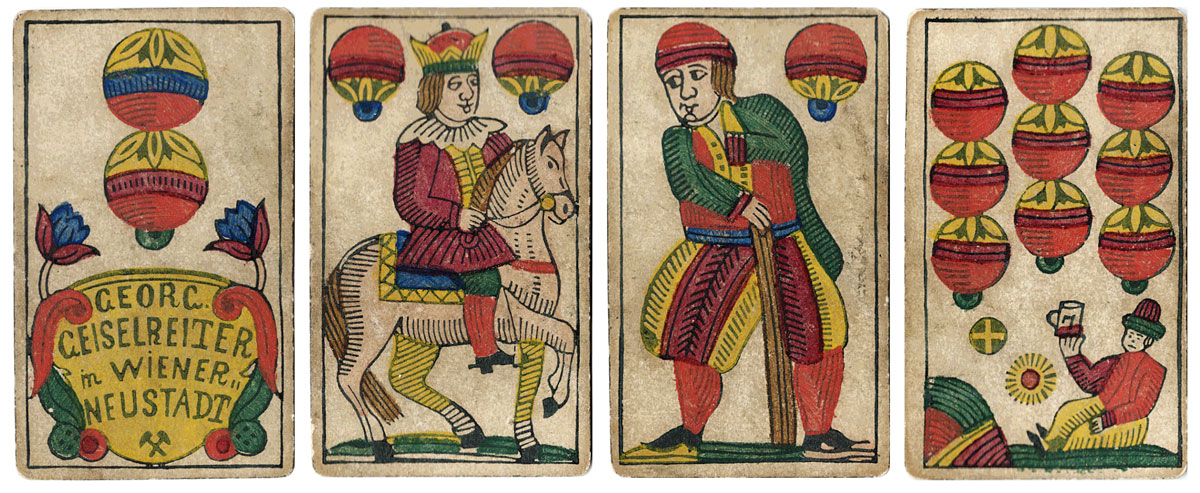
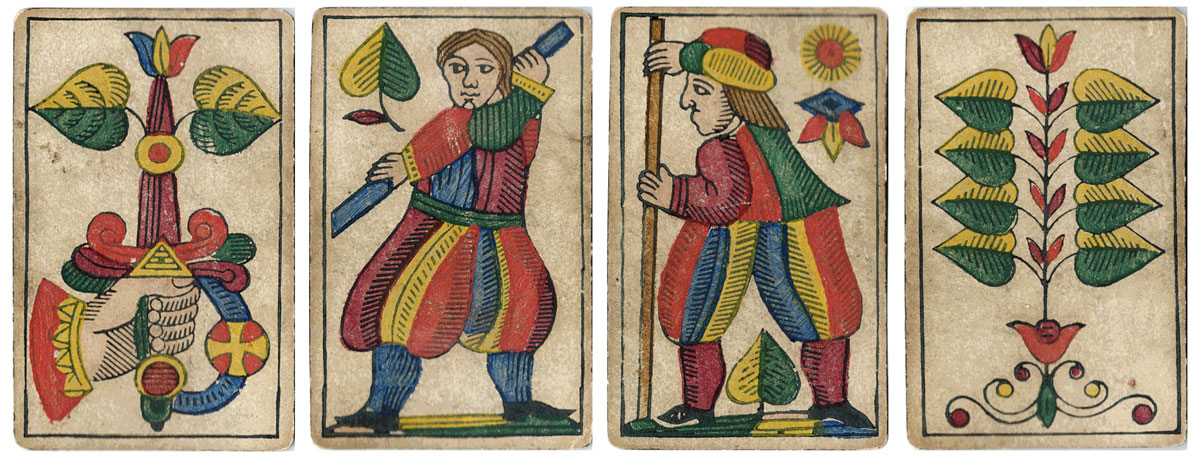
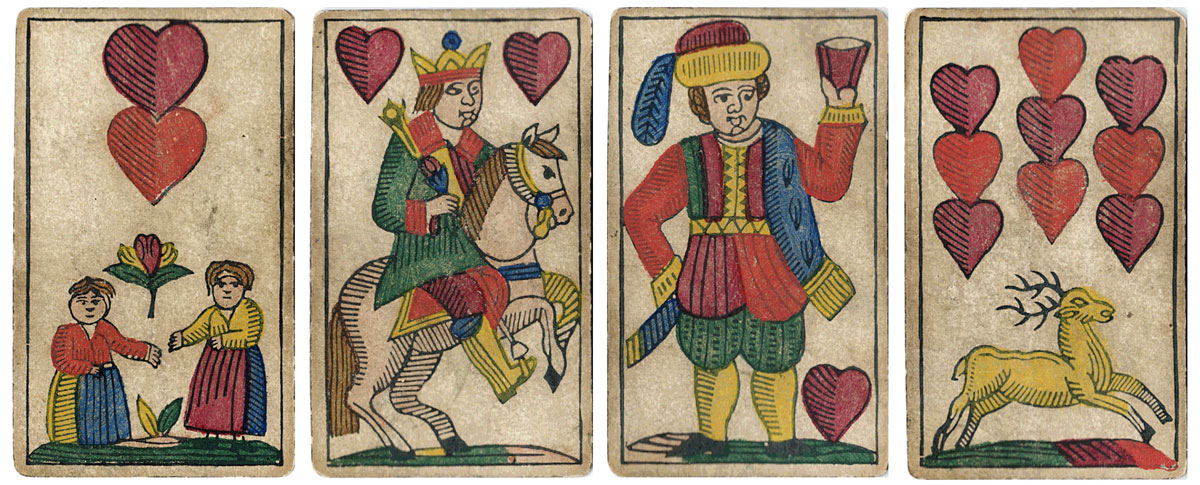
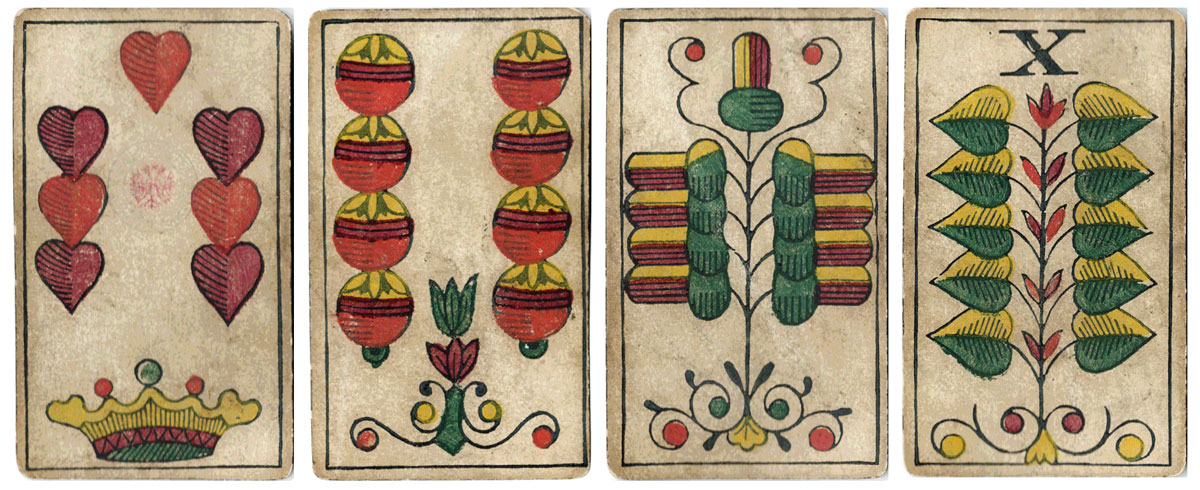
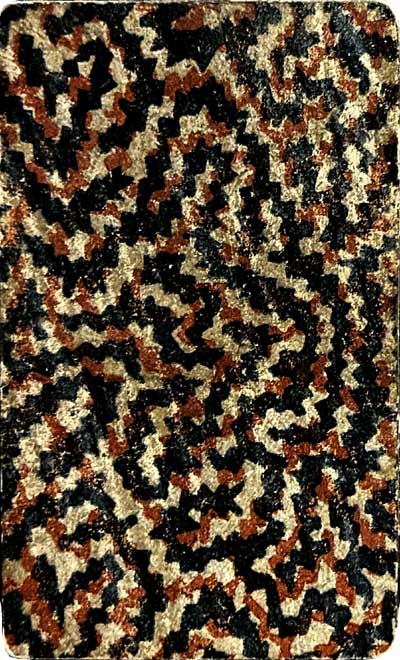
Above: Luditz pattern playing cards with German suit symbols by Georg Geiselreiter, Wiener Neustadt, 1881. 32 cards.
References
- IPCS Pattern sheet #97►
- Klaus Reisinger describes the development of the pattern in his articles in Talon No. 11/2002, available online
- Google : map►
- Also, Reisinger's upper limit of the viability of the pattern is now surpassed by the package of the manufacturer F.W. Maier from Proseč nad Nisou (Czech Republic) from 1931-2.
- see note 2
- Wolfgang Altfahrt: Kartenmaler in Wiener Neustadt in Talon Nr. 31/2022, available online
- Ročenka 2024 Clubu sběratelů karetních her / Yearbook 2024 by Czech Club of playing card collectors
- also available here►
By Marek Brejcha
Czech Republic • Member since June 13, 2024
My relationship with cards grew from playing to collecting and transformed into publishing as well. I am part of the team at Counter Clockwise, a small company that publishes traditional card games.

Activity for Luditz Pattern by Georg Geiselreiter
Sign in to comment or save this article.

Related Articles
Playing cards with prints by Sumio Kawakami
Woodblock print designs created by Sumio Kawakami in 1938-9, each card having a different illustrati...
Venus et Cupidon
“Venus et Cupidon” from Costante Costantini in his distinctive woodcut style.

Calcio Storico Fiorentino
‘Calcio Storico Fiorentino’ by Costante Costantini is based on an early form of football that origi...
“Deck with French suits”
A facsimile of an early 19th century French-suited deck from the collection of F.X. Schmid.
Jeu “Gerente”
Jeu “Gerente” - published by Moncar in 1983 in the “Cartes de Fantaisie” series.
71: Woodblock and stencil: the hearts
A presentation of the main characteristics of the wood-block courts of the heart suit.
70: Woodblock and stencil : the spade courts
This is a presentation in a more straight forward fashion of the work done by Paul Bostock and me in...
I. Schenck, Nuremberg
I. Schenck, Nuremberg, late XVIIIth century
Lilian Cailleaud’s Tarot Project
Lilian Caillaeud lino-cuts his version of the tarot by Nicolas Rolichon of Lyon c.1600
Xilografías de Mallorca
Spanish National pattern re-printed from original woodblocks which are preserved in the monastery at...
Minchiate Fiorentine, 17th C.
17th century Minchiate cards reprinted from the original woodblocks.
Reynolds c.1830
Woodblock and stencil playing cards, produced by Reynolds & Sons c.1830-1850.
Early Anglo-French Cards
Cards produced in Rouen during the sixteenth century. It was cards like these which were imported to...
Regarding the designs of playing cards
The quality of playing card designs often deteriorates with time…
Hewson Replica Pack
Hand-made replica 17th century English playing cards, based on museum originals.
Russian Standard Playing Cards
Cards from an early version of a Russian standard woodblock and stencil pack of circa 1820.
Early History of Playing Cards & Timeline
Out of an apparent void, a constellation of references in early literature emerge pointing to the su...
Woodblock and Stencil Playing Cards
Around 1987 I decided to make a pack of playing cards from woodblocks and coloured with stencils. I ...
Most Popular
Our top articles from the past 60 days


jan merc
19 May 2026, 23:58SavedSaved this article to MOST WANTED