


Czech National Patterns by S.D. Modiano
Modiano produced cards with the Prague and Trappola patterns in the early 20th century.
Today we perceive the Modiano brand as one of the main Italian card manufacturers. The company is proud of its recognition as a Historical trademark of national interest in Italy. However, at the beginning of the 20th century, the company S.D. Modiano tried to establish itself as one of the main card manufacturers in the Austro-Hungarian Empire, to which the city of Trieste belonged at that time. At that time it also produced cards with Czech national designs.
One such design is the Prague Trappola pattern, a standard part of the range of Czech and also large Viennese card companies. Modiano Trappola cards are double-ended, in a clean graphic design, measuring 59 x 111 mm. The pack traditionally contains pip card values 1, 2, 7 - 10 and court cards of jack, knight and king in the Italian suits of coins, cups, clubs and swords. Identification of the manufacturer S.D. Modiano is found on the Ace of Batons and the Ten of Coins, where the original trademark is also visible. The feint tax stamp on the Ten of Coins was used during 1900-1920. The reverse has a pattern known as wienerbitz (Viennese lightning) - a later development. The Knight of Cups contains an interesting anomaly : it is the only one to be divided with a horizontal line.
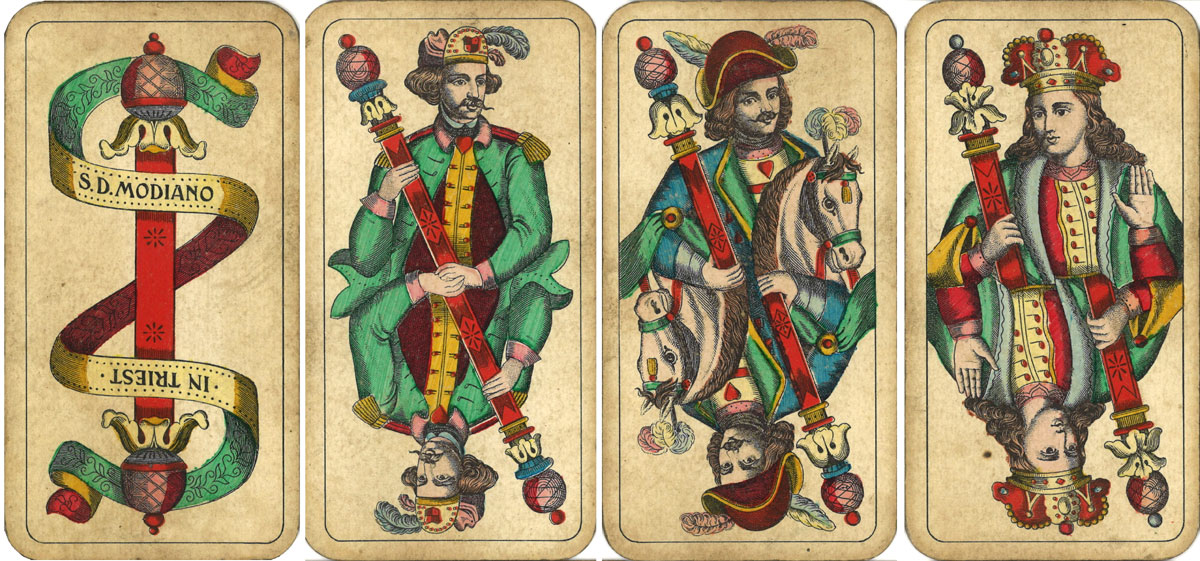
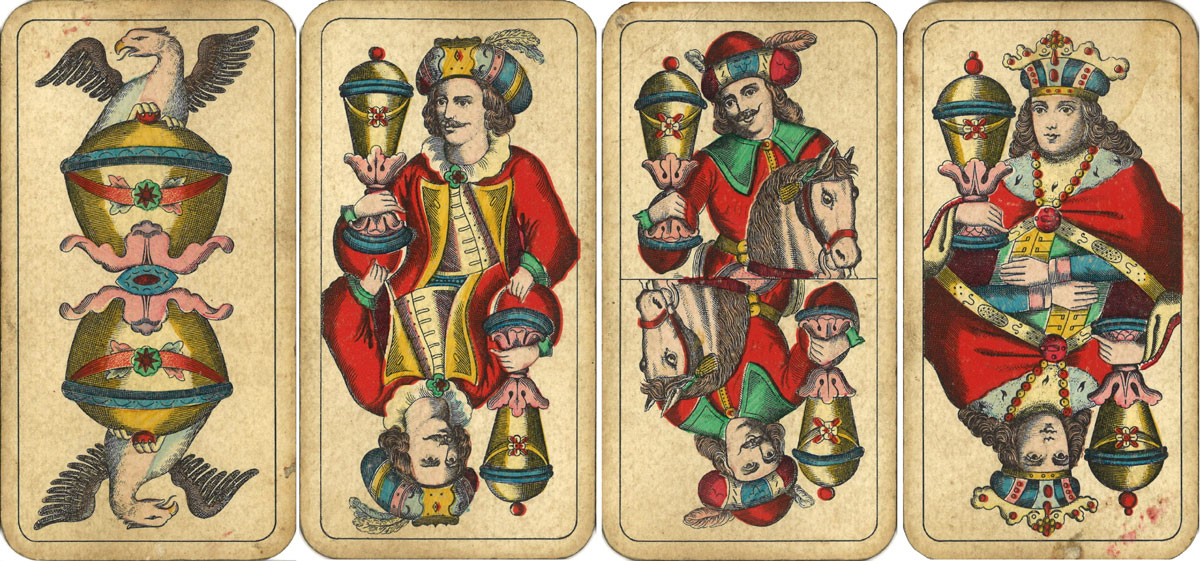
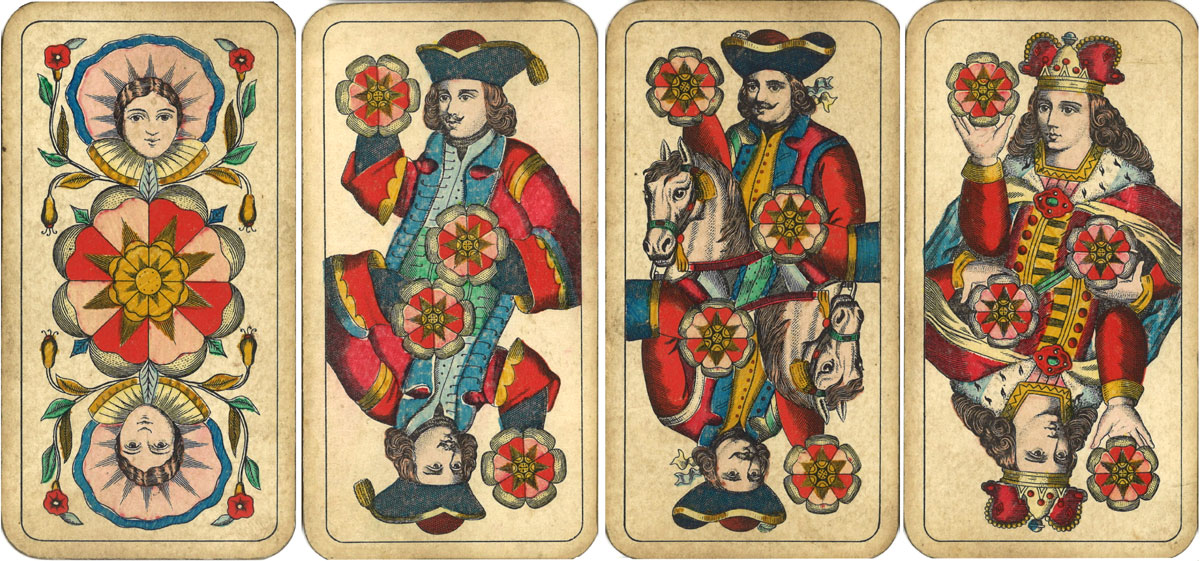
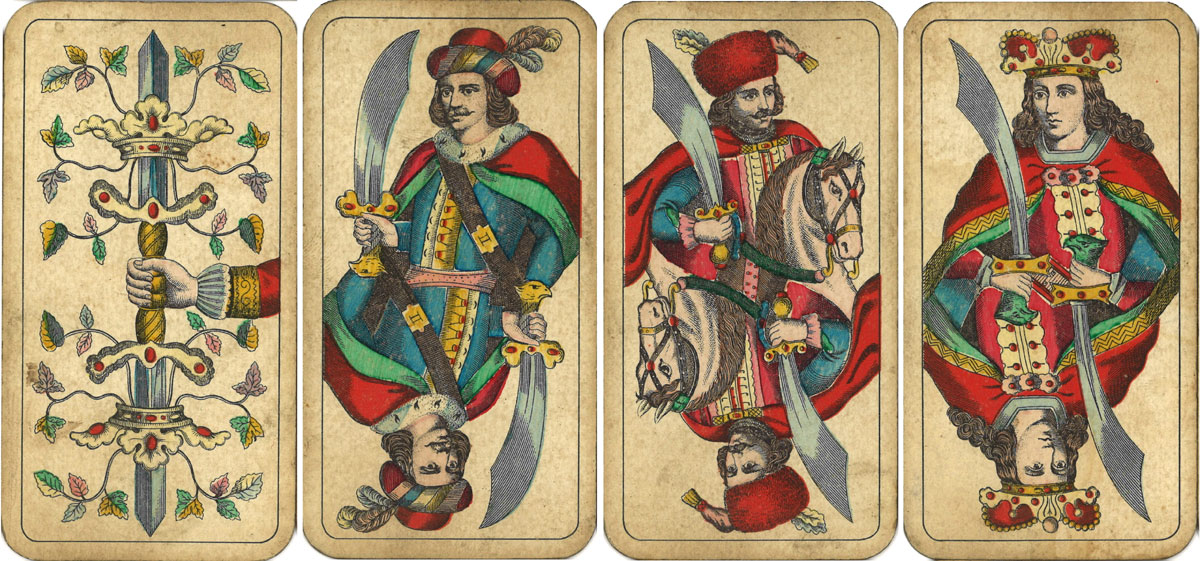
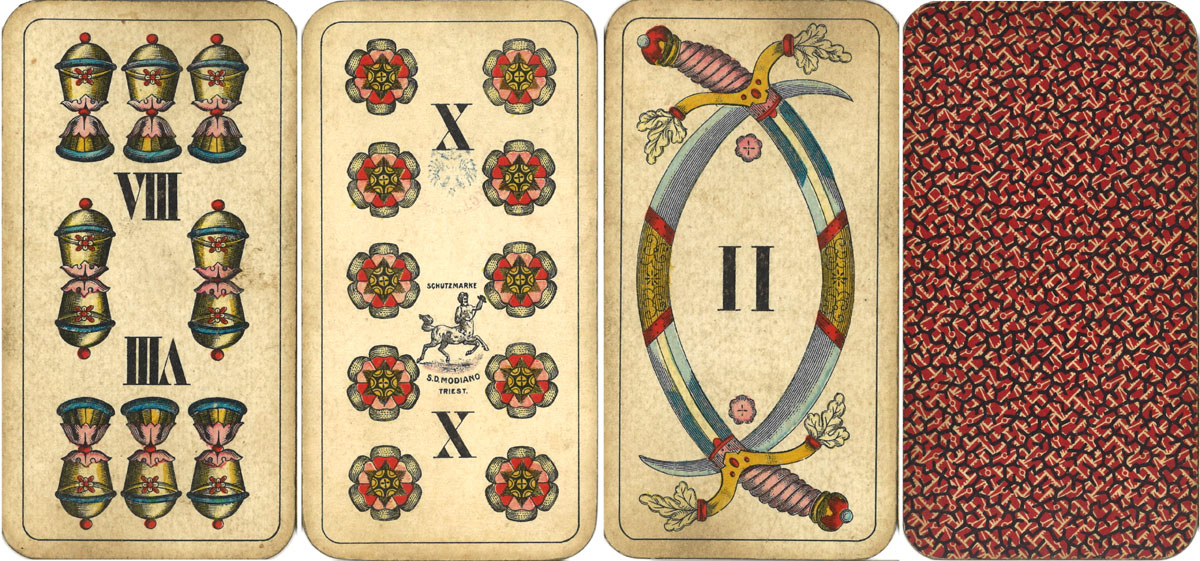
Above: the Prague Trappola pattern pack by S.D. Modiano, c.1920.
Probably around this time Modiano also offered cards with the Prague pattern. The result in three colours is simpler than in the case of the Trappola cards. I assume they were intended mainly for sale in Bohemia - another part of the Austro-Hungarian Empire. I doubt that this deck could have found greater use elsewhere.
The design corresponds to the usual contemporary versions of this pattern found in the production of other manufacturers. In the coats of arms of the Aces of Bells and Acorns we see a heraldic figure referring to the emblem of the empire - a double-headed eagle. On Prague pattern decks created after World War I, they are often replaced by other heraldic figures (compare, for example, Prager Pattern by Bratří Willnerové) - the patriotic demands of players in the newly independent Czechoslovakia are taken into account. The solution of heart pip cards in different colours disappeared over time and today are commonly in one colour. Similarly, the colour differentiation of the Seven and Nine of Leaves is also made - the upper leaves are half yellow. This solution was a minority and disappeared at the beginning of the 20th century.
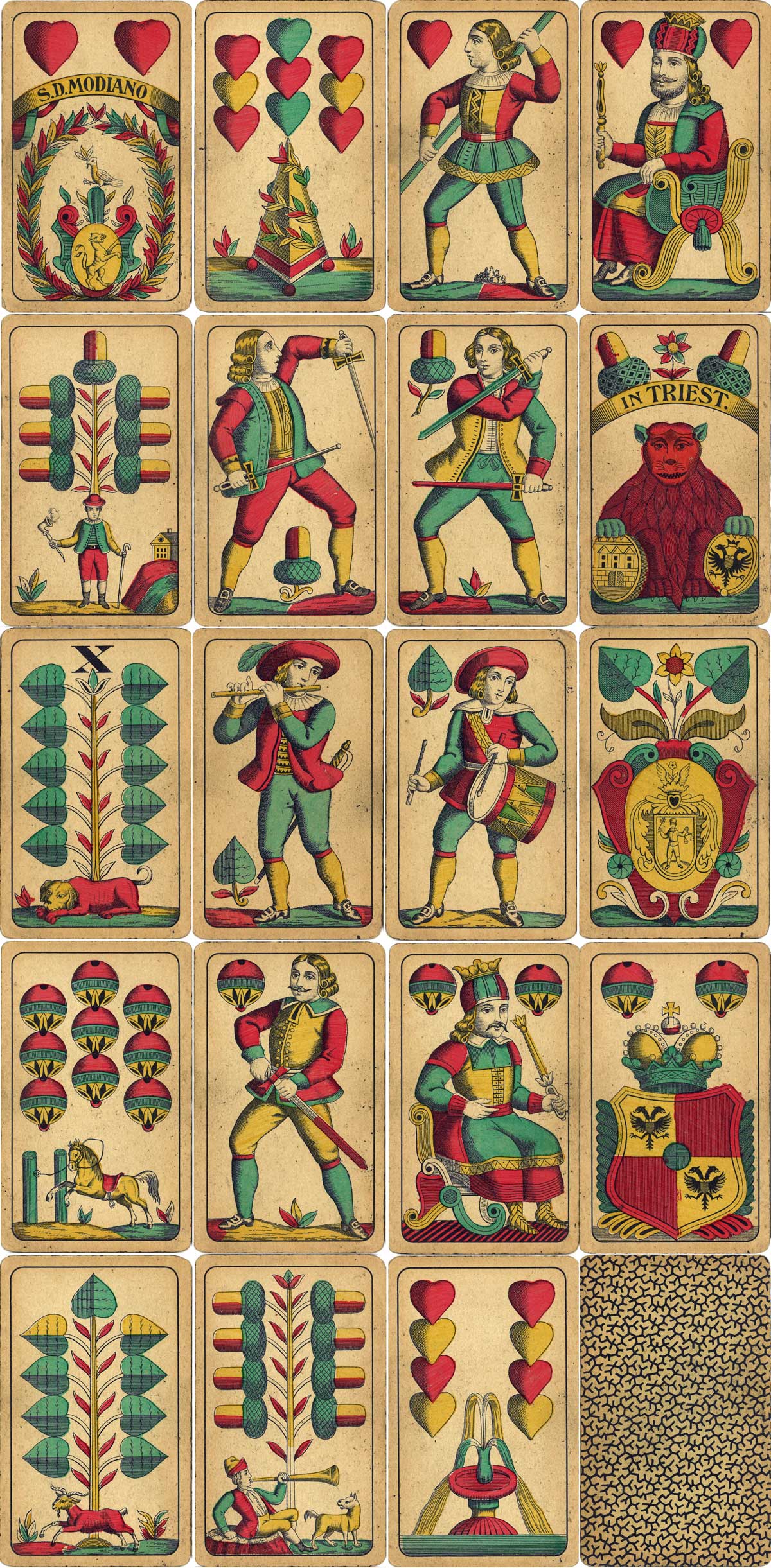
Above: the Prague pattern pack by S.D. Modiano, c.1920s
The cards measure 62 x 101 mm, the manufacturer's identification is visible on the Aces of hearts and acorns. The Eight of Bells was not preserved in my deck. Thus, a card is missing that should traditionally contain a trademark, but also a tax stamp. The reverse side with the popular wienerblitz pattern uses only the black layer of print - compare with the Trappola above.
Reference
IPCS pattern sheet 42 : Prague Trappola►
By Marek Brejcha
Czech Republic • Member since June 13, 2024
My relationship with cards grew from playing to collecting and transformed into publishing as well. I am part of the team at Counter Clockwise, a small company that publishes traditional card games.

Activity for Czech National Patterns by S.D. Modiano
Sign in to comment or save this article.

Related Articles
Modiano Napoletane Cards
From Trieste with Pride – a 150th Anniversary Edition of the Neapolitan Pattern.
Emilio Tadini playing cards
Beautiful dreamlike playing card designs by Emilio Tadini.
Austrian Tarock by S.D. Modiano
Modiano’s Austrian Tarock with country scenes has been in production for over 100 years.
Il Quinto Seme
An Italian pack with a fifth suit of “amici” (“friends”).
Topolino Fiat Cinquecento
Fully illustrated Italian Disney pack advertising the Fiat Cinquecento, made by Modiano, Trieste, It...
Sarde Pattern
Sarde pattern published by Modiano, c.1975, based on early XIX century Spanish model.
Triestine Pattern
The Triestine pattern is derived from the Venetian (Trevisane) pattern but with its own characterist...
Primiera Bolognese
Primiera Bolognese by Modiano, c.1975
Bergamasche Pattern
Bergamasche Pattern by Modiano, 1970s.
Il Destino Svelato Dal Tarocco
The Cagliostro Tarot was first published in 1912 as “Il Destino Svelato Dal Tarocco”.
Tarocco Siciliano
The highly individual Sicilian Tarot has the Italo-Portuguese suit system with straight, interlockin...
Club Bridge
Modiano’s ‘Club Bridge’ is a new edition of a stylish deck originally published in c.1895.
Modiano Patience
Patience cards published by Modiano, c.1945.
Austrian Lloyd Steamship Company
Possibly one of the most beautiful decks produced for commercial purposes, this was printed by Modia...
Piacentine Pattern
Piacentine Pattern, several double-ended versions.
Lombardy (or Milanesi) pattern
The origins of the Lombardy pattern probably lie in the early 19th century when it was a full-length...
Trevisane pattern
The double-ended version of the ‘Trevisane’ pattern originated in the early 19th century.
Sicilian Pattern
The Sicilian pack has a similar composition to the Neapolitan pack, and is small and squat in appear...
Neapolitan Pattern
Cartine da Gioco Vesuvio miniature Neapolitan pattern.
Brescia pattern
The Brescia pattern contains elements which come from a past age.
Most Popular
Our top articles from the past 60 days


