


Les Chevaliers de la Toison d’Or
Medieval manuscript art at its finest.
In 1430 AD, Philip III (aka Philip the Good), the Duke of Burgundy, formed a chivalric order called The Order of the Golden Fleece. It was essentially an elite fraternal organization designed to show off Philip’s power and the prestige of its members. (It still exists today!)
Armorials – the medieval version of a yearbook – contained names, ranks, and coats-of-arms of the members. Sometimes, these rosters became works of art; such is the case with the stunning Great and Small Equestrian Armorials of the Golden Fleece in this deck. The courts show nobility – including women – in gorgeous heraldic robes on caparisoned horses, with lions, fleurs-de-lis, crosses, and eagles prominently displayed on the cards. The aces bear elaborate coats-of-arms.


Les Chevaliers de la Toison d’Or heraldic playing cards published by Éditions J.C. Dusserre, Paris.
Cards two through four explain the Order in several languages, while cards five through seven provide member names. The jokers are the bishop/duke of Laon and the bishop/comte de Beauvais – church officials who also had feudal titles. It’s unclear why they’re the jokers, but I don’t think it’s meant as an insult, as is sometimes the case in other decks. Philip the Good’s arms are on the backs.

By Lev Golinkin
United States • Member since May 26, 2026
I'm a US-based author and journalist. I've been collecting playing cards since I was about 8 years old, when I got mesmerized by the various decks that were used in Soviet Ukraine, where I'm from. I collect mainly European decks such as those by Dondorf, Grimaud, and Piatnik. I love courts above all else, and am drawn toward historical and artistic decks.

Activity for Les Chevaliers de la Toison d’Or
Sign in to comment or save this article.

Related Articles
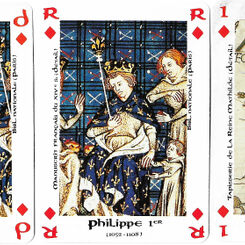
Jeu Roman
The splendour of early medieval France, courtesy of Éditions Dusserre.
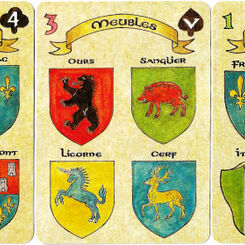
Jeu des Blasons
Heraldry meets playing cards.
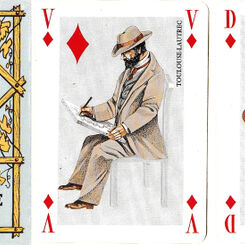
Jeu de la Belle Epoque
Jeu de la Belle Epoque, remembering a golden age of optimism, progress and elegance.
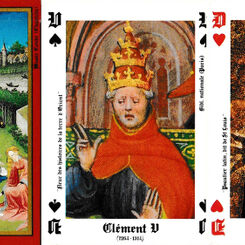
Jeu Gothique
‘Jeu Gothique’ illustrating the Gothic period in France, published by Editions Dusserre.
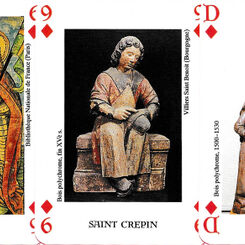
Les métiers et leurs protecteurs
“Les métiers et leurs protecteurs” playing cards published by Editions Dusserre, c. 1995.
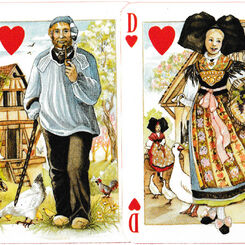
Costumes Alsaciens
Typical costumes and views of Alsace together with lists of the principal sights.
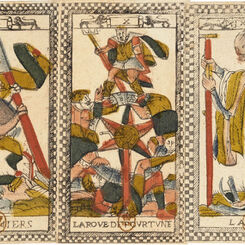
The Parisian Tarot
The “Parisian Tarot”, early 1600s, with imagery and design synthesizing several influences.
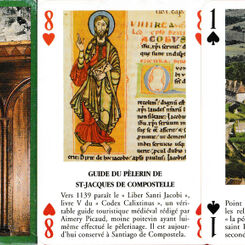
Les Chemins de Saint-Jacques
Paintings, statues, monuments and maps associated with different routes to Compostela.
The story behind some special Jokers
How the “Gibbons” Jokers came into being.
Schweizer Trachten
Schweizer Trachten No.174 (Costumes Suisses) by Dondorf.
64: The descendants of the French regional patterns: 2
A continuation oF the development of the off-spring of the Paris patterns and a few examples of how ...
Alcatel
Alcatel playing cards published by Éditions Dusserre, c.1970s
Éditions Dusserre, Paris
Éditions Dusserre, Paris: games with a history.
Arms of English Peers
The Arms of English Peers playing cards were first published in 1686. Heraldry, or a knowledge of th...
Flemish Hunting Deck
Set of medieval playing cards with King, Queen, Knave and numeral cards from one to ten in each of f...

Jeu Moyen Age
Quénioux believed that aesthetic feelings are the highest values: “C’est précisément cet amour de l’...
19: 19th Century Breaks with Tradition - Unusual versions of the Standard English Pattern
The centuries-long tradition of English court cards was subject to misinterpretation and in some cas...
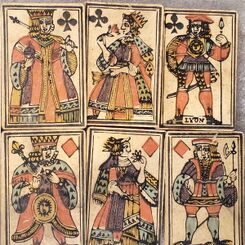
Lyon Pattern type iii
This pattern was used in various parts of eastern France but was ultimately replaced by the official...
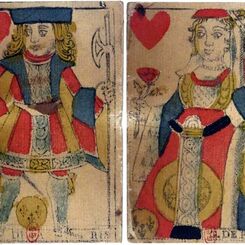
Paris Pattern
The Paris pattern was established as such around the middle of the seventeenth century (based, perha...
The History of Playing Cards
Playing cards appear in European records in the late 14th century, but their earlier history lies fu...
Most Popular
Our top articles from the past 60 days


