


Heinrich Hauk
Early German playing cards by Heinrich Hauk of Frankfurt, 16th C.
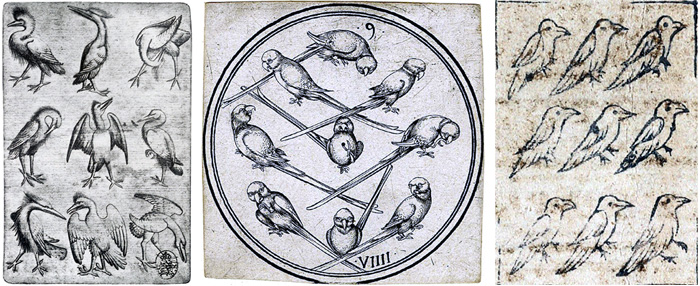
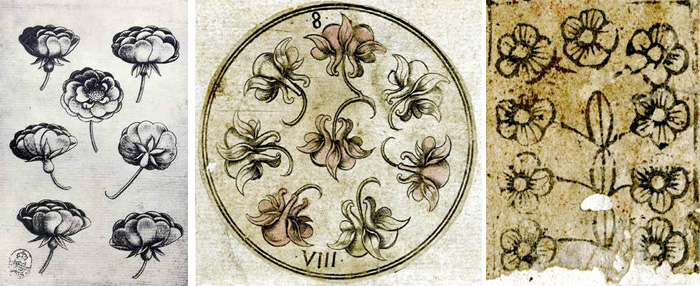
Above: birds and flowers as suit signs in cards by the Master of the Playing Cards, Germany, c.1455; the Master PW, Cologne, c.1500; and by Heinrich Hauk, Frankfurt c.1585.
These 16th C. German cards are later than the ‘Stukeley’ type cards (described here). Heinrich Hauk’s woodblock-printed cards are produced in a rudimentary style which would not be as expensive as the fine copper engraved cards by the Master of the Playing Cards, whose images are also found illuminating bibles, or the Master PW, who uses a variety of more fanciful suit symbols on round playing cards. These are cards for everyday use, not the wealthy collector's cabinet.
The suits are acorns, roses, birds and bells which in themselves are interesting as they are a hybrid of the German and the Swiss national systems - neither one nor the other. The kings are seated on thrones, three facing right and one to the left, each bearing his suit symbol while three of them also hold sceptres. The upper-knaves hold their suit symbols upwards, the lower-knaves’ are low down. The banner-10 of roses has the date 1585. The complete pack has a total 48 cards: 2-10, lower knave, upper knave & king in each suit (i.e. no aces or queens).
Heinrich Havck zv Franckfvrt
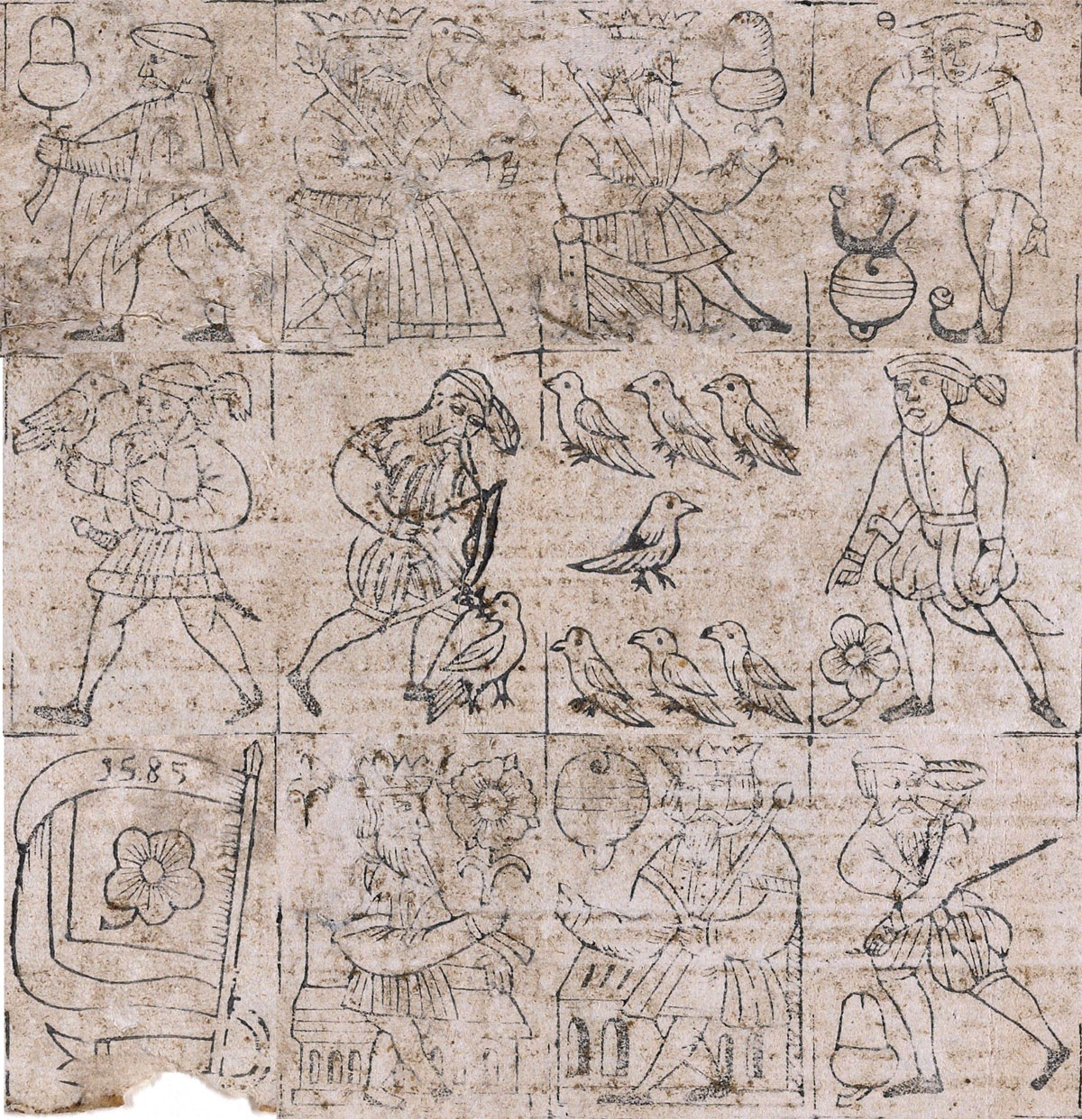
Above: 12 cards taken from an uncut sheet by Heinrich Hauk, Frankfurt, c.1585, with suits of acorns, roses, birds and bells. Card size varies between around 36x52 - 39x50 mm. Source: Yale University Library GERsheet249 • Fragment sheets of 16th century German playing cards►
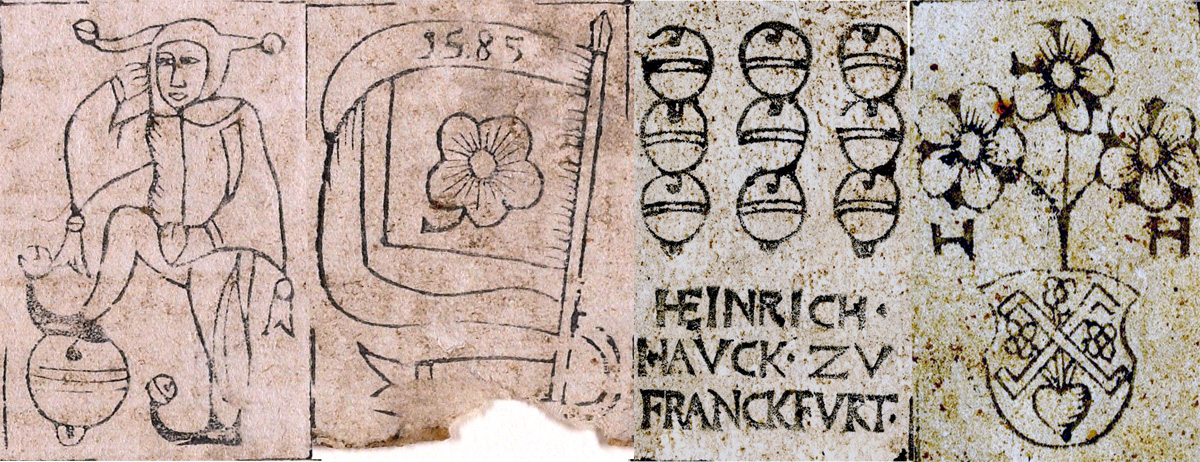
Above: Heinrich Hauk of Frankfurt was the son of Hans Hauk of Frankfurt, also a cardmaker. Heinrich signed himself as Heinrich Havck zv Franckfvrt. (In some Scandinavian languages Hauk translates as Hawk but not in German). Regarding the three of roses’ shield, the turnip is an old vegetable charge in heraldry. It was used by Leonhard von Keutschach, prince-archbishop of Salzburg. The turnip is still the heart shield in the arms of Keutschach am See. The arms of the former municipality of Kiikala, Finland, were Gules, a turnip Or.
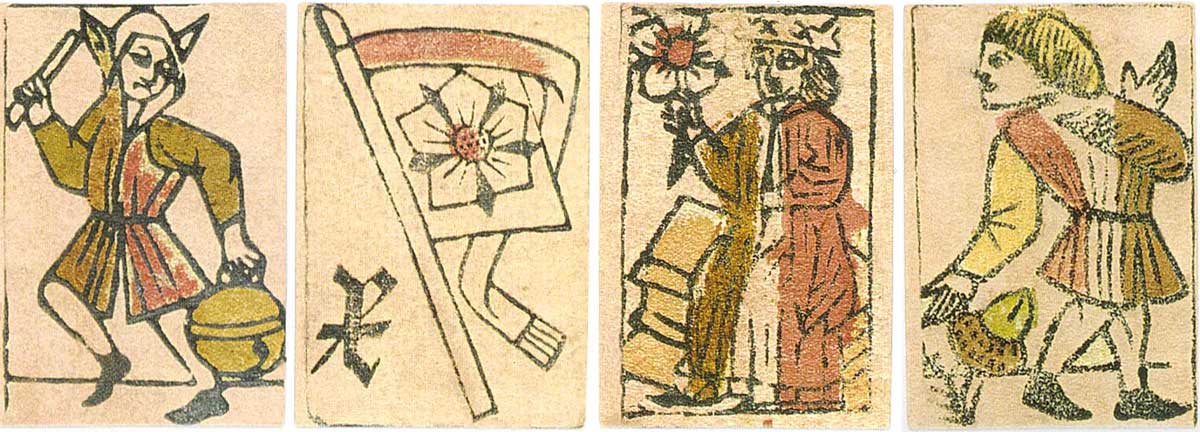
Above: comparison with early 16th century Swiss playing cards produced by woodblock and stencil printing, unknown manufacturer. The Swiss suit system of shields, acorns, hawkbells and flowers originated sometime during the fifteenth century. Notice that the unter of bells resembles a court jester as in Hauk's pack. The Swiss-suited pack does not display ten suitsigns on a 10, but, instead, shows a banner bearing a single suit-sign and a roman numeral 'X'; for this reason, these are often referred to as Banner-10s.
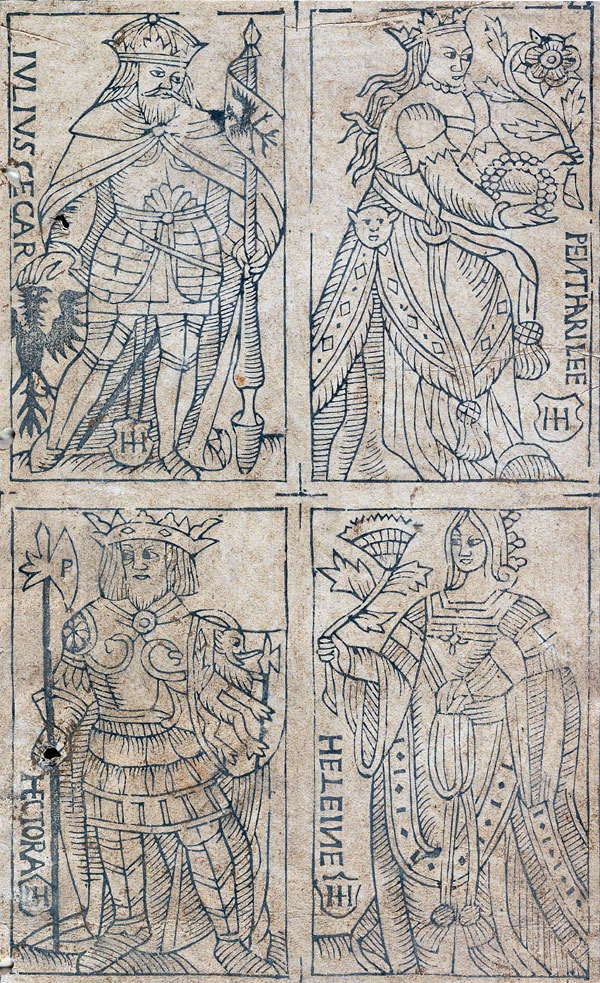
French-suited cards by Heinrich Hauk, c.1590
Female figures didn't appear in German-suited packs but they were part of the French-suited pack when this was introduced, with the jack, queen & king court hierarchy and four suits.
The court cards are named, in the French mannner, after persons from history and mythology; Julius Cesar, Penthesilea (an Amazonian queen in Greek mythology), and so on.
The kings and queens are all standing and elaborately dressed in royal regalia, while the jacks wear feathered hats and short, baggy and fashionable Spanish breeches, very similar to the knaves in the German-suited pack by Hauk (shown above).
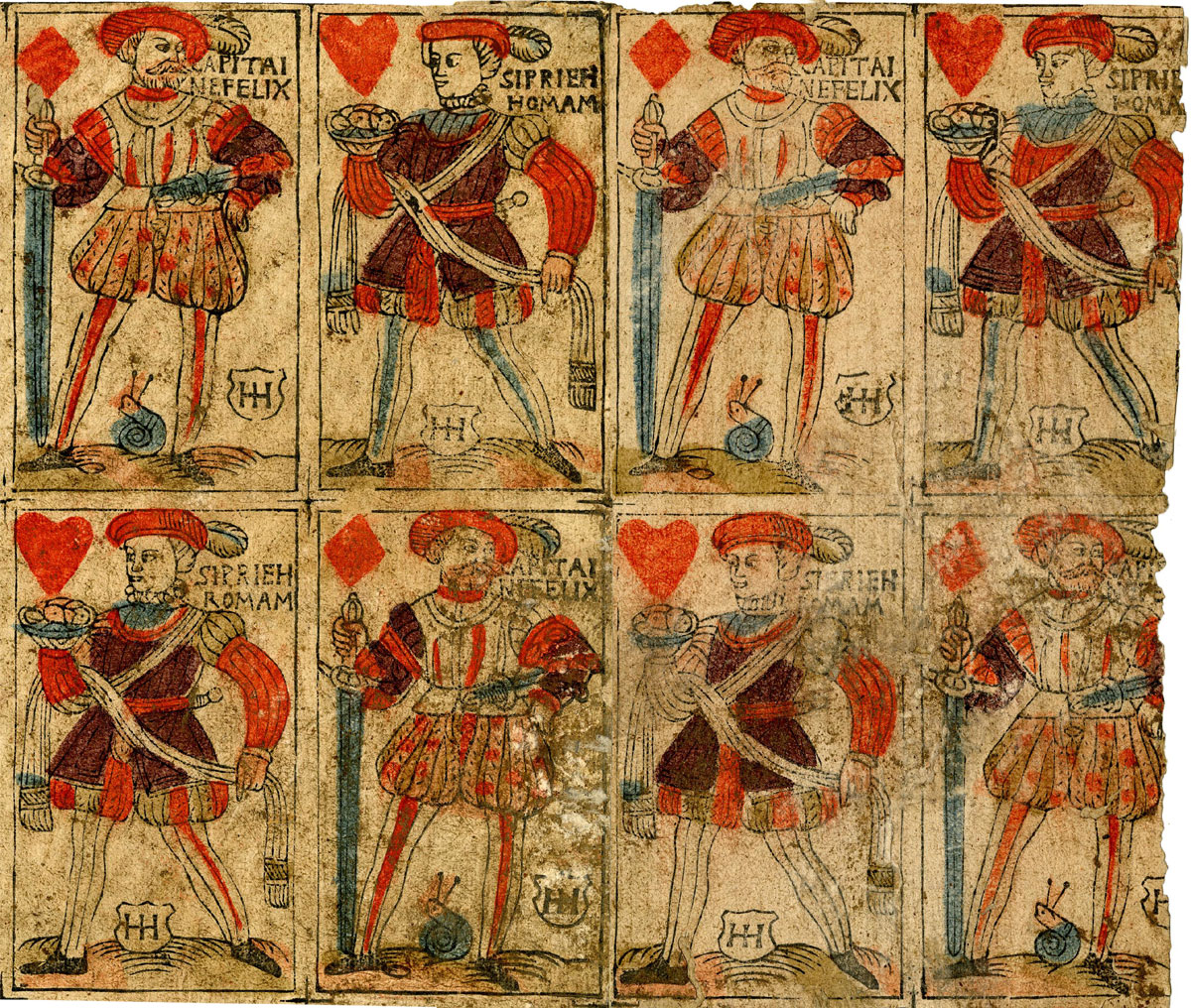
Above: cards printed by Heinrich Hauk, Frankfurt am Main, in c.1590, consisting of uncut fragmentary sheets containing four hand coloured playing-cards, all repetitions of the knave of hearts and knave of diamonds. Hand-coloured woodcut. © The Trustees of the British Museum • Museum number 1896,0501.1387►
References
• Beinecke Rare Book and Manuscript Library : Fragment sheets of 16th century German playing cards►
• Tor Gjerde : Heinrich Hauk, Frankfurt, 1585►

By Simon Wintle
Spain • Member since February 01, 1996
I am the founder of The World of Playing Cards (est. 1996), a website dedicated to the history, artistry and cultural significance of playing cards and tarot. Over the years I have researched various areas of the subject, acquired and traded collections and contributed as a committee member of the IPCS and graphics editor of The Playing-Card journal. Having lived in Chile, England, Wales, and now Spain, these experiences have shaped my work and passion for playing cards. Amongst my achievements is producing a limited-edition replica of a 17th-century English pack using woodblocks and stencils—a labour of love. Today, the World of Playing Cards is a global collaborative project, with my son Adam serving as the technical driving force behind its development. His innovative efforts have helped shape the site into the thriving hub it is today. You are warmly invited to become a contributor and share your enthusiasm.

Activity for Heinrich Hauk
Sign in to comment or save this article.

Related Articles
Most Popular
Our top articles from the past 60 days


