


Double-ended German-suited pack by Josef Glanz, Vienna.
From the British Museum collection.
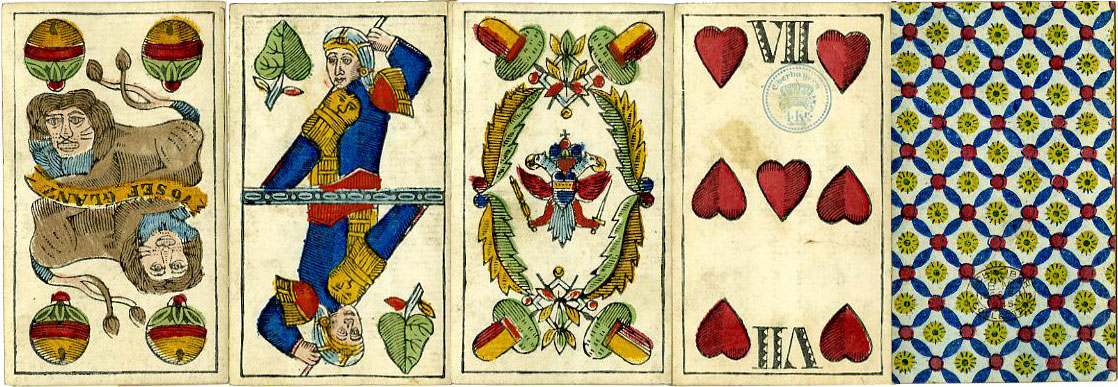
A double-ended, German-suited pack produced by Josef Glanz in Vienna, printed by J. Wolf, in c.1880 is preserved in the British Museum collection. The 2 of bells bears a lion with “J Glanz, Wien” on a scroll. The 2 of acorns bears the Austrian arms. Although the designs are non-standard, some of the court cards are reminiscent of earlier Bavarian patterns, such as the knaves sparring with military weapons, swords or playing musical instruments, wearing varied headgear. It is not easy to say whether the four kings, holding sceptres and each having two suit symbols, are seated or standing. The court cards are devided horizontally with decorative strips. The numeral cards, also double-ended, have Roman numerals but no vignettes. See the wrapper
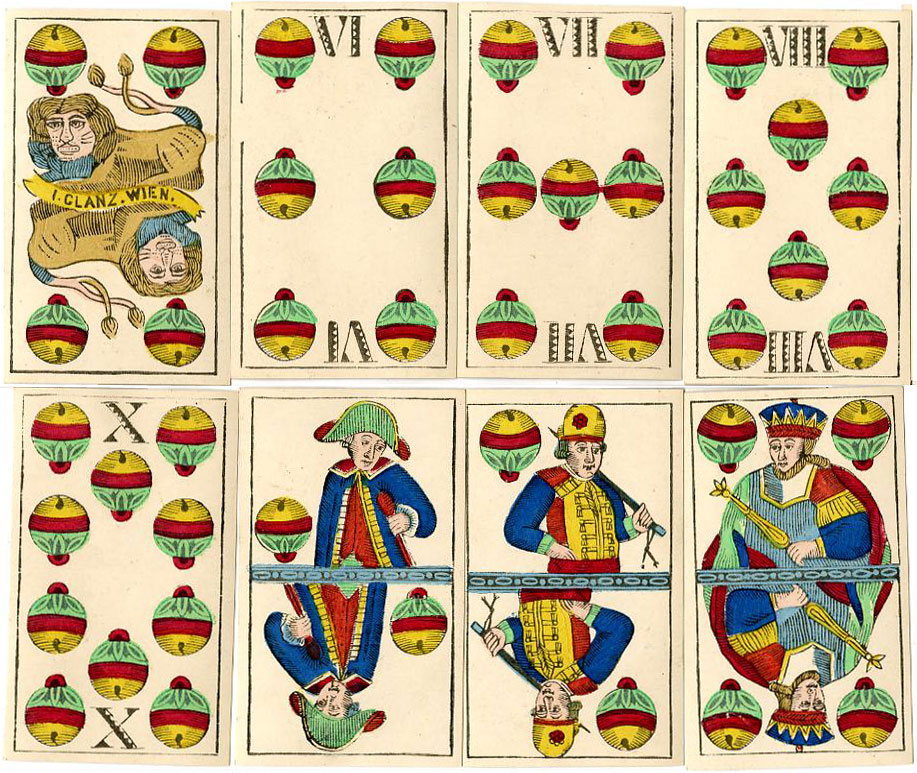
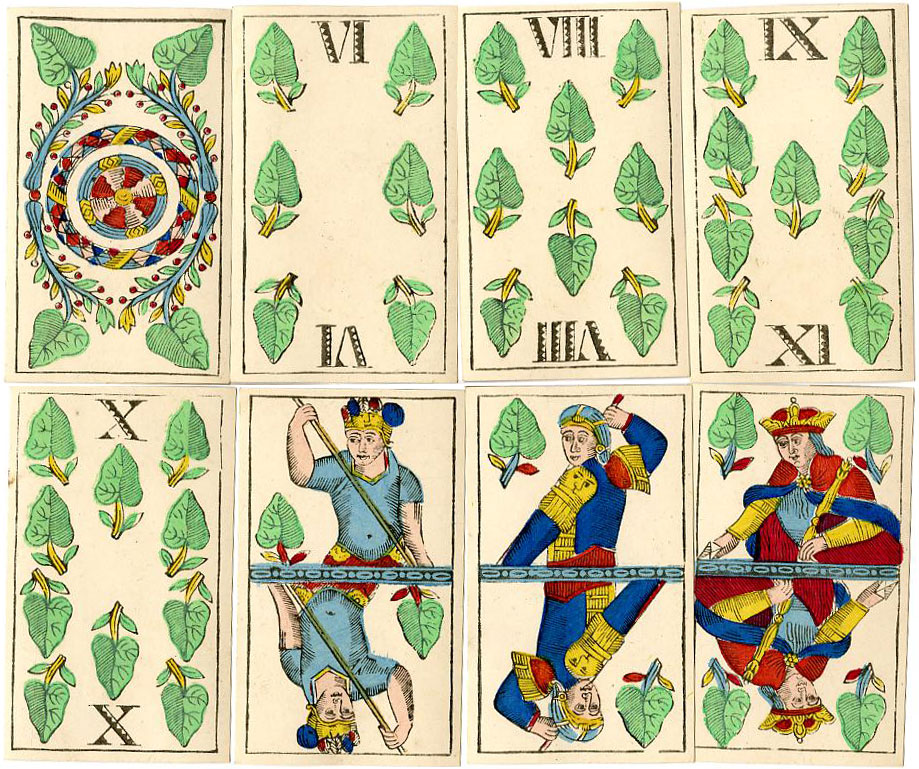
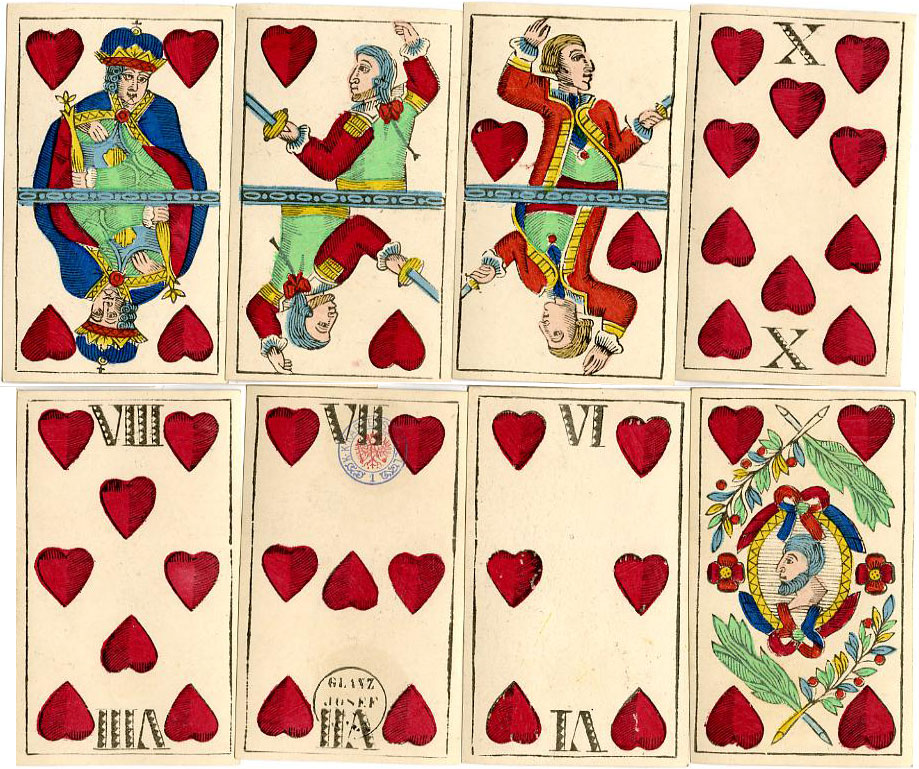
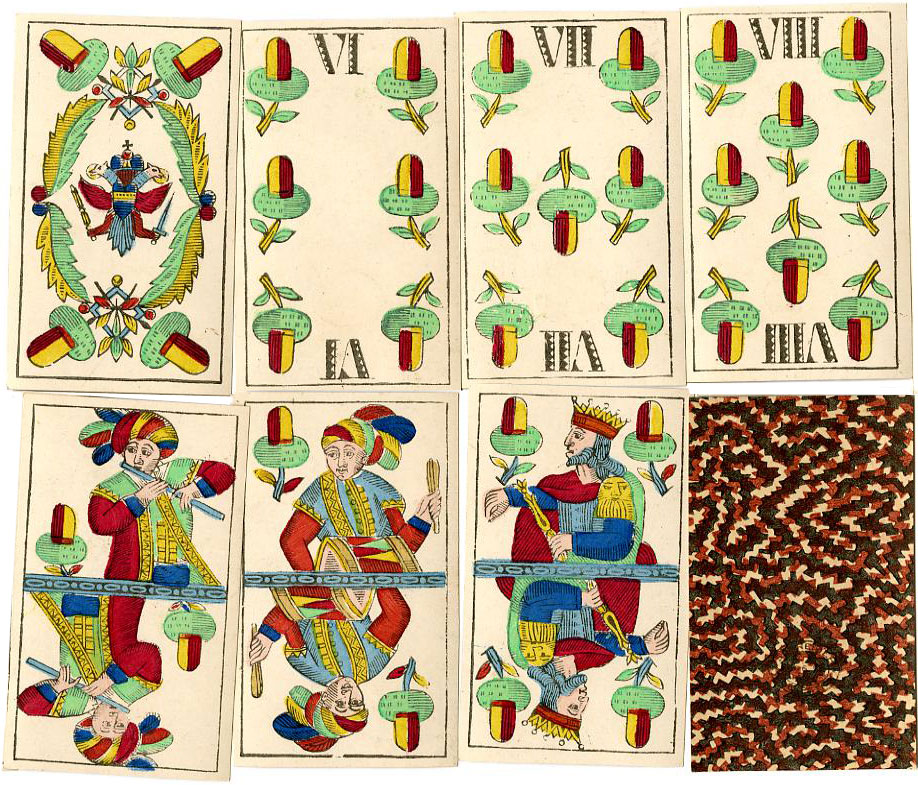
Above: double-ended, German-suited, 36-card pack produced by Josef Glanz, printed by J. Wolf. The backs are decorated with a zigzag pattern in red and brown achieved using rollers. The tax stamp on the VII of hearts was in use in Austria from 1877 to 1881. © The Trustees of the British Museum • Number 1896,0501.237►
The British Museum has another edition of this pack only with slight differences. It is catalogued as Museum Number 1896,0501.246*. The maker's name "Josef Glanz" appears on the 2 of bells (without the location) and the 2 of acorns bears the Austrian arms. A 4 Kreuzer German tax stamp is found on the VII of hearts, used between 1854 and 1874, and the cards have a different back design.
Above: © The Trustees of the British Museum
Reference
O’Donoghue, Freeman M: Catalogue of the collection of playing cards bequeathed by Lady Charlotte Schreiber (German 41 & 42), Trustees of the British Museum, London, 1901 [digital version here]

By Simon Wintle
Spain • Member since February 01, 1996
I am the founder of The World of Playing Cards (est. 1996), a website dedicated to the history, artistry and cultural significance of playing cards and tarot. Over the years I have researched various areas of the subject, acquired and traded collections and contributed as a committee member of the IPCS and graphics editor of The Playing-Card journal. Having lived in Chile, England, Wales, and now Spain, these experiences have shaped my work and passion for playing cards. Amongst my achievements is producing a limited-edition replica of a 17th-century English pack using woodblocks and stencils—a labour of love. Today, the World of Playing Cards is a global collaborative project, with my son Adam serving as the technical driving force behind its development. His innovative efforts have helped shape the site into the thriving hub it is today. You are warmly invited to become a contributor and share your enthusiasm.

Activity for Double-ended German-suited pack by Josef Glanz, Vienna.
Sign in to comment or save this article.

Related Articles
Warrior from Cattaro
A typology of Austrian Tarock documented through the evolution of one of its motifs.
Militar-Tarock No. 38
Non-standard tarock cards combining theatrical and military themes by Joseph Glanz.
Julius Berndl and his Austrian tarock
Josef Glanz's Tarock: a classic deck with artistic innovation by Julius Berndl.
Gigerl-Tarock by Joseph Glanz
Urban Dandy caricature deck from 19th century Vienna designed by Julius Berndl.
Patience by Joseph Glanz
A refined and distinctly European Patience pack by Joseph Glanz from Austria.
Whist by Ditha Moser
Ditha Moser created this minimalist Whist deck in 1905, in the style of the Vienna Secession art mov...
Joseph Sürch, Engraver
Joseph Sürch, a prominent Viennese engraver, made significant contributions to card sheet engraving ...
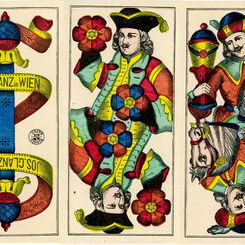
Trappola pack by Joseph Glanz
Double-ended Trappola pack by Joseph Glanz, Vienna, late 19th century.
Jugendstil Tarock
‘Jugendstil Tarock’ was designed by Ditha Moser and first published by Albert Berger and Josef Glanz...
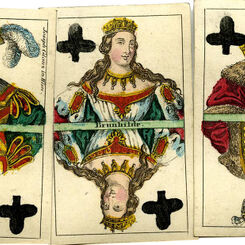
J. Glanz Historical playing cards
Historical Theatrical playing cards manufactured by J. Glanz, c.1860.
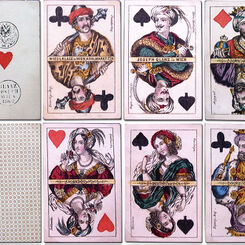
Joseph Glanz, 1862
Playing cards depicting Turkish and Greek rulers manufactured by Joseph Glanz, Vienna, Austria, 1862...
Most Popular
Our top articles from the past 60 days


jan merc
19 May 2026, 23:58SavedSaved this article to MOST WANTED