


61: French regional patterns: the kings
On page 11 I illustrated several examples of the regional French patterns from Sylvia Mann's collection; this is a more in-depth look at the figures of these patterns ("portraits" in French).
In 2015-16 I published an article in two parts about the court figures that appear in the French regional patterns in The Playing Card (Vol. 44/2 & /4). This is a simplified presentation of my findings. My aim is to trace the history of some of the figures and see how they were distributed in different patterns. I restrict myself to the French-suited patterns, though some of the figures appear in the Spanish-suited packs from Southwest France, too. For our purposes here, the standard English pattern is a French regional one.
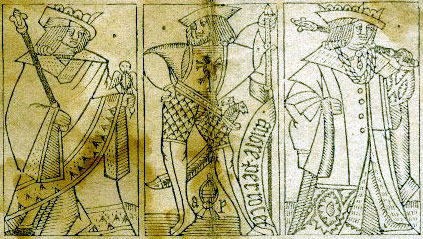
Above: detail of uncut sheet by André Perrocet, British Museum 1896,0501.1315►
The earliest recognizable figures appear in the last part of the 15th century and the first half of the 16th and some of them are still around today, even though their appearance has changed, sometimes quite dramatically. One of the earliest court sets comes from Lyons by a maker named Andre Perrocet, who is known to have operated from 1491 until 1524. The KC from the Perrocet set turns up facing the other way in Burgundy and later in the 18th century Lyonnais pattern carrying an orb as well as a sceptre.
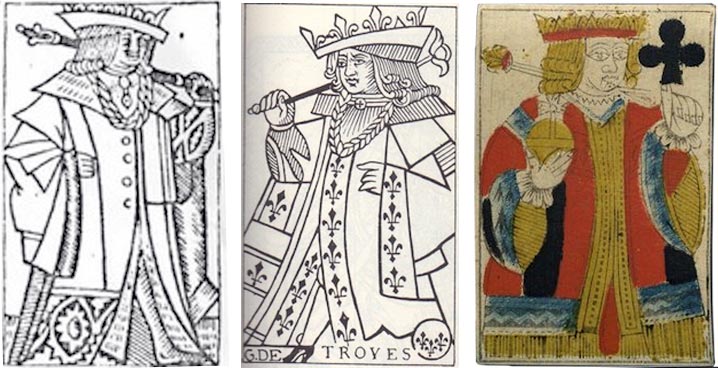
Above: Perrocet KC; Burgundy KH; Lyons KC (K5)
Although the Perrocet sheet is uncoloured without pips, it is easy to determine the suits from later examples of the courts. In the case of the Burgundian example it, too, is from an uncoloured sheet, but there are plenty of coloured examples to indicate the suit. The differences in detail between the three examples need not concern us too much. The orientation of a figure is quite arbitrary and can be changed, if the original is copied directly onto the block without making the necessary adjustment of turning it to produce a print facing the same way. The addition of features like the orb in the later KC can be seen as a deliberate attempt to make a difference with what is being copied and/or 'artistic licence'. In some of the earliest uncut sheets there are examples of the same figure facing different ways and the same figure holding different attributes. On the example below there are two KCs (Alesandre) each facing in opposite directions and two JC, one with an arrow and one with a halberd.
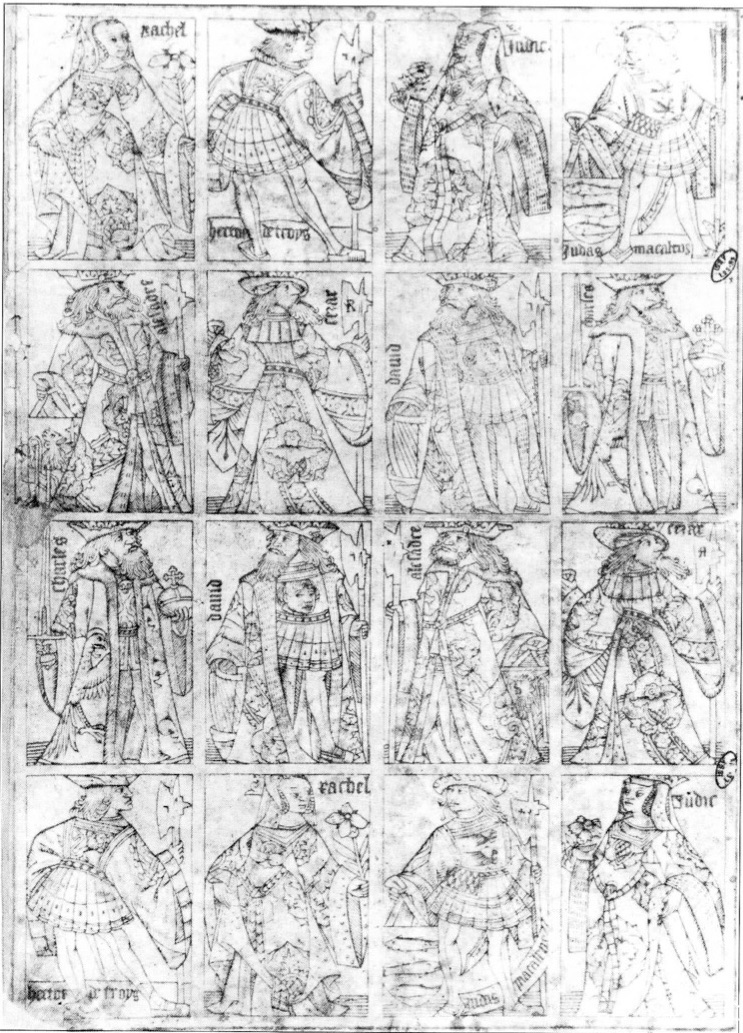
Above: Uncut sheet by Guymier (?c.1500 or earlier). This is a very early version of the first Paris pattern; the name of the JC is Judas Macabeus (not Lancelot).
So, the change of orientation and the alteration or addition of attributes need not concern us in dealing with sameness of figure. They are within the range of possible variation and, of themselves, do not necessarily constitute a different figure. (Think of the variation found in the standard English figures, a major topic of this blog.) We can now move on to consider the various figures in the regional patterns and determine their distribution throughout the different court sets. I've numbered each figure for reference.
The Kings
K1 is KS in Perrocet's sheet, Provence and 18th century Lyons (third pattern).
K2 is a clean-shaven KD from the second Lyons pattern (which eventually became the Austrian patterns A and B), a bearded KD in Auvergne and a bearded KH in Dauphiné. The last two are holding a dagger in their belt.
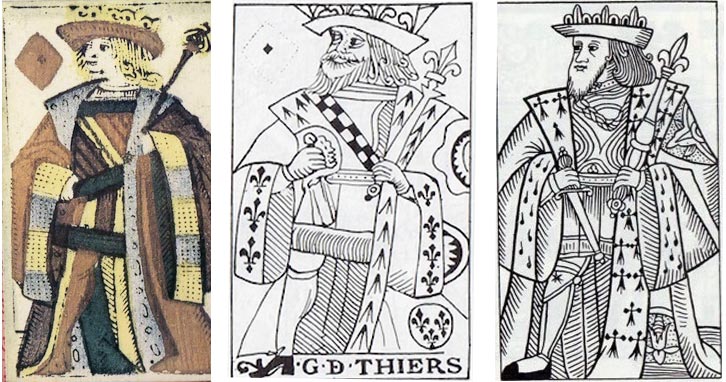
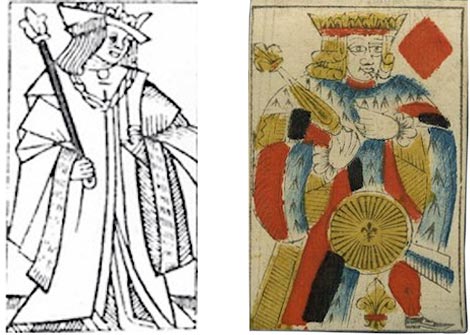
K3 is another descendant of Perrocet's court set found in the third Lyons pattern of the 18th century. In both cases he is the KD.
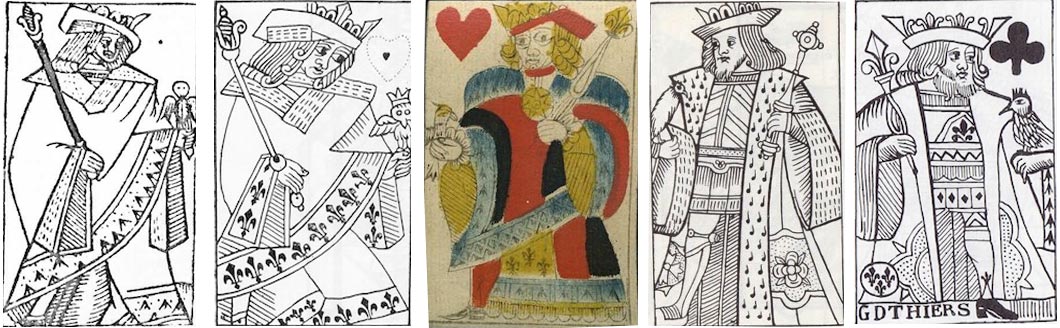
K4 is the bird-holding king found in a number of patterns: KH in Perrocet's set and in Provence; in Lyons 3 he is facing left. In Dauphiné he is KD facing left and in Auvergne KC facing right.
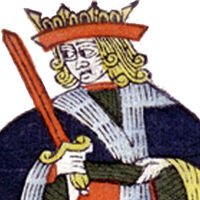
K5 is exemplified at the top of the page.
K6 is KS in Lyons 2 and Auvergne, KD in Provence and Burgundy and KC in Languedoc, the last three facing left
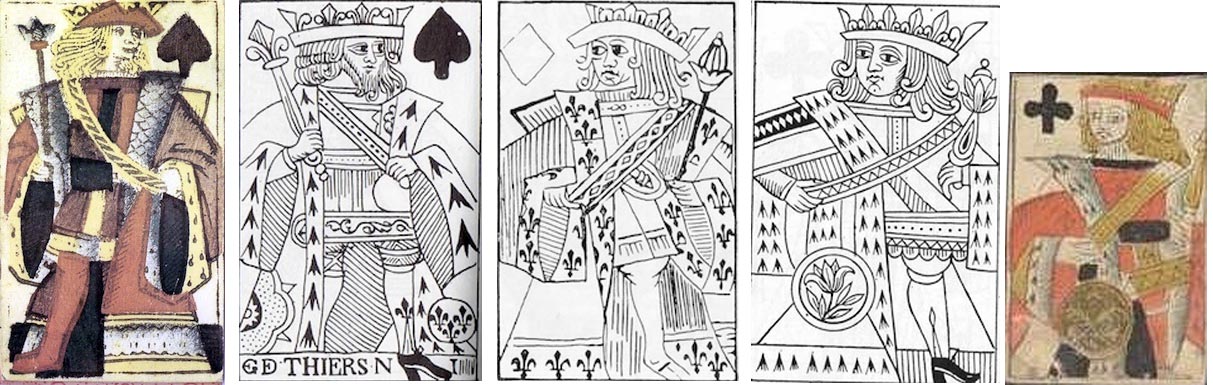
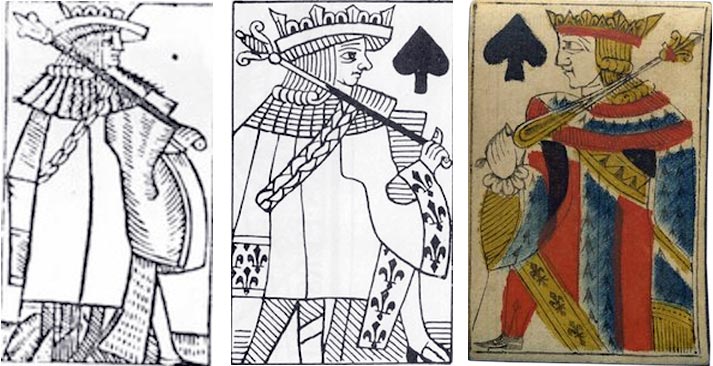
K7 is the axe-wielding king found in a number of patterns including the English standard, though he now wields a sword behind his head. The Rouen example below is from the Maréchal court set. In Languedoc he is the KS and in Provence the KC facing right.
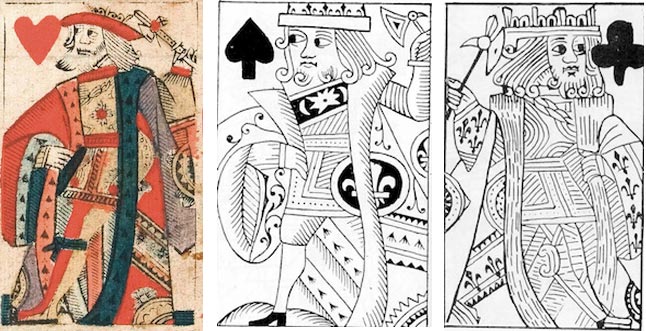
There are other figures that are more restricted, which I discuss in my The Playing Card article, but I will close this page of kings with just one more.
K10 is the first Paris KH, the Auvergne KH facing left and the Dauphiné KC.
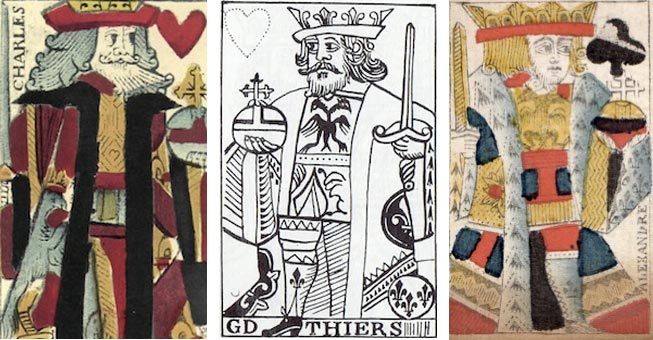
According to Seguin Le jeu de carte (1968), several of the regional patterns were exported from Lyons to other parts of France and one was exported from Auvergne, as follows: Lyons 1 represented by the Perrocet sheet; Lyons 2 represented by the pack from Sylvia Mann's collection with the identifier IV on the JC (KD and KS illustrated above); Lyons 3 was the third version, as used in the 18th century; Lyons 4 exported to Burgundy; Lyons 5 exported to Dauphiné; Lyons 6 exported to Provence. Auvergne 2 was exported to Languedoc.
The queens and jacks will be dealt with on the


By Ken Lodge
United Kingdom • Member since May 14, 2012
I'm Ken Lodge and have been collecting playing cards since I was about eighteen months old (1945). I am also a trained academic, so I can observe and analyze reasonably well. I've applied these analytical techniques over a long period of time to the study of playing cards and have managed to assemble a large amount of information about them, especially those of the standard English pattern. About Ken Lodge →

Activity for 61: French regional patterns: the kings
Sign in to comment or save this article.

Related Articles
French Revolutionary cards by Pinaut
Seven cards from a French Revolutionary pack by Pinaut featuring characters from classical antiquity...
Rouen Pattern - Portrait Rouennais
An attractive XV century French-suited design from Rouen became the standard English & Anglo-America...
The Parisian Tarot
The “Parisian Tarot”, early 1600s, with imagery and design synthesizing several influences.
Languedoc pattern - Portrait de Languedoc
The old Languedoc pattern was known at the beginning of the seventeenth century, if not before.
Pierre Roiné Aluette
Archaic form of Aluette published by Pierre Roiné, Nantes, c.1785.
Antoine de Logiriera
Archaic Spanish-suited playing cards published in Toulouse by Antoine de Logiriera (1495-1518).
A. Camoin & Cie
This deck was inherited from ancestors, it has has a family history surrounding it. Details of the l...
Prisoners of War
Hand-made playing cards by French prisoners of war in Porchester Castle, Hampshire, c.1796.
64: The descendants of the French regional patterns: 2
A continuation oF the development of the off-spring of the Paris patterns and a few examples of how ...
63: The descendants of the French regional patterns: 1
A great many regional patterns were exported from France and subsequently copied elsewhere. Some of ...
62: French regional patterns: the queens and jacks
Continuing our look at the figures from the regional patterns of France.
Pedro Varangot, 1786
Archaic Navarra pattern produced for the Pamplona General Hospital Monopoly by Pedro Varangot in 178...
Provence Pattern - Portrait de Provence
The 'Provence' pattern contains figures which go back to the fifteenth century.
Pierre Marechal
Rouen became an important centre for card-making whose influence extended far afield. Cards from Rou...
Benoist Laius
Spanish playing cards such as these were used in those parts of France where certain games were enjo...
Lyon Pattern type iii
This pattern was used in various parts of eastern France but was ultimately replaced by the official...
1: Playing Cards and their History: An Introduction and some links to other sites
What was considered the first mention of playing cards in England is in 1463 when Edward I banned th...
Paris Pattern
The Paris pattern was established as such around the middle of the seventeenth century (based, perha...
Early Anglo-French Cards
Cards produced in Rouen during the sixteenth century. It was cards like these which were imported to...
History of Court Cards
The court cards in English packs of playing cards derive from models produced by Pierre Marechal in ...
Most Popular
Our top articles from the past 60 days


