


Pictures of Early Whist writers and their stories
The Invisible Experts: Tracking the Elusive Faces of Whist History.
I have spent a chunk of the last decade researching and writing about various aspects of card playing history, particularly in the 19th century. There are any number of great names from this era and earlier. From Edmond Hoyle to James Clay, Henry Jones (“Cavendish”) and the great R. F. Foster. In earlier articles I have tried to identify their place and role in the evolution of writing about whist and other card games¹. It has been possible to illustrate articles with books from my collection, but finding pictures of the authors has proved inordinately difficult. On reflection, one should not be surprised. Although crude photography was being developed from the mid-1830s it was many decades before it became commonplace. It was simply not the norm to include photographs of authors in books until well into the 20th century, and in the 19th century paintings were largely the prerogative of the aristocracy, senior politicians and the like. While there are numerous paintings and engravings of, for example, the great composers such as Chopin, Beethoven, Mozart et al, and military figures such as Napoleon and Wellington, the same is not true of the “great” writers on whist, bezique, and the like!
Not surprisingly, therefore, finding pictures of the “great names” in whist was like searching for hens’ teeth. Going back to the early days I have in the past used a well-known engraving of Edmond Hoyle² – a founding father of whist writing – but it is only recently that I have discovered a painting by an Irish artist, James Latham, which is believed to be the only other picture of Hoyle in existence. Although one can see the resemblance to the engraving, he does seem instantly more like a real person.

Edmond Hoyle (1672–1769)³
Continuing my search, I have recently at last tracked down a book I have been targeting for some time, namely “The Whist Table”, edited by “Portland” (James Hogg) and published by John Hogg, London, 1894⁴. Even by this date, pictures of the key authors were considered rare. “Three Portraits are given in this volume, for the first time, which will be prized by lovers of Whist.” Despite his enthusiasm for including pictures of key people, he did not, sadly, offer one of his own and so we know little of James Hogg himself or what he looked like.
The first picture from the book (below, right) is of James Clay, a key figure on the world of whist from the middle of the 19th century until his death in 1873, as well as being MP for Hull for 22 years. The one on the left, as a much younger man when beginning his career as an MP, is from the National Trust Collections.

James Clay (1804-1873)⁵ ⁶
With John Loraine Baldwin, Clay wrote the seminal work “The Laws of Short Whist and a Treatise on the Game” in 1881⁷. This caricature of Baldwin was drawn by Sir Leslie Matthew Ward and published in Vanity Fair on 5th November 1895 underling that Baldwin too was a significant figure of his time.

John Loraine Baldwin (1809-1896)⁸
Both men were keen to rationalise the game of whist as it was being played and an appeal was made to some of the key London card-playing clubs for their assistance and support. As a result, a committee was set up, and James Clay was appointed chairman in 1863. Their version of the Rules, subject to minor amendments suggested by the Portland Club (see below), became the laws of whist as they have been played just about everywhere since.
James Clay, as politician, was a member of the Liberal Party, and considered to be a radical. He was a strong advocate for parliamentary reform, specifically focusing on expanding the franchise to include educated working men. He was a close friend and associate of the Conservative leader Benjamin Disraeli and worked with him to ensure the passage of the Reform Act 1867.
But his political career was not without controversay….to say the least. Clay was MP for Kingston upon Hull from July 1847 until 1853 when he was unseated by a Parliamentary Committee following a bribery inquiry. The inquiry concluded that Clay’s agent had “actively engaged… in carrying into effect a most extensive system of bribery and treating” during the election campaign, “bribing the poorer class of voters in great numbers” at roughly thirty shillings a head. It was not proven whether Clay had approved or even known about what had been going on but the election result was nevertheless voided. Despite this controversy, the good people of Hull returned Clay to Parliament at a by-election in 1857, and he continued to serve as their MP until his death in 1873. None of this appears to have had a major impact on his political career or his role in the whist playing community! At his death an anonymous obituary in the whist and chess periodical, The Westminster Papers, described him as “the acknowledged head of the Whist World”.
John Loraine Baldwin, benefitting from inherited private wealth, was an all-round games and sports enthusiast. In addition to his work codifying the laws of short whist, in 1845 he was one of the founders of the “I Zingari” nomadic amateur cricket club⁹ and produced the first standardised rules for badminton in 1868. In 1870, Baldwin "devoted his time to a careful study of the game of Besique", producing a volume on its rules and "a system ... by which all players should regulate their game".
Few 19th century writers on whist and card games rivalled our next portrait taken from The Whist Table, namely Henry Jones who wrote numerous books and articles under the pseudonym “Cavendish”¹⁰. His eminence in the field is underlined by the inclusion of this portrait as the Frontispiece to the book.

Henry Jones “Cavendish (1831-1899). Here is an early photograph, source unknown (1); photograph from “The Whist Table” (2) and the photograph used with his obituary in the Illustrated London News, 25th February 1899 (3). Profiles were evidently very much in vogue.
“Cavendish” was a prolific writer on whist, card games and other games in the second half of the 19th century. As Chairman of the Portland Club Whist Committee he had collaborated with James Clay in framing the final version of the “Laws of Short Whist” edited by John Loraine Baldwin in May 1864.
In addition to his work on Whist, Cavendish produced guides to croquet (1869), bezique (1870), écarté (1870), euchre (1870), calabrasella (1870), cribbage (1873), piquet (1873 to 1896), vingt-et-un (1874), go-bang (1876), lawn tennis and badminton (1876), chess (1878), backgammon (1878), and patience games (1890). He was also interested on croquet and helped to found the Wimbledon-based All England Croquet Club and proposed that one of the croquet lawns should be given over for lawn tennis thus heralding the origins of the Wimbledon Tennis Championships. He was the author of articles about these games in the Encyclopædia Britannica and Chambers Encyclopædia as well as in many journals of the day. Jones worked closely with De La Rue both in writing their pocket guides and as the named sponsor of De La Rue’s uniquely designed “Cavendish Whist Marker”¹¹.
My next image is of Major Arthur Campbell-Walker (1834-1887)¹².

Major Campbell-Walker was the author of the “The Correct Card or How to Play at Whist”, 1876. It is a small volume presented uniquely in the form of questions (as if from a beginner) and answers (from the author). He had previously had a distinguished army career in the Queen’s Own Cameron Highlanders, serving in both the Crimean War and the Seige of Lucknow during the Indian Rebellion of 1857.¹³ My edition of the book, dated 1882, is designated as “Eleventh thousand” which I presume is an unusual reference to the number of copies previously sold. In his preface to the 1879 edition – “Dedicated, with permission, to ‘Cavendish" – he brags about how his book is on sale in Yokohama, Japan and that a recent letter to him “in no spirit of egotism, shows that the book is now a household word in America”. Major Campbell-Walker was not a shrinking violet despite his exceedingly modest contribution to the literature on whist.
Next, the rather more esteemed Richard Anthony Procter¹⁴.

Richard Anthony Procter (1837-1888), “Five of Clubs”
Richard A Proctor was primarily an astronomer and was elected a fellow of the Royal Astronomical Society in 1866, becoming its honorary secretary in 1872. He still found time to write a number of books and articles on gambling, chance and luck and to pen his influential book “How to Play Whist” in 1885. As far as I can tell, the only time he used the “Five of Clubs” pseudonym was in the first edition of his book on whist; everything else – before and afterwards - appeared in his own name. But even here, he included his own name in brackets underneath his pseudonym. Why he would use a pseudonym at all – other than the fact that everyone else seemed to be doing it¹⁵ – is beyond my understanding!


Major-General Alfred Wilks Drayson 1827–1901¹⁶
The Major-General came to my attention as the author of “The Art of Practical Whist”, 1879, together with a number of other publications on whist on both sides of the Atlantic, and his “The Art of Practical Billiards for Amateurs”. Before this he had had a significant career in the Royal Artillery serving in the seventh Xhosa war in South Africa, India and Nova Scotia.
Between 1858 and 1873 he worked at the Royal Military Academy, Woolwich, serving as Professor of Surveying and Topographical Drawing. The sketch below shows a group of instructors in 1869, with Alfred Wilks Drayson on the extreme right. He retired from the army in 1883 with the honorary rank of major-general, and became president of the Portsmouth Literary and Scientific Society.¹⁷

My next picture is of someone who played a role more behind the scenes than in the full glare of publicity in the world of whist but is no less worthy of a mention here. The photograph of Charles Mossop is the third of the three portraits contained in “The Whist Table”. This was “kindly allowed from an original in the possession of the family”.

Charles Mossop
Charles Mossop was a solicitor by day, and at other times for many years was the proprietor and editor of “The Westminster Papers: A Monthly Journal of Chess, Whist, Games of Skill and the Drama". He is described by “Portland” (James Hogg) as a “distinguished authority on Whist, Baccarat, and other games and has thus enabled the Editor to popularise many valuable papers now almost inaccessible – out of those rare quartos which for eleven years embodied so much humour and wisdom on the Royal Game of Whist”.¹⁸
Finally, (for the moment), I present a photograph of my own 19th century whist writing hero, R.F Foster, with a tale about how I managed to track it down.

Robert Frederick Foster (May 31, 1853 – December 25, 1945)
I have written elsewhere at length about the contribution of this extraordinary writer on card games¹⁹. He is, in my view, unsurpassed as a codifier and presenter of the rules of just about any card game you wish to mention.
As he died in 1945, much later than my other characters, surely there must be pictures or photographs of him somewhere to illustrate my various articles, but extensive internet and other searches failed over a number of years. For someone who was so well known in his field for so long it seems extraordinary to think that he must have been so averse to his picture being taken and published that none existed. Eventually, courtesy of Copilot AI, I managed to identify the existence of one photograph taken by US photographer Arnold Genthe in November 1918. A copy, I understood, was housed in the US Library of Congress. I spent over an hour seeking entry to the Library, via my computer, only to fail repeatedly to convince the Library of Congress computer that I was not a robot! In frustration I returned to Copilot and asked if this AI robot could obtain a copy of the aforementioned picture. Within a few minutes I had it, shown above. So, as a human being I had failed to convince a computer that I was not a robot, but a robot had managed to evade the restrictions and gain access instantly. It’s a funny old world!
So, what have we learned. Portraits of the great 19th century writers of key books on whist and other card games, despite their celebrity, are rare, and exceedingly hard to find. Even in 1894 James Hogg was obviously delighted to be able to track down and include three such pictures in his book, reproduced with their permission or that of their families. Things changed dramatically as photography in the 20th century became commonplace and today pictures of celebrity writers, and just about anyone else, are available at the click of a mouse.
Tony Hall, 5th February 2026
References
- See for example: “The Personalities and Books which shaped the game of Whist, 1860 – 1900”, 2022; and “Whist Writers and their Pseudonyms”, 2023, updated 2025
- “Hoyle and his Legacy”, 2023
- Painting sold by Country House Fine Art
- I can find no familial link between James Hogg the editor and John Hogg the publisher.
- Portrait owned by the National Trust by an unknown artist sometime between 1830-1835
- Reproduced in “The Whist Table”, edited by “Portland”, Page 49
- Published by De La Rue.
- Sir Leslie Matthew Ward published over 1300 portraits in Vanity Fair over four decades under various pseudonyms. For this one he used the name “Spy”.
- The club still exists today playing around 20 matches a year.
- For details see “The Personalities and Books which shaped the game of Whist, 1860–1900”, 2022;
- A New Look at the Evolution of Whist Markers and Gaming Counters, 2023
- Engraving included with his obituary in The Chronicle, 8th April, 1887
- See Personalities and Books etc, op cit
- Science Photo Library
- Whist Writers and their Pseudonyms, op cit
- Morgan Family History Blog
- Details of army career and sketch from Wikipedia.
- The Whist Table, preface, pp. vii
- For example, Hoyle v Foster: Whose name should we remember?, 2023

By Tony Hall
United Kingdom • Member since January 30, 2015
I started my interest in card games about 70 years ago, playing cribbage with my grandfather. Collecting card game materials started 50 years or so later, when time permitted. One cribbage board was a memory; two became the start of a collection currently exceeding 150!
Once interest in the social history of card games was sparked, I bought a wooden whist marker from the 1880s which was ingenious in design and unbelievably tactile. One lead to two and there was no stopping.
What happened thereafter is reflected in my articles and downloads on this site, for which I will be eternally grateful.

Activity for Pictures of Early Whist writers and their stories
Sign in to comment or save this article.

Related Articles
Cheating at Whist and Bridge
The Blackleg in the Drawing-Room: Cheating and the Victorian Gentleman.
Solo Whist
A distinctive British trick-taking game that emerged in the mid-19th century.
The Molassine Company and its link to Whist and Bridge
A savvy marketing strategy blending Victorian decorative design with Edwardian practicality.
Scientific Whist
“Scientific Whist” : standard cards with instructions for play on the faces by Chas Goodall & Son, 1...
Agatha Christie and Playing Cards revisited
Agatha Christie uses card-play as a primary focus of a story, and as a way of creating plots and mot...
Dorset Dialect Trails
‘Dorset Dialect Trails’ playing cards, United Kingdom, 2015.
De La Rue Pocket Guides
The 19th Century saw the production, by all of the major companies, of pocket guides or “mini-books”...
Whist writers and their pseudonyms
Why did so many early writers about whist and other card games feel the need to write under a pseudo...
Whist marker boxes
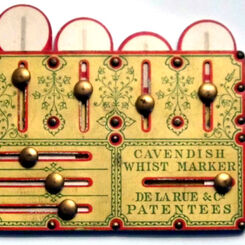
The Camden Whist marker was being advertised by Goodall and son in 1872 as a new product.
Shakespeare finely illustrated playing cards
Shakespeare playing cards with illustrations by Sir John Gilbert RA, United Kingdom.
Vanity Fair 1868-1914
Vanity Fair 1868-1914 playing cards published by Billy Bembo, United Kingdom, 1995.
Agatha Christie Playing Cards
Agatha Christie playing cards produced by Planet Three Collection, United Kingdom, c. 2004.
Library Lovers
Library Lovers playing cards published by Word Nerd Games, 2016.
Sixty Penguin Years Playing Cards
In celebration of 60 years of publishing Penguin Books Ltd, 1995.
Alice in Wonderland by Dominic Murphy
Alice in Wonderland playing cards produced by Dominic Murphy.
Alice’s Adventures in Wonderland
Alice's Adventures in Wonderland illustrated by Helen Oxenbury, 1999.
Alice in Wonderland by Cultzilla
Alice in Wonderland 'Curious' playing cards by Cultzilla.
Dickens Character Collection
Dickens Character Collection published for a London Casino as a promotional gift.
Dickens Snap
Dickens Snap, c.1890.
Aesop’s Fables
Aesop’s Fables playing cards by I. Kirk, c.1759.
Most Popular
Our top articles from the past 60 days


