


Cheating at Whist and Bridge
The Blackleg in the Drawing-Room: Cheating and the Victorian Gentleman.
For as long as card games have been played, there are those who would seek to gain an unfair advantage by cheating. Sadly, this seems to be a universal truth, and not just in the field of card games. How this cheating was done and how attempts were made to stop it, or at least to identify those involved and minimise its impact, is a rich vein for study. Whilst the “problem” potentially impacts all card games, particularly when playing for high stakes, the comparison between whist in the 19th century and bridge in the 20th century and beyond is probably the best documented and therefore the most fruitful area for a closer look.
Cheating at cards is not a modern phenomenon. Regrettably it has been identified for as long as card games have been played, and before that the Romans used loaded dice and certainly followed corrupt practices in relation to gladiatorial combat as did the Greeks in relation to the ancient Olympics¹. Compiling his bibliography of card games in 1905, Jessel² includes no fewer than 31 books and articles on the subject of card sharping dating from 1714 to 1895. More recently T. Hayes has produced a 167-page eBook³ identifying 151 English language publications on card cheating before 1900 and identifies and classifies no fewer than 146 different cheating techniques.

Above: ‘The Female Coterie’ satirical print made by Thomas Bonnor, 1770, on the Coterie, a society of ladies and gentlemen. People are gambling for high stakes ("Mortgage", "£50,000", a jewelled necklace), cheating at cards, flirting, drinking, kissing; a lady holds up a miniature of her husband while embracing another man who makes the sign of the cuckold behind the portrait; a couple are heading up a staircase. © The Trustees of the British Museum • number 1868,0808.9914 ►
Whist
From the earliest writings on whist, concern was expressed about the problem of cheating. In the early to mid-19th century concern was about professional card sharpers known as “blacklegs” who engaged in various forms of card manipulation, using stacked decks, bottom dealing, the marking or “shaving”⁴ of cards and improper signalling by a partner or observer. Members of the Devy family, for example, were the subject of newspaper reports of their dodgy dealing in the 1820s and 30s and they were banned from a number of London clubs as a result. Several players were banned from the Crockford’s Club in the 1830s, accused of manipulating cards whilst playing whist and écarté.⁵

Above: "a Ruse, a Ruse" cartoon refering to the Lord de Ros case in 1836.
In 1836 a Mr. Cumming and several other club members⁶ accused the baronet Lord de Ros, a noted whist player, of cheating at cards at Graham’s Club in London. Rumours circulated that when playing whist and écarté he used cards marked with a thumbnail, sleight of hand and frequently revoked when it benefited his play. The rumours lead to an exchange of letters and reports of the incident. Given the potential reputational damage caused, Lord de Ros sued Cumming and others for libel claiming that the accusations of cheating were false and that he had suffered severe reputational damage. The case was heard by Lord Denman and a “Special Jury”.⁷
After evidence was presented by several club members who had observed the activities of Lord de Ros, the jury retired and returned in only 15 minutes with a verdict against Lord de Ros. They believed that he had cheated at cards as described and therefore there had been no libel. Lord de Ros was ruined socially and moved abroad.
The problem of cheating at cards was regarded so seriously that in 1844 the Parliamentary Committee on Gaming started gathering evidence about widespread cheating in card rooms and gambling houses, including whist-related fraud. Their report expressed concern about the growth of unregulated gaming houses, the weak enforcement of existing laws, and the social problems associated with betting. Its views contributed to the Gaming Act, 1845, and the Betting Act, 1853, which influenced the growth of gaming houses and street betting, but did little to tackle the problem of cheating at cards other than to highlight concerns about the practice.
A few high profile cases of cheating ended in the Courts. In 1851, two professional gamblers, Orme and Miner⁸, were accused of using chemically marked cards and fraudulent play at whist in London Clubs before opening their own gaming houses where various forms of cheating were easier to manage. (One of the accusations concerned “signalling” which is discussed below.) Both were convicted.
In a Divorce Court hearing in 1866⁹, cheating at whist became part of the evidence. Witnesses testified that one spouse regularly colluded with a whist partner and used fraudulent techniques such as card-marking and signalling.
Contemporary literature attests to the fact that cheating at cards was a well-known phenomenon. Charles Dickens and other Victorian writers frequently included whist cheats in their stories, based on real figures of the time. Dickens’ portrayal of Sir John Chester in Barnaby Rudge — a polished but unscrupulous Whist player — reflects widely known stereotypes of fashionable cheats of the era. While fictional, these portrayals were easily recognised by contemporary readers.
No review of cheating at cards in the 19th century would be complete without reference to the Baccarat scandal of 1891. Sir William Gordon-Cumming¹⁰, a decorated Lieutenant Colonel in the Scots Guards and close associate of the Prince of Wales, was accused of cheating at Baccarat at a house party at Tranby Croft in Yorkshire hosted by the wealthy ship owner, Arthur Wilson. The Prince of Wales was present.
Although itself illegal in private houses at the time, guests played the high stakes gambling game baccarat. Gordon-Cumming was accused of cheating by dishonestly increasing his bets after seeing the outcome of the cards played. This was observed by several guests. To avoid a scandal, Gordon-Cumming signed a written agreement promising never to play cards again in exchange for keeping the matter private.
But rumours of the event circulated widely so Gordon-Cumming felt his only option was to sue for slander against his accusers. At the trial, the Prince of Wales was a witness to the signing of the document, although Gordon-Cumming claimed he had done so under duress and was innocent. Given the fact that a senior member of the Royal family was involved in illegal gambling, and required to give evidence in court, it is not hard to imagine the extent and nature of the publicity caused by this case.
In the event, the jury, as it was a slander case, was not required to adjudicate on whether or not cheating had taken place but whether the accusers had made their claims in good faith and were not, therefore, guilty of slander. They found against Gordon-Cumming and, in doing so, he not only lost his case but also his reputation. He was socially ostracised and forced to resign his commission in the army.

Above left: Engraving by William D. Almond. Right: Part of front page of a “Penny Dreadful”, 6th June 1891
Evidently, there were numerous instances of charges of cheating, and counter claims of slander at this time, occasionally ending in court action.¹¹ But most such instances were hushed up to avoid embarrassing and potentially damaging publicity for the clubs involved, and miscreants were quietly asked to resign and faced the social consequences.
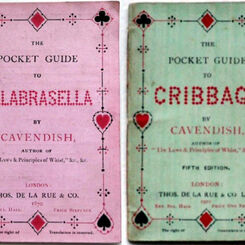
Henry Jones (“Cavendish”), one of the key 19th Century writers on whist and other card games, wrote, in 1870: “Cheating at Whist is, unhappily, no new practice…Whenever money is staked, the sharper is tempted to ply their vocation; and the modes of signalling, of marking the cards, and of tampering with the deal are innumerable.”¹² Cheating is everywhere. “The honest player”, he argues, “must keep a vigilant eye, for the cheat is generally a person of agreeable manners, studied composure and long practice”. And the consequences of being caught cheating can be grave: “To be suspected of foul play at Whist is, in club life, a stain scarcely to be erased. It is far better to lose a rubber than to sit at a table with those whose integrity is doubtful.”
What counts as cheating?
The issue of managing this evidently widespread problem was complicated by evolving views on what constituted cheating. Cavendish was particularly concerned about illegal signalling, probably the most frequent form of cheating, both socially and in the clubs. “Much of the dishonesty at the whist-table consists in conveying information to a partner by signs, touches and movements intended to escape detection. These are wholly incompatible with the spirit of the game, and the player who resorts to them is guilty of an offence not only against honour but against reason".¹³
Some forms of communication between partners were clearly unacceptable. “An agreement to hold trumps in a particular part of the hand, or to hold the hand loosely or tightly, according to the number of trumps, or to hold the honours slightly sloped, or to discard alternately from the highest or lowest suit, or to communicate by attitude any other information, would almost infallibly give the victory to the players making it, and in many cases could never be detected.”¹⁴
But other forms of signally were still up for debate. Even by 1879, an article in The Spectator under the heading “Cheating at Whist” quotes Dr. W. Pole, another of the great names of the era, criticising some of the card plays who conveyed to a partner whether or not to lead a trump, or signalling a short suit.¹⁵ Pole considered such practices to be “the thin end of the wedge” leading to increasingly complex and illicit forms of communication between partners.

Above: The Spectator 5 April 1879, carried an article titled Cheating at Whist: “MR. W. POLE, a well-known authority on Whist, has fired rather a heavy shot through this month's Fortnightly into the English Whist Clubs. He ventures to deprecate the practice of using a conventional signal as a call for trumps, as not only injurious to the game itself, which is an intellectual game mainly from the demand it makes on the faculty of observation, but as tending to increase the facilities for cheating” read more →
By 1885, a further article in The Spectator¹⁶ underlines how attitudes on this issue had changed in just five and a half years. “Signalling for trumps has become one of the commonplaces of the game, and no-one thinks of doubting its fairness.” Indeed, all forms of signalling through the play of the cards, as evidenced by the enthusiasm for so-called Scientific Whist towards the end of the century, were seen as the key to good play. Such “conventional behaviours” – i.e. what to lead and what to play depending on your hand holding – was seen as essential to being a successful player. Opponents who do not know these conventions had simply not done enough reading to be able to understand and respond. Good players were not required to explain these conventions to their opponents. But the problem of illegal signalling and other sharp practices remained.

How did the Victorians seek to combat cheating of various kinds?
Whist was regarded as a Gentleman’s Game and therefore Gentlemanly rules were needed to minimise the opportunities for the unscrupulous to gain unfair advantage. The first Code of Laws was drawn up in about 1760 by the members of White’s and Saunders’ Clubs in London. These remained standard until “Caelebs”¹⁷ published “The Laws and Practice of Whist” in several editions between 1851 and 1862. Then, in 1863, John Loraine Baldwin, with support from several of the key London Clubs, drew up a code of laws which remained the standard for as long as whist was played. These were reproduced in “The Laws of Short Whist and a Treatise on the Game” by James Clay in 1881.¹⁸
The Laws specified every aspect of the game as it should be played and identified appropriate penalties when these are not followed, intentionally or in error. But even here when specifying how “gentlemen” should behave at the whist table, the author recognises that formal rules were not enough. He writes: ”The following rules belong to the established Etiquette of Whist. They are not called laws, as it is difficult in some cases impossible, to apply any penalty to their infraction, and the only penalty is to cease to play with players who habitually disregard them”. He goes on to list some of the behaviours which, whilst not covered by the laws, should nevertheless be considered unacceptable. These include intimating to partner by any means the nature of strength of their card holding, asking pointedly to see again the last trick for the benefit of partner, attempting to see an opponent’s cards, purposely revoking and so on.¹⁹
The great R. F. Foster, writing at the turn of the 19th century includes no fewer than 17 sections on Cheating relating to various card games²⁰. Most of these refer to the activities of the card sharper which, unfortunately, both in the text and in his Glossary of Terms, he calls “Greeks”.²¹ Cheating can cover everything from shuffling, cutting the pack and dealing specific beneficial cards to himself or partner.
Interestingly, even Foster clearly struggles with what is and what is not acceptable in communicating with partner directly by “signalling” through the play of the cards. The signal game “comprises all the various methods of signalling up hands between partners, according to certain arbitrary and prearranged systems of play. Many players object to these methods as unfair; but they are now too deeply rooted to yield to protest; and the best thing for a player to do is to familiarise himself with his adversaries’ weapons.”
So, in short, cheating in various ways was not only possible but widespread in 19th century whist and card-playing circles. The higher the stakes, the greater the risk. Some cases ended in the courts, but more often than not offenders were ostracised and suffered the social consequences of being labelled a cheat. Rules and etiquette were the primary means deployed to combat these excesses with varying degrees of success. Signalling through the play of the cards caused concern but became commonplace. Indeed, accurate signalling came to be seen as the sign of a good whist player, or partnership, and it was up to their opponents to work out what was going on and to counter this with their own knowledge and skill.
Bridge
When bridge took over from whist as the game of preference for serious card players, the opportunities for cheating or sharp practice massively increased. As soon as players spoke when making a bid, the potential for communicating more than just the value of their hand increased tenfold. Particular bids could have meaning way beyond their face value or even beyond their “conventional” meaning. The tone or pitch of voice, a delay in responding, a rapidly corrected bid were (and still are in many social bridge contexts) means of conveying more than just the value of the bid being stated.
I suspect that we have all encountered dubious practices when playing whist or bridge, ranging from downright cheating (an illicit look at an opponent’s card holding before attempting a finesse), to various forms of gamesmanship such as chatting while declarer is pondering a lead. But bridge at the highest international level has been subject to any number of serious cases of cheating, or alleged cheating, which have had a profound impact on the way the game is now played.
In the early decades of the 20th century the evolving game of bridge was played very much the way whist had been played. The informal “conventions of play” remained a matter for each partnership. It was only in the late 1930s and 40s that players began to use more formally recognised bidding conventions such as Stayman²² and Blackwood.²³ However, secrecy about partnerships’ bidding arrangements remained, with no obligation to admit to their use or to specify their meaning. Whilst Stayman and Blackwood became well known and were relatively easily identified, the door was left open to any partnership to invent their own secret array of meaningful bids. It is a matter of opinion as to whether this was good play or a form of cheating!
It was as late as the 1960s that Bridge authorities around the world first introduced mandatory disclosure rules which required each partnership to advise their opponents in advance of the system they were using, together with all conventional bids they might use. In addition, opponents were entitled to ask the meaning of a particular bid when in play, and tournament directors could penalise failure to disclose any aspect of bidding which was not covered by the disclosure document or the subsequent explanation. By this means, secrecy in bidding using previously unidentified conventional bids was outlawed and penalties were in place to deal with infringements of the rules.²⁴
Now that full disclosure of bidding systems was mandatory we might suppose that the opportunities for cheating were substantially reduced. Not a bit of it. Sadly, the game was changed forever by a bidding scandal which rocked the Bridge world in the mid-1960s.

Reese-Shapiro Cheating Scandal
At the Bermuda Bowl international Bridge tournament in Buenos Aires in 1965, the English pair of Terence Reese and Boris Shapiro were accused by the American Team of using the number of fingers when holding their cards to indicate to each other the size of their heart suit. Once the complaint had been made to tournament officials, a series of hands were observed and the complaint was upheld at the subsequent inquiry held by the World Bridge Federation. Britain’s two most senior, world-renowned players had been found guilty of cheating. This was clearly very serious indeed.
When the players returned home, the British Bridge League held their own investigation headed by two British judges leading to the Foster Report. It accepted that the various finger positions had been used and this might have conveyed the length of the heart suit holding, but they were not satisfied that the pair actually used the information conveyed to influence their actions. On the basis of “reasonable doubt”, the inquiry concluded that they were not guilty. Not everyone accepted this decision.
Terence Reese spent the rest of his professional life arguing that the cheating accusation was baseless and wrote a book about it.²⁵
Reese and Shapiro never played together again, and Shapiro retired from International bridge after 1965. Reese played internationally once more, in 1970, but with a different partner, and never again.
However, according to two credible observers²⁶, Reese admitted to them years later that they had indeed used fingers to signal heart length but claimed that they never used the information in play. He argued that they were researching for a book on cheating and wished to demonstrate that this was technically possible. We shall never know the truth. To my mind, developing a system to cheat, whether or not you found it useful, is still cheating.
Response to the Bermuda Bowl Scandal, 1965
Whatever the truth in this case, the impact of the scandal had a huge impact on how bridge would be played thereafter. It led to the universal use of bidding boxes and, at International level, the introduction of screens.
The bidding box was invented in Sweden in 1962²⁷, aimed at removing the potential for conveying illicit signals to partner by tone of voice, undue delay before bidding and so on. Each player is provided with a box containing cards printed with all of the possible bids which might be used in an auction, together with a number of other cards to be used during the bidding process. As the auction proceeds each player, in turn, presents the appropriate card to indicate their bid. No verbal communication is required or indeed allowed. Each potential bid has a card indicating the suit and the level of that bid. A “PASS” card is used to indicate no bid. A card marked “X” indicates a double and “XX” a redouble.

Above: one design of a bidding box currently in use. It folds and is easily tacked when not in use.
Building on the extra security provided by full disclosure in bidding, the box also contains (and players are required to use) two additional cards. The “Stop” card is used to warn opponents of a skip bid and requires the next player to pause for about 10 seconds before making their response. The “Alert” card is used to indicate that a call’s meaning is not what opponents would normally expect i.e. the bid is a deviation from the player’s explicit conventional use of that bid. In tournament play, any deviation from the proper use of these cards can be referred to the tournament director.
The bidding box was first used in the World Championship in Stockholm in 1970 but, following the Bermuda Bowl scandal, was rapidly introduced into all serious bridge tournaments soon thereafter. It was designed to remove the possibility of illicit verbal communication between partners and had the added advantage of reducing noise from other tables when bidding and playing hands in a tournament. Bidding boxes are now used in bridge competitions at all levels and, much to my surprise, are even used by some in “social bridge” as players, familiar with normal club-play procedures, adopt the same practices when playing at home.
The other major change following the 1965 scandal was the introduction of bidding screens to prevent partners signalling each other by visual means, hand movements or facial expressions. “Franco boards” were the first generation of table-top bridge screens which have evolved into those used today. They were first used at the Bermuda Bowl tournament (in Bermuda) in 1975. A screen is erected diagonally across the centre of the table so that players in both pairs cannot see their partners, and only one of their opponents. There is a gap at the base of the screen through which players’ bidding cards are shown to those on the other side of the table. Once the bidding is completed, cards are played by each player so that they can also be seen through the gap.

Above: Bridge table with screen (above table), showing bidding boxes and bridge board which provides the pre-prepared card deals for duplicate and tournament bridge.
Surely all of these changes were enough to prevent traditional forms of cheating. Apparently not. At this same tournament in1975, two Italian players, Gianfranco Faccchini and Sergio Zucchelli were accused of conveying information by tapping their partners feet under the table. The behaviour was observed by monitors and the Americans refused to continue to play until the pair were removed. There was no inquiry of the type experienced by Reese and Shapiro, but the pair were “stood down” by the Italian team, and they were never selected to play for Italy again. However, this case contributed to the decision to introduce additional screens from the base of the table to the floor to reduce even further the opportunities for illicit communication between partners.

Above: table screen design and playing with the screen.
Sniffs and Coughs
In the 1976-7 US team trials in Houton, Texas, Larry T. Cohen and Dr. Richard H. Katz – an elite American partnership – were accused of signalling by means of sniffs and coughs. This way of illicit communications was impossible to prove but match officials and other players became convinced that something nefarious had been going on. Cohen and Katz quit the match after 96 of the scheduled 128 boards thus forfeiting the match for the whole of the team. They withdrew from the American Contract Bridge League (ACBL) shortly afterwards.
Katz and Cohen subsequently sued the ACBL for $44m arguing that they had been improperly accused and that due process had not been followed. The case was eventually settled out of court (with no financial settlement) with the players agreeing not to play together for two years. Cohen and Katz were readmitted to the ACBL in 1982 on condition that they would never play together as partners again.
The Impact of changes made to combat cheating
By the early years of the 21st century a bridge tournament was barely recognisable to those playing in a similar event in the early 1960s. Tables, bidding boxes and screens were all designed to combat cheating and were all testament to the attempts by Bridge authorities around the world to clean up the game. Players and tournament officials alike were aware of the potential of noises being used to convey information, so all were alert to the possibility of this form of illicit communication. What was left for potential cheats was what could be seen through the gap at the base of the screens.

Above: image of bridge tournament played in 2008. The extra chairs allow for kibitzers and scrutineers to observe play at close hand.
Boye Brogeland and the Impact of the “Bridge Winners” website
Boye Brogeland is a professional Bridge player from Norway. He played with Ron Schwartz and Lotan Fisher as members of the same team when it had won major American titles; both the Spingold and Reisinger in 2014, and Jacoby Swiss in 2015. Later in 2015 he played for another team against his former colleagues still in the Ron Schwartz team. After his new team lost to Schwartz in the quarterfinals, he could not understand how some of the results could have been reached using explicit conventions and he spent the next day reviewing video recordings and bidding patterns. He concluded that Fisher and Schwartz had been cheating by placing the orientation of the duplicate bidding board, visible to all players, at different angles indicating the strength of particular suits and what to lead when in defence.²⁸
Later that month, Brogeland created a website “Bridge Winners” publishing his accusations of cheating and naming those involved, along with his evidence, having first alerted the Bridge authorities and the Norwegian police, as he knew the effects would we potentially devastating, both to him and to the Bridge-playing world.
Not surprisingly, Fisher and Schwartz threatened legal action against their accuser, demanding $1m in compensation.²⁹ Meanwhile each of the key bridge authorities conducted their own investigations, using similar methods to Brogeland, and each concluded that Fisher and Schwartz had indeed been cheating in the ways described. Not only were Fisher and Scwartz banned in Europe and expelled from the ACBL but were stripped of all their previous wins (which of course included Brogeland who had been a member of the Schwartz team at the time).
Once the bridge authorities were alerted to this form of cheating, other players were included in the enquiries and sanctions imposed.
In September 2015 two German players, Josef Piekarek and Alexander Smirnov admitted, under investigation, that they had committed *some ethical violations” in previous tournaments³⁰ and, as a result, the German team withdrew from the Bermuda Bowl in that year. Their statement included a voluntary two-year ban³¹ and an agreement never to play together again. The method deployed was similar to that used by Fisher and Schwartz. “We decided to communicate additional information on the strength of our own hand by positioning the bidding cards on the tray”. And, by way of justification added “We copied this method… We used it only sporadically, especially against pairs/teams where we suspected they were not playing cleanly”. So even a pair who admitted cheating suggested that others were also communicating illicit information to improve their chances of success.
Between 2013 and 2015 Fulvio Fantoni and Claudio Nunes were the strongest partnerships in world bridge, ranked World no. 1 and 2, representing Monaco from 2011 onwards. In September 2015, following the Brogeland revelations, the pair were also publicly accused of cheating. In this case changing the orientation (vertical or horizontal) of cards being played while defending against a contract was used to convey information about suit strength and about what to lead in defence. It appeared that the same method had been used both in the Bermuda Bowl final in 2013 and in the European Championships in 2014. Unusual play of a hand in the 2015 Italian Open Championship added to suspicion that the play could only have been achieved by the illegal transfer of information between the two but this could not be proved, and they were acquitted by the Italian Bridge Federation (FIGB).
However, in March 2016, the FIGB found them guilty of cheating as described in the tournaments 2013 and 2014 and banned the pair for three years. Appeals were subsequently rejected by the FIGB and Italian Olympic Committee. Further appeal was made to the Court of Arbitration in Sport (CAS) which ruled that the level of proof required did not meet the necessary standard and that the three-year ban could not be allowed to stand. The net result of these various cases over subsequent years was that the Italian Bridge Federation ban was lifted, the European Bridge League five-year ban was overturned by CAS on procedural grounds but the permanent expulsion from the ACBL still stands having stripped them of all their masterpoints, titles, ranks and privileges.³²
However, formal exoneration by CAS did not affect opinions in the bridge-playing world. As recently as 2021 Italy fielded a team including Fantoni in the Italian Open and all 30 other national teams refused to play against Italy who won by default with not a single board being played. This boycott demonstrates the strength of feeling in the bridge community about cheating and its impact on the game.
As a result of cases of this kind, all the bridge authorities increased the level of scrutiny of the process of bidding and play at top level tournaments. Changes were made to the use of bidding equipment, video was deployed and bidding patterns analysed to ensure, as far as was possible, that all contracts were consistent with known and explicit agreements on bidding conventions and play. Each of the national Bridge authorities have established expert panels to scrutinise bidding patterns to identify irregular patterns in bidding, leads and play even without necessarily knowing the methods of cheating being used. So surely now we can be satisfied that serious bridge at the top levels is now played without nefarious methods being used to win. Possibly…until the advent of on-line play.
From Table play to Online
The move from table play to on-line was almost inevitable given the convenience of playing from home or at least not being required to travel huge distances to take part in a tournament. This process was speeded up by the Covid pandemic in 2020-21 which made tournament play impossible. Currently, a majority of inter-county competitions in the UK appear to take place online although the exact figures are not known. It is not difficult to see the potential for cheating under these circumstances. Any player could have his mouse in one hand and his phone on WhatsApp in the other telling his partner exactly what to lead and how to play. In practice, cheating was even more extreme that that!
In July 2020, the “Bridge Winners” website announced the creation of the On-line Anti-Cheating Committee made up of Brogeland and seven other key bridge figures from around the world. It was later renamed the Credentials Advisory Team to reflect its wider role. It uses sophisticated statistical analysis of bidding and play to detect patterns which indicate bids and contracts which could not have been achieved by legitimate means.
Self Kibitzing
The primary online cheating method was described as “self-kibitzing” – logging on to a second device to see the distribution of all 52 cards³³. Once again, the Bridge authorities reviewed digital evidence, analysed thousands of hands for impossible accuracy, unnatural leads and patterns of play which were statistically incompatible with fair play. As a result, the Credentials Advisory Team (CAT) compiled and published a list of more than 30 internationally known players, including world champions, who appeared to be guilty of foul play.
One of the most prominent offenders was Sylvia Shi, a US Grand Master who admitted, when challenged, that she had used “prohibited sources of information” (by means of self-kibitzing) during online play. The ACBL suspended her for three years (2020-2023), imposed three further years of “probation” and forfeited 25% of her masterpoints. She became ineligible for Grand Life Master status for at least five years after her suspension.
Johan Upmark, a Swedish Bridge player with world titles to his name, was identified by CAT as using similar methods in a number of tournaments during 2020 and his case was referred to the Swedish Bridge Federations (SBF) Disciplinary Board who suspended him from 2021 to 2023.
“EDGAR”
In 2024 The ACBL introduced a Computer-based Cheating Detection System (nicknamed EDGAR). Between 2024 and 2025 Edgar scanned more than 38,000 players for on-line cheating patterns, resulting in over 3% of those investigated being identified as cheating online. By the end of 2025 it recorded 784 “convictions” with only one being reversed. Clearly for some, the temptation to cheat was too strong to resist.
I could go on, but it is too depressing to see to what extent large numbers of senior and professional bridge players around the world rapidly realised how they could cheat when so much bridge was played online. However, thanks to groups like CAT and systems such as EDGAR, sophisticated computerised statistical analysis can now be used to detect circumstances in which cheating has occurred even if the precise means of achieving it is less evident. It is perhaps more difficult to cheat now than ever before, although the methods of detection mean that detection takes place, and sanctions imposed, well after the event and can be open to challenge.
The changing response to cheating in the 19th, 20th and 21st centuries
So what have we learned from this canter through the history of cheating at Whist and Bridge. What appears to be universally true throughout over two and a quarter centuries of scrutiny is that cheating is endemic wherever there is competition, and that methods of cheating evolve to overcome every new weapon used to combat the problem. It has clearly been a major issue for players and the various overseeing authorities from the 19th century to the present day.

The Victorians attempted to manage the problem by the introduction of precise rules and etiquette for conduct while playing. A small number of cases ended in court; more frequently the Clubs dealt with cheats by requesting the perpetrators to resign and the grapevine would no doubt have ensured that those involved suffered severe social consequences. Similar social retribution awaited anyone believed to have been cheating in domestic encounters. The price of discovery was extremely high in social terms.
By the 20th century, as the games evolved, the bridge authorities combatted cheating by requiring full disclosure of bidding conventions and introduced a variety of physical means to limit the opportunities for illicit communication between partners.
By the 21st century the physical restrictions introduced from the mid-1960s were clearly not enough to combat increasingly complex methods of cheating, so sophisticated computer programmes were devised to detect patterns of bidding or play which could not be achieved through legal means. Even with video surveillance it is at times difficult to see what particular method of cheating has been used.
Personal post-script
I don’t know how you feel when reading this article, but I confess to feeling increasingly depressed as I did my research in order to write it. So many of these identified cases of cheating involved players at the top of their profession. All had knowledge and skills in the game that most of the rest of us could only dream of. All could probably have succeeded in these various contests by legitimate means. Yet all felt the need to gain further advantage over their opponents by cheating. And this was not cheating by a casual glance at an opponent’s cards while playing. In each case the method of cheating involved elaborate systems which had to be devised, learnt and used by both partners.
As we have seen, the price of being caught cheating both in whist and bridge was and remains huge, destroying careers and reputations. And yet for some the need to win at any cost seems to make the risk seem worthwhile. For me, at least, the motivation is hard to understand. Fortunately, prevention and detection methods are now so extensive and sophisticated as to make successful cheating less likely to succeed than ever before, but in the process the game has changed beyond recognition. But we shall have to wait and see whether even these levels of scrutiny can be overcome by those still determined to seek unfair advantage over their opponents.
Tony Hall, 3rd March 2026
References
- Cicero, Juvenal, Pausanias et al.
- Frederic Jessel, A Bibliography of Works in English on Playing Cards and Gaming, Longmans, Green & Co., 1905.
- Available from Lybrary.com
- The process of reducing the width of a card by a tiny amount to make it easy to produce in a cut or deal.
- Contemporary accounts.
- Mr Payne, Mr Brooke Greville and Lord Henry Bentinck.
- “Special Juries” comprised “men of means” drawn from a list of socially and economically prominent men. This practice was followed in high profile cases involving prominent individuals throughout the 19th century, arguing that such a jury was best placed to judge what was and was not appropriate behaviour. The practice was phased out early in the 20th century but did not cease entirely until the Juries Act, 1949.
- Regina v Orme and Miner (Court of Queen’s Bench, 1851).
- Galsworthy v Galsworthy, (Divorce Court, 1866).
- No relation to Mr Cumming, the principal accuser in 1836!
- The Times, 21st September 1840. Report of a whist card sharper with a marked deck.
The Times, 28th April 1861. Report of gambling dens and the use of stacked decks. - The Laws and Principles of Whist, multiple editions in 1860s and 70s.
- ibid
- The Spectator, 5th April 1879
- ibid
- The Spectator, 26th September 1885.
- Edward Augustus Carlyon, (1828-1874).
- In the USA, a code “more suited to the American style of play” was drawn up by the American Whist League in 1891 and after several revisions were finally adopted universally in the States from1893.
- Agatha Christe has some excellent examples of fictional characters cheating at whist, but clearly based on her, and common experience of the times in the 1920s and 30s. See: Agatha Christie and Playing Cards Revisited, wopc, April 2025.
- R. F. Foster, “Handbook to the Card Games”, Simkin, Marshall, Hamilton, Kent & Co, London , c1904.
- This was common and well-established slang for a dishonest card player or rogue by 1800 and clearly survived throughout the 19th century and into the early years of the 20th c.
- Stayman involves bidding one no trump asking partner to bid and 4-card major. It was devised by various players in the 1930s but Sam Stayman was the first to publish the convention in 1945 after which it was widely adopted.
- Blackwood exploring the possibility of a slam involves a bid of 4 no trumps inviting partner to respond with the number of Aces held; diamonds 1, hearts 2 etc. It was devised in 1933/4 and rapidly became popular.
- In practice, of course, at a large tournament every partnership may experience a wide variety of different systems and conventions used by successive opponents, and to be successful they need to have not only a working knowledge of these but be able to take this on board during their own bidding and play.
- Story of an Accusation, Heinemann, 1966.
- Robin Sorensen and David Rex-Taylor.
- By Gosta Nordenson.
- The precise method used was detected by a Swedish international bridge player, Per-Ola Cullen, using video recordings from the 2014 European Bridge Championship, which were widely used in the investigations following the 2015 accusations.
- The threat never materialised as a court case.
- At the European Championships 2014 (Opatija), European Champions Cup 2014 (Milan) and European Championships 2015 (Tromso).
- This was extended to four years by the European Bridge League.
- Wikipedia
- Bridge Base Online, the system widely used for tournament play, offers the opportunity for non-players to watch international bridge being played as it happens. Unfortunately, unscrupulous players were also able to log in to the Kibitzers room on another device to see all the hands at once and bid and play their own hand accordingly.

By Tony Hall
United Kingdom • Member since January 30, 2015
I started my interest in card games about 70 years ago, playing cribbage with my grandfather. Collecting card game materials started 50 years or so later, when time permitted. One cribbage board was a memory; two became the start of a collection currently exceeding 150!
Once interest in the social history of card games was sparked, I bought a wooden whist marker from the 1880s which was ingenious in design and unbelievably tactile. One lead to two and there was no stopping.
What happened thereafter is reflected in my articles and downloads on this site, for which I will be eternally grateful.

Activity for Cheating at Whist and Bridge
Sign in to comment or save this article.

Related Articles
La baraja de Almagro
De la chimenea al monumento nacional: la baraja de Almagro y el renacer del corral de comedias.
Pictures of Early Whist writers and their stories
The Invisible Experts: Tracking the Elusive Faces of Whist History.
Solo Whist
A distinctive British trick-taking game that emerged in the mid-19th century.
The Molassine Company and its link to Whist and Bridge
A savvy marketing strategy blending Victorian decorative design with Edwardian practicality.
De La Rue Pocket Guides
The 19th Century saw the production, by all of the major companies, of pocket guides or “mini-books”...
Whist writers and their pseudonyms
Why did so many early writers about whist and other card games feel the need to write under a pseudo...
The Personalities and Books which shaped the game of Whist, 1860-1900
All the books described here are from Tony Hall's own collection, put together over years because of...
Progressive Whist Cards
There are references to “progressive whist” or “whist drives” during the 19th and early years of the...
Progressive Whist Cards - page 2
Wireless Whist itself, in many forms...
Canasta
Canasta is a card game of the Rummy family which originated in Uruguay probably about 1947.
Suicide King
The King of Hearts, holding a sword behind his head, is sometimes nicknamed the “Suicide King”. He c...
1: Playing Cards and their History: An Introduction and some links to other sites
What was considered the first mention of playing cards in England is in 1463 when Edward I banned th...
Jumbo Bridge 88
Cards with jumbo indices were introduced in 1895, and were given the subtitle '88'.
History of Blackjack
Over the years the origin of Blackjack, like many other games, has eluded researchers for a long tim...
Paris Pattern
The Paris pattern was established as such around the middle of the seventeenth century (based, perha...
Mamluk Playing Cards
Nã'ib, the game of lieutenants... these cards are amongst the earliest Arabic playing cards ext...
Italian Playing Cards
The first reliable evidence that playing cards were being used in Italy is from 1376, when a game ca...
The History of Playing Cards
Playing cards appear in European records in the late 14th century, but their earlier history lies fu...

Early History of Playing Cards & Timeline
Out of an apparent void, a constellation of references in early literature emerge pointing to the su...
History and Evolution of Spades
History and Evolution of Spades
Most Popular
Our top articles from the past 60 days


Athena McCarty
14 March 2026, 02:56SavedSaved this article to history