


Gibson & Co., c.1770
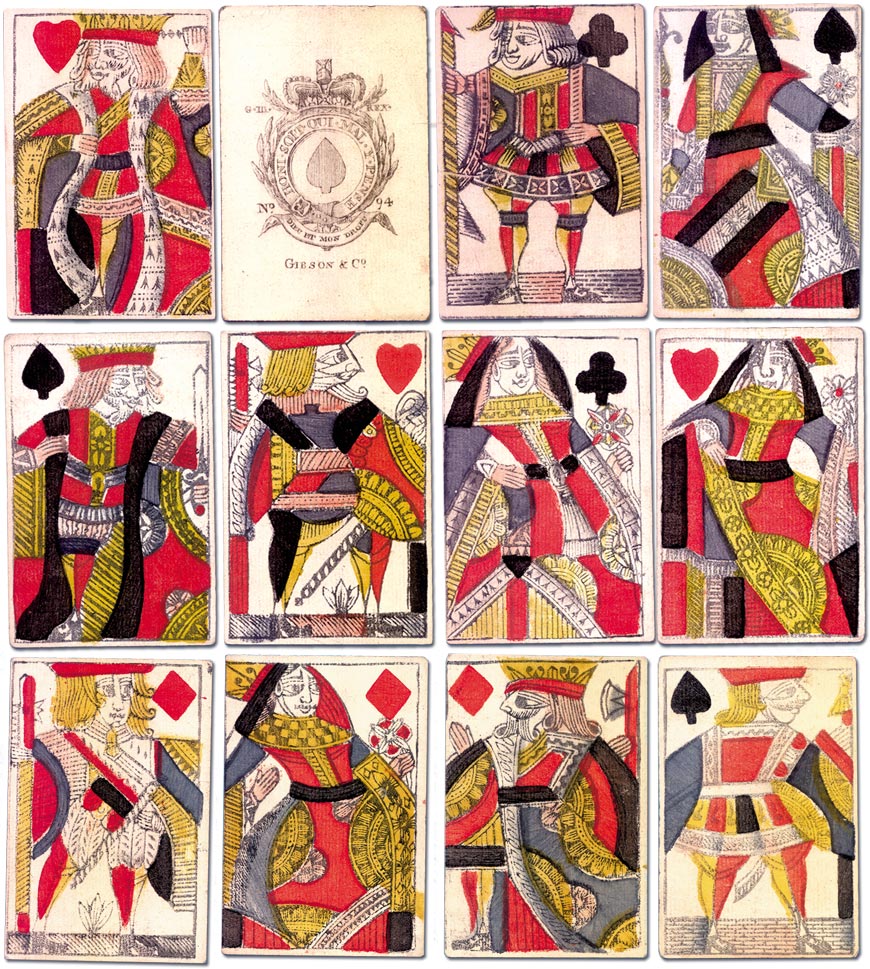
Standard English playing cards manufactured by Gibson & Co., c.1770.
Gibson & Co., c.1770
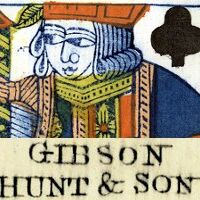
Standard English playing cards manufactured by Gibson & Co., c.1770, with a ‘Garter’ Ace of Spades. The style of the cards is very similar to those of Blanchard. Charles Gibson had been apprenticed to Phillip and Christopher Blanchard and later became their foreman. On Christopher Blanchard’s death in 1769 Gibson took over the company. He was later joined by John Gisborne (sometimes spelt ‘Gisbourne’) in c.1780. Charles Gibson’s son Matthew joined the firm in 1798 and then linked up with Joseph Hunt in 1801 (see: Gibson Hunt & Son) so that a continuous succession of firms comprising Gibson & Gisborne, Hunt, Hall and Bancks Brothers endured until c.1886. During this period the standard English pattern, as shown here, evolved into the modernised and double-ended version which prevailed by the end of the Victorian era.
References:
Lodge, Ken: The Standard English Pattern (second revised and enlarged edition), Bungay, Suffolk, 2010

Jack of Clubs: After Charlotte Corday had murdered the villainous Jean Paul Marat in his bath in July, 1793, a book was discovered lying nearby which contained a Jack of Clubs as a bookmark. Curiously the card is often considered a lucky one.

By Simon Wintle
Spain • Member since February 01, 1996
I am the founder of The World of Playing Cards (est. 1996), a website dedicated to the history, artistry and cultural significance of playing cards and tarot. Over the years I have researched various areas of the subject, acquired and traded collections and contributed as a committee member of the IPCS and graphics editor of The Playing-Card journal. Having lived in Chile, England, Wales, and now Spain, these experiences have shaped my work and passion for playing cards. Amongst my achievements is producing a limited-edition replica of a 17th-century English pack using woodblocks and stencils—a labour of love. Today, the World of Playing Cards is a global collaborative project, with my son Adam serving as the technical driving force behind its development. His innovative efforts have helped shape the site into the thriving hub it is today. You are warmly invited to become a contributor and share your enthusiasm.

Activity for Gibson & Co., c.1770
Sign in to comment or save this article.

Related Articles
Moguls, Highlanders and Merry Andrews
Discover the historic origins and evolution of card naming and quality designations like ‘Moguls’ an...
30: The Not-So-Minor Cardmakers of the 19th Century - Gibson, Hunt & Bancks
A preliminary look at the card-makers operating in the 19th century.
20: English Card-Makers 1761-1905
An initial survey of 19th century playing-card production. More detailed information appears on othe...
Gibson, Hunt & Son
Gibson originally took over the business of Blanchard in 1769. Gibson & Hunt operated briefly and we...
Most Popular
Our top articles from the past 60 days


