

Owen Jones (1809-1874)
Owen Jones (1809-1874) was a Welsh architect and interior designer who designed the backs of playing cards for Thomas de la Rue.
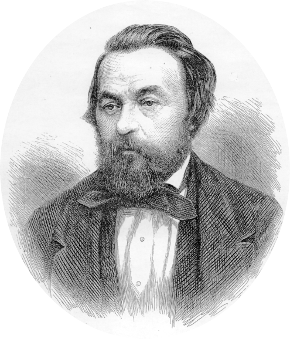
wen Jones (1809-1874), the son of a Welsh antiquary, was an architect and interior designer. He studied with the architect Lewis Vulliamy (1791-1871) and then entered the Royal Academy schools. After a European tour which led him to sketch and paint the Alhambra, the Moorish palace at Granada, his attempts to get these lithographed led him to set up a printing establishment. Apart from the Plans, Elevations, Sections and Details of the Alhambra (1836), which was the first English chromo-lithographed work, Jones is best known for his Grammar of Ornament (1856) which came to be regarded as a masterpiece, but he specialised as a colour printer in the illuminated gift book beloved by the Victorians.
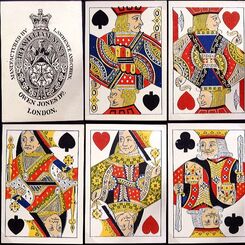
Owen Jones started working for Thomas De La Rue in 1844, who was at that time keen to have the best artists working for him. In the ensuing twenty years Jones created 173 different playing card designs varying from fruit-and-flower themes to Chinese and Arabesque. Owen Jones played a prominent part in the lives of three generations of De La Rues - Thomas, assisting Warren and William Frederick, and finally Warren's son, the eccentric Warren William, who was sent to him to learn lithography. Owen Jones was appointed superintendent of works for the 1851 Crystal Palace Exhibition and took an active part in decorating and arranging the building. Louis Cohen, who founded New York playing card maker Lawrence & Cohen, also shared the services of Owen Jones, whose name appeared on their ace of spades in c.1865.
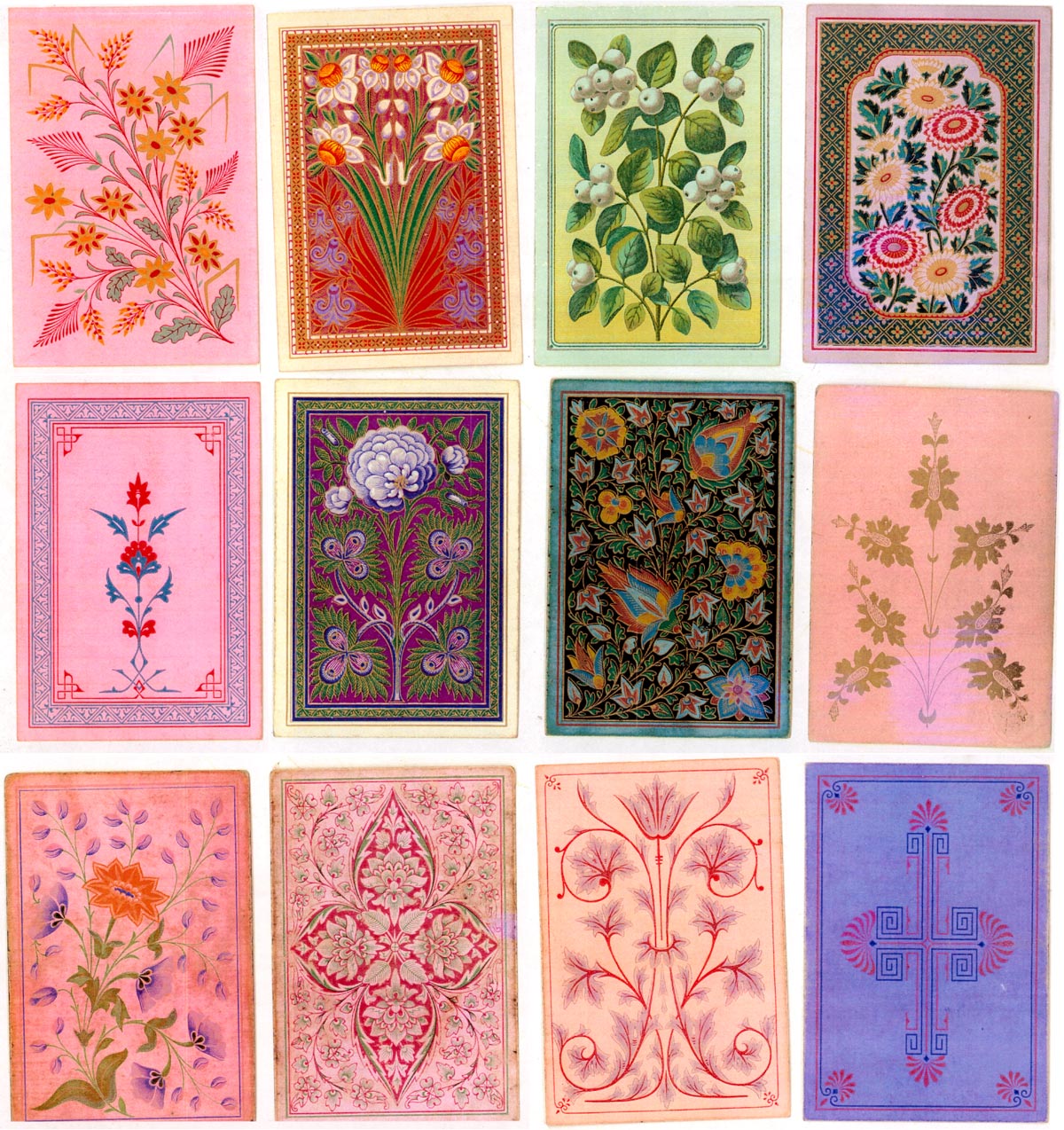
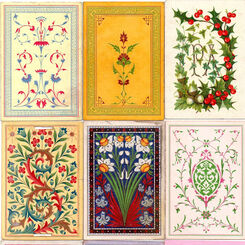
Above: eight playing card back designs by Owen Jones. Jones advocated a strong design philosophy with an underlying sense of the unity between art and culture. He realised that many of the great masterpieces from antiquity, including Moorish art, were based on geometrical grid patterns embellished with graceful and refined arabesques.
 |
 |
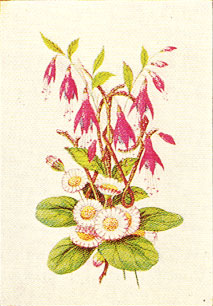 |
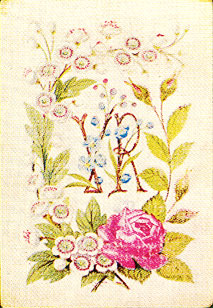
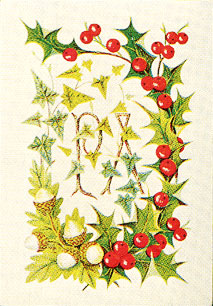
Above: three backs from the Royal Illuminated Playing Cards, c.1850. Charles Dickens was delighted with the 'poetry of card-making', the 'graceful designs' and 'dainty little pictures' by Owen Jones which appeared on the firm's playing cards for members of the Royal family. Jones-designed cards were expensive. De La Rue advertised the 'Royal Illuminated Playing Cards' in an 1851 Illustrated London News at 'Two Guineas the Set of four patterns or singly 10s 6d the pack'. This was, of course, extremely expensive. The Queen's design depicts roses and hawthorn. Prince Albert's consist of prickly holly, ivy and oak. The Prince of Wales' design depicts daisies and fuchsias.
Owen Jones was a member of the circle of people around Henry Cole who was aiming at higher standards in the Art Manufactures and whose ideas later influenced William Morris. In later life he decorated private houses including the Palace of the Viceroy of Egypt. He exhibited architectural designs at the Royal Academy between 1831 and 1861, and he also designed wallpaper, textiles and carpets. He died in 1874 aged 65 at his home in Argyll Place, Regent Street, London.
For further reading see: Michael Cooper & Ken Lodge, "Owen Jones (1809-1874): Architect, Decorative Artist & Designer of Playing Cards" in 'The Playing Card', Journal of The International Playing Card Society, Vol.34, No.3, Jan-March 2006, pp.181-192. Also: The Newsletter of The English Playing Card Society, No.10, November 1985, pp.8-9.

By Simon Wintle
Spain • Member since February 01, 1996 • Contact
I am the founder of The World of Playing Cards (est. 1996), a website dedicated to the history, artistry and cultural significance of playing cards and tarot. Over the years I have researched various areas of the subject, acquired and traded collections and contributed as a committee member of the IPCS and graphics editor of The Playing-Card journal. Having lived in Chile, England, Wales, and now Spain, these experiences have shaped my work and passion for playing cards. Amongst my achievements is producing a limited-edition replica of a 17th-century English pack using woodblocks and stencils—a labour of love. Today, the World of Playing Cards is a global collaborative project, with my son Adam serving as the technical driving force behind its development. His innovative efforts have helped shape the site into the thriving hub it is today. You are warmly invited to become a contributor and share your enthusiasm.

Leave a Reply

Your Name
Just now Your comment here. Your comment here. Your comment here. Your comment here. Your comment here. Your comment here. Your comment here. Your comment here. Your comment here. Your comment here. Your comment here. Your comment here. Your comment here. Your comment here. Your comment here. Your comment here. Your comment here. Your comment here. Your comment here. Your comment here. Your comment here. Your comment here. Your comment here. Your comment here. Your comment here. Your comment here. Your comment here. Your comment here. Your comment here. Your comment here. Your comment here. Your comment here.
Related Articles

59: Owen Jones (1809-74) and De La Rue
A selection of examples of Owen Jones's artwork printed by De La Rue.
Waddington’s 1940 Trade Brochure
Waddington’s 1940 Trade Brochure.

Rufford Playing Cards
Rufford playing cards is one of several brand names used by Boots for their stationery department, a...

Welsh Brewery Playing Cards
Welsh Brewery Playing Cards
Draughts League Medals
Arthur Charles Prince worked for De la Rue as a playing card cutter and later was promoted to superv...
14: Back Designs
A few examples of the many interesting back designs.
Jean Picart le Doux
Jean Picart le Doux playing cards, issued in 1957 to celebrate the company's 125th anniversary, feat...
De La Rue
De La Rue introduced letter-press printing into playing card production and his patent was granted i...

About Peter Wood
Peter Wood is a UK based artist.
About Shelley Fowles
Shelley Fowles was born in South Africa but has lived in the United Kingdom since 1979. She trained ...
Playing cards in Wales - Welsh playing cards
Whereas the distinctiveness of Wales is an important resource contributing to the rich texture of va...
Lawrence & Cohen, New York
Lawrence & Cohen decided to hire Owen Jones, the English playing card designer who produced back des...

Amalgamated Playing Card Co., Ltd
Agreement had been reached between Waddington's and De La Rue during the second world war for Waddin...
Romanian playing cards by Alf Cooke
Romanian playing cards, manufactured and exported by the Universal Playing Card Co., Leeds, in the 1...
Waddington’s Encore Series
Waddington’s Encore Series 1933.
Barribal Series
William H. Barribal (1873 - 1956) was a London artist who created the Waddingtons 'Barribal' playing...
2000Pips Transformation Pack
2000Pips Transformation Pack
Most Popular
Our top articles from the past 60 days


