


The Book of Trades by Jost Amman, 1588
The Book of Trades by the prolific German Renaissance artist Jost Amman (1539-91). Suits are books, printers' pads, wine-pots and drinking cups.

Jost Amman, “Book of Trades”, 1588
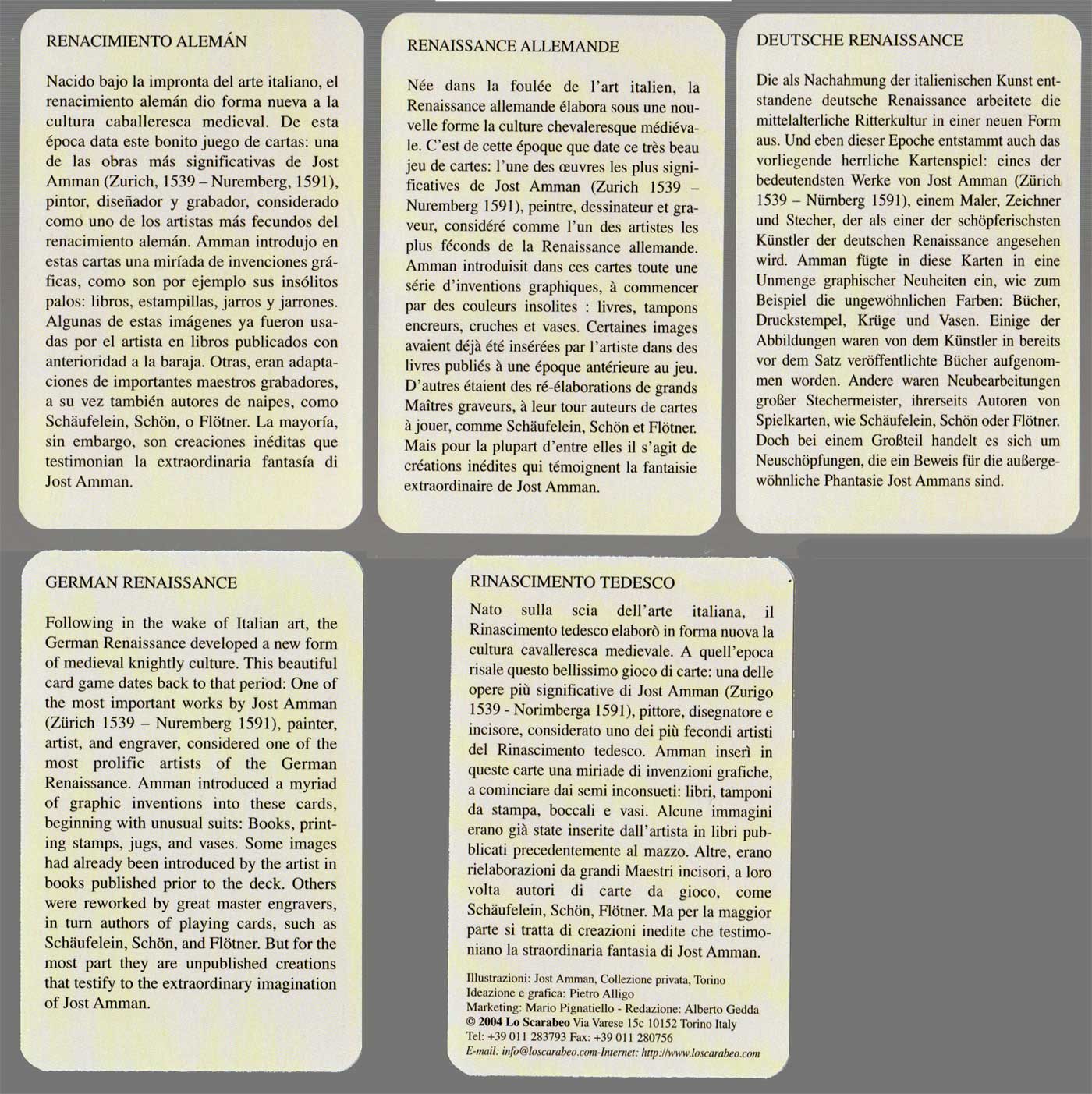
Following in the wake of Italian art, the German Renaissance developed a new form of medieval knightly culture. Imaginative decks of playing cards were produced by Jost Amman, Schäufelein, Schön and Peter Flötner...
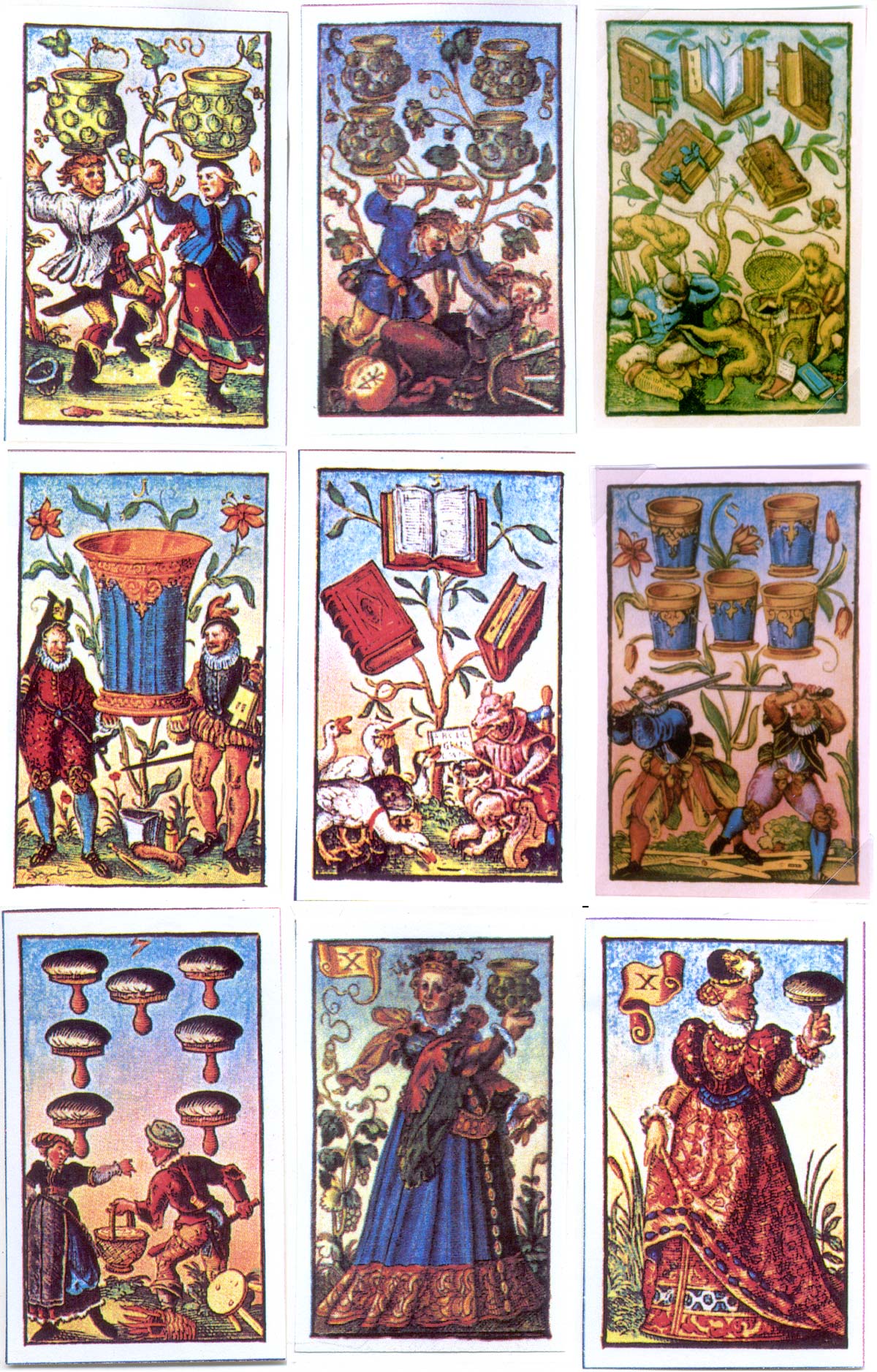
Above: cards from the Book of Trades by the prolific German Renaissance artist Jost Amman (1539-91). Suits are books, printers' pads, wine-pots and drinking cups. Some of the images had already appeared in books published prior to the cards, along with moralising verses beneath each card. The deck promotes industry and learning over idleness and drunkenness.
"Indulging their fancy, they [German card-makers] varied the signs according to every capricious notion: unicorns, dogs, rabbits and apes, monkeys and lions, parrots and peacocks, stroll or fly or flutter through the cardboard world. Packs appeared with suits of pinks, of columbines, printers' inkpads, vases, drinking cups, books, combs, fishes, crowns, bellows, frying-pans, shields, alms-houses and knives; some were circular." Roger Tilley 'Playing Cards', p. 35.
The artist's humour is discernible in almost every card, where little groups of figures decorate the numeral cards. Jost Amman's cards influenced several later cardmakers. Below are two recent facsimiles read more►
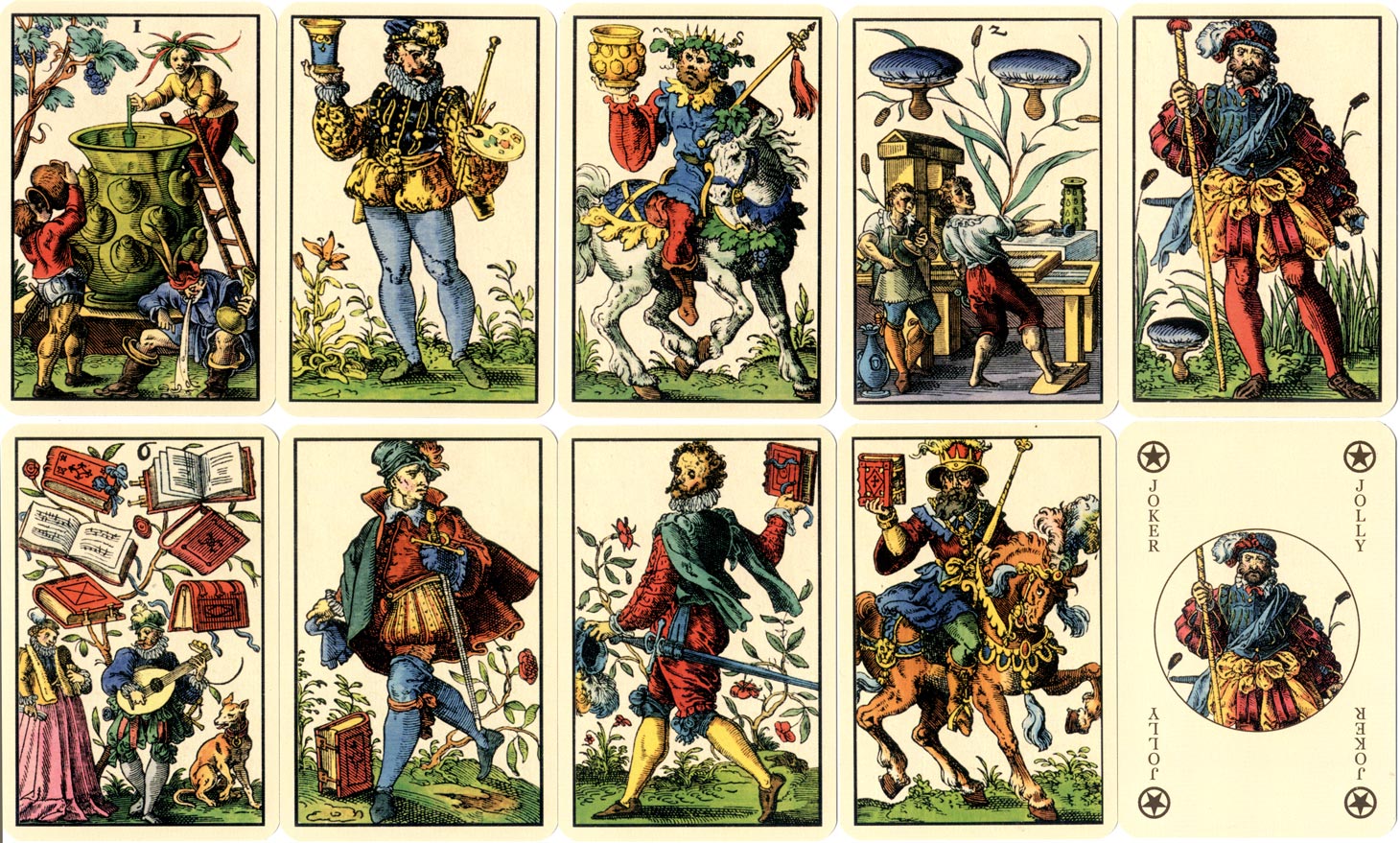
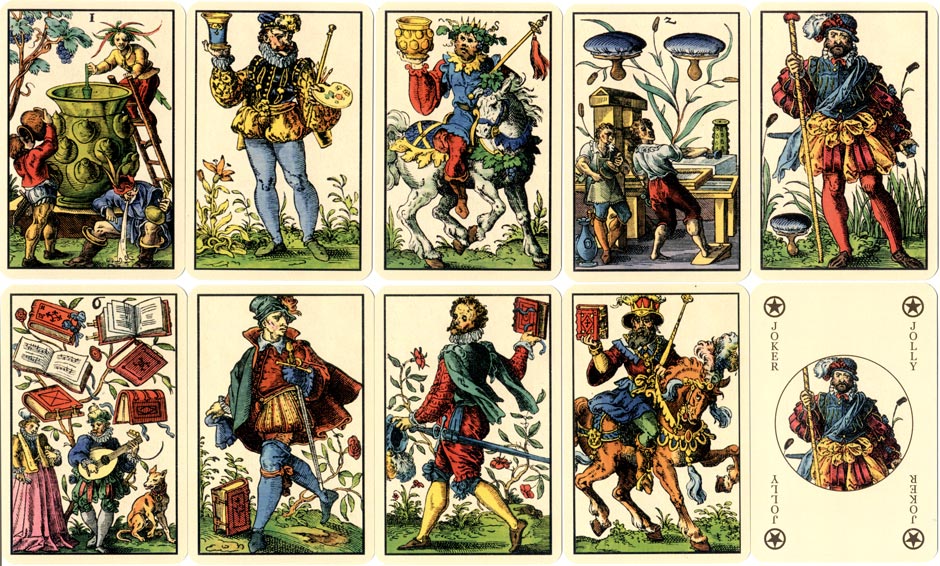
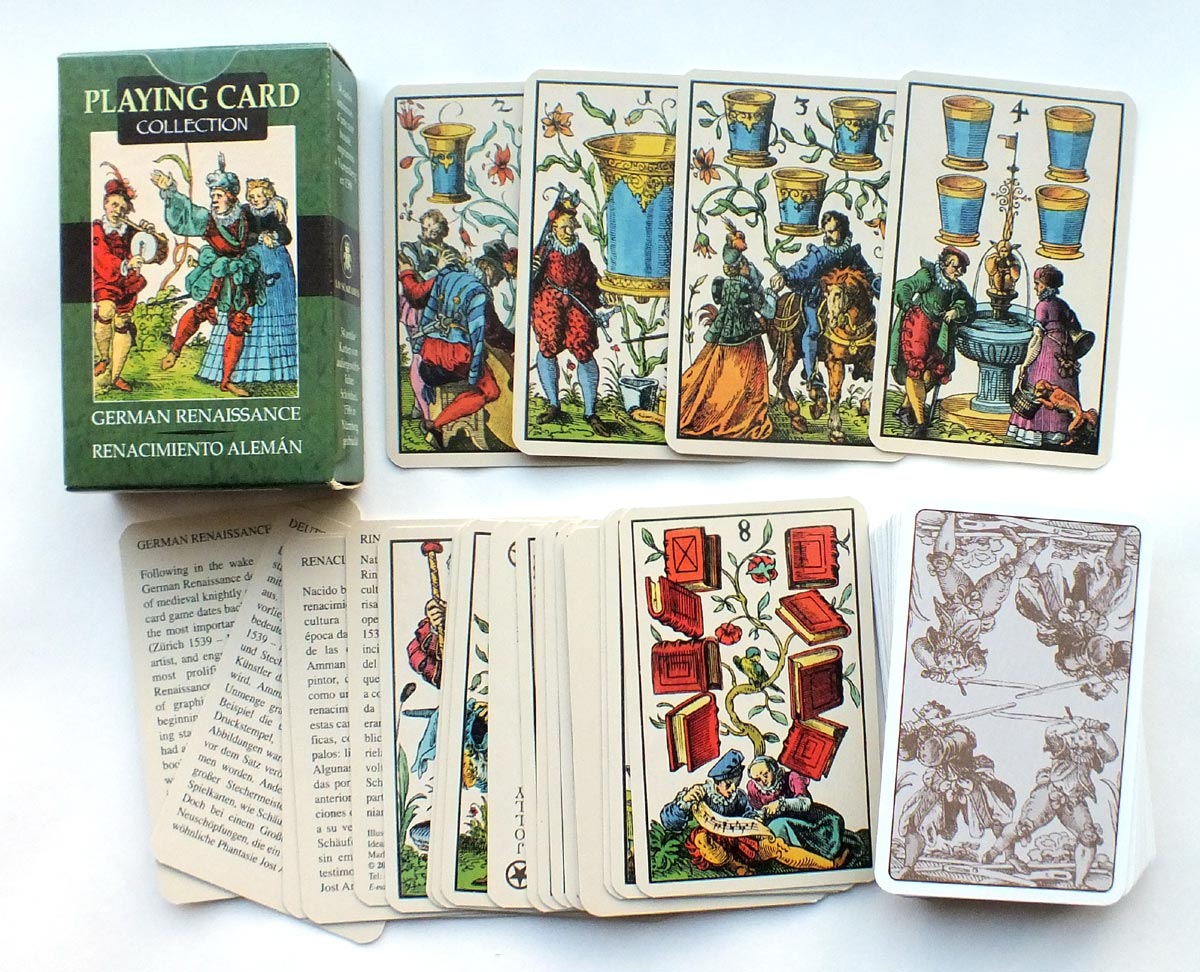
Above: cards from facsimile edition “The Book of Trades” by Jost Amman (1588) published by Lo Scarabeo, Torino, Italy 2004. This modern edition contains 2 jokers and six extra information cards see more →
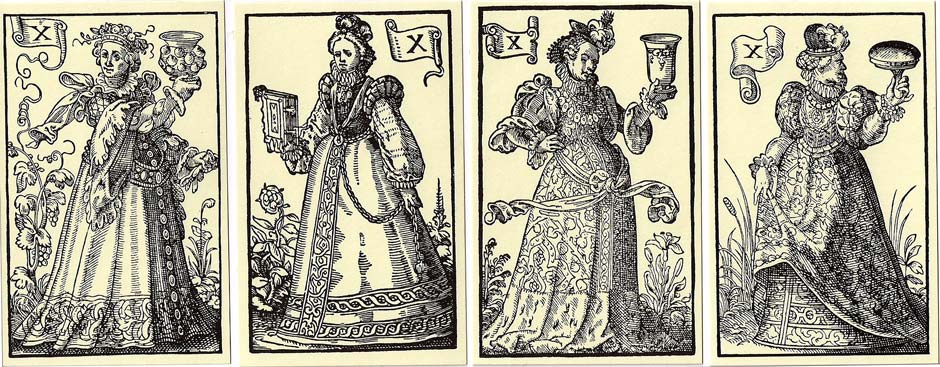
Above: the four cards designated by the Roman numeral 'X' are female. Are these 'Queens' or female pages? German decks, like Spanish ones, do not usually contain Queens. The Kings are mounted on horseback. If these ladies are Queens then we have an Italian or French element to account for. But in Spanish decks the 10s are 'Sotas' and sometimes female. Cards from the limited edition facsimile deck published by Edizone Il Meneghello, Via Fara 15, Milano, Italy.

By Simon Wintle
Spain • Member since February 01, 1996
I am the founder of The World of Playing Cards (est. 1996), a website dedicated to the history, artistry and cultural significance of playing cards and tarot. Over the years I have researched various areas of the subject, acquired and traded collections and contributed as a committee member of the IPCS and graphics editor of The Playing-Card journal. Having lived in Chile, England, Wales, and now Spain, these experiences have shaped my work and passion for playing cards. Amongst my achievements is producing a limited-edition replica of a 17th-century English pack using woodblocks and stencils—a labour of love. Today, the World of Playing Cards is a global collaborative project, with my son Adam serving as the technical driving force behind its development. His innovative efforts have helped shape the site into the thriving hub it is today. You are warmly invited to become a contributor and share your enthusiasm.

Activity for The Book of Trades by Jost Amman, 1588
Sign in to comment or save this article.

Related Articles
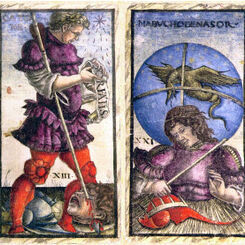
The Sola-Busca Tarot
Humanist Iconography, Alchemical Metaphor, and the Origins of the Illustrated Minor Arcana.
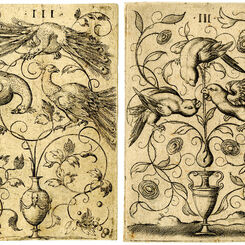
Virgil Solis
Remarkable pack of 52 animal-suited playing-cards designed and etched by Virgil Solis.
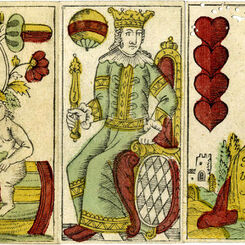
Bavaria pattern
Classic German-suited Bavarian pattern by Joseph Fetscher, Munich, early 19th century.
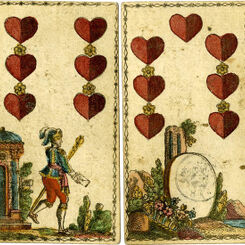
Historical playing cards by Joseph Fetscher
Historical playing cards by Joseph Fetscher, Munich, c.1820.
Moorish Deck
Review of “Trzes’ Moorish Deck” facsimile published by Ulrich Kaltenborn, Berlin, 2023.

Fantasy Bavarian pack
An early Bavarian-style deck by Johann Conrad Jegel, Nürnberg, Germany , c.1835.
Master of the Playing Cards
Animal suited playing cards engraved by the Master of the Playing Cards, Germany, c.1455
Stuttgart pack, c.1430
The luxury, hand-painted Stuttgart Cards (Stuttgarter Kartenspiel) dated c.1430, with suits of ducks...
Hans Sebald Beham
Playing cards designed by Hans Sebald Beham (1500–1550).
Serravalle-Sesia Tarot
Serravalle-Sesia Tarot published by Fratelli Avondo, c.1880.
Master PW Circular Cards
Master PW Circular Playing Cards: roses, columbines, carnations, parrots and hares... everyday objec...

Dondorf
The luxury playing card factory founded in Frankfurt am Main by Bernhard Dondorf in 1833 existed for...
German playing cards
Card-playing rapidly became popular in medieval Bavaria and German printers were quick to supply the...
No.407 Naipe Español by F. X. Schmid
Naipe Español No.407 by F. X. Schmid, c.1980.
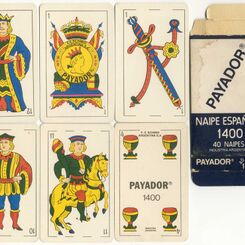
Naipe PAYADOR by F.X. Schmid (Argentina) S.A.
Naipe Español "PAYADOR ®"
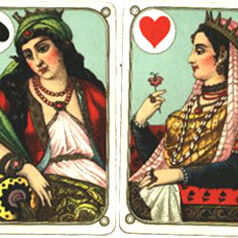
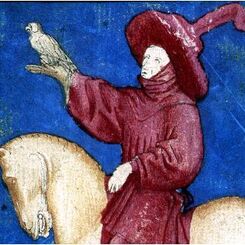
The Princely Hunting pack, c.1440
The Princely Hunting Pack, c.1440/45, is attributed to Konrad Witz and his workshop in Basle.
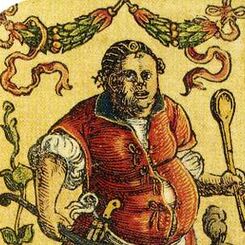
Peter Flötner, c.1545
Seven cards from a satirical pack produced by Peter Flötner of Nuremberg, c.1545. The suit symbols a...
The History of Playing Cards
Playing cards appear in European records in the late 14th century, but their earlier history lies fu...
Silk Inlaid playing cards for Charles I.
Silk Inlaid playing cards said to have been made for Charles I
Most Popular
Our top articles from the past 60 days


Max Wright
14 March 2024, 17:59Simon,
Would you know where I might find a copy of this marvelous deck, The German Renaissance reprint by Lo Scarabeo would be great (WWPCM00359/02: reprint by "Lo Scarabeo" (Italy)? I can't find any version of this regular-sized deck for sale anywhere except Japan, where, even there, they are sold out. There are some knock-off decks available (Noble Knight Games) but these copies have cards only 2"x 3" size with blank backs and sold in a ziplock? Do you know if Lo Scarabeo will print this set again?
Thanking you for your time,
Ms. Max
p.s. link to this deck in Japap GERMAN RENAISSANCE トランプ ジャーマン・ルネッサンス (sold out). Link to deck sold in Spain but don't ship to US: Cartas Renacimiento Aleman