


The Sola-Busca Tarot
Humanist Iconography, Alchemical Metaphor, and the Origins of the Illustrated Minor Arcana.
The Sola-Busca Tarocchi consists of seventy-eight engraved prints forming an unconventional and intriguing tarot deck. At first sight the images may appear strange, archaic, slightly forbidding, even as they suggest an obscure symbolic logic. Yet this is the earliest tarot set known to survive complete, and the earliest preserved entirely in the medium of engraving. The deck was completed in 1491, after which it virtually disappeared from view for centuries. It exerted no discernible influence on the mainstream development of tarot during the following four hundred years, until its rediscovery in 1909. This rediscovery provided A. E. Waite with a historical precedent for his decision to fully illustrate the Minor Arcana in the Rider–Waite deck.
The name “Sola-Busca” derives from two former owners, Count Sola and the Marchese Busca, whose illuminated copy of the deck was acquired by the Pinacoteca di Brera in 2009. Alongside this hand-coloured set, a number of uncoloured impressions also survive, revealing the cards in their engraved state before paint was applied. For example, four court cards are preserved in the British Museum:¹
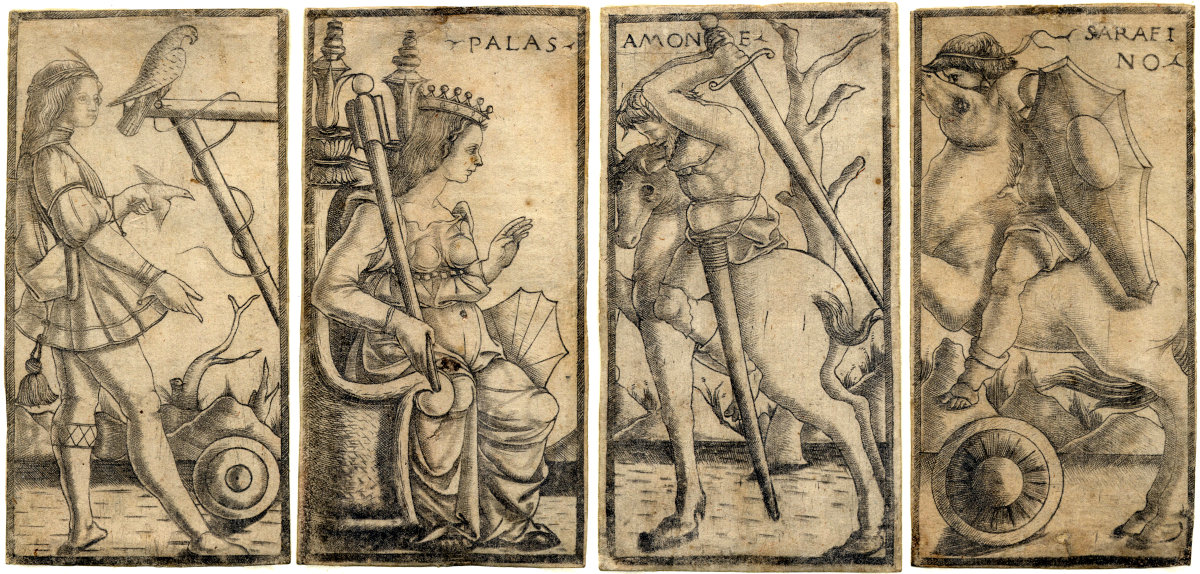
Above: four cards from the British Museum. The Museum Curator’s descriptions are: Knave of Coins (unnamed), a young man in contemporary garb pointing to a medallion at his feet and holding a bird in his right hand, with a tethered falcon at right above, a barren landscape behind; Queen of Clubs titled “Palas”; sitting facing right on a throne, wearing a crown and holding a mace in her right hand; Knight of Swords “Amone”, a semi-naked man on horseback wielding an enormous sword, with a scabbard hanging from his waist, a barren tree behind; Knight of Coins “Sarafino”, a man on horseback holding a shield, with a large medallion at his feet, a landscape of hills behind. There are 16 such court cards in a complete set. © The Trustees of the British Museum • Nicola di Maestro Antonio►
A further 23 uncoloured cards are preserved in the Albertina², Vienna. Here are 8 major arcana or trump cards:
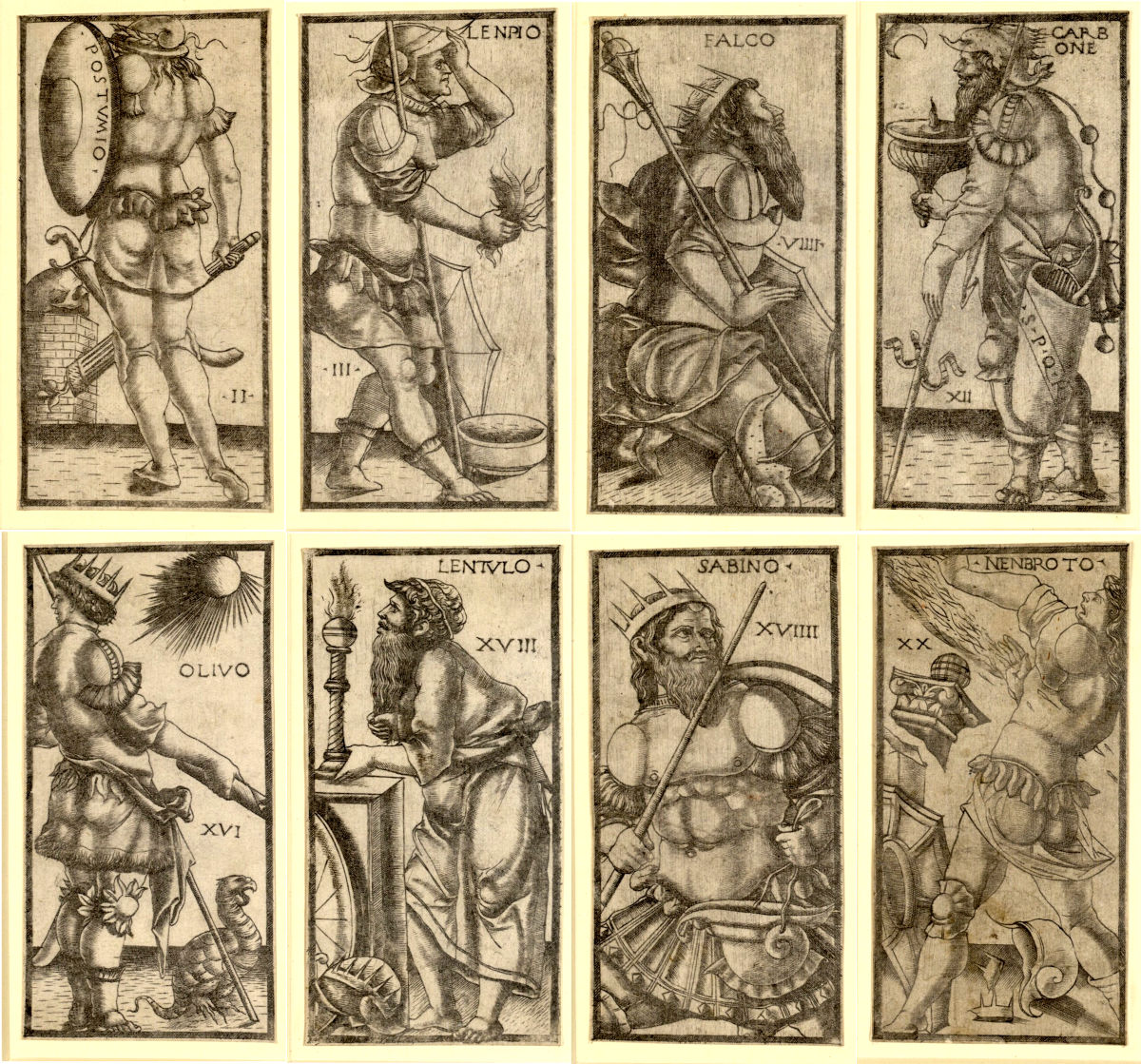
Above: 8 uncoloured cards from the Albertina collection (Public Domain). The bodies of the younger men are muscular and heavy whilst the older men wear full beards. • Sola-Busca tarot cards in the Albertina►
The Sola-Busca tarot stands at the threshold between the late medieval imagination and the full emergence of a Renaissance worldview. Created on the eve of the European discovery and exploration of the Americas³ - a pivotal moment in human history - the deck’s imagery remains firmly grounded in the classical and biblical traditions of Rome, Greece, Egypt, and Judea.

The Artistic Style
The clear, precise contours of the engravings, together with their dense shading and cross-hatching, are most evident in the uncoloured impressions. These reveal a combination of imaginative flair and exaggerated anatomy. Willshire (1876, p.77-78)⁴ remarked on the “grotesqueness of design and want of proportion” while Zucker (1997, p.185)⁵ described the figures as bloated and flabby. Gnaccolini (2024)⁶ has drawn attention to the legacy of Francesco Squarcione’s art school in Padua which focused on copying from antiquities. The engraver has been associated with the style of Nicola di Maestro Antonio from Ancona (1448-1511), who inherited from Squarcione “a love for forced poses, nervous profiles and a heightened expressiveness”.
The figures are muscular and weighty. Their postures feel theatrical, like classical heroes, emphasizing physical drama. At the same time, they do not yet display the anatomical precision and empirical naturalism that would soon come to define the High Renaissance. When the deck was hand-coloured by an anonymous illuminator in 1491, layers of paint partially obscured the fine lines of the engraving, particularly in the faces, and softened or overrode other details.

Above: 4 cards from the Wikipedia Commons Sola-Busca tarot deck: Venturio, Catone, Nabuchodenasor and the king of swords as Alexander.
The Iconography
The traditional imagery of 15th century trumps is here replaced by a series of figures drawn from Roman antiquity and biblical history, accompanied by latin inscriptions. Supported by emblematic objects and stylised poses, the scenes evoke themes of triumph, spiritual struggle, ascent and decline, often resonating with contemporary political concerns.
All twenty-two major arcana cards in the Sola-Busca tarot depict male figures. Women appear only as queens in the court cards and occasionally on the numeral cards. Furthermore, seven of the Major Arcana portray older men with long, patriarchal beards - an attribute associated in medieval tradition with religious authority, wisdom and sanctity, even with representations of God himself. The remaining figures are muscular and martial in appearance, frequently equipped with shields or weapons, suggesting vigilance, self-defence and moral fortitude.
The deck was likely produced for a male elite, possibly a noble patron, who would have recognised in these figures a cycle of masculine moral exemplars drawn from selected classical and biblical sources, embodying ideals of virtue, authority and ethical conduct. In this sense, the Sola-Busca tarot may have functioned not only as a game or symbolic object, but also as a form of elite self-presentation, inviting identification with these exemplars while signalling humanist learning within a restricted social milieu. In this respect, the Sola-Busca tarot shares with earlier luxury decks (such as those commissioned by Francesco Sforza), a function of elite self-presentation, while differing markedly in the values and forms of distinction it sought to project.

Above: 8 cards from the Sola-Busca tarocchi (Wikipedia Commons). The four queens are shown in the top row. The coats-of-arms have been interpreted as those of two Venetian noble families: Venier and Sanudo.
As several scholars have observed, it is often possible to discern echoes of traditional trump subjects, though not necessarily in their customary order. Identifying specific equivalents for figures such as the Pope, High Priestess, Empress, Temperance, or other female archetypes remains problematic. More recently, attempts have been made to impose comprehensive divinatory interpretations on the entire deck⁷.
The numeral cards, which in earlier decks typically displayed only suit symbols, are here fully illustrated. This was an important innovation. Many of these scenes allude to themes familiar from medieval alchemical literature, centred on the pursuit of the philosopher’s stone (lapis philosophorum), or “the gold of the philosophers.” Such imagery functioned as a metaphor for spiritual transformation or inner regeneration, framed in the language of the chemistry laboratory and intended for an initiated readership. However, the Sola-Busca deck presents no consistent sequence or coherent alchemical narrative. Rather, it offers a selection of didactic metaphors and literary ideas embedded within a broader humanist moral discourse. It does not appear to conceal a systematic alchemical programme, nor is it necessarily a grimoire or an esoteric system, despite occasional over-speculative interpretations by later commentators.
Replica by Ediciones Orbis / Lo Scarabeo
A full-colour replica deck of redrawn cards, titled Tarot Alquímico, was published in several languages by Ediciones Orbis S.A. (Spain) in conjunction with Lo Scarabeo (Italy) in 2000. In the accompanying leaflet, Giordano Berti presents the deck as “halfway between fantasy and didactic,” with “clearly esoteric” numeral cards owing to their allusions to alchemy (for example, the Queen of Cups and Polisena).

Above: 8 cards from so-called “Tarot Alquimístico” facsimile pack published by Ediciones Orbis S.A., Spain, in conjuntion with Lo Scarabeo, Italy, 2000. 78 cards + 2 extra cards + leaflet in box.
In conclusion, the Sola-Busca tarot remains an extraordinary product of Italian humanism. Its imagery draws eclectically on classical and biblical traditions, as well as philosophical, hermetic, and alchemical sources, suggesting moral and ethical meanings rather than a systematic esoteric programme. It belongs to a cultural world shaped before Columbus, before Copernicus, before the emergence of systematic alchemy, and long before the development of an occult tarot tradition.
The Rider-Waite / Pamela Colman Smith Connection
In 1909, Arthur E. Waite was shown the Sola-Busca tarot by an acquaintance, Professor Luigi Speranza. He was struck by the fully illustrated narrative scenes on the Minor Arcana, a feature largely absent from the tarot decks with which he was familiar. Until then, most decks - including the Tarot de Marseille - had displayed repetitive suit symbols on the pip cards rather than figurative scenes. Waite recognised the expressive and interpretive potential of the Sola-Busca’s illustrated numerals and resolved that his own deck would adopt this approach, adapted to the spiritual and esoteric concerns of the early twentieth century.
To realise this vision, Waite commissioned the artist Pamela Colman Smith, supplying her with detailed symbolic instructions for each card. Smith interpreted these guidelines in her own distinctive visual language, shaped by her experience in theatre design, illustrated children’s books, and the Arts and Crafts movement. While she occasionally drew on earlier postures or compositional ideas, her scenes are original in tone and execution.
In this way, the Sola-Busca tarot served as both historical precedent and catalytic spark for the most innovative feature of the Rider–Waite–Smith deck: its fully illustrated Minor Arcana. It provided an architectural blueprint for scenic pip cards, but Waite and Smith constructed an entirely new symbolic and artistic structure upon it. This approach introduced a new paradigm of tarot interpretation—one that has largely displaced the older Marseille tradition, based on numerology and suit symbolism, and has become one of the dominant models for divinatory and meditative tarot in the twentieth and twenty-first centuries.

References & Links
- British Museum : Nicola di Maestro Antonio►
- Albertina : Sola-Busca tarot cards►
- Aritio, Luis Blas : “Vasco Núñez de Balboa, La Crónica de los Cronistas de Indias”, Ediciones Balboa, Panama, 2014. "La trascendencia de este descubrimiento desborda la propia historia panameña y se convierte en uno de los jalones más importantes de la historia de la Humanidad. La realidad geopolítica euroasiática y africana, que apenas estaba abandonando la Edad Media, se complementa con la nueva realidad americana, y todo se convierte en una unidad global del planeta Tierra."
- Willshire, W.H.: A Descriptive Catalogue of Playing and Other Cards in the British Museum, Trustees of the British Museum, 1876, reprint 1975.
- Zucker, Mark J.: The Master of the "Sola-Busca Tarocchi" and the Rediscovery of Some Ferrarese Engravings of the Fifteenth Century, Artibus et Historiae, Vol. 18, No. 35, (1997), pp. 181-194. • JSTOR►
- Gnaccolini, Laura Paola, Pinacoteca di Brera : The Sola Busca Deck and the Tarot Game (English version)► Italian version : Il mazzo Sola Busca e il gioco dei tarocchi►
- L’Arte de’Ciompi : History, meaning and divination of the Sola Busca cards►
Thanks to Samten de Wet for inspiration and for generously sharing ideas and resources from his archives.

By Simon Wintle
Spain • Member since February 01, 1996
I am the founder of The World of Playing Cards (est. 1996), a website dedicated to the history, artistry and cultural significance of playing cards and tarot. Over the years I have researched various areas of the subject, acquired and traded collections and contributed as a committee member of the IPCS and graphics editor of The Playing-Card journal. Having lived in Chile, England, Wales, and now Spain, these experiences have shaped my work and passion for playing cards. Amongst my achievements is producing a limited-edition replica of a 17th-century English pack using woodblocks and stencils—a labour of love. Today, the World of Playing Cards is a global collaborative project, with my son Adam serving as the technical driving force behind its development. His innovative efforts have helped shape the site into the thriving hub it is today. You are warmly invited to become a contributor and share your enthusiasm.

Activity for The Sola-Busca Tarot
Sign in to comment or save this article.

Related Articles
Murder of Crows Tarot
Corrado Roi’s 2020 tarot pack presents a dark, watchful world of crows and ritual figures.
Tarocco Gumppenberg
Neoclassical Empire-style Tarocchi cards by Ferdinando Gumppenberg, Milan, c.1810.
Dylan Dog
Characters and objects from the Italian comic book series Dylan Dog, written by Tiziano Sciavi and d...
Le Monde Primitif Tarot
Facsimile edition produced by Morena Poltronieri & Ernesto Fazioli of Museo Internazionale dei Taroc...
I Tarocchi del Buongustaio
A less-than-serious set of major arcana on a gourmet theme, with designs by Cosimo Musio.
The Lovers playing cards
Reproductions of old postcards with romantic messages for Valentine’s Day.
Jack-O’-Lantern Tarot
Giuliano Costa's Jack-O’-Lantern tarot blends Rider-Waite symbolism with the rich and atmospheric th...
I Tarocchi del Cinema (di Sesar)
A set of Tarot trumps on the subject of the cinema, with designs by Sergio Sarri.
Natural History Tarocchi
Natural History Tarocchi by Ferdinando Gumppenberg, Milan.
Portraits of a Lady
Portraits of a Lady by Lo Scarabeo, 2003.
Moon Race
A concise overview of early space exploration illustrated by Giordano Tacconi, 2004.
William Tell
Facsimile of Swiss William Tell deck from c.1870 published by Lo Scarabeo.
Musikalisches Kartenspiel
Facsimile of Dondorf’s “Musikalisches Kartenspiel” (c.1862) published by Lo Scarabeo, 2004
Tarocchi di Mantegna, c.1465
The so-called Tarocchi di Mantegna (c.1465) reflect an ideological structure bringing to mind the so...
Sola-Busca Tarocchi
The Sola-Busca Tarocchi, c.1491
History of Flight
“History of Aviation” playing cards published by Lo Scarabeo (2003) in which every card carries a pa...
Oliver Mundy tarot
Original Tarot designs in Italian Renaissance style by Oliver Mundy.
Serravalle-Sesia Tarot
Serravalle-Sesia Tarot published by Fratelli Avondo, c.1880.
The Visconti-Sforza Tarot, c.1460
This pack of tarot cards appears to have have been made in the Bembo workshop in Cremona for Bianca ...
Hand-Painted Tarocchi Cards
Hand-painted Tarocchi cards sometimes known as ‘Charles VI tarot’, North Italy, 1475-1500.
Most Popular
Our top articles from the past 60 days


