


South German Engraver
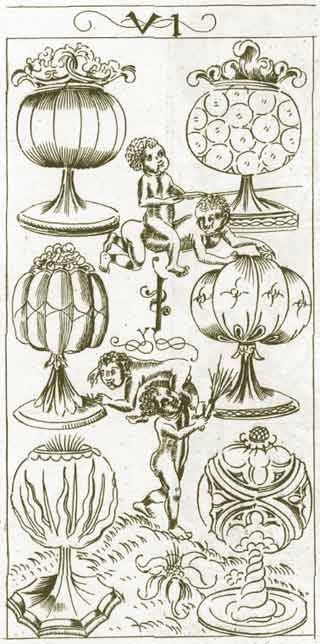
A pack of 52 cards with banner 10s, female 'Sotas', horsemen and kings, the pack was engraved in the new Plateresque style for a royal wedding.

A craftsman known as the “South German Engraver” produced this elaborate Plateresque (in the manner of the silversmith) interpretation of the Spanish-suited pack which appears to commemorate the marriage, in 1496, of Felipe I of Spain and Doña Juana, daughter of Ferdinand and Isabella. The Plateresque artistic movement was popular amongst the ruling classes of Imperial Spain, following the Reconquista and the beginning of the colonisation of the Americas, but was usually applied to architecture.
Sometimes referred to as Schongauer's follower, the engraver worked the same way as most of his colleagues of the time: he copied and re-worked other engravers, as well as other playing cards and popular images. Some of the court figures have been adapted from other sources where they might have held a falcon rather than the present suit symbol.
(Click here to see enlargement and engraver's monogram)

The pack conforms to an archaic format of 52 cards with numeral cards running from 1 to banner 10s, female 'Sotas' or maids (not queens), cavaliers and kings. A number of other packs with similar characteristics survive elsewhere. As can be seen, these late gothic playing cards are decorated - not quite 'transformed' - with birds, animals, plants, children and other miniature creatures. The suit sign of pomegranates probably alludes to the recently reclaimed kingdom of Granada. Several original examples of this pack are known, although none are coloured, and facsimile editions have also been produced.
A sheet with facsimile illustrations of nine cards appeared in Johann Gottlieb Immanuel Breitkopf’s “Ursprung der Spielkarten”, 1784.

Above: a facsimile copy published by Johann Gottlieb Immanuel Breitkopf, Leipzig, 1784. © The Trustees of the British Museum • number 1896,0501.1431►
Breitkopf’s “Ursprung der Spielkarten” (Attempt to research the origin of playing cards, the introduction of linen paper and the beginning of woodcutting in Europe), Leipzig, 1784, can be consulted online here►
See also:
The Upper Rhine Master of the Banderoles Early German Engraved Cards Gothic Spanish-suited Playing Cards Ambras Hunting Pack The Stuttgart Pack History Hunting Germany Spain Italy Portugal Master of the Playing-Cards Master PW Circular Playing Cards.

By Simon Wintle
Spain • Member since February 01, 1996
I am the founder of The World of Playing Cards (est. 1996), a website dedicated to the history, artistry and cultural significance of playing cards and tarot. Over the years I have researched various areas of the subject, acquired and traded collections and contributed as a committee member of the IPCS and graphics editor of The Playing-Card journal. Having lived in Chile, England, Wales, and now Spain, these experiences have shaped my work and passion for playing cards. Amongst my achievements is producing a limited-edition replica of a 17th-century English pack using woodblocks and stencils—a labour of love. Today, the World of Playing Cards is a global collaborative project, with my son Adam serving as the technical driving force behind its development. His innovative efforts have helped shape the site into the thriving hub it is today. You are warmly invited to become a contributor and share your enthusiasm.

Activity for South German Engraver
Sign in to comment or save this article.

Related Articles
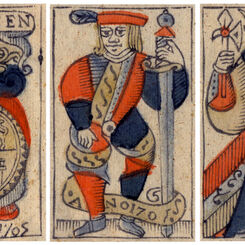
The archaic “Classic Madrid” Pattern
Centralisation, standardisation and consolidation of the Spanish card tradition.
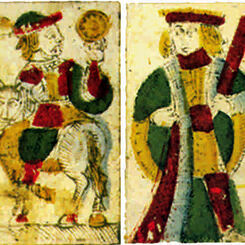
La baraja de Almagro
De la chimenea al monumento nacional: la baraja de Almagro y el renacer del corral de comedias.
Sant Jordi playing cards
Catalonia’s patron saint celebrated on cards with non-standard suits designed by Jan Baca and Marta ...
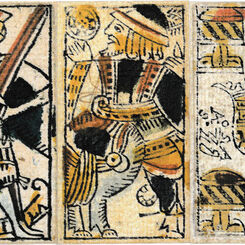
Sevilla 1647 reproduction
Facsimile of Spanish-suited pack produced in Sevilla, Spain, 1647.
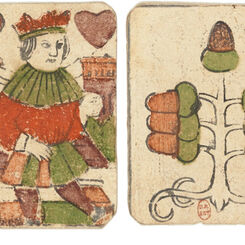
Early German playing cards
Some early examples of popular German playing cards from the XV and XVI centuries.
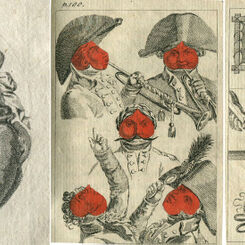
The Kiss, 1808
‘Aphorisms on the Kiss’ published by C. A. Solbrig, Leipzig, 1808.
History of Playing Cards explained in 5 Minutes
Video by Art of Impossible. In this video you will get a short overview of the most important histor...
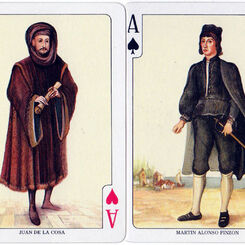
Christopher Columbus 5th Centenary playing cards
Fifth Centenary of the Discovery of America playing cards by published by Heraclio Fournier.
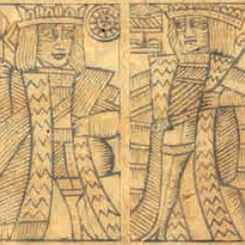
Navarra Pattern, 1682
Navarra pattern produced for the Pamplona General Hospital Monopoly in 1682.
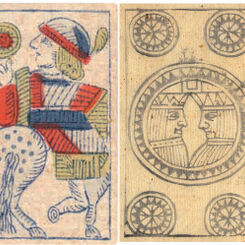
Navarra Pattern
Navarra Pattern produced for the Pamplona General Hospital Monopoly.
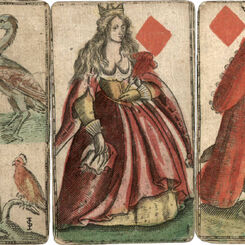
XVII Century Engraved Animal Cards
Anonymous French-suited German engraved cards c1610 to 1650.
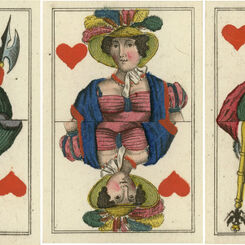
Unknown Maker
Early German deck by unknown maker, c.1825
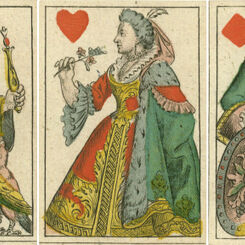
Joseph Losch
French-suited pack with full-length courts by Joseph Losch, c.1800.
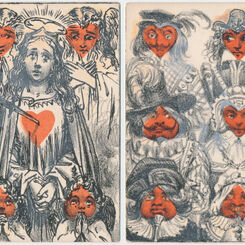
Carl Arnold Transformation
Transformation playing cards designed by Carl Johann Arnold (1829-1916), the court artist for King F...
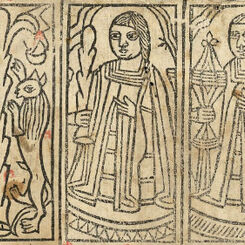
XV Century Catalan playing cards
XV Century Catalan Playing Cards, featuring four female Sotas, four Aces and four cards from the sui...
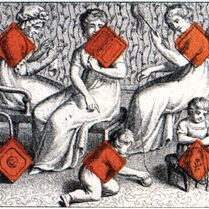
Cotta Transformation playing cards
In 1804, J.G. Cotta, a publisher and bookseller in Tübingen, Germany, produced the first set of tran...
Das Kupferstichspiel des I.M.F. von 1617
Playing cards had been made as precious objects for wealthy clients since the late 14th century. The...
Hundertjahrkarte
A new ‘medieval look’ is intended to suggest the power and virtue of the German character.
Master of the Banderoles
Playing Cards by the Master of the Banderoles, one of the earliest professional printmakers.
Gothic Spanish-suited cards
These cards may be a typical example of early 'standard' Spanish playing cards, maybe from before Co...
Most Popular
Our top articles from the past 60 days


Alannyë Daeris
19 November 2025, 09:47SavedSaved this article to Decks Históricos