


Musical playing cards
German song texts for domestic music-making on attractive early 19th-century playing cards.
Hybrid playing cards from the British Museum collection with half-length courts with French-suited pips at the top ends paired with a bar of music and German lyrics on the lower end of each card. These are not ordinary game cards, but didactic-leisure Hausmusik cards meant to be sung as well as played with. The lyrics appear to be anonymous or lightly adapted Volkslied material drawn from the popular song tradition. Stylistic features point to the Biedermeier period (c.1815–1848).
Artistically, the cards are engraved and stencil-coloured in a manner typical of German or Austrian production of the period, with figures wearing contemporary Biedermeier costume. The music is simple and tuneful, suited to unaccompanied singing or performance on common household instruments. These pleasing and attractive cards offer a glimpse into a period when playing cards served not only for amusement, but also as vehicles for musical instruction and sociable domestic recreation.


Above: anonymous musical playing cards from the Biedermeier period, c.1830s. 32 cards, no indices, square corners, plain backs. © The Trustees of the British Museum.
References
British Museum : 1896,0501.391►
O’Donoghue, Freeman M: Catalogue of the collection of playing cards bequeathed by Lady Charlotte Schreiber, Trustees of the British Museum, London, 1901 (German 210) [digital version here]

By Simon Wintle
Spain • Member since February 01, 1996
I am the founder of The World of Playing Cards (est. 1996), a website dedicated to the history, artistry and cultural significance of playing cards and tarot. Over the years I have researched various areas of the subject, acquired and traded collections and contributed as a committee member of the IPCS and graphics editor of The Playing-Card journal. Having lived in Chile, England, Wales, and now Spain, these experiences have shaped my work and passion for playing cards. Amongst my achievements is producing a limited-edition replica of a 17th-century English pack using woodblocks and stencils—a labour of love. Today, the World of Playing Cards is a global collaborative project, with my son Adam serving as the technical driving force behind its development. His innovative efforts have helped shape the site into the thriving hub it is today. You are warmly invited to become a contributor and share your enthusiasm.

Activity for Musical playing cards
Sign in to comment or save this article.

Related Articles
Views of Baden-Baden
Views of Baden-Baden: a Biedermeier souvenir deck by Johann Anton Steinberger.
The Comedy of Courtship
Courtship, class and convention in a Biedermeier satirical card deck from Germany.
Learning to play Cribbage
I learned to pay cribbage when I was very young, aged around six or seven.
OH Cards
A Series of Metaphoric Cards to unlock your story, conceived and designed by Ely Raman
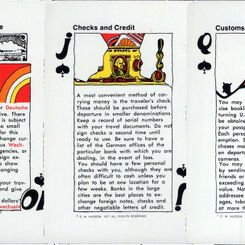
German Travel Cards
A travel-themed educational deck helping American tourists visiting Germany.
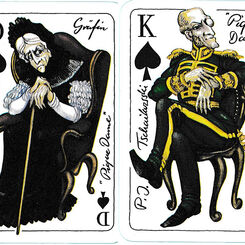
Opernkarte I
Humorous designs by Peter Becker on the theme of the Opera.
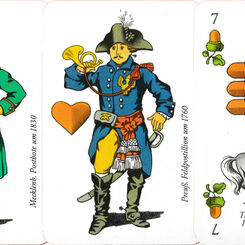
Postgeschichte
A celebration of different postal systems in Germany from 1630 to 1850, with designs by Volker Hartm...
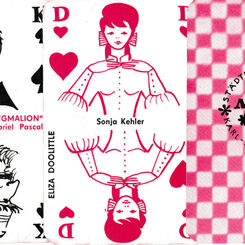
My Fair Lady
Theatre programme in the form of a pack of cards. East Germany, c.1967.
Bedeutende Erfindungen im Alltag
‘Significant Inventions in Everyday Life’ quartet game published by Verlag für Lehrmittel, Pössneck,...
Musikinstrumente
Musikinstrumente quartet game published by Verlag für Lehrmittel, Pössneck, 1984.
Deutsche Geschichte
German History Quartet published by Otto Maier Verlag Ravensburg, c.1930-35.
Musical Snap
Musical Snap by C.W. Faulkner & Co., c.1900.
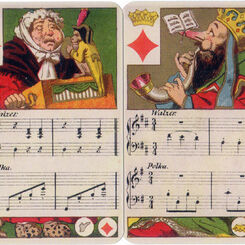
Musikalisches Kartenspiel
Facsimile of Dondorf’s “Musikalisches Kartenspiel” (c.1862) published by Lo Scarabeo, 2004
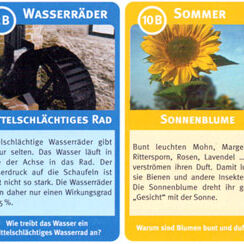
Klipp Klapp Karten
“Klipp Klapp Karten” printed by KZWP-Trefl (Poland) for Kindermuseum Oelde (Germany) in 2004
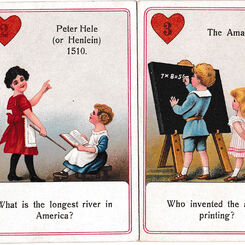
Who Knows?
Who Knows? game of questions and answers produced by Adolf Sala Games, Berlin, c.1900.
Austrian Cartomancy Cards
During the 19th century a system of fortune telling arose in Europe using unnumbered, pictorial card...
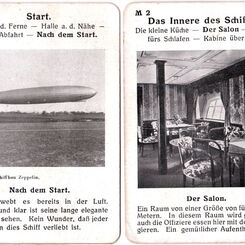
Graf Zeppelin
A card game commemorating the first round the world flight by the Graf Zeppelin, published by J.W. S...
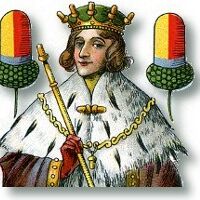
Gaigel-Karten
The Valets in this deck appear in costumes of the Biedermeier period, portraying sentimental and pio...
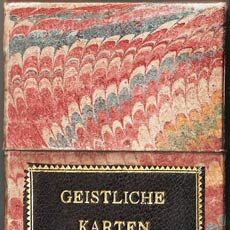
Geistliche Karten
Geistliche Karten, Augsburg, 1718. Each card carries a text in Gothic typeface giving advice regardi...
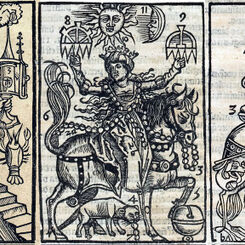
Logica Memorativa
Logica Memorativa playing cards by Thomas Murner, Brussels, 1507.
Most Popular
Our top articles from the past 60 days


