


Lidia Schöffer art-deco playing cards
A prize winning design from The Netherlands
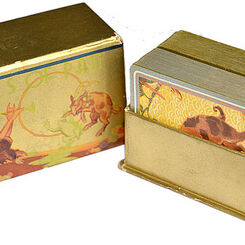
This pack of playing cards was the winning design of a competition organised for the pupils of Association of Arts and Crafts Education (Vereniging voor Kunstnijverheidsonderwijs) in Amsterdam. It is now known as the Rietveld Academy. The winner was Lidia Schöffer who designed these cards in a striking art-deco style using only three colours. They were printed lithographically by NV Drukkerij v.h. Dieperink & Co., Spuistraat 84, Amsterdam in 1942 in a limited number of 50 packs. There are rumours that a second edition was printed by the Speelkaartenfabriek Nederland but none have been found, and I have only ever seen a very few packs from the original edition. Whatever the case, it is an extremely rare pack to find. The pack consists of 52 cards plus one joker in a cardboard case, with either a blue or green reverse.
If you look carefully at the top flap on the scan of the reverse of the box you will see a small number printed 'K187'. These so-called K-numbers were issued during the occupation in WW2 to printers in the Netherlands who had to print their number on everything they produced. They were in use from 1942 until 1947. Printers were only allowed to print approved items and only on certain qualities of paper or card, often with only a single or reduced number of colours.


Below: The reverse, the joker
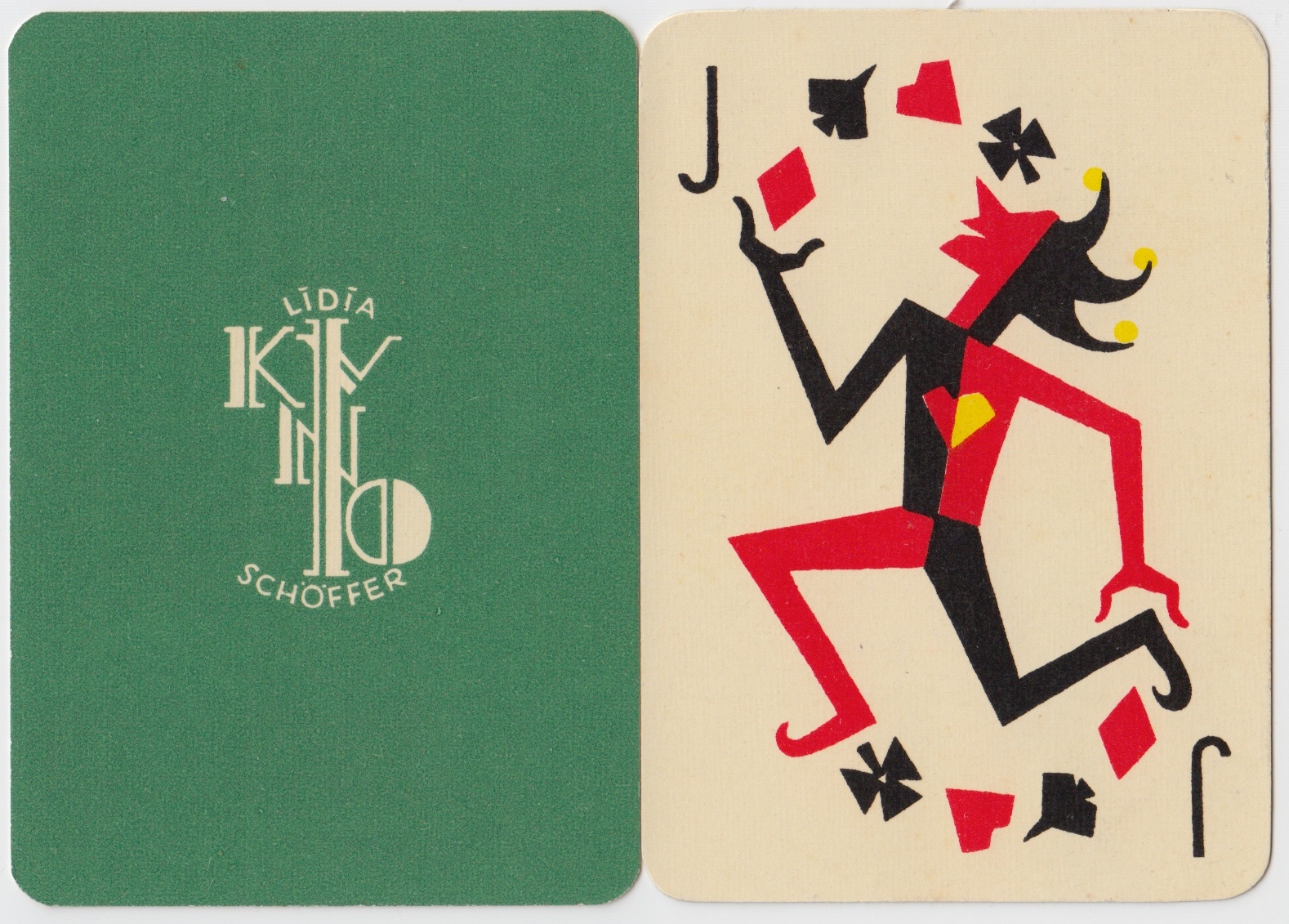
Below: both sides of the box


References:
- In de Kaart gekeken. Exhibition catalogue Amsterdam 1976. Cat.nr. 31
- Spielkarten Jugendstil und Art Deco, Segeth 1994. Page 145
- Auction catalogue Spielkarten Jugendstil und Art Deco, 1997. Nr. 102
All cards shown are from the collection of Paul Symons ©

By Paul Symons
Netherlands • Member since February 01, 2016
I'm British but I have now lived in the Netherlands for more than 50 years and am still enjoying every minute of it. I started collecting playing cards in the early 1980’s after speaking with my neighbour who was at that time a croupier in a casino. I started with just collecting jokers, but that soon led me to complete packs of cards and eventually to specialising in old and antique playing cards, particularly those of C.L. Wüst of Frankfurt, Germany. I am presently the Dutch representative of the I.P.C.S. and the auctioneer at the IPCS conventions.

Activity for Lidia Schöffer art-deco playing cards
Sign in to comment or save this article.

Related Articles
Balearic Souvenir Cards
Mediterranean Souvenir deck by Rioba Studio, Pollença, Mallorca.
Whist by Ditha Moser
Ditha Moser created this minimalist Whist deck in 1905, in the style of the Vienna Secession art mov...
-playing-cards-with-wüst-courts/images/rijks-1.f6075e41.jpg "Oude Kunst (Old Art) playing cards with Wüst courts")
Oude Kunst (Old Art) playing cards with Wüst courts
made for export to the Netherlands.
51: Some modern variations
A brief survey of some current variations in the standard English pattern.
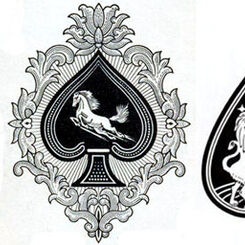
Modern Aces of Spades
Many modern aces of spades are anonymous so that, in the absence of any other information, the colle...
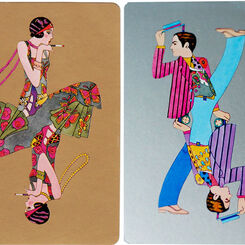
Roaring Twenties
Roaring Twenties playing cards by Angel Playing Cards Co Ltd, Japan. 1980.
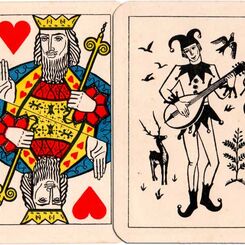
Anonymous Dutch deck, 1940s
Anonymous Dutch deck, 1940s
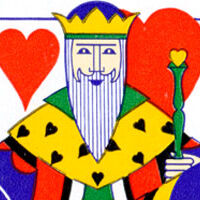
Hycrest Modern Royalty
Published by the Hycrest Playing Card Co., New York, c.1931. The large suit symbol behind each figur...
Past-L-Eze Playing Cards
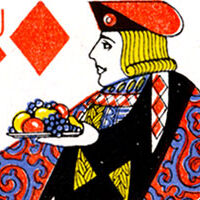
On “Past-L-Eze” playing cards Kings, Queens and Jacks are no longer stodgy and conventional but plea...
Ritter & Cie, 1933
A colourful re-working of the standard Anglo-American pattern in Art Deco style.
Smart Set 400
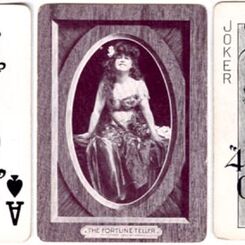
The “Smart Set 400” brand with named backs was introduced in c.1906 by the Kalamazoo Playing Card Co...
Transformation of Playing Cards
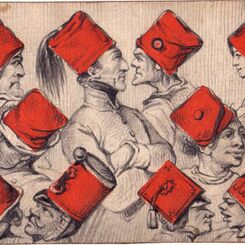
The best-known fantasy playing cards are Transformation cards, in which figurative scenes are drawn ...
19: 19th Century Breaks with Tradition - Unusual versions of the Standard English Pattern
The centuries-long tradition of English court cards was subject to misinterpretation and in some cas...
14: Back Designs
A few examples of the many interesting back designs.
Waisenfond
Intended to attract donations on behalf of the Imperial Royal Austrian Military Widows’ and Orphans’...

Vaivorykste (The Rainbow)
Vaivorykštė ('the Rainbow') playing cards manufactured in Lithuania by Spindulys, 1930s. The deck ha...
Balázs Pál Nagy's Tell No. 3306 Playing Cards
Balázs Pál Nagy Tell 3306
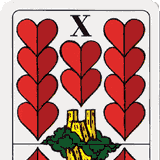
Balázs Pál Nagy's Playing Cards
Balázs Pál Nagy's Playing Cards
The History of Playing Cards
Playing cards appear in European records in the late 14th century, but their earlier history lies fu...
Queen of Hearts
“Queen of Hearts” by Josie Callipari, winner of the Brian Tucker Accounting Desert Fantasia Award 20...
Most Popular
Our top articles from the past 60 days


Ваня Козлов (Vanya Kozlov)
19 November 2025, 09:47SavedSaved this article to Ваня Козлов's Collection