


Jass Allemand
Egbert Moehsnang produced this contemporary Swiss-suited, double-ended pack, based on original XV century sources, but they were shunned by card players.
Egbert Moehsnang: ‘Jass Allemand’
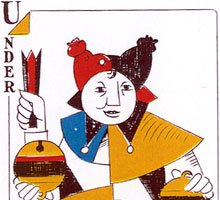
In 1978 the Swiss manufacturer AG Müller decided to redesign the Swiss pattern, in the hope that the traditional designs could be updated and reinstated as a strategy to overcome the foreign playing cards flooding into the market. They commissioned Egbert Moehsnang, who in consultation with a leading art historian took almost two years researching and designing the cards. Moehsnang produced this contemporary Swiss-suited, double-ended pack, based on original XV century sources, with highly legible indices and colour scheme, but they were simply shunned by card players and the idea wasn't successful.
See also: Abstract Bridge►
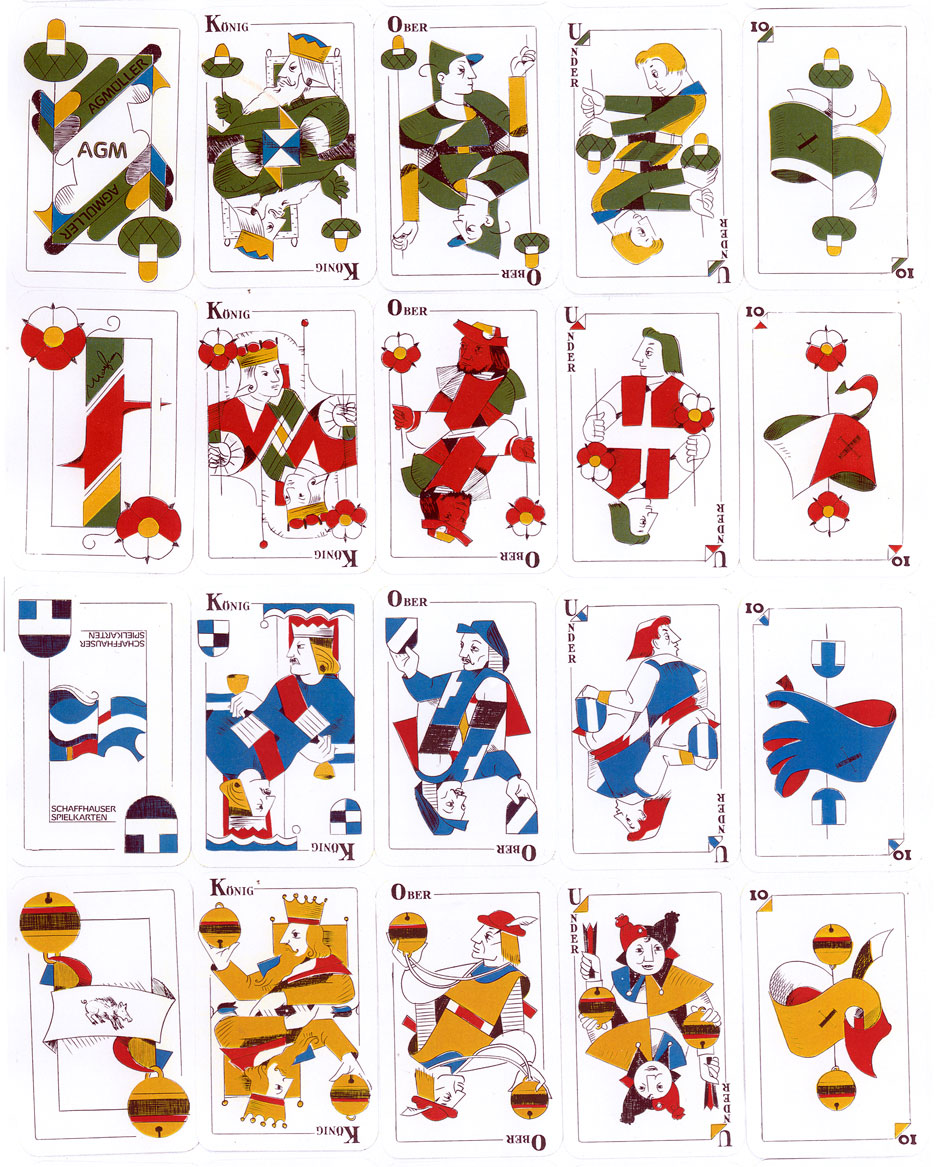
Above: cards from Egbert Moehsnang's ‘Jass Allemand’ Swiss-suited playing cards published by AG Müller, 1982. The original cards were produced from copper plate engravings, hand coloured with brush and stencils. The designs are flat, 2-dimensional figures rather than 3-dimensional as in older cards.
Update from Roddy Somerville
When the first edition was obviously not selling well, the card-playing fraternity was asked to come up with some possible improvements. There was therefore a second edition which included the following changes:
- The dark green colour has been replaced by a khaki colour.
- The yellow colour has been replaced by a mustard colour.
- "AGM" on the Daus of Acorns is not filled in but left white with a black outline.
- The panel behind the King of Acorns' head is now coloured both sides.
- The Ober of Flowers' hat is now completely red.
- The central design on the Daus of Shields has been redrawn.
- The Under of Shields no longer has a bald patch or tonsure.
- Behind the King of Bells is now red instead of yellow.
- The Ober of Bells' hat is now blue instead of red.
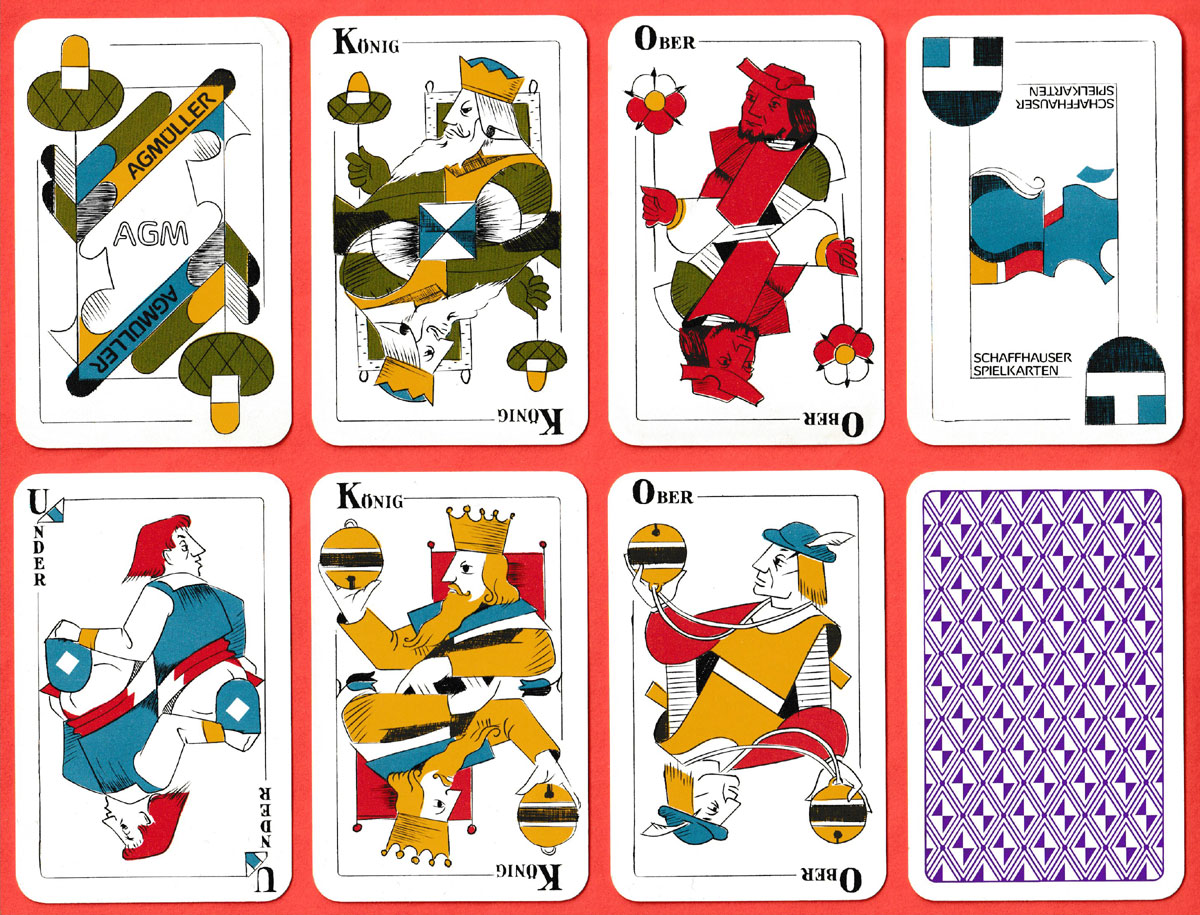
There are other small differences too numerous to mention. The back design remained the same. I have also seen both editions with advertisements on the back. There are subtle differences in colour on the boxes, reflecting the colour differences found on the cards inside. See the boxes►
Unfortunately, the second edition was not particularly popular either. AGM were clearly keen that this pack should be accepted and played with as they included a questionnaire in German with the second edition asking players what they thought of the cards. One wonders what responses they received - RS.

By Simon Wintle
Spain • Member since February 01, 1996
I am the founder of The World of Playing Cards (est. 1996), a website dedicated to the history, artistry and cultural significance of playing cards and tarot. Over the years I have researched various areas of the subject, acquired and traded collections and contributed as a committee member of the IPCS and graphics editor of The Playing-Card journal. Having lived in Chile, England, Wales, and now Spain, these experiences have shaped my work and passion for playing cards. Amongst my achievements is producing a limited-edition replica of a 17th-century English pack using woodblocks and stencils—a labour of love. Today, the World of Playing Cards is a global collaborative project, with my son Adam serving as the technical driving force behind its development. His innovative efforts have helped shape the site into the thriving hub it is today. You are warmly invited to become a contributor and share your enthusiasm.

Activity for Jass Allemand
Sign in to comment or save this article.

Related Articles
Para Jass
Humorous court card designs by Léon Schnyder for the Swiss Paraplegics Association.
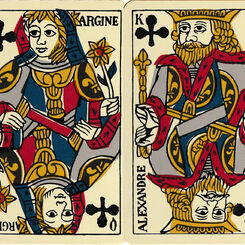
Bourbon Bridge
Attractive, woodcut-style courts adapted for modern play.
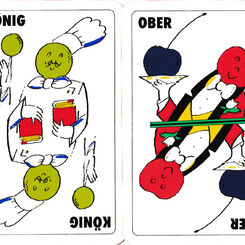
Bischofszell
Advertising pack for the food producer Bischofszell, designed by Heinz Looser-Brenner, with non-stan...
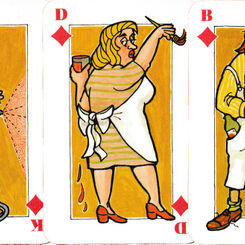
Scheffmacher
Advertising pack for Scheffmacher, master painters in Schaffhausen, with comic designs by Fritz Bünz...
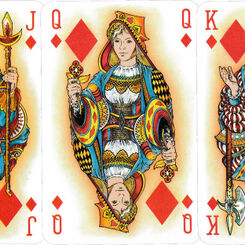
Tavaglione playing cards
Well-designed pack by Giorgio Tavaglione, with courts in medieval costume.
Schwyzer Fasnachts-Jass
Traditional carnival figures from the Swiss canton Schwyz, as interpreted by the artist Léon Schnyde...
Swiss Souvenir
55 different scenic photographic views of Switzerland.
Standard Swiss-German pattern (single-ended)
20th century version of a single-ended Swiss-German pattern pack for the game of Jass.
Mini Jass
Pocket-size cards with modern designs for playing the Swiss national card game, Jass.
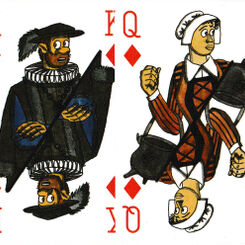
La Compagnie de 1602
Characters from the annual festival held to commemorate the failed attempt to storm Geneva in 1602. ...
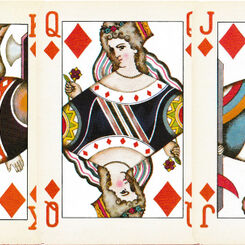
Ilford playing cards
Colourful advertising pack for Ilford designed by Mario Grasso, based on standard English courts.
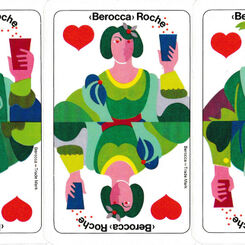
Roche
Advertising pack for the Swiss-based healthcare company.
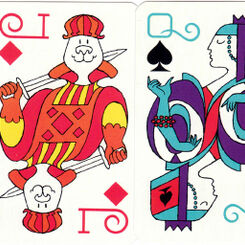
Investors Overseas Services
Investors Overseas Services, Ltd. (IOS) by A. G. Müller (Schaffhausen), c.1969.
AGMüller English Pattern
AGMüller standard English pattern for the Royal Jordanian Airline, 1980s
Modern Swiss-German Pattern
Modern Swiss-German Pattern by AGMüller, c.2000.
Schweizer Luxus-Jasskarte No.41
The lower and upper knaves are depicted in a vibrant and lively manner, while the enthroned kings ar...
Egbert Moehsnang
The suit signs and indices are clear and easily recognisable, and each suit has a different predomin...
Swiss Playing Cards
The Swiss national suit system of shields, acorns, hawk bells and flowers emerged sometime during th...
Swiss Playing Cards by David Hurter, c.1830
David Hurter had begun to build up a playing card business in Schaffhausen during the late 18th cent...
Antique Swiss Playing Cards, c.1530
The Swiss national suit system of shields, acorns, hawkbells and flowers originated sometime during ...
Most Popular
Our top articles from the past 60 days


