

Thomas Creswick
Thomas Creswick was a paper-maker and wholesale stationer. Playing cards were produced from c.1820 onwards.
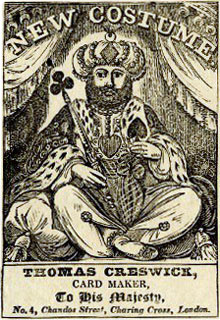
Thomas Creswick, 16 Skinner Street, Snow Hill, London
Thomas Creswick was a paper-maker and wholesale stationer who first entered the card business in 1812. Standard woodblock & stencil playing cards were produced from c.1820 onwards, following the traditional designs, including smaller-sized piquet packs and a special non-standard pack featuring historical kings and queens of various nations in c.1830 (shown below). Advertisements of the day mentioned that Creswick took great pains to make cards which slip easily in the hand whilst also introducing improvements in the manufacturing process. Duty Aces of Spades were registered from c.1820, and an exportation Ace of Spades in 1828.
Creswick was appointed as manufacturer of paper and cards to William IV in 1831 and he advertised as such in 1834. Thomas Creswick died at 12 Clarendon Place, Maida Vale in September 1840, age 66, described as cardmaker and stationer of Chandos St (Gentleman's Magazine, 1840, vol.168, p.553).
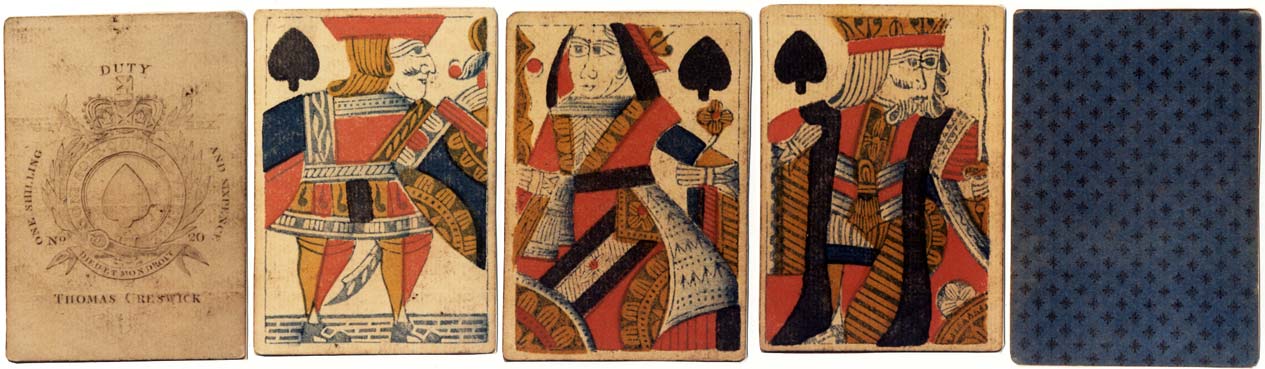
Above: standard pack of English playing cards with 'Garter' Ace of Spades manufactured by Thomas Creswick, c.1825. The court cards in this example are of the type used by Josiah Stone. There seems to have been some kind of take-over c.1825, as there is reference in the taxation records to Creswick's taking over a number of Stone Garter ASs. More usually Creswick uses Type IV court cards (shown below).
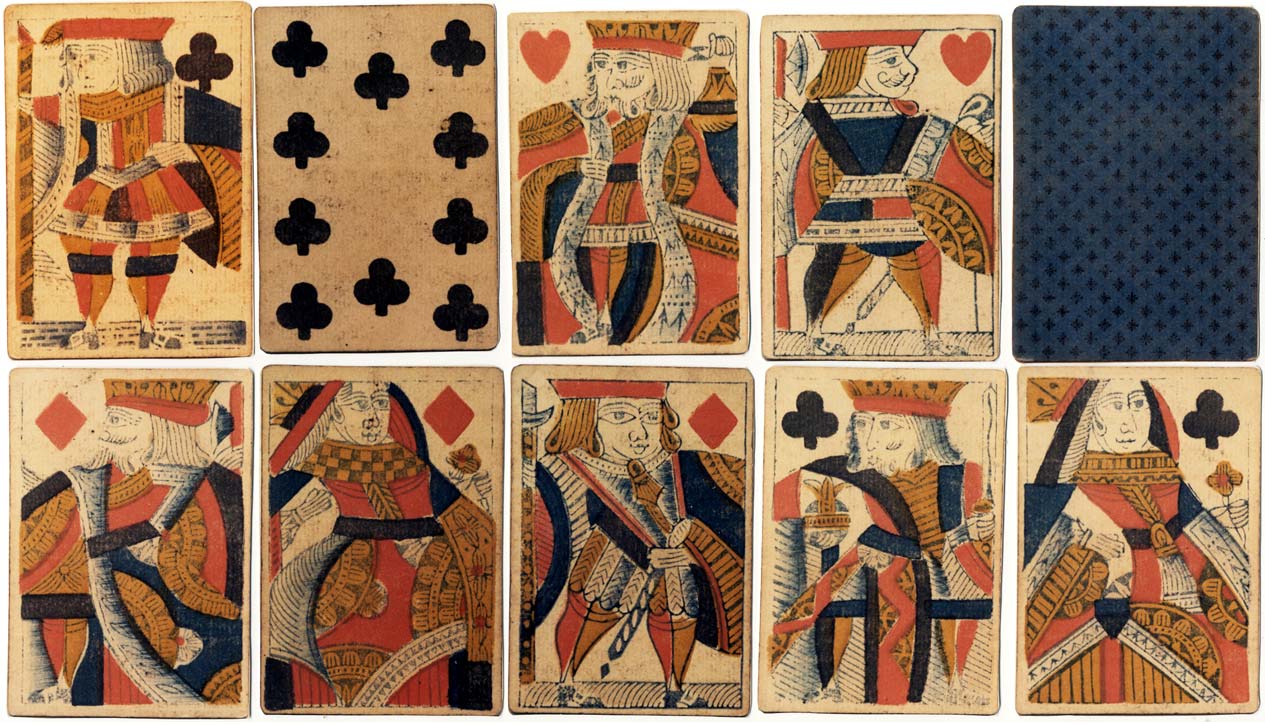
Above: standard pack of English playing cards with 'Frizzle' Ace of Spades manufactured by Thomas Creswick, c.1830. This pack uses Creswick's more usual type of court card designs, except the red jacks which are of the Stone Type II kind. Image courtesy Ken Lodge.
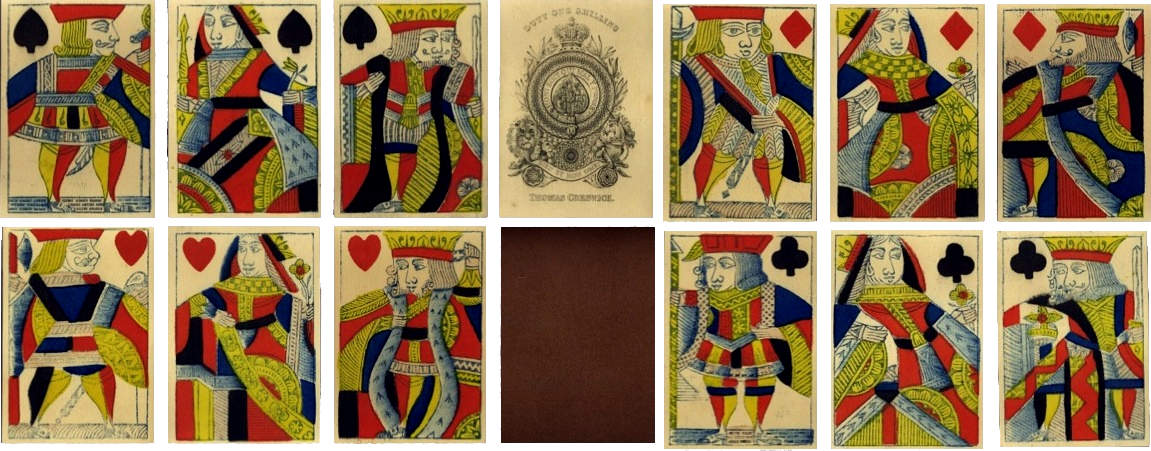
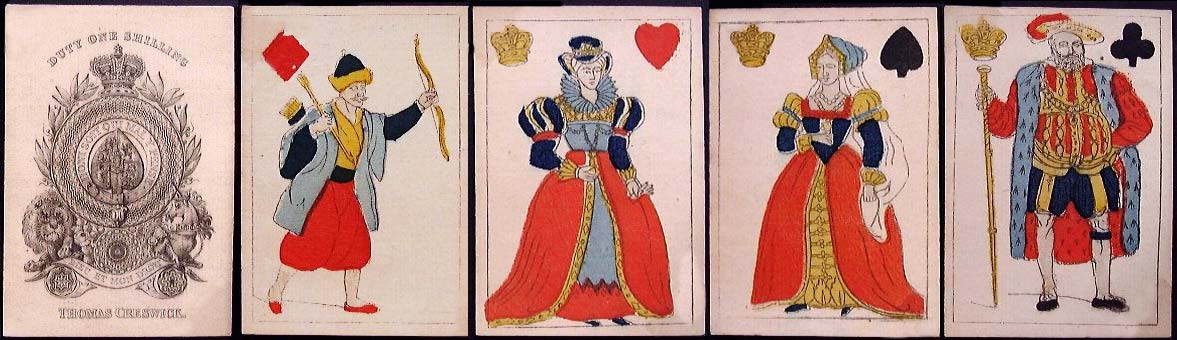
King of Clubs. Pope wrote “That long behind he trails his pompous robes. And, of all the monarchs only grasps the globe”. The title “King of Clubs” was bestowed by Johnson on the Literary Club.
In his advertising sheet dating to about 1832, Creswick informed his customers that he had removed his ‘Warehouse and Manufactory’ to larger and more commodious premises at 4 Chandos St, ‘where he has now room enough for the sale of Paper of every variety, as well as the goods of his own Production’. As well as writing paper and playing cards, he offered various of his own papers, including ‘prepared smooth and rough surface’ white drawing papers, ‘tinted and coloured Drawing Papers, Originally invented by him with prepared Surface…’
Below: pack produced by Thomas Creswick in c.1830 with 'Old Frizzle' Ace of Spades depicting historical Kings and Queens of various nations. The Kings and Queens are unnamed but are evidently meant to represent actual people. The King of Clubs is Henry VIII.
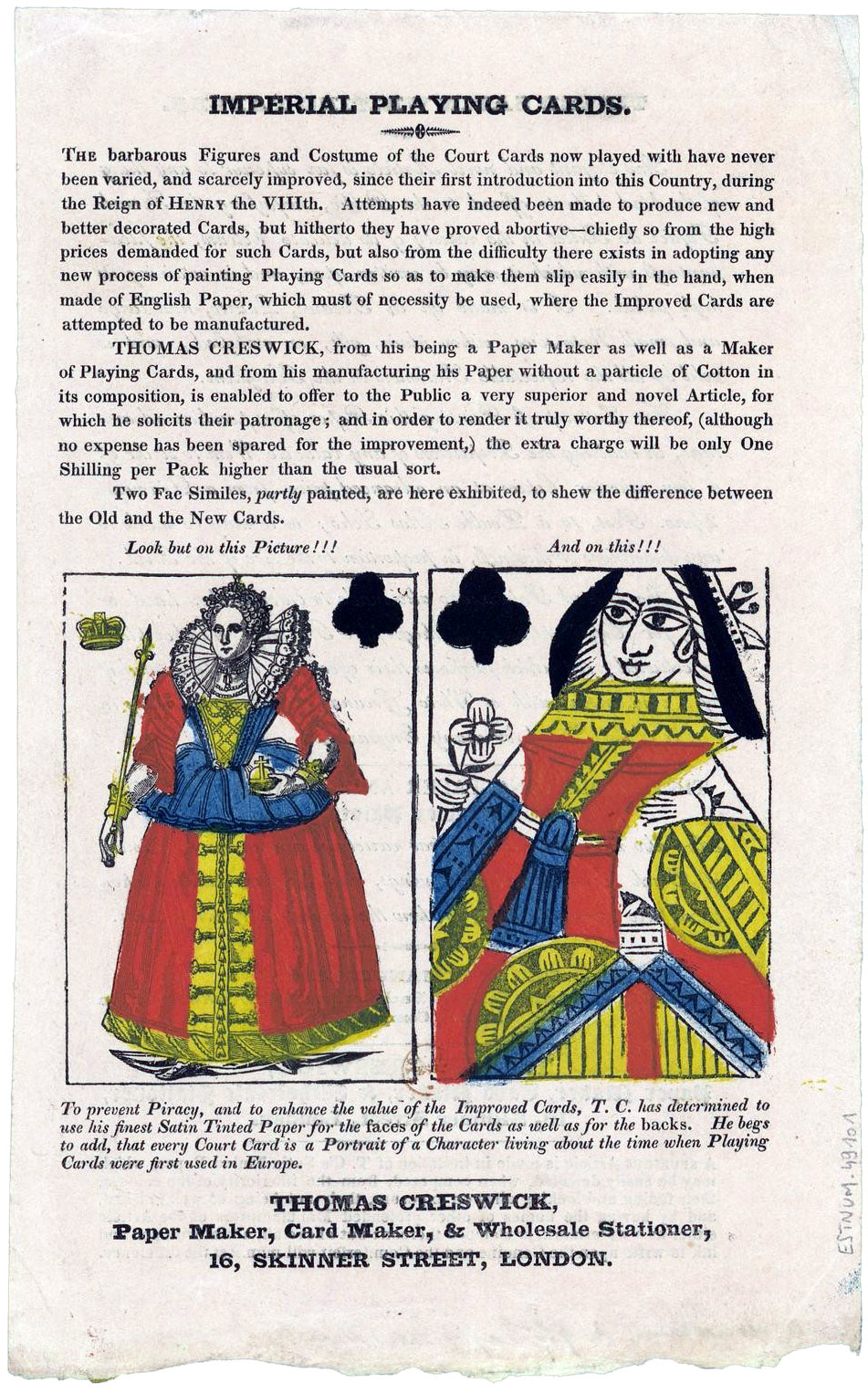
Above: Imperial Playing cards prospectus on fly leaf of New Monthly Magazine, Dec. 1827. Source gallica.bnf.fr / Bibliothèque nationale de France • Imperial Playing Cards prospectus►
REFERENCES:
Lodge, Ken: The Standard English Pattern (second revised and enlarged edition), Bungay, Suffolk, 2010
For more about Creswick, see Ken Lodge's blog, pages 15 and 19: →

By Simon Wintle
Spain • Member since February 01, 1996 • Contact
I am the founder of The World of Playing Cards (est. 1996), a website dedicated to the history, artistry and cultural significance of playing cards and tarot. Over the years I have researched various areas of the subject, acquired and traded collections and contributed as a committee member of the IPCS and graphics editor of The Playing-Card journal. Having lived in Chile, England, Wales, and now Spain, these experiences have shaped my work and passion for playing cards. Amongst my achievements is producing a limited-edition replica of a 17th-century English pack using woodblocks and stencils—a labour of love. Today, the World of Playing Cards is a global collaborative project, with my son Adam serving as the technical driving force behind its development. His innovative efforts have helped shape the site into the thriving hub it is today. You are warmly invited to become a contributor and share your enthusiasm.

Leave a Reply

Your Name
Just now Your comment here. Your comment here. Your comment here. Your comment here. Your comment here. Your comment here. Your comment here. Your comment here. Your comment here. Your comment here. Your comment here. Your comment here. Your comment here. Your comment here. Your comment here. Your comment here. Your comment here. Your comment here. Your comment here. Your comment here. Your comment here. Your comment here. Your comment here. Your comment here. Your comment here. Your comment here. Your comment here. Your comment here. Your comment here. Your comment here. Your comment here. Your comment here.
Related Articles
Wiggins Teape “Hi-Speed” playing cards
Wiggins Teape “Hi-Speed” playing cards manufactured by Waddingtons, c.1970.

32: The Not-So-Minor Cardmakers of the 19th Century - Part 3
A survey of the cards made by Creswick and Hardy, with a brief mention of De La Rue, Goodall and Rey...
Brotherton, 1789-1840
Brotherton is recorded as operating at 13 Little Britain (London) from 1789-1840. In 1851 his factor...

Hardy
The Hardy family of playing card manufacturers began with Henry Hardy (1784-89) and continued throug...
Berkshire Printing Co.
The company was founded in 1908 as the printing division of the Brooke Bond Tea Company in Reading. ...
Denbro (Denny Brothers)
Denbro (Denny Brothers) c.1975-79
Hunt & Sons, 1820-1849
Hunt & Sons (1820-1849) was the first maker to modernise the court card designs with a complete re-d...
Hunt, 1790-1801
Packs manufactured by Hunt, c.1800.

Reynolds non-standard
Sometime around c.1850 Reynolds & Sons produced this non-standard or variant pack with courts inspir...

Games & Print Services
Games & Print Services Limited, of Canvey Island, now part of Cartamundi.
Hunt, c.1800
Standard English pattern playing cards manufactured by Hunt, c.1800.
Playing cards in Wales - Welsh playing cards
Whereas the distinctiveness of Wales is an important resource contributing to the rich texture of va...
J & W Mitchell, Birmingham
This rare Victorian manufacturer made standard English playing cards for a short period during the l...
James English & Co.
Victorian Playing Cards manufactured by James English & Co., London, c.1875
History of English Playing Cards & Games
The History of English Playing Cards dates probably from the mid 15th century
Waddington’s “Envoy“ Series
Waddington’s “Envoy“ Series.
Waddington’s Classic and Wildlife Series, 1933
Waddington’s Classic and Wildlife Series, 1933.
Waddington’s Varsity Series
Waddington’s Varsity Series.
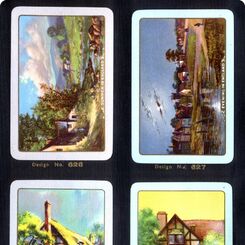
Waddington’s “Rural England” Series, 1933
Waddington’s "Rural England" Series, 1933.
Waddington’s Old Master Series, 1933
Waddington’s Old Master Series, 1933
Most Popular
Our top articles from the past 60 days


