

Squeezers No.35
By 1877 the New York Consolidated Card Co's "Squeezers" were a great success on account of the indices in the corners which enabled the cards to be fanned.
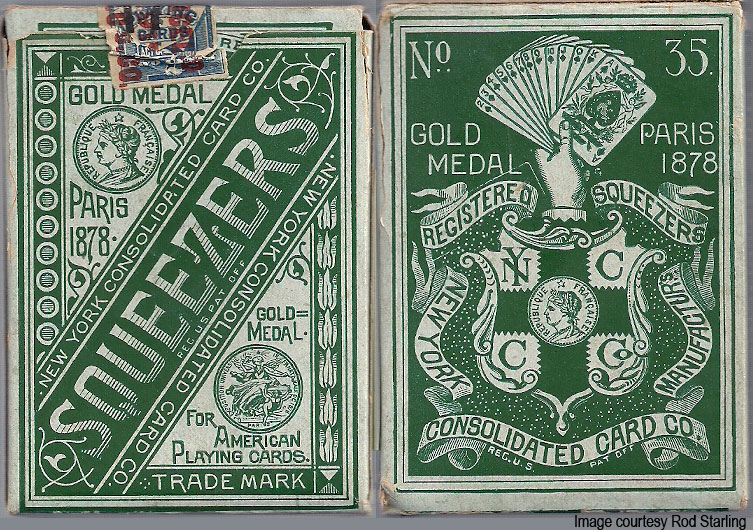
New York Consolidated Card Co: “Squeezers No.35”
By 1877 the New York Consolidated Card Co's “Squeezers” were a great success on account of little indices in the corners which enabled the cards to be held in a fan, or ‘squeezed’. The only competition came from the Andrew Dougherty Co., who were making their own patented ‘Triplicates’ with miniature cards in the corners instead of numbers, and then ‘Indicators’ with index numbers, which could also be ‘squeezed.’ A tacit understanding between the two about sales territory was established, so that the one company would not have to compete with the other. In this way by the late 1870s indices came into common use on English and American cards.
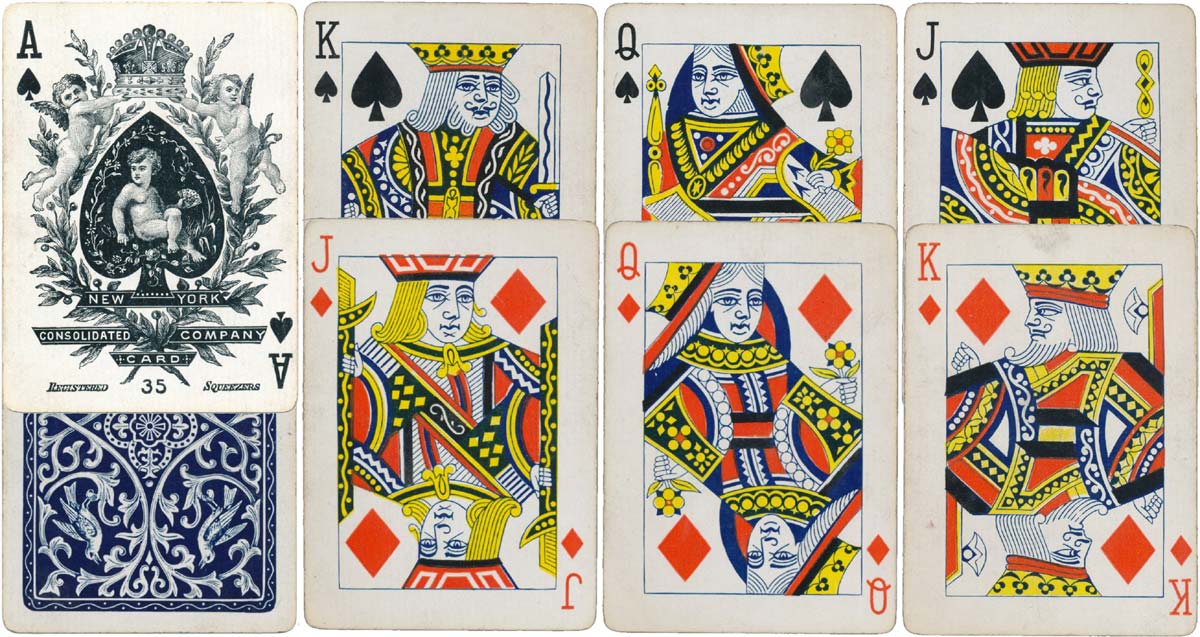
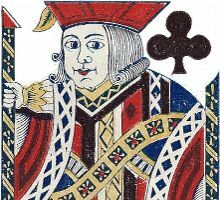
Above: Squeezers No.35, c.1895, with unturned courts. Image courtesy Matt Probert.
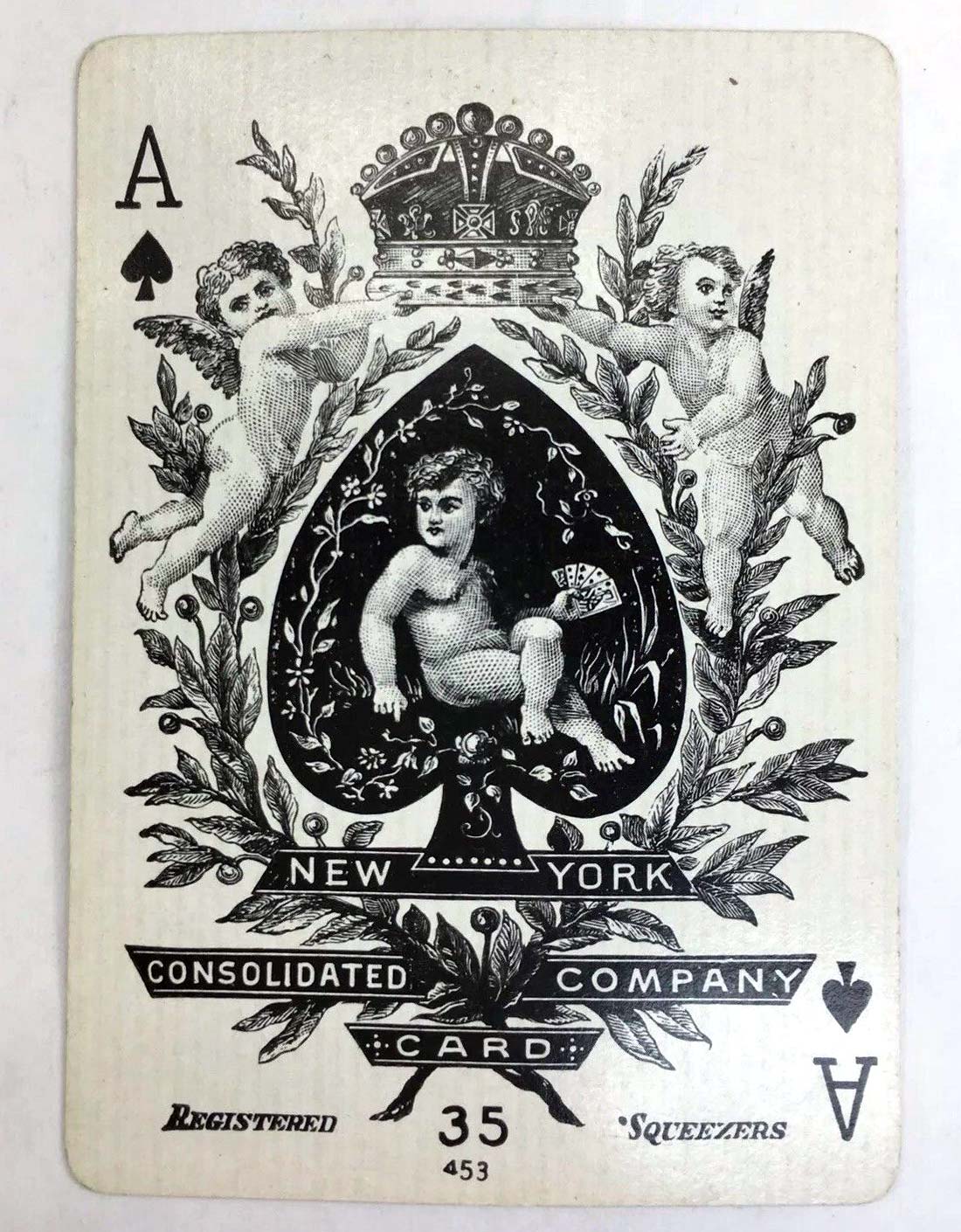
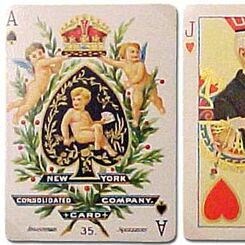
Above: Squeezers No.35, c.1915. Several versions of the Ace of Spades are known, this example has the legend "Registered Squeezers" and the number 35 at the bottom. The brand usually comes with the 'Gold Medal Joker' as shown here, but the earliest editions had the 'Best Bower'. However, the central cherub on the Ace was soon replaced by a wreath, and the outer images were also replaced. The box is shown above. Images courtesy Rod Starling.
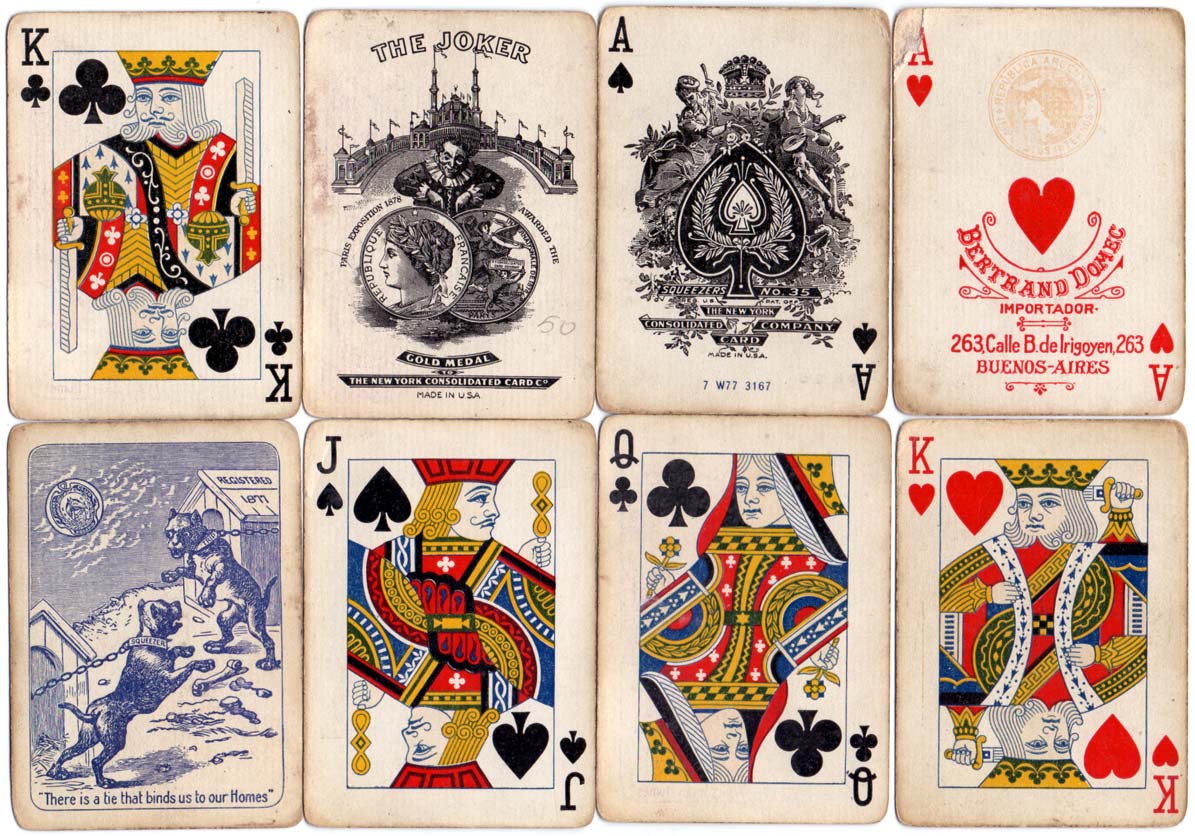
In an historic pact the two manufacturers (Dougherty & NYCCC) divided the country between themselves as a means of eliminating outside competition. To honour this agreement, NYCCC issued a ‘Squeezer’ deck with a back design showing two dogs, Squeezer and Trip, chained to their respective kennels with a caption “There is a tie that binds us to our Homes”. Note the differences in the Ace of Spades and Joker and the re-drawn courts.
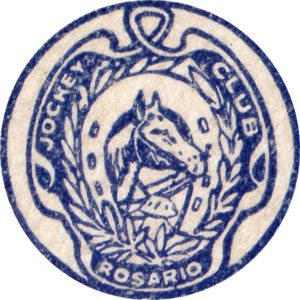
Above & Left: No.35 Squeezers issued by NYCCC in c.1916 for the Jockey Club, Rosario, Argentina. In this edition the Aces of Spades and Hearts are as in the above example. The smiling sun face on the reverse has been changed to a Jockey Club logo (see enlargement left) so this was a specially commissioned edition not sold elsewhere. An earlier example of cards customised for the Jockey club was manufactured by Chas Goodall & Son Ltd in c.1901→
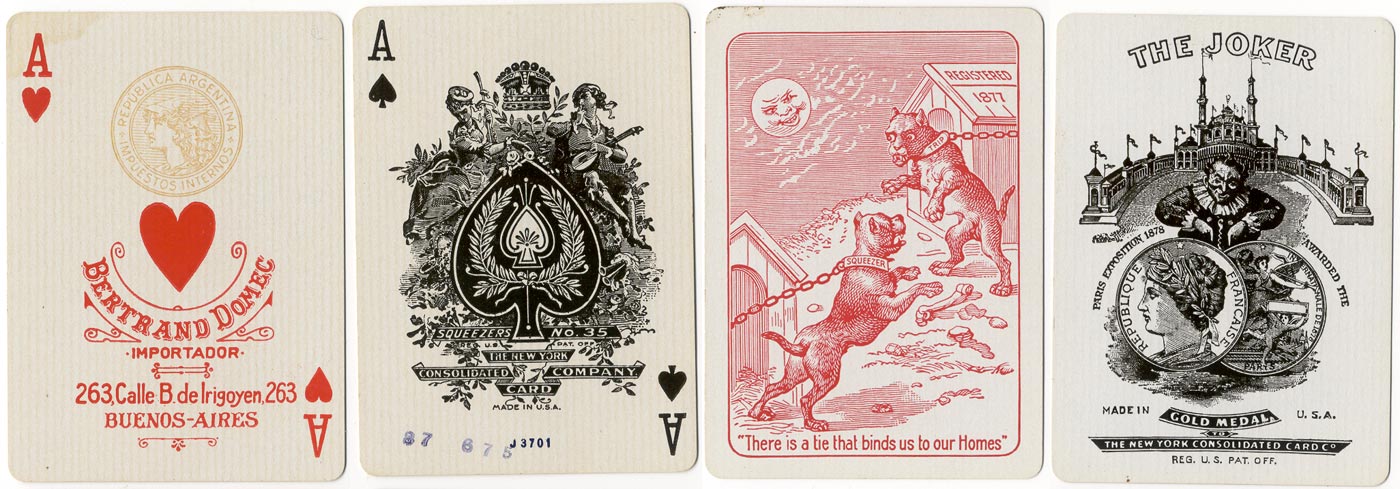
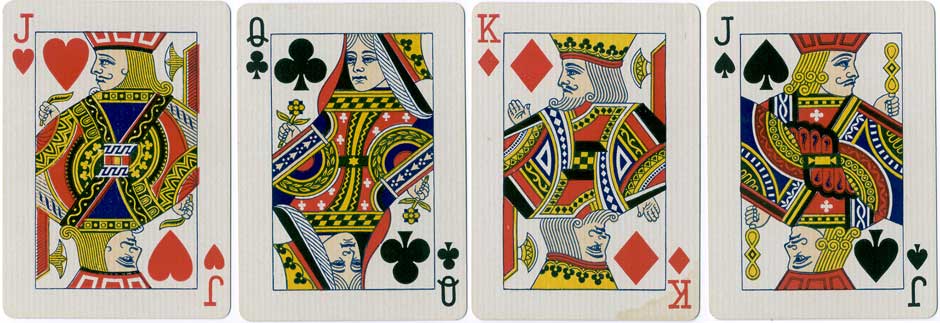
Above: No.35 Squeezers imported into Argentina by Bertrand Domec, whose details are overprinted on the Ace of Hearts, c.1927. Although the Ace states Domec's address to be Calle B. de Irigoyen 263, the box gives the newer address at no.223. Bertrand Domec had a long-standing relationship with the NYCCC and was their exclusive agent in the River Plate region.
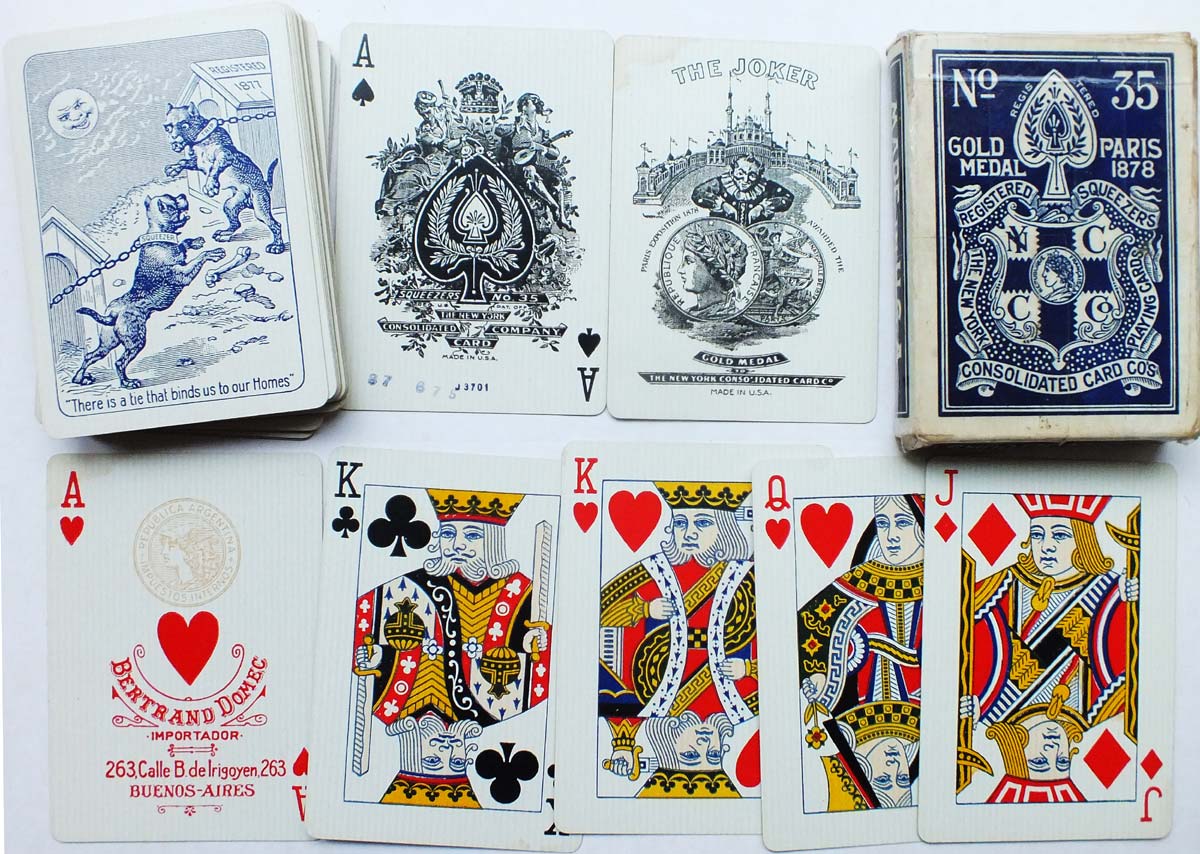
In 1930 the New York Consolidated Card Co. and the Andrew Dougherty Co. merged into Consolidated-Dougherty Card Co. Inc., with headquarters in New York. This company was dissolved in 1962 and was absorbed as a division of the United States Playing Card Co. of Cincinnati. The original Squeezer and Trip back design continued to be issued from time to time until at least 1977 (100th anniversary) with various Aces of Spades and Joker designs.
Tally-Ho Jokers
Enlargement
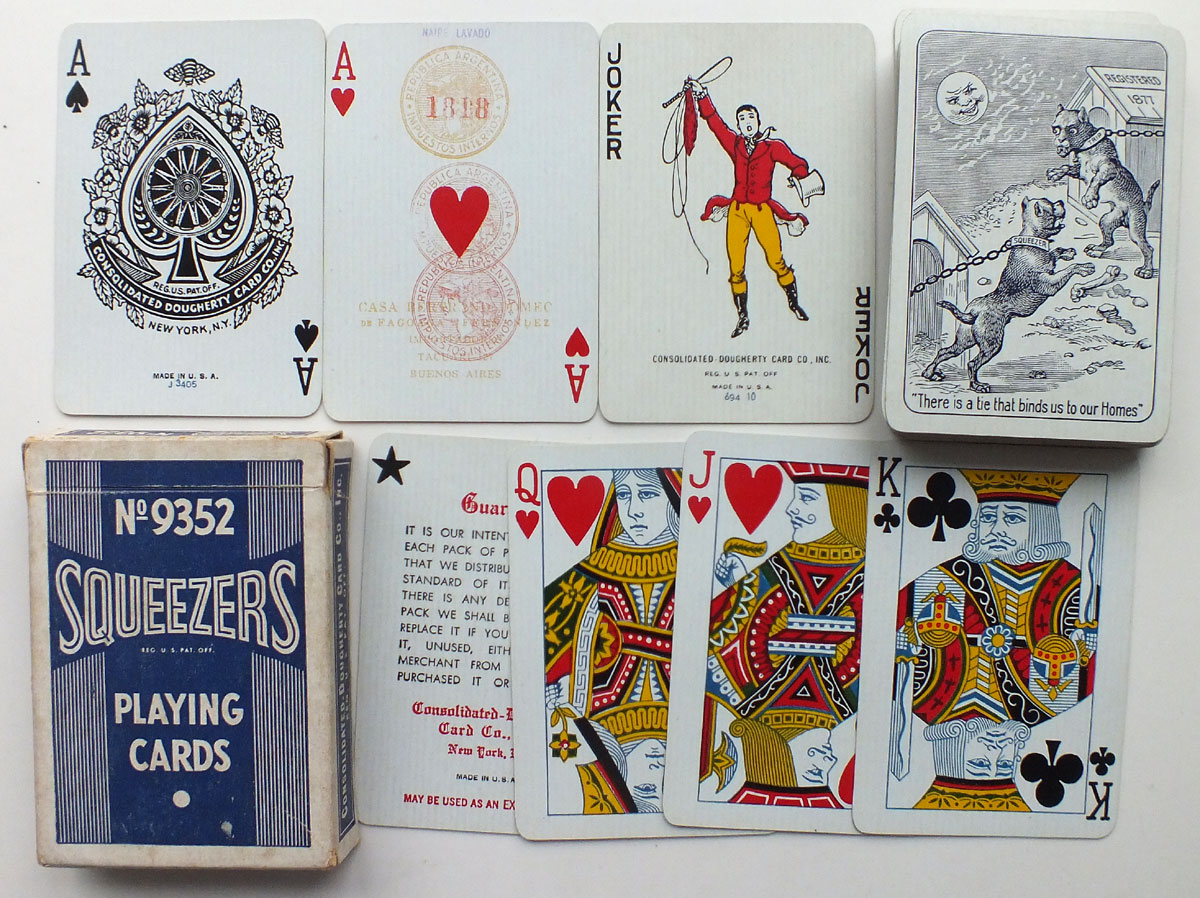
Above: No.9352 Squeezers issued by Consolidated-Dougherty Card Co., Inc. c.1947 and imported into Argentina by Casa Bertrand Domec de Fagoaga y Fernandez, Tacauri 127, Buenos Aires, whose details are overprinted on the ace of hearts. The back design is the same Squeezer and Trip picture as in the examples above. However, close examination of the ace of hearts reveals three 'Mercury' importation tax stamps, one orange (top) and two red (below) along with a control number (1818) and the legend 'Naipe Lavado' overstamped at the top of the card. This refers to the practise of refurbishing used decks which were then taxed for a second time.
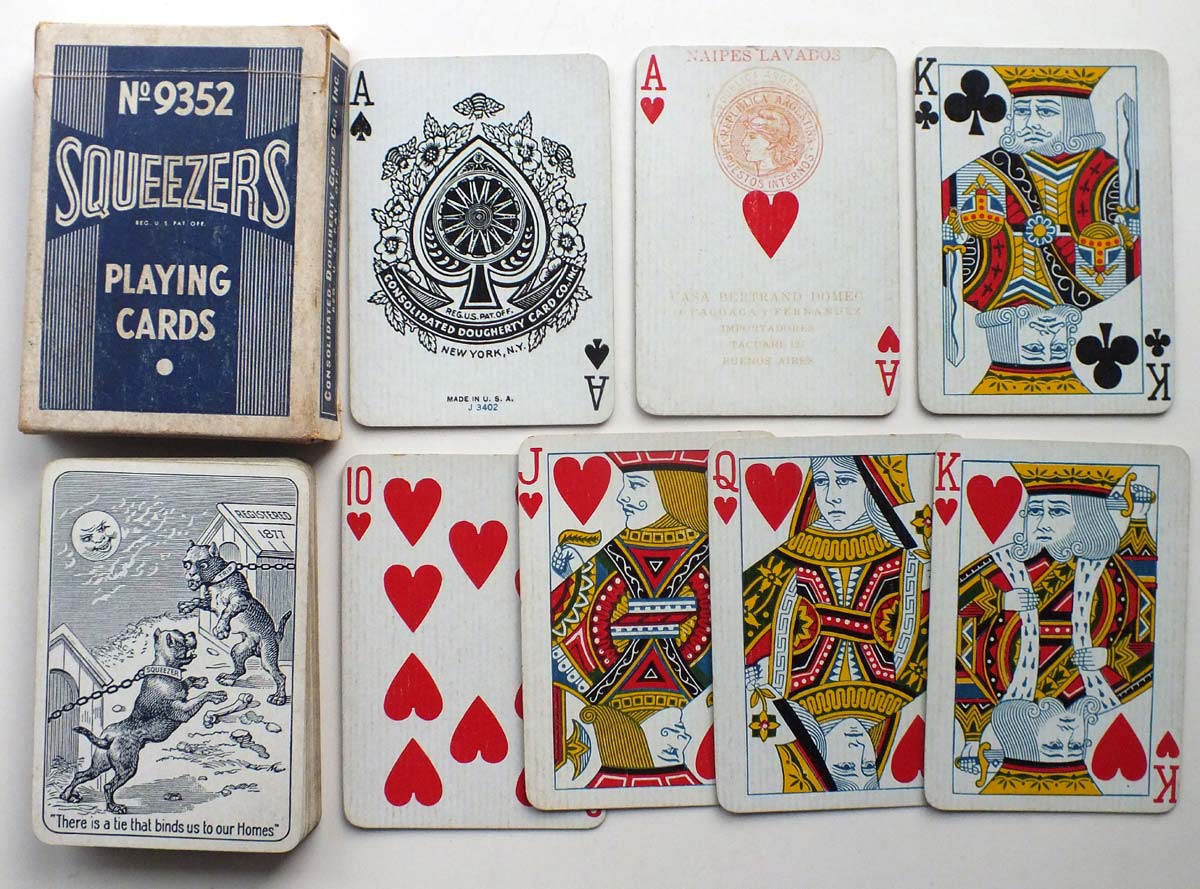
Above: No.9352 Squeezers issued by Consolidated-Dougherty Card Co., Inc. c.1947 and imported into Argentina by Casa Bertrand Domec de Fagoaga y Fernandez, Tacauri 127, Buenos Aires. The ace of spades is identical to the one shown directly above, and the back design is the same Squeezer and Trip picture as in the earlier examples. The ace of hearts carries two importation tax stamps: the original orange or light brown 'Mercury' stamp (top) and a red 'Marianne' stamp (below) with the legend 'Naipes Lavados' overstamped at the top (see enlargement at left). The 'Marianne' version of the tax stamp did not come into general use until c.1953 so some time had elapsed before the cards were refurbished. Furthermore, the cards have been trimmed to renew the edges, and the margins can now be seen to be narrower.

By Simon Wintle
Spain • Member since February 01, 1996 • Contact
I am the founder of The World of Playing Cards (est. 1996), a website dedicated to the history, artistry and cultural significance of playing cards and tarot. Over the years I have researched various areas of the subject, acquired and traded collections and contributed as a committee member of the IPCS and graphics editor of The Playing-Card journal. Having lived in Chile, England, Wales, and now Spain, these experiences have shaped my work and passion for playing cards. Amongst my achievements is producing a limited-edition replica of a 17th-century English pack using woodblocks and stencils—a labour of love. Today, the World of Playing Cards is a global collaborative project, with my son Adam serving as the technical driving force behind its development. His innovative efforts have helped shape the site into the thriving hub it is today. You are warmly invited to become a contributor and share your enthusiasm.

Leave a Reply

Your Name
Just now Your comment here. Your comment here. Your comment here. Your comment here. Your comment here. Your comment here. Your comment here. Your comment here. Your comment here. Your comment here. Your comment here. Your comment here. Your comment here. Your comment here. Your comment here. Your comment here. Your comment here. Your comment here. Your comment here. Your comment here. Your comment here. Your comment here. Your comment here. Your comment here. Your comment here. Your comment here. Your comment here. Your comment here. Your comment here. Your comment here. Your comment here. Your comment here.
Related Articles
Poker Nº 505
Heraclio Fournier ‘Poker Nº 505’ for export to Argentina with elaborate peacock joker, c.1960.
Tally-Ho
The earliest Ace of Spades had the Centre Street address and the Jolly Joker was used until the “Tal...
Bertrand Domec page 6
Playing Cards imported into Argentina by Casa Bertrand Domec de Fagoaga y Fernández (Sucesores) Bs. ...
Excelsior
Excelsior by A. Dougherty, c.1870.
Julio Laje
Julio Laje, importing agent for playing cards, Aconquija 2981, Buenos Aires, c.1930-1960.
Illuminated Playing Cards, c.1865
Facsimile edition of Andrew Dougherty's Illuminated deck, c.1865, published by U.S. Games Systems, I...
Lawrence & Cohen
Lawrence & Cohen were successors to Lawrence, Cohen & Co.
Royal Playing Cards, 1890s
Royal Playing Cards, 1890s
Lewis I. Cohen
Lewis I. Cohen made his first deck of cards in 1832. In 1835 Mr Cohen invented a new machine to prin...
New York Consolidated Card Company
The New York Consolidated Card Company was formed in 1871 by the merging of Lawrence & Cohen, Samuel...
Samuel Hart, 1846-1871
Samuel Hart was a prolific manufacturer of playing cards who commenced business sometime around 1845...
Andrew Dougherty 1848-1930
Andrew Dougherty was born in Donegal in Northern Ireland in 1827. He started his playing card busine...

Bertrand Domec, 1904-1970 page 2
Bertrand Domec page 2 (c.1905-1926).
Fagoaga y Compañía (Casa Bertrand Domec), Buenos Aires, c.1970
Playing Cards Imported into Argentina by Fagoaga y Compañía (Casa Bertrand Domec), Buenos Aires, c.1...
Naipes Coraza, Comas, Barcelona, 1940s
Naipes Coraza, Hija de Antonio Comas, Barcelona, 1940s.

Bertrand Domec, Buenos Aires 1904-1970
Bertrand Domec was an importer of playing cards into Argentina, 1904-1970.
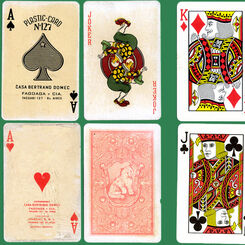
Nascal S.R.L., Buenos Aires, 1960-80
Nascal S.R.L., Buenos Aires, 1960-80.
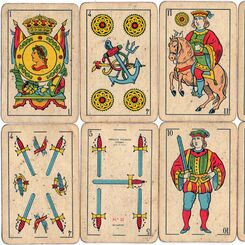
Fournier No.35 Spanish-suited playing cards
Fournier No.35 Spanish-suited playing cards imported into Argentina by Fagoaga y Compañía ...
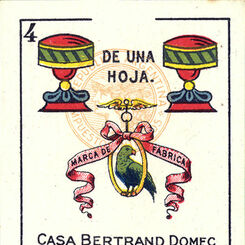
Hija de A. Comas “El Periquito”, c.1930
Sebastian Comas y Ricart - Hija de A. Comas “El Periquito” Spanish-suited playing cards for export t...
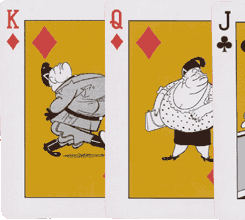
History of the War playing cards
“History of the War” playing cards with caricatures of Winston Churchill, Adolf Hitler, Joseph Stali...
Most Popular
Our top articles from the past 60 days


