


Quercia y Possi, Buenos Aires 1815-16
José Maria Quercia y Possi was an Italian immigrant who joined the Chilean Independence army. He set up a playing card factory in Argentina in 1815 known as "Fábrica de Buenos Aires".
José Maria Quercia y Possi, 1815-16
18 engraved playing cards by José Maria Quercia y Possi, Buenos Aires, 1815.
José Maria Quercia y Possi was an Italian immigrant who joined the Chilean Independence army. He fled to Buenos Aires after being defeated by Spanish forces in the Battle of Rancagua in 1814. Once he had re-settled in Buenos Aires, he set up a playing card factory known as "Fábrica de Buenos Aires" as shown on the ace of coins.
A document dated 2nd November 1816 states that the factory manager, Félipe Cardenas, filed a complaint regarding illegal imported playing cards which were damaging the business. These are likely to have been arriving from Italy and Spain. Shortly after this Quercia y Possi returned to Chile and no further information about the playing card factory is known.
Quercia y Possi was also a practising Freemason and this is alluded to on the four of cups.
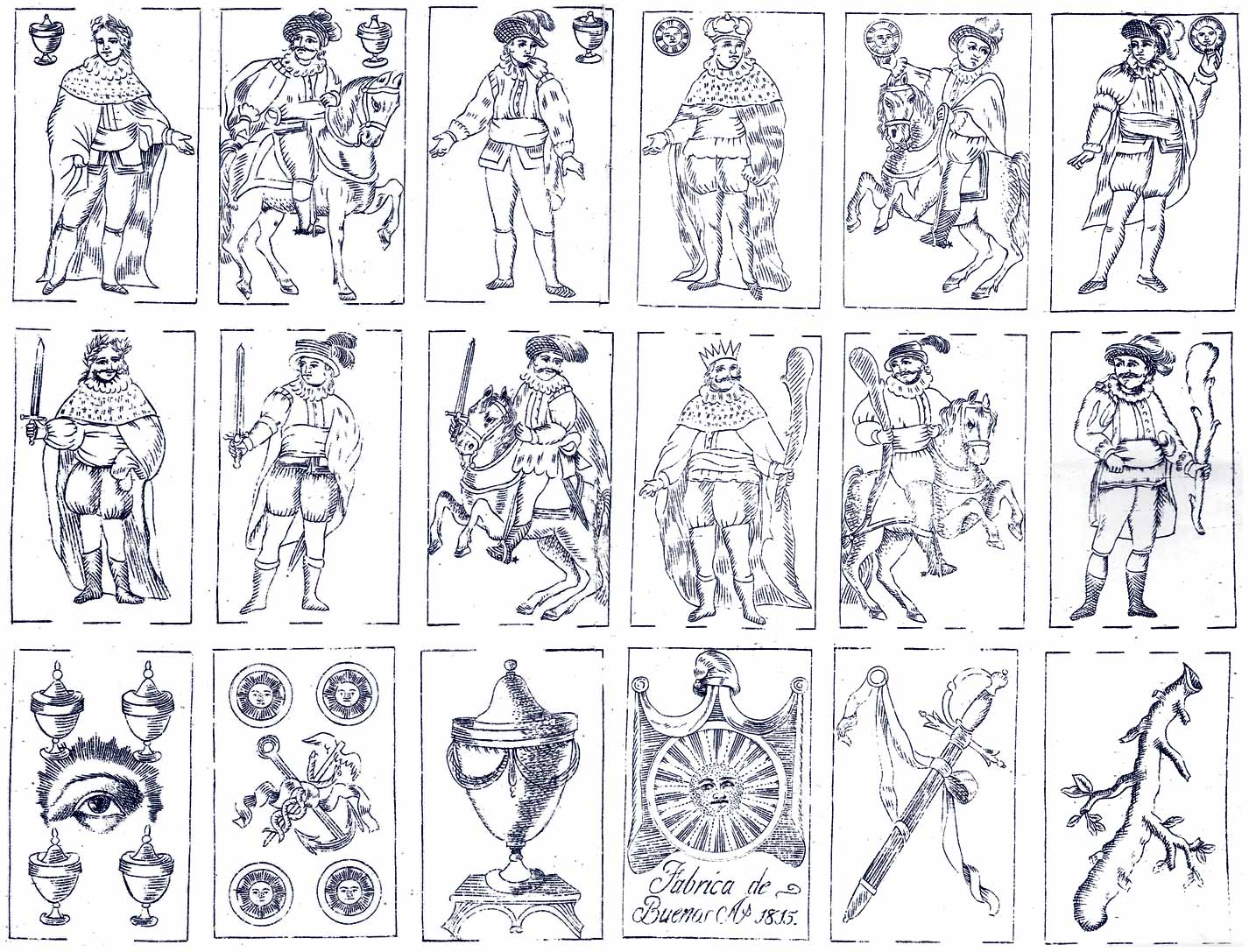
This uncoloured proof sheet is preserved in the Archivo General de la Nación (Buenos Aires). Each card measures 8.8 x 5.5 cms. The designs are based on an earlier model by Juan Francisco Maciá of Madrid, first published in around 1800, and subsequently by Juan José Maciá of Barcelona, in 1830, which was widely imitated in Spain and Italy during the19th century. More →
Thanks to Juan Carlos Recarey for help with historical information. Images from printed sheet held in the Archivo General de la Nación (Buenos Aires). A second companion sheet is believed to have existed but which is now missing from the archive.

By Simon Wintle
Spain • Member since February 01, 1996
I am the founder of The World of Playing Cards (est. 1996), a website dedicated to the history, artistry and cultural significance of playing cards and tarot. Over the years I have researched various areas of the subject, acquired and traded collections and contributed as a committee member of the IPCS and graphics editor of The Playing-Card journal. Having lived in Chile, England, Wales, and now Spain, these experiences have shaped my work and passion for playing cards. Amongst my achievements is producing a limited-edition replica of a 17th-century English pack using woodblocks and stencils—a labour of love. Today, the World of Playing Cards is a global collaborative project, with my son Adam serving as the technical driving force behind its development. His innovative efforts have helped shape the site into the thriving hub it is today. You are warmly invited to become a contributor and share your enthusiasm.

Activity for Quercia y Possi, Buenos Aires 1815-16
Sign in to comment or save this article.

Related Articles
Spanish-Suited Playing Cards in Latin America
The journey of Spanish-Suited decks from Conquistadores to local makers.

J. M. Gandarillas, Buenos Aires, c.1815
Playing cards believed to have been designed in 1815 by the Chilean immigrant Manuel José Gandarilla...
Native Indian Hand-made Cards made on rawhide
Native Indian hand-made cards made on rawhide.
Most Popular
Our top articles from the past 60 days


