


Suicide King
The King of Hearts, holding a sword behind his head, is sometimes nicknamed the “Suicide King”. He can be seen to derive from a late medieval design showing a King wielding a battle axe.

The Origin of the “Suicide King”
The “Suicide” King of Hearts derives from a medieval design showing a King wielding a battle axe
Many fanciful theories have been proposed regarding the origins of the court figures on our standard English playing cards. The fifteenth century cards of Pierre Marechal of Rouen, with their air of self-assurance, are the predecessors of our contemporary standard Anglo-American court cards which are now recognised world-wide. The early history of the development of different regional patterns is not always straightforward, so that as card makers migrated or copied each other, certain figures reoccur in patterns from other countries, even with different suit systems.
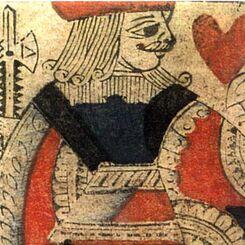
The King of Hearts, holding a sword behind his head, is sometimes nicknamed the “Suicide King”. He can be seen to derive from a late medieval design showing a King wielding a battle axe. All the important features can easily be recognised: the belt, the patterned cloak held by his hand and the stance showing one leg - except in the double-ended version. Sometimes cards were turned to face the other direction, but by around 1870 English cards were fixed with the suit symbol accommodated at the left-hand side to assist in fanning, or “squeezing” the cards in hand.
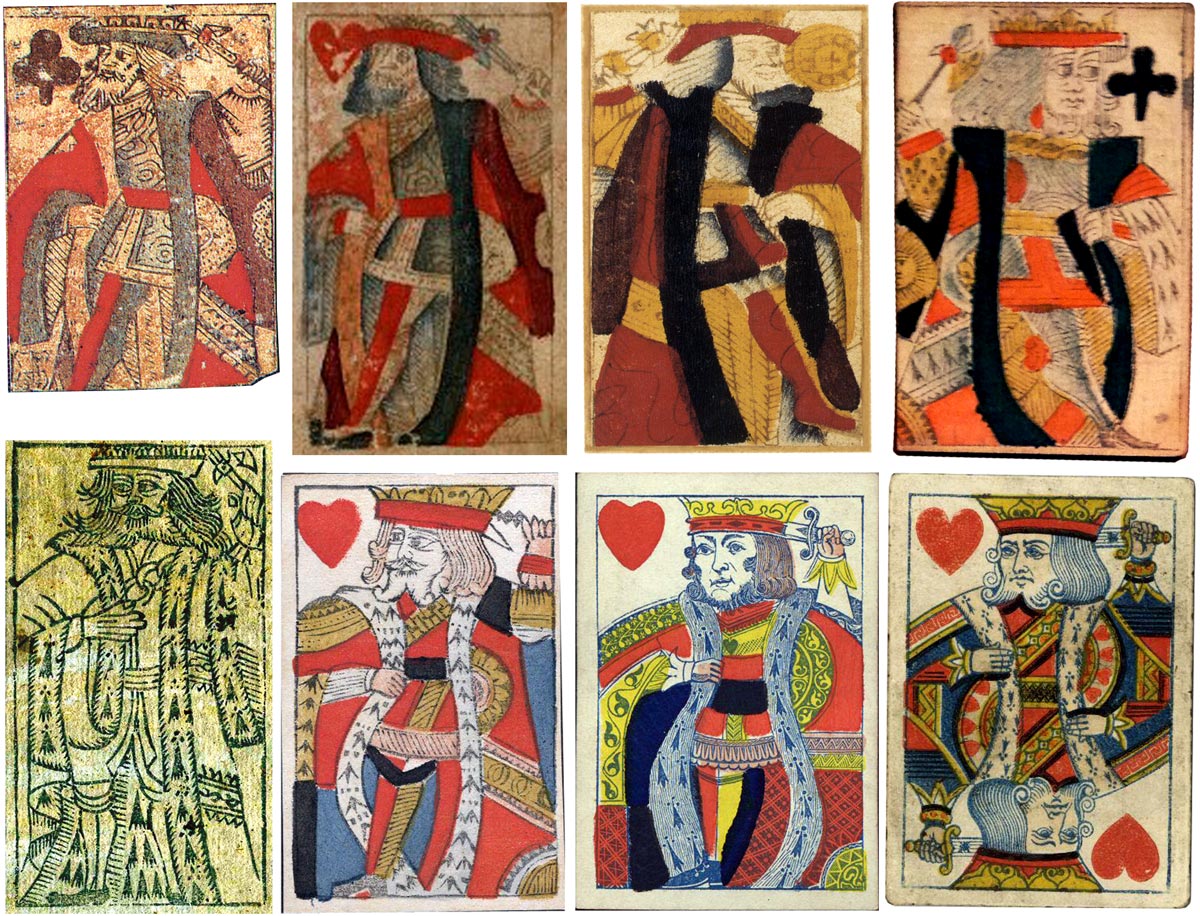
Above: eight versions of the 'battle axe' king from various periods and locations, illustrating how the King of Hearts in modern standard playing cards derives from a late-medieval design. Top Row (left to right): 1) fifteenth century French. 2) Anglo-French, late 15th/early 16th century. 3) Spanish 16th century. 4) French 17th/18th century. Bottom Row: English cards from 17th century to late 19th century.
By around 1800 the battle axe seems to have been replaced by a sword which disappears behind the King's head. Curiously, in the double-ended version, the King of Hearts becomes the only four-handed court card.
A similar late medieval derivation can be shown for the remaining court cards in the English pack. Many of the attributes, or symbols of office, have changed or become unrecognisable over the years, but the basic features are still there. The question of whether they were facing left, right or straight forwards seems to be simply a matter of chance.
See also: Pierre Marechal of Rouen • Early Anglo-French cards • Phelippe Ayet, c.1574 • Provence pattern • 17th Century Spanish cards from Navarra • Joan Barbot, San Sebastian, c.1765 • Blanchard, c.1770
Update - the “Suicide King” today
Many new decks have fully custom court designs. However, the “Suicide King” is nearly always there.

Above: five examples of the “Suicide King” from contemporary decks, 2020s.
An interesting observation

Above is a screenshot from the Clint Eastwood film “For a Few Dollars More” (set in 1872 and filmed in 1967, mostly in Spain). The cards in the film are not consistent with 1872 period, and are merely 'modern' cards from the 1970s manufactured in Spain by Naipes Fournier. The “Suicide King” (King of hearts) with Jumbo indices is shown in play (cards in the 1870s had no indices). Thanks to Jay Holtslander for spotting this.
• The Man With No Name Costume Information►
The king holds his sword in his left hand, but a second left hand is also holding his coat. This idiosyncrasy is found only in Fournier's design.


By Simon Wintle
Spain • Member since February 01, 1996
I am the founder of The World of Playing Cards (est. 1996), a website dedicated to the history, artistry and cultural significance of playing cards and tarot. Over the years I have researched various areas of the subject, acquired and traded collections and contributed as a committee member of the IPCS and graphics editor of The Playing-Card journal. Having lived in Chile, England, Wales, and now Spain, these experiences have shaped my work and passion for playing cards. Amongst my achievements is producing a limited-edition replica of a 17th-century English pack using woodblocks and stencils—a labour of love. Today, the World of Playing Cards is a global collaborative project, with my son Adam serving as the technical driving force behind its development. His innovative efforts have helped shape the site into the thriving hub it is today. You are warmly invited to become a contributor and share your enthusiasm.

Activity for Suicide King
Sign in to comment or save this article.

Related Articles
78: The Standard English pattern - Part 2, the tricky bits
There are many less straightforward aspects to the designs of the English pattern, which need carefu...
Heathen Divinities
Handmade playing cards from the British Museum depicting classical Greek and Roman gods and goddesse...
Dutch Court playing cards
Games & Print Services’ version of the Dutch pattern.
Playing Cards: A Secret History
Playing Cards: A Secret History
71: Woodblock and stencil: the hearts
A presentation of the main characteristics of the wood-block courts of the heart suit.
70: Woodblock and stencil : the spade courts
This is a presentation in a more straight forward fashion of the work done by Paul Bostock and me in...
63: The descendants of the French regional patterns: 1
A great many regional patterns were exported from France and subsequently copied elsewhere. Some of ...
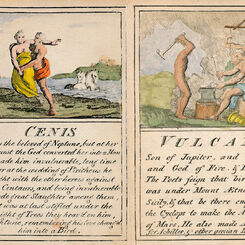
Pantheon or Heathen Mythology
Pantheon or Heathen Mythology cards for instruction of youth, c.1770.
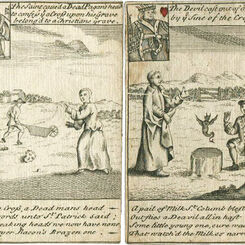
Illustrated Playing Cards, c.1740
Illustrated playing cards featuring comical engravings and rhymes about saints, c.1740.
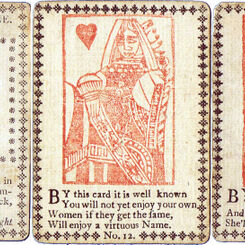
Fortune Telling playing cards
English Fortune Telling cards probably published c.1770.
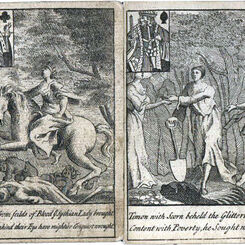
Delightful Cards, c.1723
Delightful Cards, containing variety of entertainment for young Ladies and Gentlemen c.1723.
Arms of English Peers
The Arms of English Peers playing cards were first published in 1686. Heraldry, or a knowledge of th...
Cribbage Board Collection part 2
A collection of antique and vintage Cribbage Boards by Tony Hall, part 2
Pope Joan Trays
Some traditional Pope Joan boards comprise a circular tray, others are square, divided into sections...
19: 19th Century Breaks with Tradition - Unusual versions of the Standard English Pattern
The centuries-long tradition of English court cards was subject to misinterpretation and in some cas...
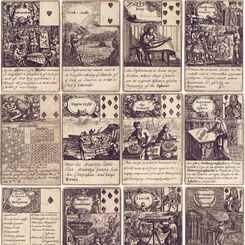
Mathematical Instruments
Mathematical Instruments playing cards forming an instrument maker's trade catalogue, Thomas Tuttell...
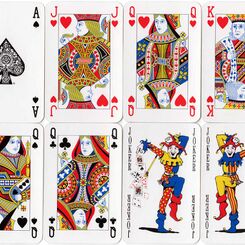
Traditional English Court
Games & Print Services Ltd traditional English courts.
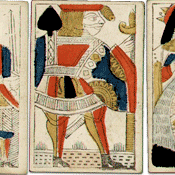
History of Court Cards
The court cards in English packs of playing cards derive from models produced by Pierre Marechal in ...
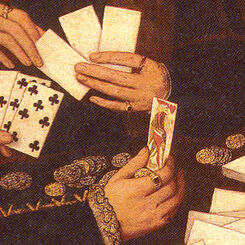
History of English Playing Cards & Games
The History of English Playing Cards dates probably from the mid 15th century
Early English Playing Cards
Early examples of traditional, standard English playing cards of which the best known are those of H...
Most Popular
Our top articles from the past 60 days


Courtney Rider
18 February 2026, 20:57SavedSaved this article to Court Cards
Jason Somers
14 June 2026, 17:11SavedSaved this article to Jason Somers's Collection