French Playing Cards
Some of the oldest cards still in existence come from France. During the 16th and 17th centuries France was the major supplier of playing cards in Europe.
Card playing was introduced into France at an early date. The game of Tarot was also brought from Italy into France. During the 16th and 17th centuries France was the major supplier of playing cards in Europe.
Some of the oldest cards still in existence come largely from Lyons, a city in which the craft of cardmaking flourished from an early date and which became an important centre of French card-making. It seems that the provinces bordering on Italy and Germany were the first to produce playing cards. Indeed, an ordinance from Paris, 1377, forbade card games on workdays. Another ordinance from the city of Lille, dated 1382, when Lille belonged to France, forbade various games including dice and “quartes” (an early word for cards). There is also the well-known account of a certain Jacquemin Grigonneur who in 1392 was paid 56 “sols Parisis” for three packs of gilded cards, painted with divers colours and several devices, to be carried to the king for his amusement. No-one knows what sort of cards these were as they did not survive.

If the French suit system was invented in circa 1480, the question arises what type of cards were the French using before that invention?

Above: archaic cards with a suit of crescent moons and a court of king, queen and knave, coloured in red, violet, green and yellow, by F. Clerc, Lyons, 1485-1496. Source gallica.bnf.fr / BnF • Cartes à jouer d'un jeu au portrait de Lyon►
Latin-suited cards
Some early French cards have Latin/Spanish suit symbols. Spanish-suited cards reached many different places, having spread along trade routes of the time or where there were dynastic connections. They were also produced in France for home consumption in certain regions, and not necessarily for export. The only survivors among Spanish-suited cards in France today are Aluette cards (primarily of Brittany) and the French Catalan pattern of the Eastern Pyrenees.
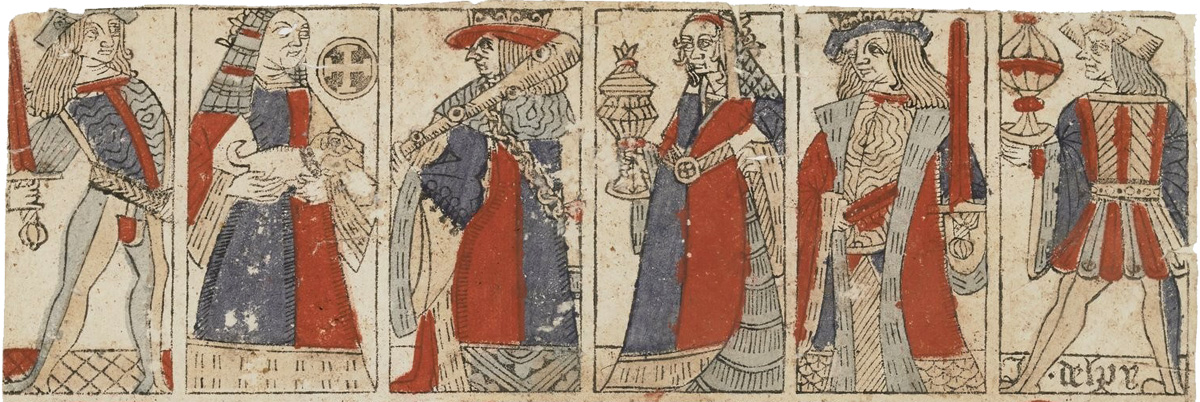
Above: Latin-suited cards produced by J. Deluy c.1490? Source gallica.bnf.fr / Bibliothèque nationale de France.
French-suited cards
Having invented the ‘French’ suit system (piques, coeurs, carreaux & trefles) in the late 15th century, which required only black and red, French manufacturers were able to introduce economies of labour which gave their products a competitive advantage over those with Spanish or German suits. French suits rapidly gained popularity and became standard in France and later spread to many parts of the world. Much of the early history of cards in France is to do with standard designs and their spread, coupled with their keen sense of economic advantage.
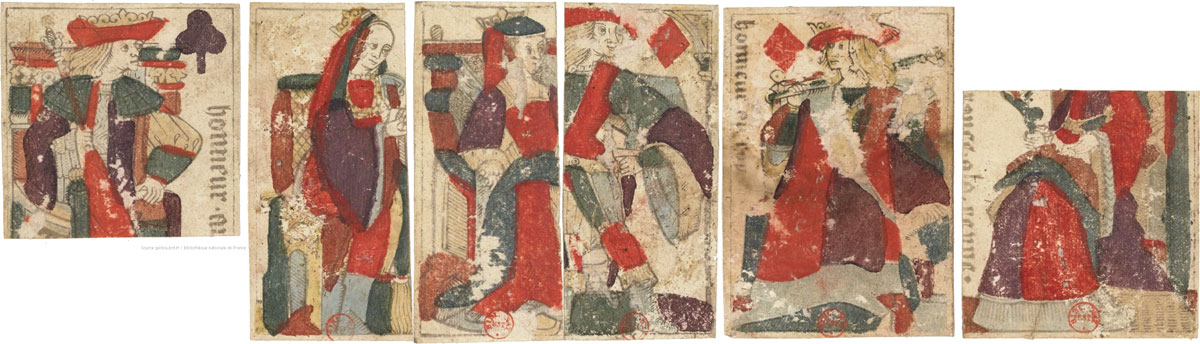
Above: fragments of early playing cards from Lyons, 1475-1575. There are kings and queens seated on thrones and a cavalier on horseback. Source gallica.bnf.fr / Bibliothèque nationale de France • Cartes à jouer et fragments de cartes au portrait lyonnais►

Above: fragment of uncut sheet containing red knaves, G. Cartier (Lyon), late-XV century. • V&A Museum►

Above: cards by Jean de Dale, c.1500.
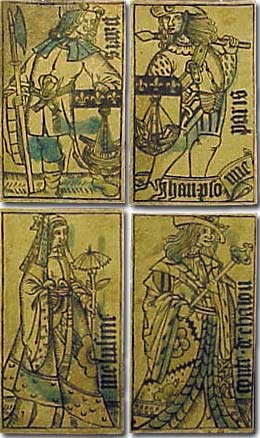
Above: cards by Jean Personne with inscriptions such as "Paris", "Melusine", "Conte de Chalou" and the maker's name "Jhan Personne" on a scroll.

Above: Lyons, c.1500
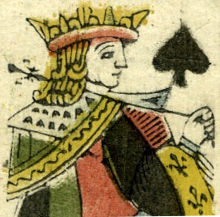
Above: the Provence pattern
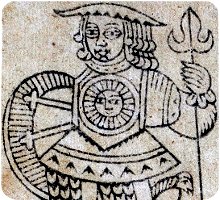
Above: Lyons, c.1780
• Jean de Dale (active 1485-1515) • Jean Personne (1493-1497) • Antoine de Logiriera (Toulouse, 1495-1518) • Marcial Gué (Limoges, c.1538) • Pierre Marechal►
French regional patterns
French regional patterns, primarily originating in Paris, Lyons or Rouen, spread across Europe in all directions and many of their descendants survive today. See the origin of the “Suicide King”►
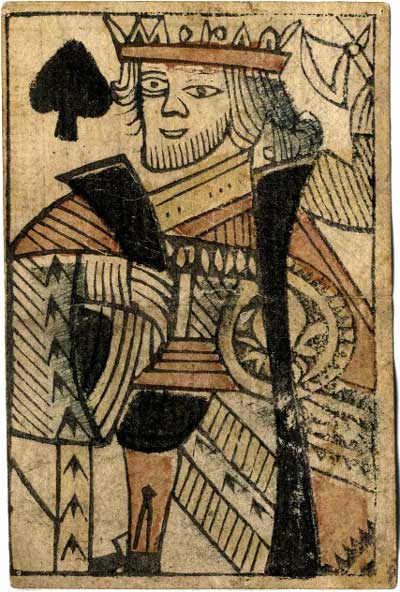
To illustrate this we show 4 playing cards from a Florentine manufacturer in a French pattern produced by Borghigiani, between 1631 and 1636.
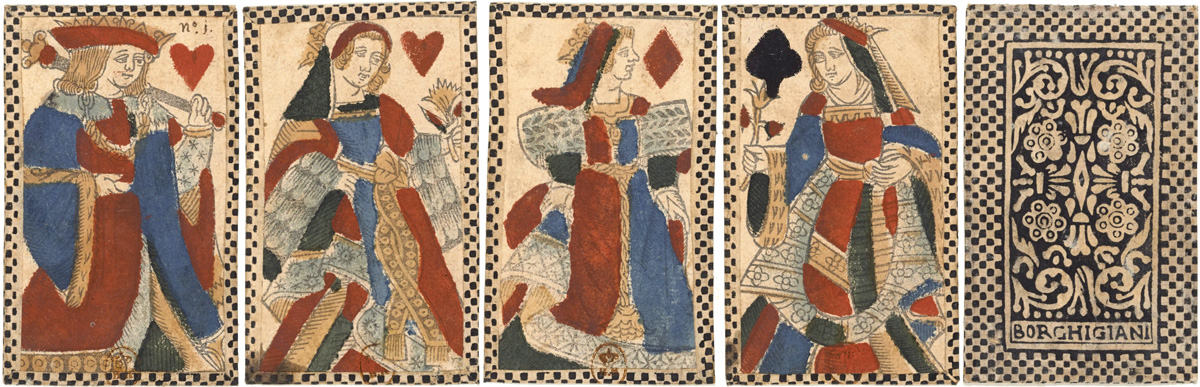
Above: stencil coloured woodcut; 9.6 x 5.9 cm. Square corners, Italian-style turned-over edges with geometric decoration in black. Many of the figures on early French court cards were interchangeable and go back to the fifteenth century. These were widely exported; consequently local manufacturers such as Borghigiani might imitate these foreign cards in their own workshops. Source gallica.bnf.fr / Bibliothèque nationale de France • Cartes d'un jeu florentin au portrait français►
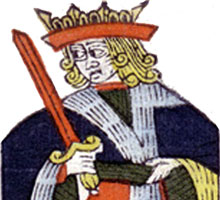
Above: Spanish-suited pack by Benoist Laius, c.1712
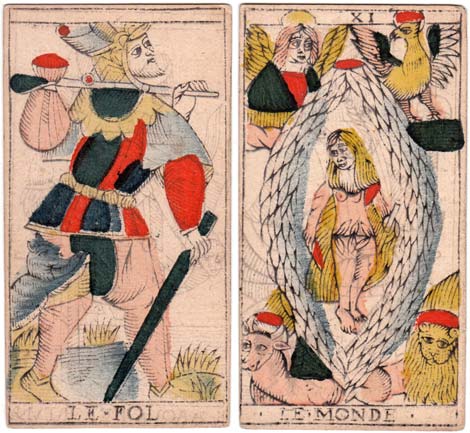
Above: Marseille tarot by Charles Cheminade
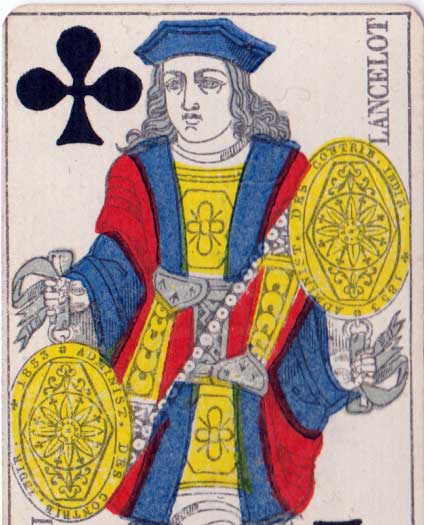
Above: Paris pattern
See also: The Dauphiné pattern The Genoese pattern.
At an early period French card makers introduced the practice of giving the names of heroes from literature or epics of chivalry to the court cards: Alexander, Julius Caesar, Charlemagne, David, Rachel, Argine, Judith, Pallas, Hector, Lahire, Lancelot and Hogier. In each case a romantic story or legend is associated with the person named on the card.
By the fifteenth century French suit symbols - hearts, diamonds, clubs and spades - had crossed to England. During the sixteenth century Rouen and Lyons became centres for the exportation of French playing cards, and cards were imported to the British Isles from Rouen and to the Netherlands and Germany. From England, of course, they spread to America and have become ubiquitous throughout the world.
Playing Card Tax
“...As everyone can see with their own eyes, playing cards, tarot cards, and dice serve not for pleasure and relaxation, as the inventors of these activities intended, but rather lead to stupidity, cause scandal, and give rise to gambling, leading to all kinds of fraud, cheating, and deception. They lead to great expenses, quarrels, blasphemy, murders, vagrancy, poverty, and the ruin of families, causing the youth to neglect their daily duties and possessions, and to engage in a dissolute life. As a result, no one ends up well-off, and people end up spending their time and money on gambling instead of on commendable activities and the service of the Lord and the state...” Thus reads an introduction to a French edict of May 22, 1583, on taxes on playing cards. Similar publications from other countries can be found that speak with equal disdain about the excesses of card games.
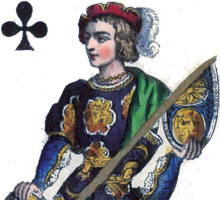
Playing cards soon attracted the attention of tax authorities in France. As early as 1613, Louis XIII decreed that cardmakers should place their name on the knave of clubs. In 1701 a further law was passed under Louis XIV imposing taxes and regulations leading to fixed designs for the cards from each of the nine regions, so that stereotyped figures (portraits) from each region were produced which could be identified by the authorities. Some individual court designs reoccur in different regional or even foreign (exported) patterns, sometimes reversed or with a different suit symbol.
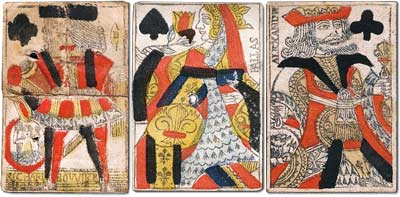
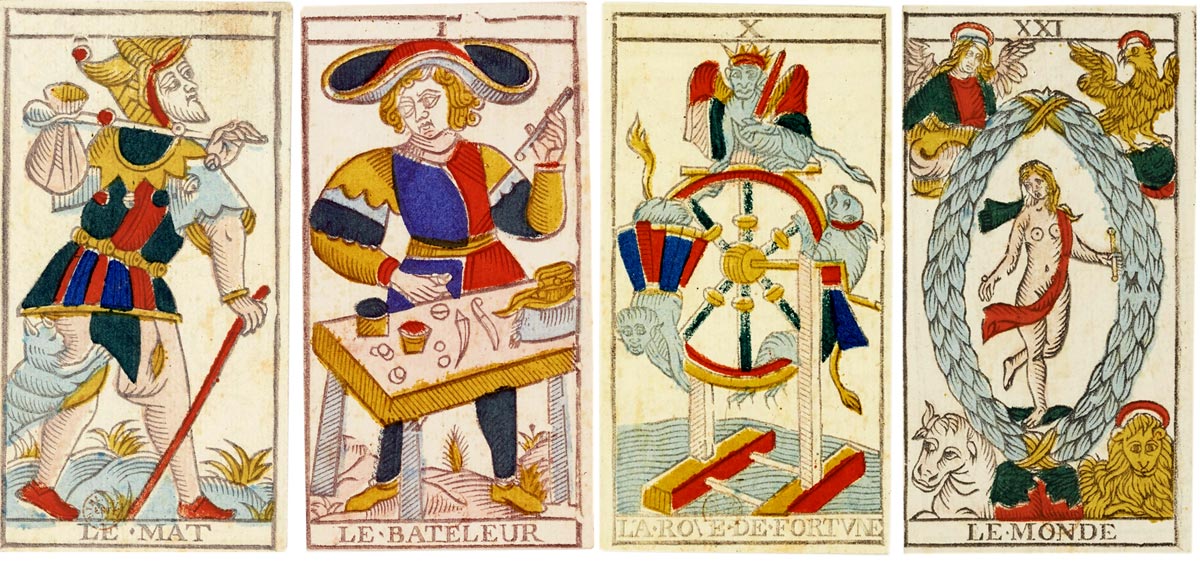
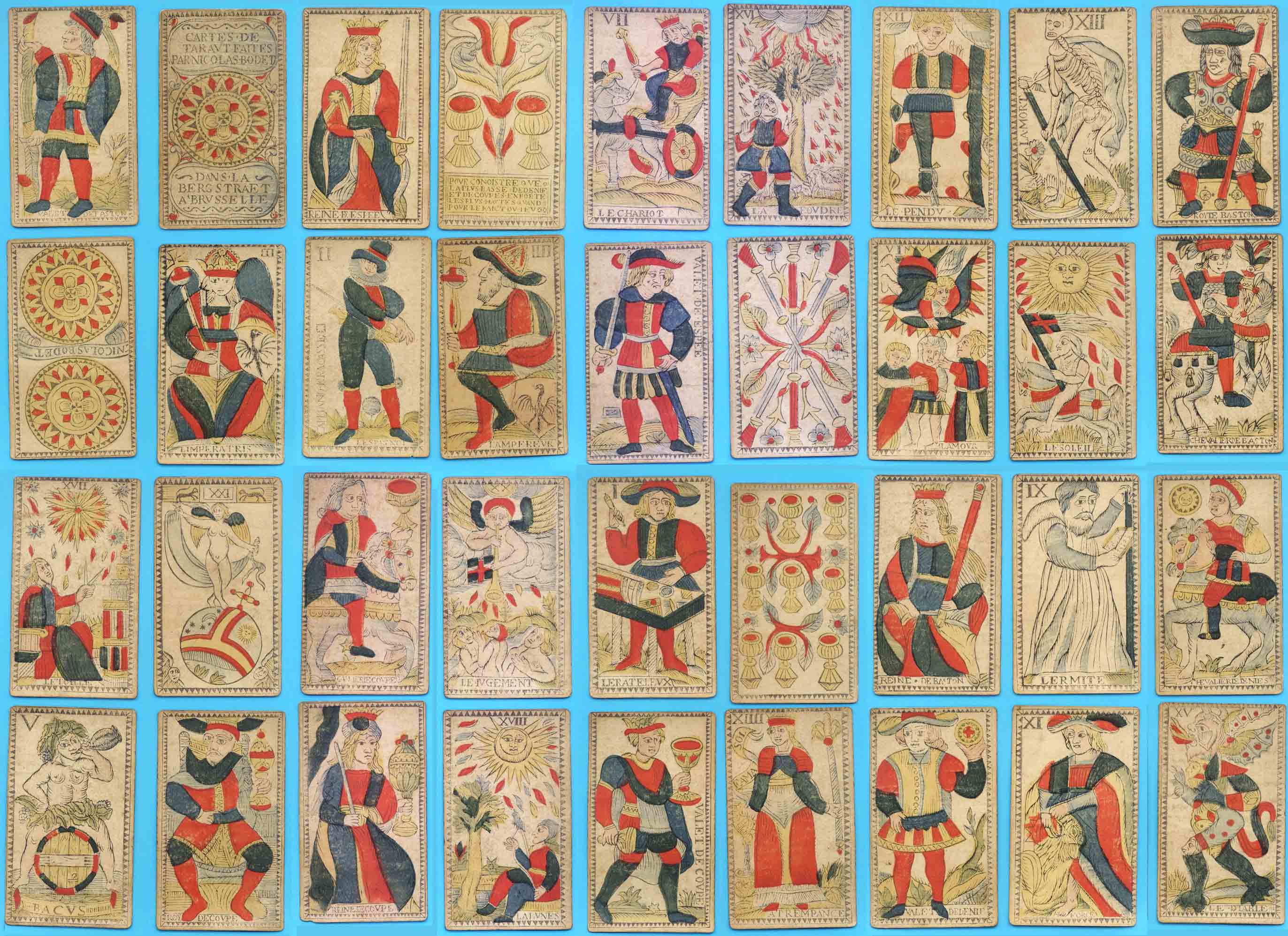
Tarot cards had arrived in France from Italy in the first half of the 16th century, with Italian suit symbols, introducing the idea of trumps. Subsequently, French-suited tarots were also produced. There appear to have been three standard tarot types in France: "Tarot de Marseille", "Tarot de Besancon" and "Belgian Tarot" but today most tarot games are played in France with the "Bourgeois Tarot". The esoteric tarot was also developed in France during the 18th and 19th centuries.
During the seventeenth century a number of attractive non-standard cards were issued, including educational and quartet games, heraldic or armorial cards and geographical cards. These have been followed more recently by important editions of cartomancy cards, several types of tarot cards and elaborately engraved costume cards.
The backs of playing cards used to be plain, without any printed patterns. As an economy measure, incomplete packs would not be thrown away. Instead the plain backs were often re-used as notelets, invitations, calling cards, library cards, bookmarkers, and so on more →
Revolutionary Cards
The National Convention issued a decree on October 22, 1793, urging French municipalities to purge their playing cards of all emblems of royalty and feudalism as quickly as possible. It was then that truly revolutionary portraits were created, out of fear that the adjustments made to the older designs might not be considered satisfactory. The first Empire packs were published, artistically designed by David, Gatteaux and others, which aligned with the new ideas. These enjoyed only a brief popularity and the old type soon reappeared. See: Jeu de l'an 2→
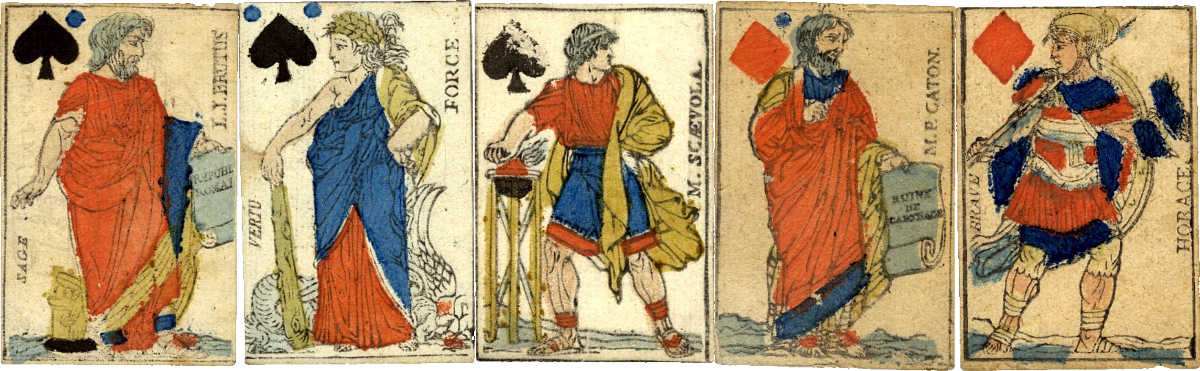
Above: Revolutionary figures on the court cards, end of 18th century. Stencil-coloured woodcuts, French suit signs. Images courtesy Dan Dragojevich. See also: French Revolutionary anti-Royalist playing cards, subtitled “Jeu des Philosophes de l’An II”, first published by the printer Gayant in Paris, 1793.
Nouvelles Cartes de la République Française - 1793
The kings, queens and jacks are replaced with Geniality, Liberty and Equality, above which there is only the Law (the true sovereign of free people). See the wrapper
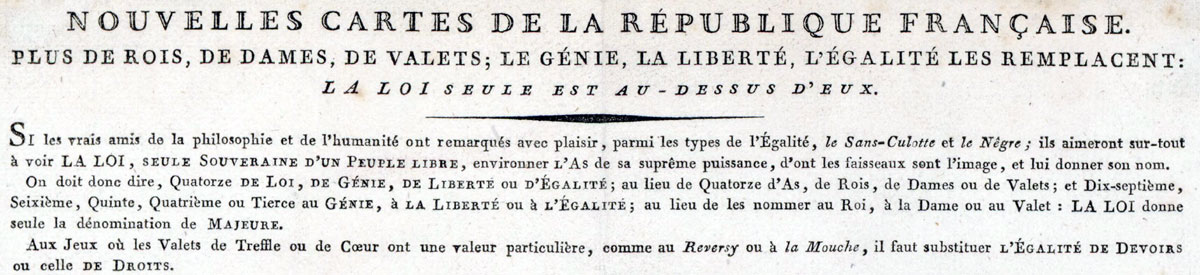
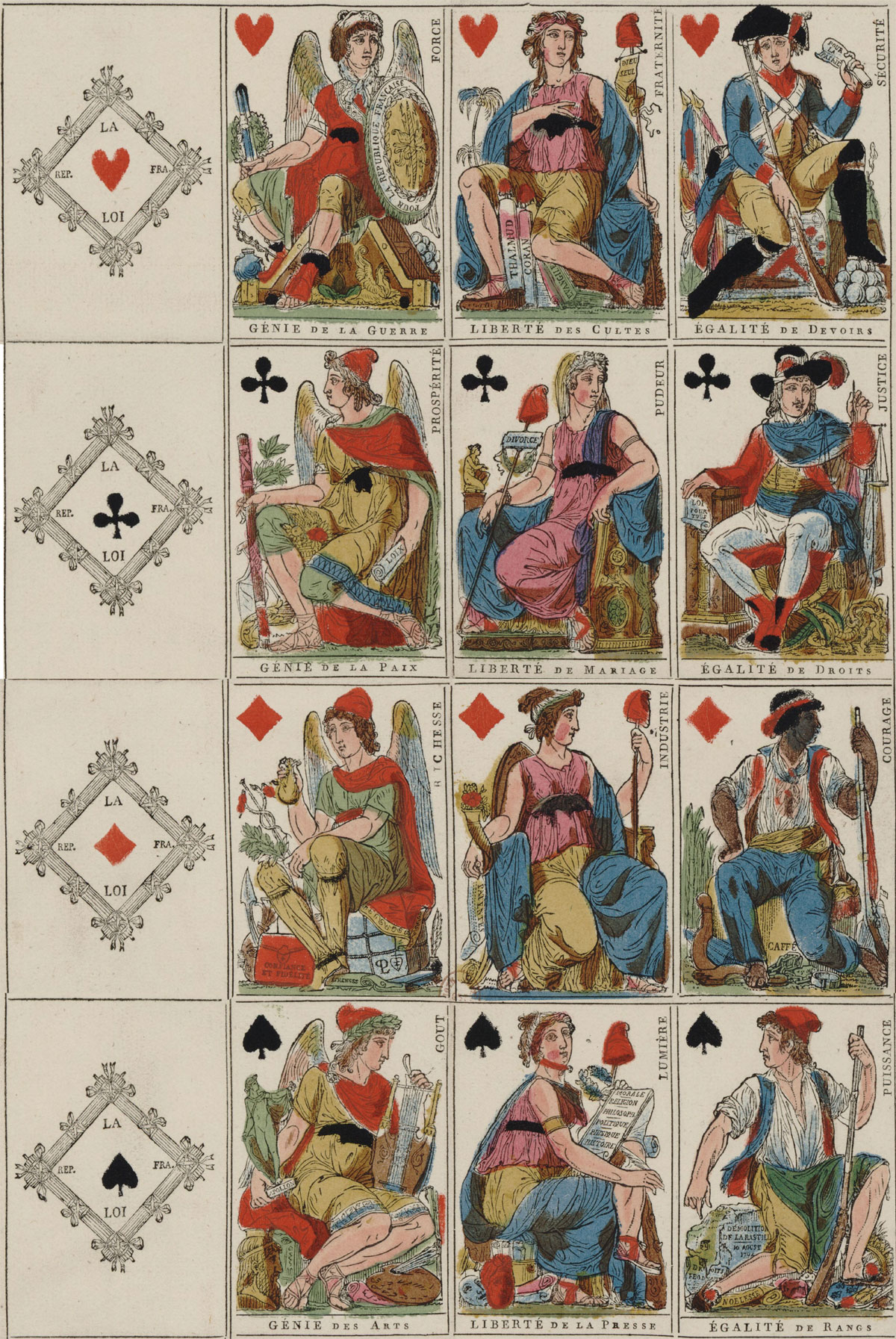
Above: Nouvelles Cartes de la République Française printed by U. Jaume et J.D. Dugourc, Paris, 1793. Source Bibliothèque nationale de France.
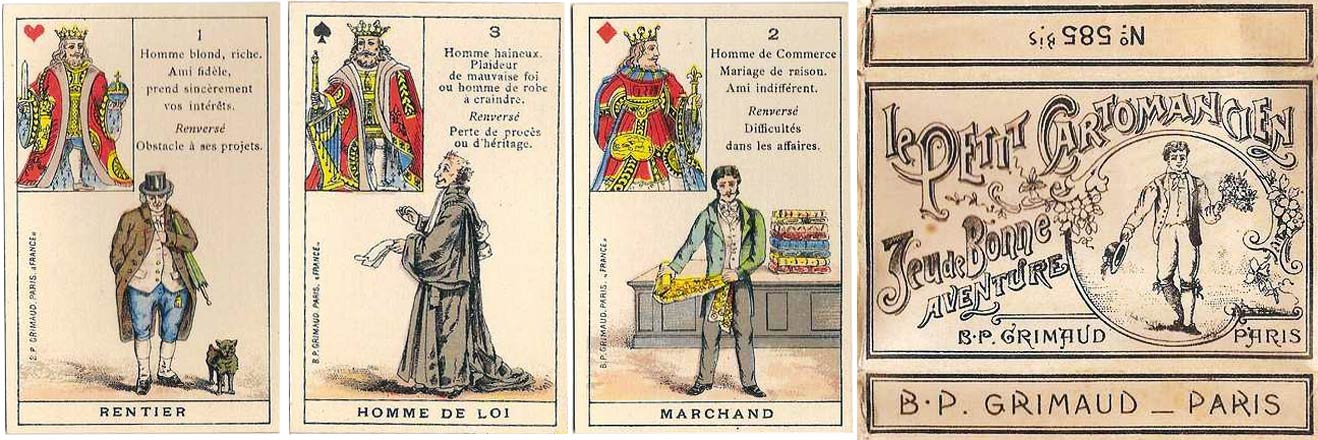
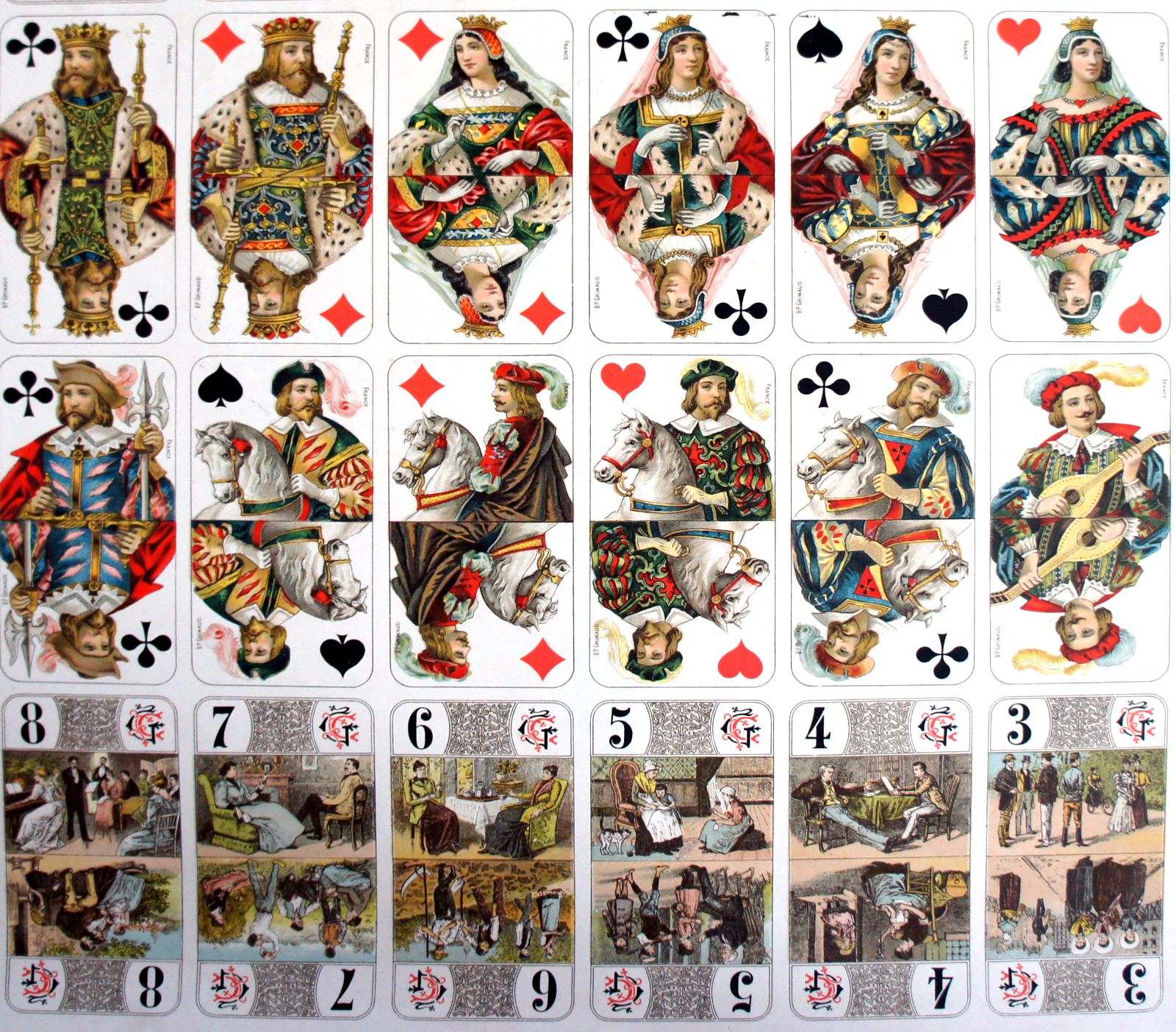
Above: three cards and wrapper from "Le Petit Cartomancien" manufactured by B.P. Grimaud, Paris. The miniature playing cards in the top corners depict full-length 'Paris' type courts, whilst the rest of the cards contain divinatory interpretations and images of different personalities. See more →
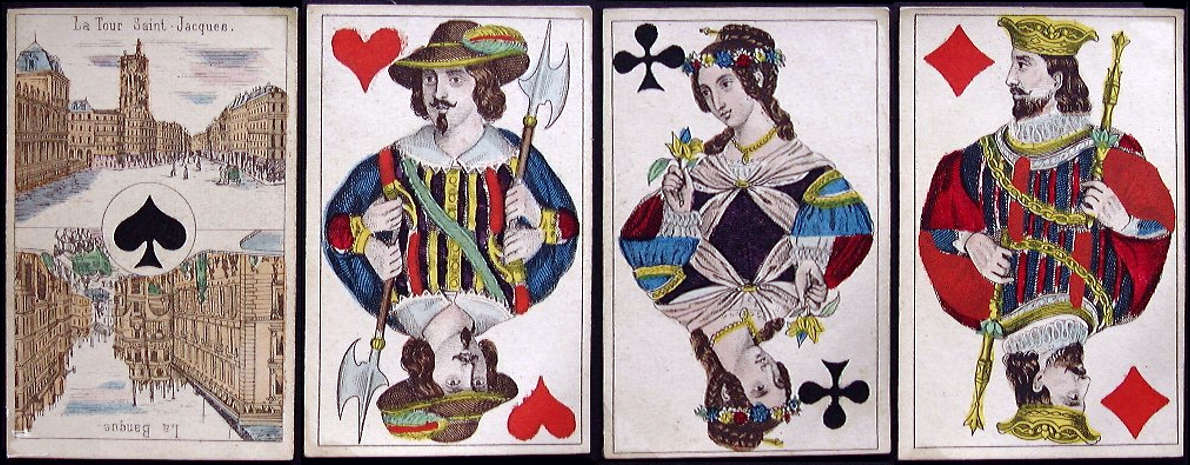
Above: cards from a finely engraved deck by F. d'Alphonse Arnoult (Paris), c.1860. 52 cards. more →.

References
d'Allemagne, Henry-René : Les cartes à jouer du XIVe au XXe siècle, Hachette et Cie, Paris, 1906. 2 vols.
Bibliothèque nationale de France: French edict of May 22, 1583►
Bibliothèque nationale de France: Nouvelles cartes de la Republique française, 1793►
Cremers, Filip: Belasting is Troef, Nationaal Museum van de Speelkaart, Turnhout, 1992, p.95.

By Simon Wintle
Spain • Member since February 01, 1996
I am the founder of The World of Playing Cards (est. 1996), a website dedicated to the history, artistry and cultural significance of playing cards and tarot. Over the years I have researched various areas of the subject, acquired and traded collections and contributed as a committee member of the IPCS and graphics editor of The Playing-Card journal. Having lived in Chile, England, Wales, and now Spain, these experiences have shaped my work and passion for playing cards. Amongst my achievements is producing a limited-edition replica of a 17th-century English pack using woodblocks and stencils—a labour of love. Today, the World of Playing Cards is a global collaborative project, with my son Adam serving as the technical driving force behind its development. His innovative efforts have helped shape the site into the thriving hub it is today. You are warmly invited to become a contributor and share your enthusiasm.

Activity for French Playing Cards
Sign in to comment or save this article.

Related Articles
Catalan pattern by B.P Grimaud
Standard Spanish Catalan pattern deck made in Paris by B.P Grimaud.
Cartes politiques : Jeu d'actualité
Political playing cards published by Grimaud et Chartier, Paris, 1872.
English Pattern by B.P. Grimaud
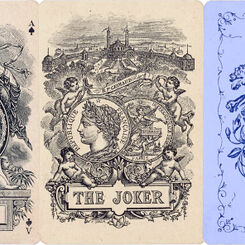
Standard English pattern published by B.P. Grimaud with engraving by F. Simon, c.1880.
Compagnie Maritime des Chargeurs Réunis
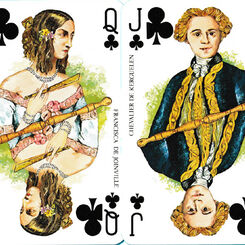
French navigators and explorers on a promotional pack for the C.M.C.R shipping company.
Cartes Catalanes by Fossorier, Amar et Cie
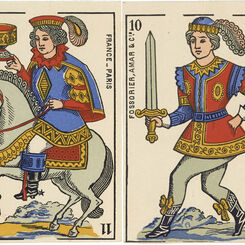
‘Cartes Catalanes’ published by Fossorier, Amar et Cie (Paris)
B.P. Grimaud pack for Bolivia
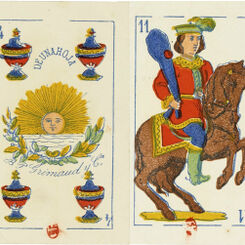
Spanish-suited pack made in France for sale in Bolivia, c.1880.
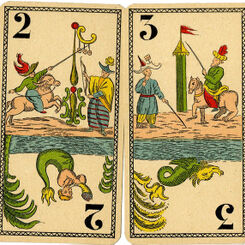
Oriental Scenes tarock
Trumps have oriental scenes on one end of the card, and mermaids, mermen, assorted sea serpents and ...
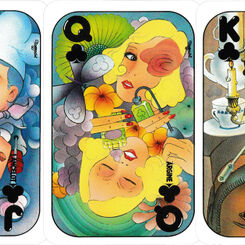
French External Trade Organization
Promoting the elegance and quality of a range of French products.
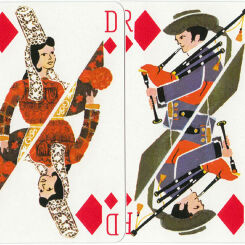
Bretagne
Bretagne (Brittany) playing cards, Grimaud, c.1970.
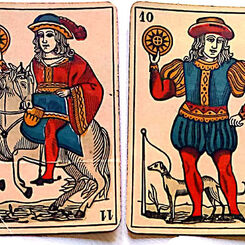
Parisian style Spanish deck by Grimaud
Parisian style Spanish deck by Grimaud for export to Uruguay.
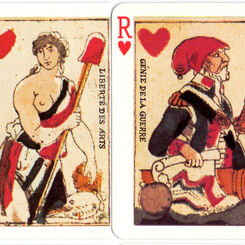
Jeu de l’an 2
“Jeu de l’an 2” by Grimaud is a facsimile of French Revolutionary cards first published by Veuve Mou...
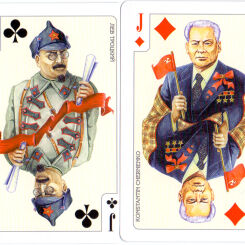
Back to the USSR
Back to the USSR deck featuring communist party leaders and politicians, c.1995
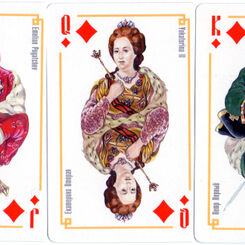
Glorious Russia
‘Glorious Russia’ playing cards made in France by Grimaud, c.1995
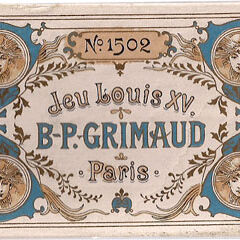
Jeu Louis XV
B.P. Grimaud of Paris issued this very ornate costume deck called “Jeu Louis XV No.1502” in c.1895. ...
Masonic Playing Cards
A set of playing cards designed by Julien Lebleu, an original work in the history of Freemasonry. Je...
S.S. France playing cards
A special non-standard pack of playing cards was designed by M. Marie for the maiden voyage of the t...
Livre du Destin
Livre du Destin / The Book of Fate, c.1900, entire deck (32 cards)
Livre du Destin
Livre du Destin or Book of Fate, printed by B.P.Grimaud, Paris, c.1900.

Genoese pattern
The design is purely 'Parisian' but the colouring is green, red, yellow and black. Belgium has taken...
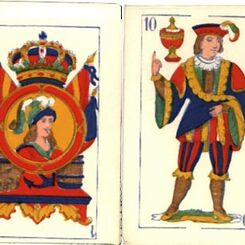
Grimaud Spanish pattern
Grimaud Spanish pattern, c.1880
Most Popular
Our top articles from the past 60 days