


Auvergne Pattern - Portrait d'Auvergne
The Auvergne pattern is one of the oldest in France.
For centuries, Lyon and Thiers in Auvergne served as prominent hubs for cardmaking. Within France, this particular pattern stands as one of the oldest. In its earliest iterations, the kings and queens were named after historical figures (David, Cezar, Artus, Charles, Bersabee, Iudic, Rachel, Helene). However, this naming convention was eventually discontinued, except in the Paris pattern. The king of hearts is depicted holding an orb and a sword. The king of clubs is portrayed with a falcon perched on his left wrist, while the queen of spades cradles a lapdog under her right arm. The remaining three queens are depicted holding flowers. As for the four jacks, they resemble one another and wear helmets and beards.
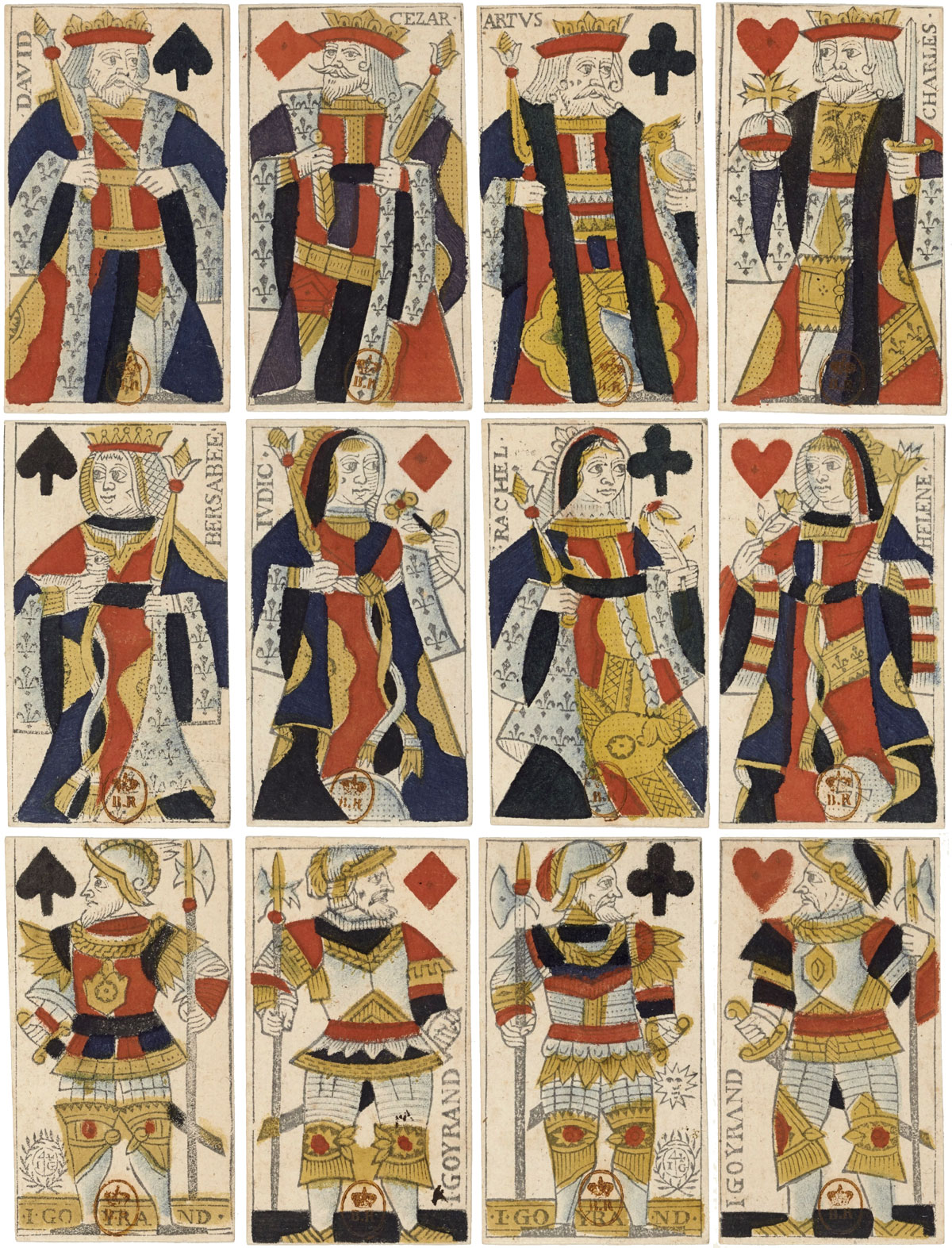
Above: cards from Auvergne pattern deck by Jean Goyrand (Lyon, 1675-1699). The jacks have the manufacturer's name, and two of them also show the manufacturer's trademark. Source gallica.bnf.fr / Bibliothèque nationale de France • Cartes de tête issues d'un jeu au portrait d'Auvergne, Jean Goyrand, Lyon, 1675-1699►
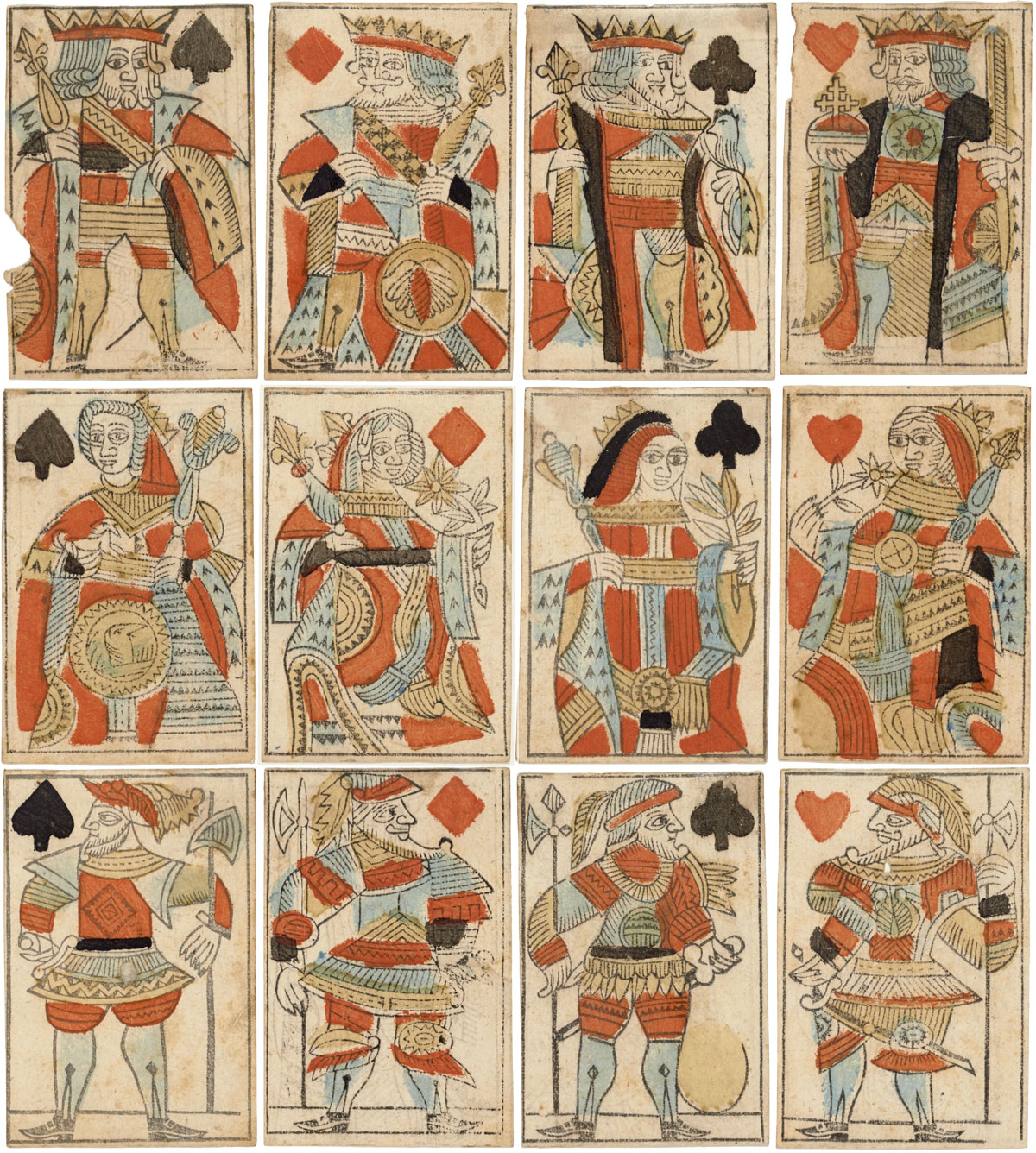
Above: cards from anonymous Auvergne pattern pack, c.1700-1750. Stencil-coloured woodcut. The jack of clubs may have had a trademark in the oval frame, which has been removed. Source gallica.bnf.fr / Bibliothèque nationale de France • Cartes de tête d'un jeu au portrait d'Auvergne►
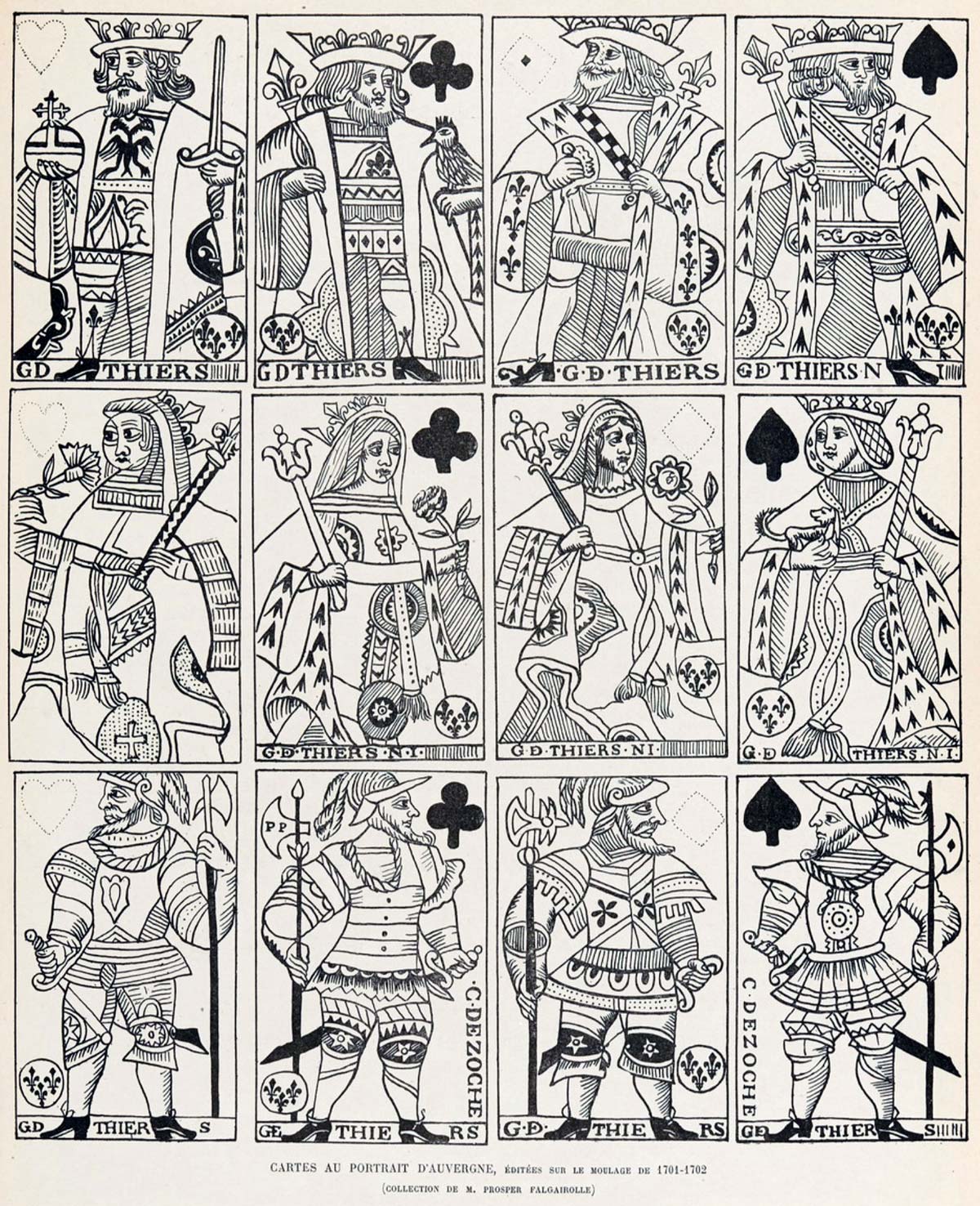
Above: Auvergne pattern by C. Dezauches, Thiers, c.1701-02. According to d'Allemagne (1906: p.118) the Auvergne pattern was used in Thiers, Clemont and Le Puy.
French-suited cards (spades, diamonds, clubs and hearts) have infuenced or been copied in playing card designs around the world. For further discussion of the origins of the French regional patterns, see Ken Lodge’s blog page 61 and page 62►
Further References
d'Allemagne, Henry-René : Les cartes à jouer du XIVe au XXe siècle, Hachette et Cie, Paris, 1906, vol 1, p.118.
Mann, Sylvia: Collecting Playing Cards, Arco Publications, 1966
Mann, Sylvia: All Cards on the Table, Jonas Verlag/Deutsches Spielkarten-Museum, Leinfelden-Echterdingen, 1990

By Simon Wintle
Spain • Member since February 01, 1996
I am the founder of The World of Playing Cards (est. 1996), a website dedicated to the history, artistry and cultural significance of playing cards and tarot. Over the years I have researched various areas of the subject, acquired and traded collections and contributed as a committee member of the IPCS and graphics editor of The Playing-Card journal. Having lived in Chile, England, Wales, and now Spain, these experiences have shaped my work and passion for playing cards. Amongst my achievements is producing a limited-edition replica of a 17th-century English pack using woodblocks and stencils—a labour of love. Today, the World of Playing Cards is a global collaborative project, with my son Adam serving as the technical driving force behind its development. His innovative efforts have helped shape the site into the thriving hub it is today. You are warmly invited to become a contributor and share your enthusiasm.

Activity for Auvergne Pattern - Portrait d'Auvergne
Sign in to comment or save this article.

Related Articles
Most Popular
Our top articles from the past 60 days


