


Guyenne Pattern - Portrait de Guyenne
The Guyenne pattern emerged from the earlier Languedoc pattern.
Until 1716 Guyenne cardmakers had copied the Languedoc pattern. The 18th century was the heyday of French-suited regional patterns and new distinctive patterns, or 'portraits', emerged. Archaic features from other regions of France and England can be seen in these cards: the axe-wielding king here represented in the spade suit; the king of hearts' harp; the valet of spades has a hand on his hip and wears knee-length breeches. The English jack of spades is here the valet of hearts.
In 1701 a law was passed in France laying down fixed designs for the playing cards from each of the nine regions, so that a distinctive pattern from each region was produced which could be identified by the tax authorities. Between 1716-1743 the Guyenne cardmakers were required by the authorities to adjust the size of their cards by about 3-5 mm each way to comply with the law. This affected the aesthetic proportions of the designs, also various features such as the kings' sceptres were modified, and royal robes and symbols of office were adjusted or refashioned. The four queens hold flowers. Three of the valets have rather voluminous sleeves.
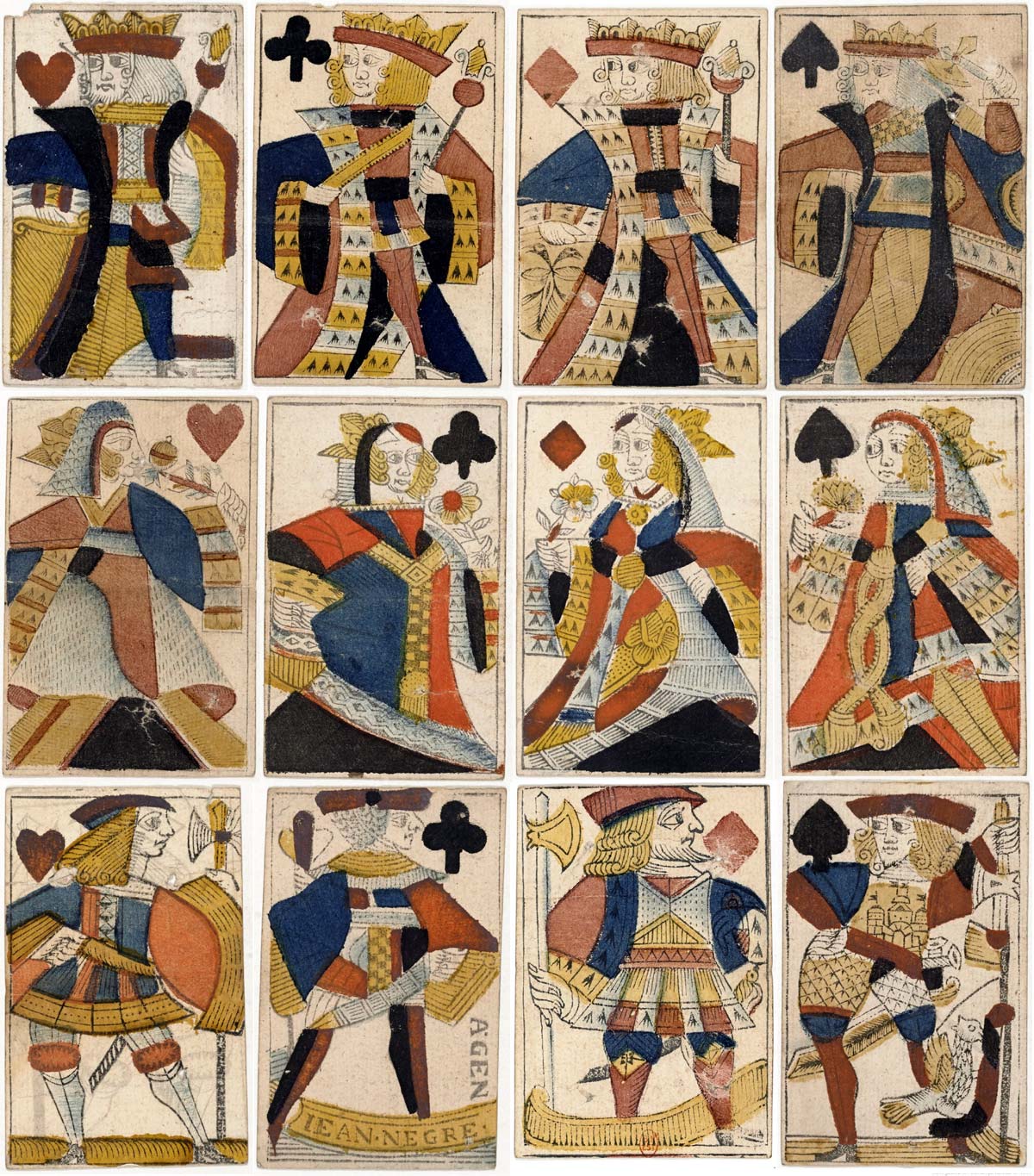
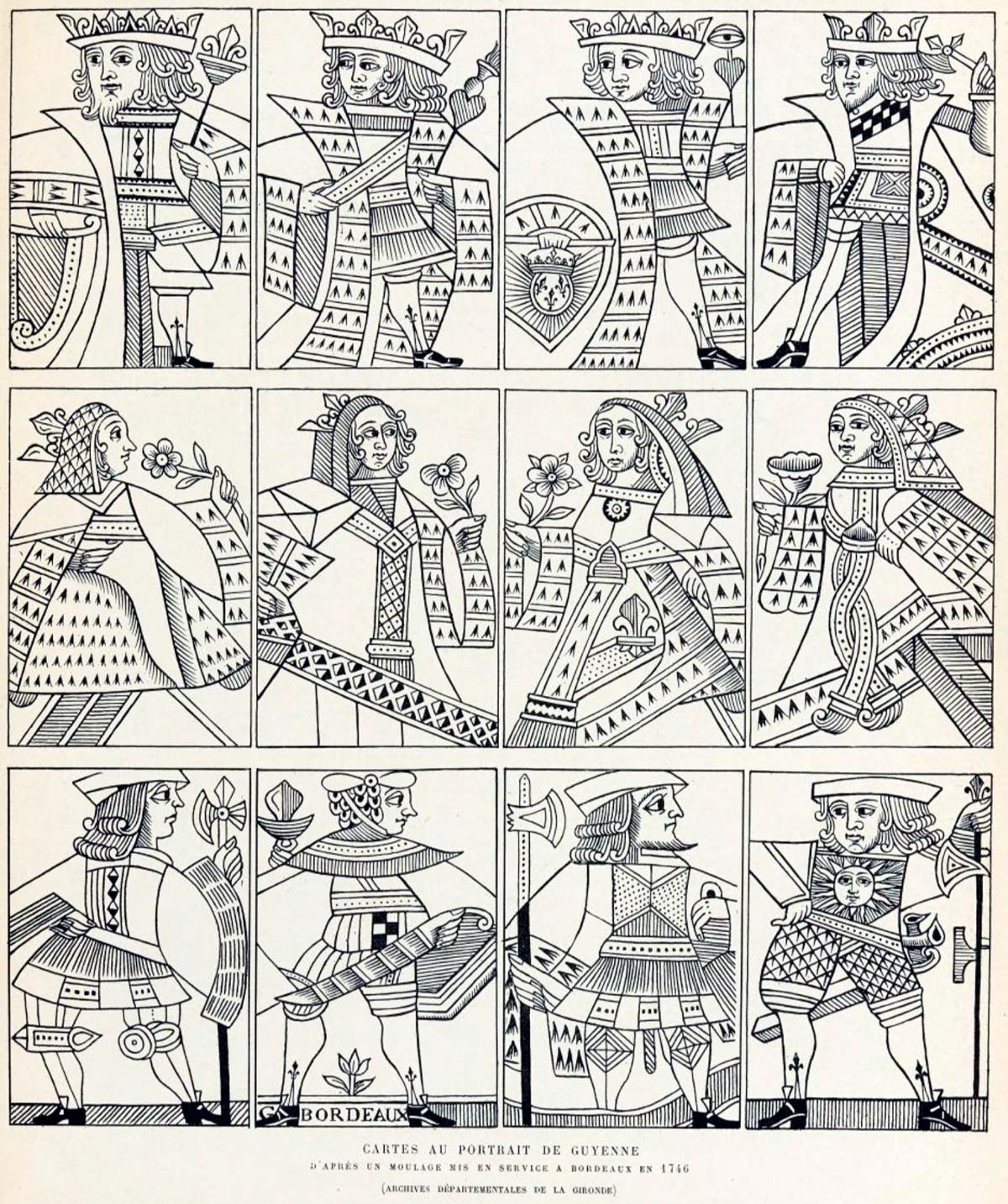
Above: Guyenne pattern, Bordeaux, c.1746. Image from d'Allemagne, Henry-René : Les cartes à jouer du XIVe au XXe siècle, Hachette et Cie, Paris, 1906, vol.1, pp.124 ff.
Bordeaux cardmakers placed their mark in the escutcheon held by the King of Diamonds in his right hand, which had previously been reserved for the inscription or signature of the tax authority. In the second half of the eighteenth century, this escutcheon was occupied, depending on the various changes in block design, by the royal coat of arms, the intertwined initials of King Louis XV, or by a radiant sun. Similarly, motifs or symbolism on the valet of spades also varies. Another idiosyncrary is that in cards produced in the town of Agen, the valet of spades (see above) has a medieval castle depicted on his breast, complete with turrets, and an eagle by his foot, whereas the Bordeaux example has a sunburst.
References
d'Allemagne, Henry-René : Les cartes à jouer du XIVe au XXe siècle, Hachette et Cie, Paris, 1906, vol.1, p.124 ff
Bibliothèque nationale de France: Cartes de tête issues de jeux au portrait de Guyenne►
Bibliothèque nationale de France: Cartes de tête issues de jeux au portrait de Guyenne►
Bibliothèque nationale de France: Cartes de tête d'un jeu à enseignes françaises, G. Grossard (Bordeaux) 1690►
Mann, Sylvia: Collecting Playing Cards, Arco Publications, 1966

By Simon Wintle
Spain • Member since February 01, 1996
I am the founder of The World of Playing Cards (est. 1996), a website dedicated to the history, artistry and cultural significance of playing cards and tarot. Over the years I have researched various areas of the subject, acquired and traded collections and contributed as a committee member of the IPCS and graphics editor of The Playing-Card journal. Having lived in Chile, England, Wales, and now Spain, these experiences have shaped my work and passion for playing cards. Amongst my achievements is producing a limited-edition replica of a 17th-century English pack using woodblocks and stencils—a labour of love. Today, the World of Playing Cards is a global collaborative project, with my son Adam serving as the technical driving force behind its development. His innovative efforts have helped shape the site into the thriving hub it is today. You are warmly invited to become a contributor and share your enthusiasm.

Activity for Guyenne Pattern - Portrait de Guyenne
Sign in to comment or save this article.

Related Articles
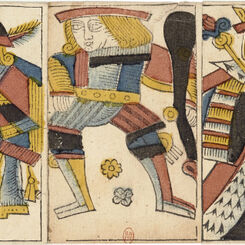
Archaic Franco-Spanish pattern
Archaic Franco-Spanish pattern by Guillaume & Jean Grossard (Bordeaux).
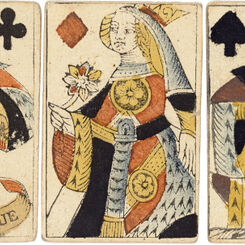
Languedoc pattern - Portrait de Languedoc
The old Languedoc pattern was known at the beginning of the seventeenth century, if not before.
Most Popular
Our top articles from the past 60 days


