


Dubois
Dubois card makers from Liège in the Walloon Region of Belgium.
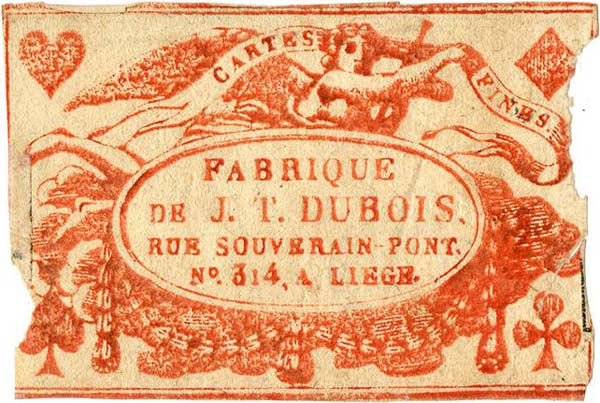
Above: J T Dubois operated at Rue Souverain-Pont No. 314, Liege. Detail from a wrapper, c.1800-1825. © The Trustees of the British Museum online here►
Cardmakers by the name of J.B, J.T and J.J Dubois of Liège are known from the late-18th ’til mid-19th centuries.
J B Dubois had a workshop behind the Maison de Ville
J J Dubois was established at Haute-Sauvernière 352, or Rue de Stokis 188
J T Dubois operated at Rue Souverain-Pont No. 314.
They produced standard Belgian, Liège and Paris patterns, also Animal Tarots, children’s cards, a fantasy design with decorative aces and Gatteaux's Empire cards, in several qualities and sizes. Their businesses were eventually taken over by G. Gluck, also of Liège.
Paris pattern - J.T Dubois
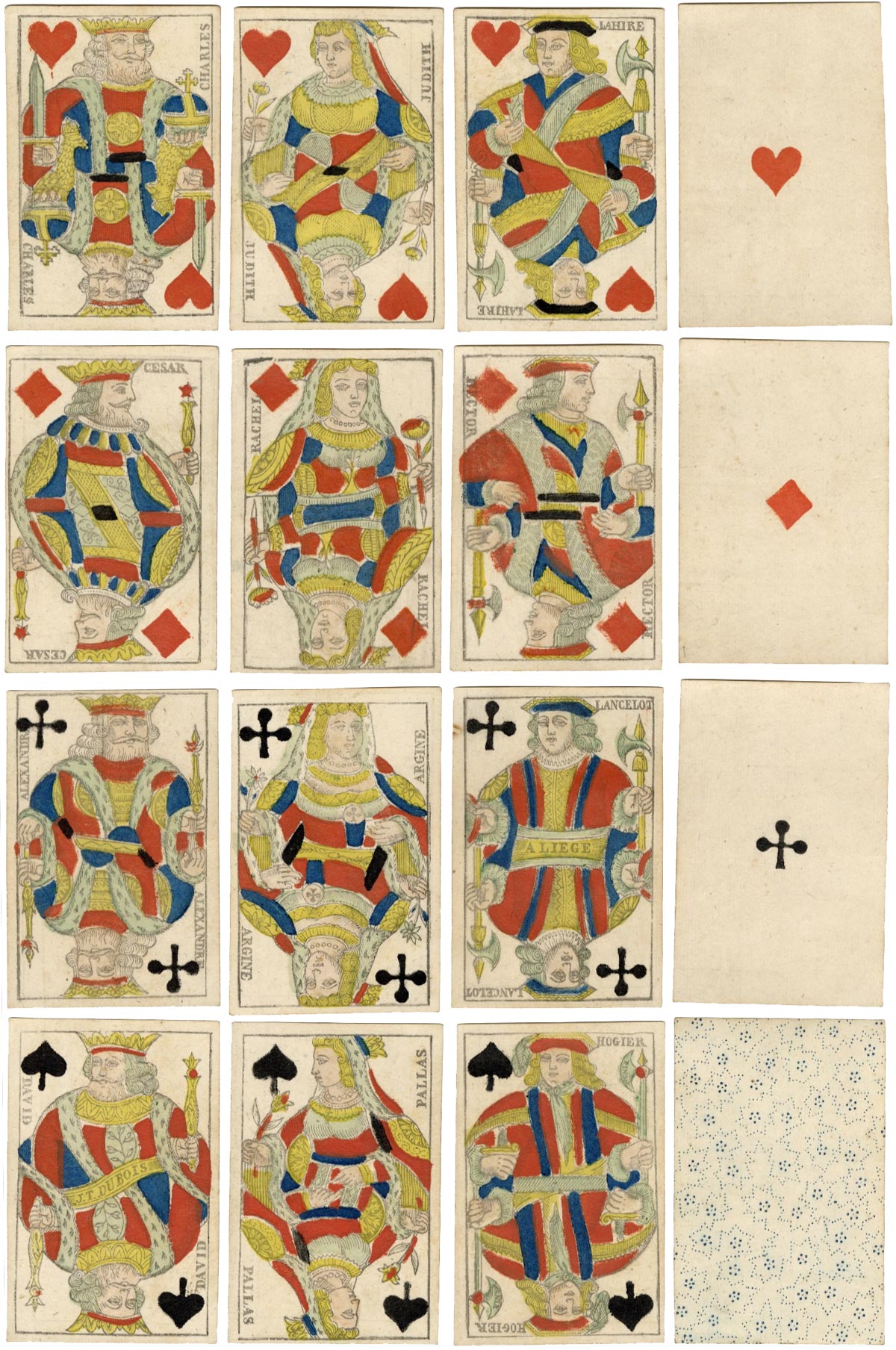
Above: double-ended Paris pattern piquet deck manufactured by J.T Dubois, Liège, c.1810-1820. Named courts. Stencil-coloured woodcut prints. The king of spades has the legend "J T DUBOIS" in the middle and the jack of clubs "A LIEGE". From the National Museum of the Playing Card collection, online here►
• Gatteaux's Empire cards published by J T Dubois, British Museum online collection►
• 18th Century Animal Tarot published by J B Dubois, British Museum online collection►
• 19th Century Animal Tarok published by J J Dubois, National Museum of the Playing Card online collection►
Belgian pattern
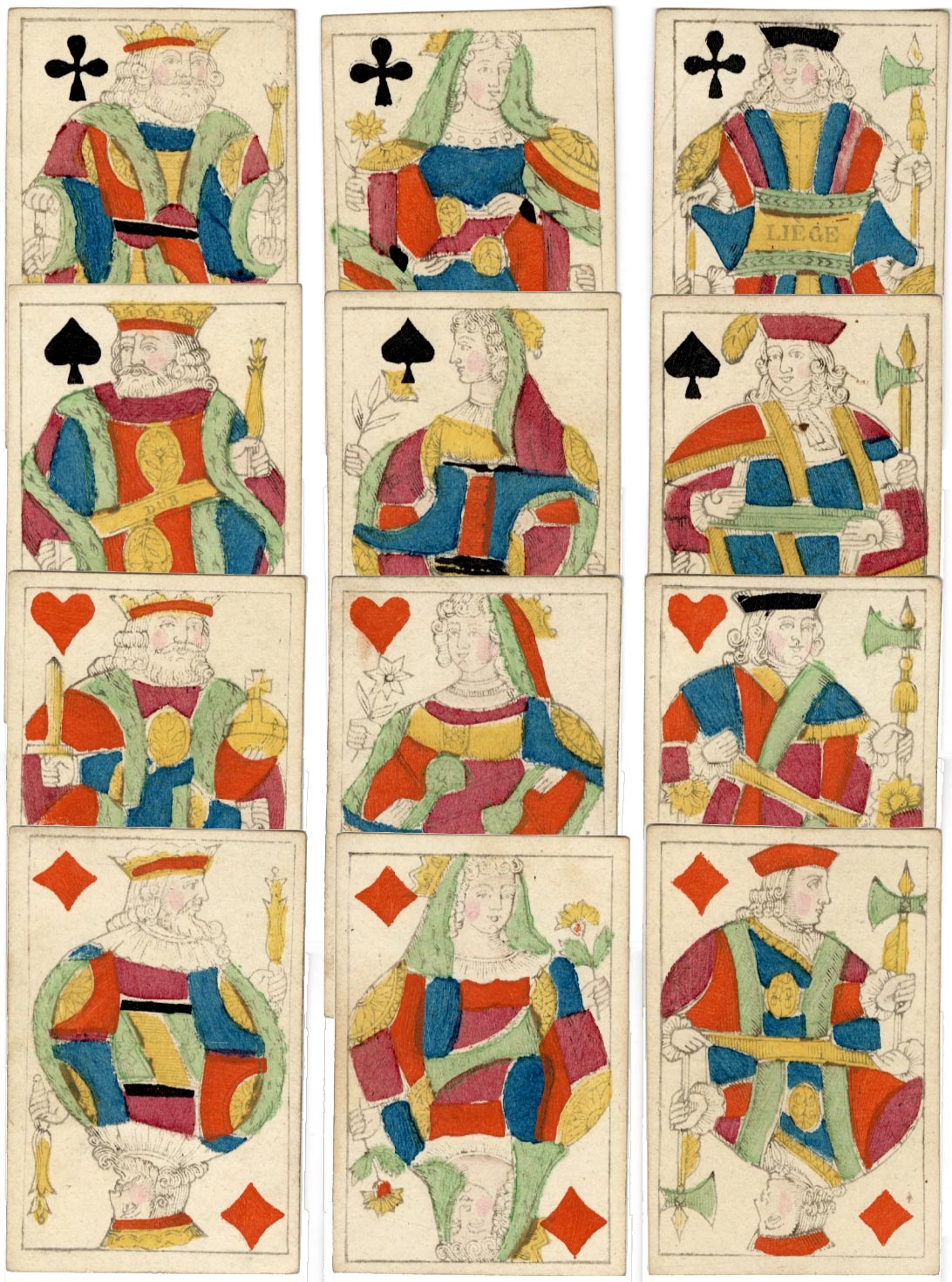
Above: Belgian pattern manufactured by Dubois, Liège, mid-19th century. Based on the French Paris pattern, but unnamed courts and unconventional colour scheme. Stencil-coloured woodcut prints. The king of spades has the letters "DUB" in the middle and the jack of clubs "LIEGE".
Liège pattern - J.J Dubois
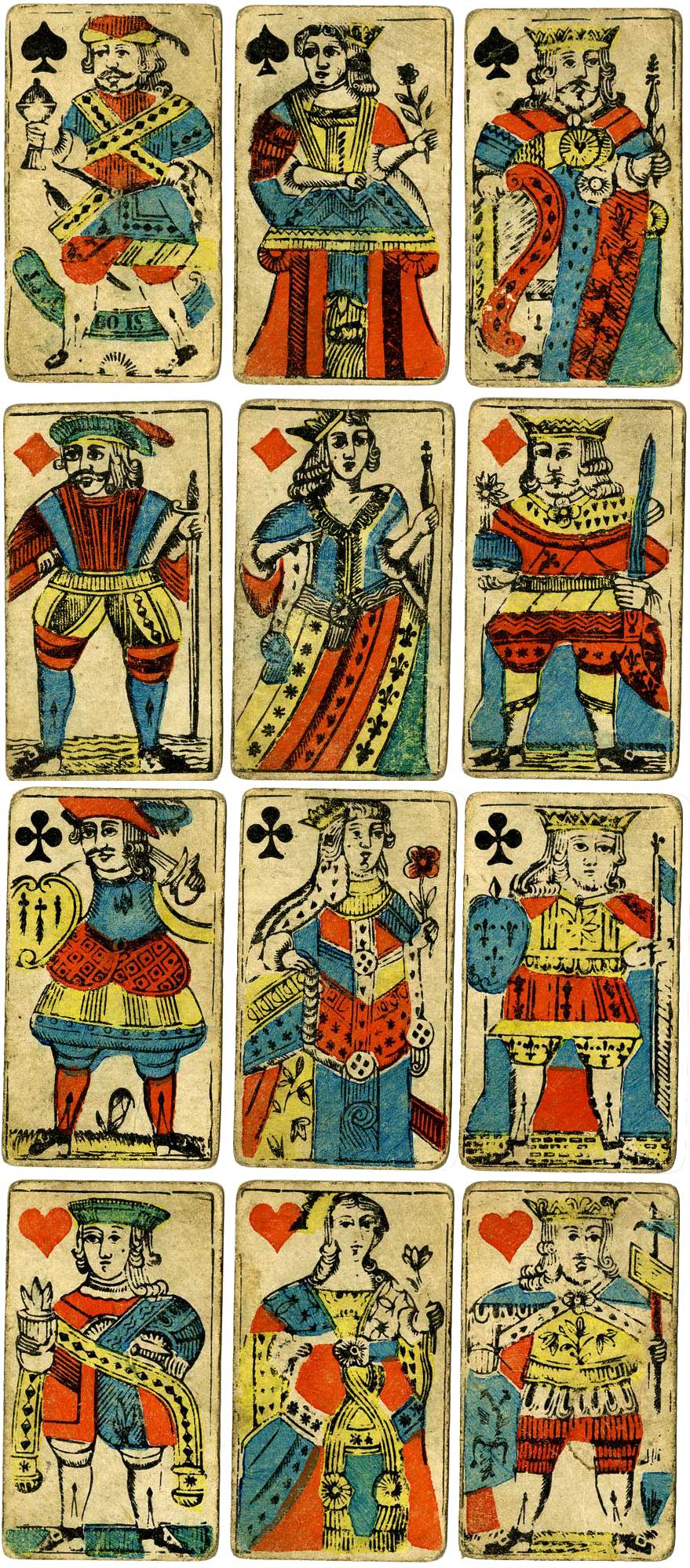
Above: Liège pattern manufactured by J.J Dubois. Complete piquet pack of 32 playing-cards, hand-coloured woodcut, backs printed with a small black pattern, 19th century. The king of hearts holds a shield charged with an eagle, and that held by the king of clubs is charged with the fleur-de-lis of France. The king of spades holds a harp. The inscription on the knave of spades is "J. J. Dubois". © The Trustees of the British Museum online here►
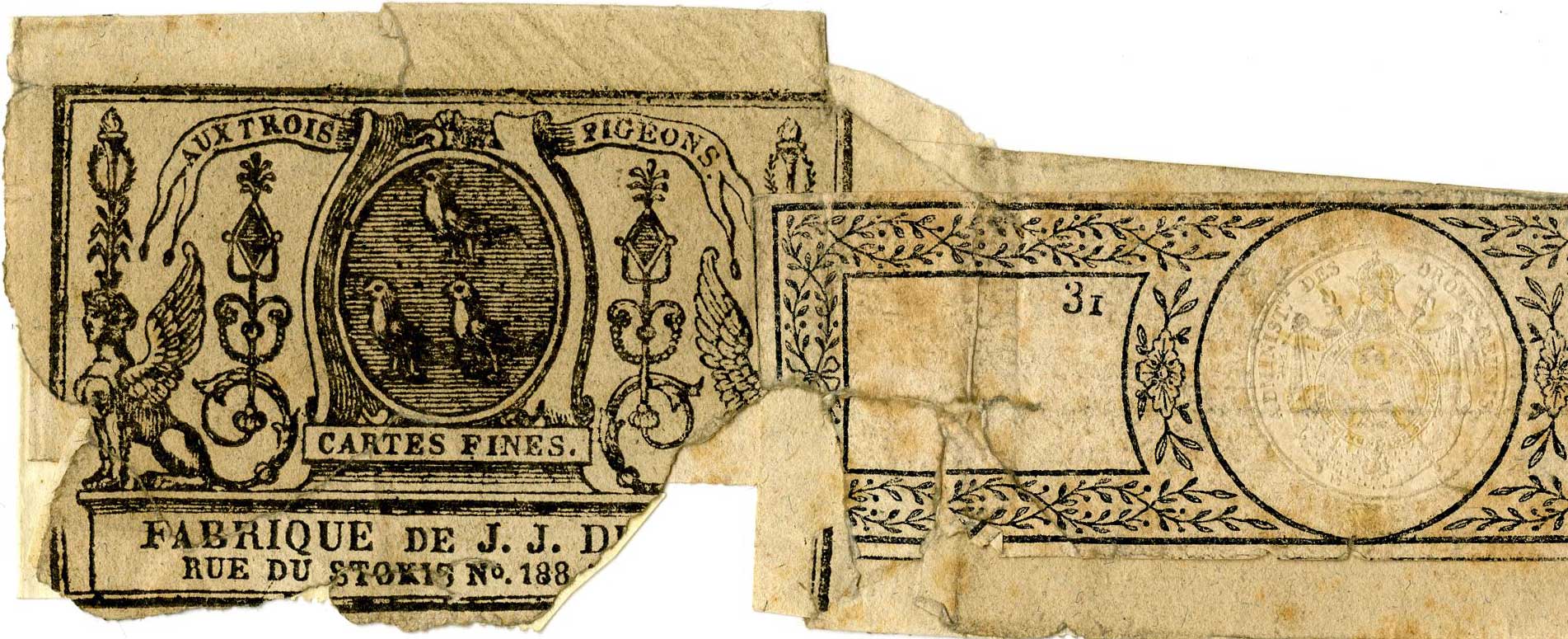
Above: part of wrapper by J.J Dubois bearing the device "Aux trois Pigeons" and showing address at Rue de Stokis 188. © The Trustees of the British Museum online here►
REFERENCES
Cremers, Filip: Kaartenmakers in Wallonië - Cartiers en Wallonie, Nationaal Museum van de Speelkaart, Turnhout, 1994
Gatteaux's Empire cards published by J T Dubois, British Museum online collection►
18th Century Animal Tarot published by J B Dubois, British Museum online collection►
19th Century Animal Tarok published by J J Dubois, National Museum of the Playing Card online collection►

By Simon Wintle
Spain • Member since February 01, 1996
I am the founder of The World of Playing Cards (est. 1996), a website dedicated to the history, artistry and cultural significance of playing cards and tarot. Over the years I have researched various areas of the subject, acquired and traded collections and contributed as a committee member of the IPCS and graphics editor of The Playing-Card journal. Having lived in Chile, England, Wales, and now Spain, these experiences have shaped my work and passion for playing cards. Amongst my achievements is producing a limited-edition replica of a 17th-century English pack using woodblocks and stencils—a labour of love. Today, the World of Playing Cards is a global collaborative project, with my son Adam serving as the technical driving force behind its development. His innovative efforts have helped shape the site into the thriving hub it is today. You are warmly invited to become a contributor and share your enthusiasm.

Activity for Dubois
Sign in to comment or save this article.

Related Articles
La baraja de Almagro
De la chimenea al monumento nacional: la baraja de Almagro y el renacer del corral de comedias.
History of Tarot and Playing Cards: Timeline & Origins
An alternative history of tarot and playing cards – from Mamluk Egypt to the invention of tarot in R...
Ganjifa - Playing Cards from India
Indian playing cards, known as Ganjifa, feature intricate designs with twelve suits and are traditio...
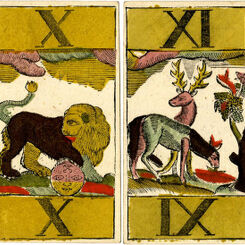
Animal Tarot by J. B Dubois
French-suited Bavarian Animal Tarot by J B Dubois, Liège, Belgium, late 18th C.
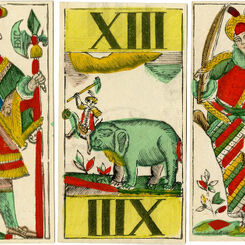
Animal Tarot by J. T Dubois
Early 19th century Animal Tarot pack produced by J T Dubois, Liège, Belgium.
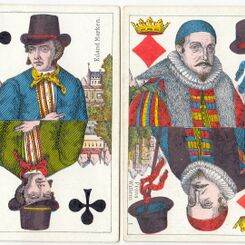
Dutch costume playing cards from an unknown maker
Another pack of Dutch costume playing cards c.1880.
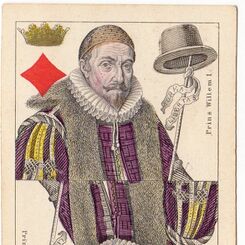
Dutch costume playing cards
Dutch costume playing cards made for the Dutch market in the second half of the 19th century.
70: Woodblock and stencil : the spade courts
This is a presentation in a more straight forward fashion of the work done by Paul Bostock and me in...
64: The descendants of the French regional patterns: 2
A continuation oF the development of the off-spring of the Paris patterns and a few examples of how ...
Trentine Pattern
Trentine Pattern
Anonymous Spanish Suited pack, c.1760
Anonymous archaic Spanish suited pack, c.1760.
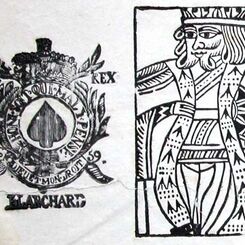
Fake Blanchard Ace of Spades
Fake Blanchard Ace of Spades with court cards based on Hall.
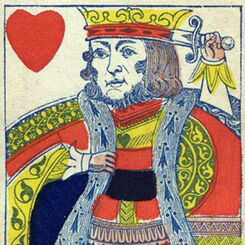
Suicide King
The King of Hearts, holding a sword behind his head, is sometimes nicknamed the “Suicide King”. He c...
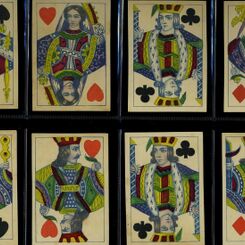
21: Belgian Makers: Brepols and Biermans
Brepols started making playing cards in 1826, although he had been in the printing trade since 1800....
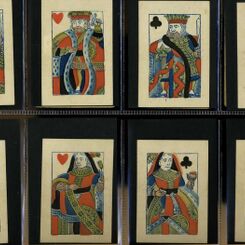
19: 19th Century Breaks with Tradition - Unusual versions of the Standard English Pattern
The centuries-long tradition of English court cards was subject to misinterpretation and in some cas...
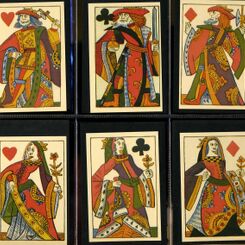
1: Playing Cards and their History: An Introduction and some links to other sites
What was considered the first mention of playing cards in England is in 1463 when Edward I banned th...
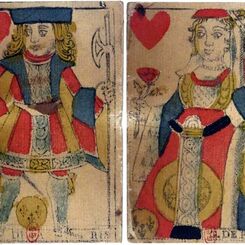
Paris Pattern
The Paris pattern was established as such around the middle of the seventeenth century (based, perha...
Portuguese Type Cards made in Belgium
Portuguese Type Playing Cards made in Belgium, c.1878.
Italian Playing Cards
The first reliable evidence that playing cards were being used in Italy is from 1376, when a game ca...
The History of Playing Cards
Playing cards appear in European records in the late 14th century, but their earlier history lies fu...
Most Popular
Our top articles from the past 60 days


Fleur Samantha Dubois
26 March 2026, 14:58SavedSaved this article to Fleur Samantha Dubois's Collection