


Portuguese pattern by Real Fábrica
Later Portuguese pattern by Impressão Règia, Real Fábrica de Lisboa.
This splendid pack from the British Museum collection, with serpents or dragons on the aces and with court cards wearing theatrical costumes, may be seen as a later version of the ‘Portuguese pattern’. The kings are standing. The female court cards are not queens, but female maids or ‘sotas’, a feminine word. They have no crowns and rank below the knights. Whilst the maid of coins carries a small coffer, the other three carry only their suit symbol. There are no ‘pintas’ or breaks in the frame lines, which of course suggests a destination other than Spain. However, this pattern was by no means confined only to Portugal.
On the 4 of coins is a scroll which reads "Real Fabrica", presumably the Impressão Règia, Real Fábrica de Lisboa. The bright gold-coloured coins are designed with 5-petalled flowers, apart from the 2 & 3 which contain busts or a heraldic device. Shields or escutcheons appear on most of the intercrossing sword and club numeral cards. The figure on the two of clubs, wearing a plumed hat, is of archaic origin. The cups are chalices; the four has a scroll with no inscription, the 6 having the initials "F.B." interlaced and repeated in reverse, with a crown above, possibly made to resemble that of the Real Fábrica de Lisboa. There are no 10s: numerals 1-9 and 3 courts per suit = 48 cards.
The decline of the Portuguese pattern occurred as French playing cards, with hearts, diamonds, clubs and spade suits, became more popular and widespread across Europe. French cards were more easily mass-produced, leading to the gradual replacement of local Portuguese cards. By the mid-19th century French-suited cards had largely supplanted traditional Portuguese decks. The ‘Portuguese pattern’ is now all but extinct, though it survives in the Sicilian tarot, and was known in earlier Spanish, Italian and Maltese cards, and also influenced some East Asian patterns where it travelled with traders and colonialists.
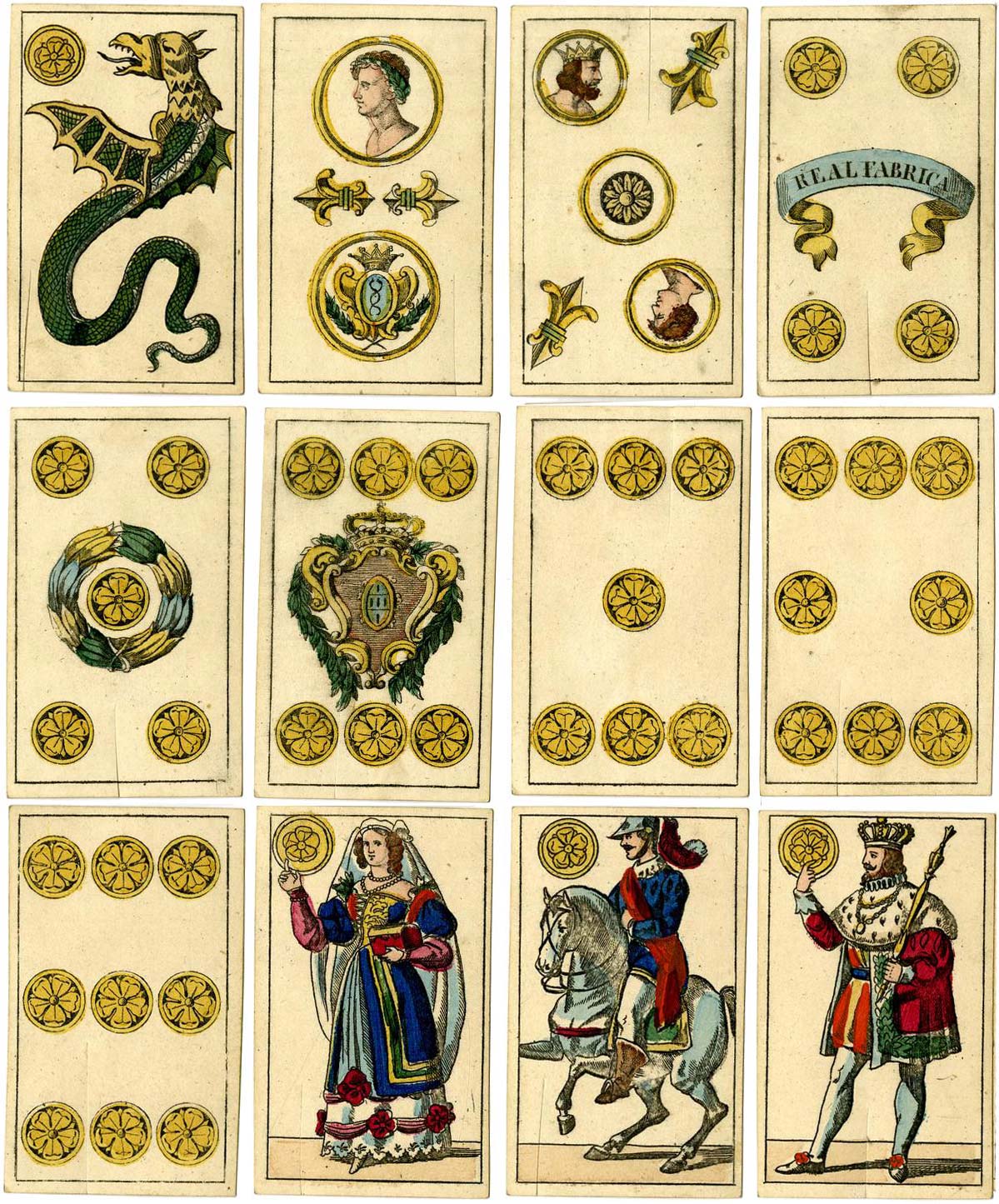
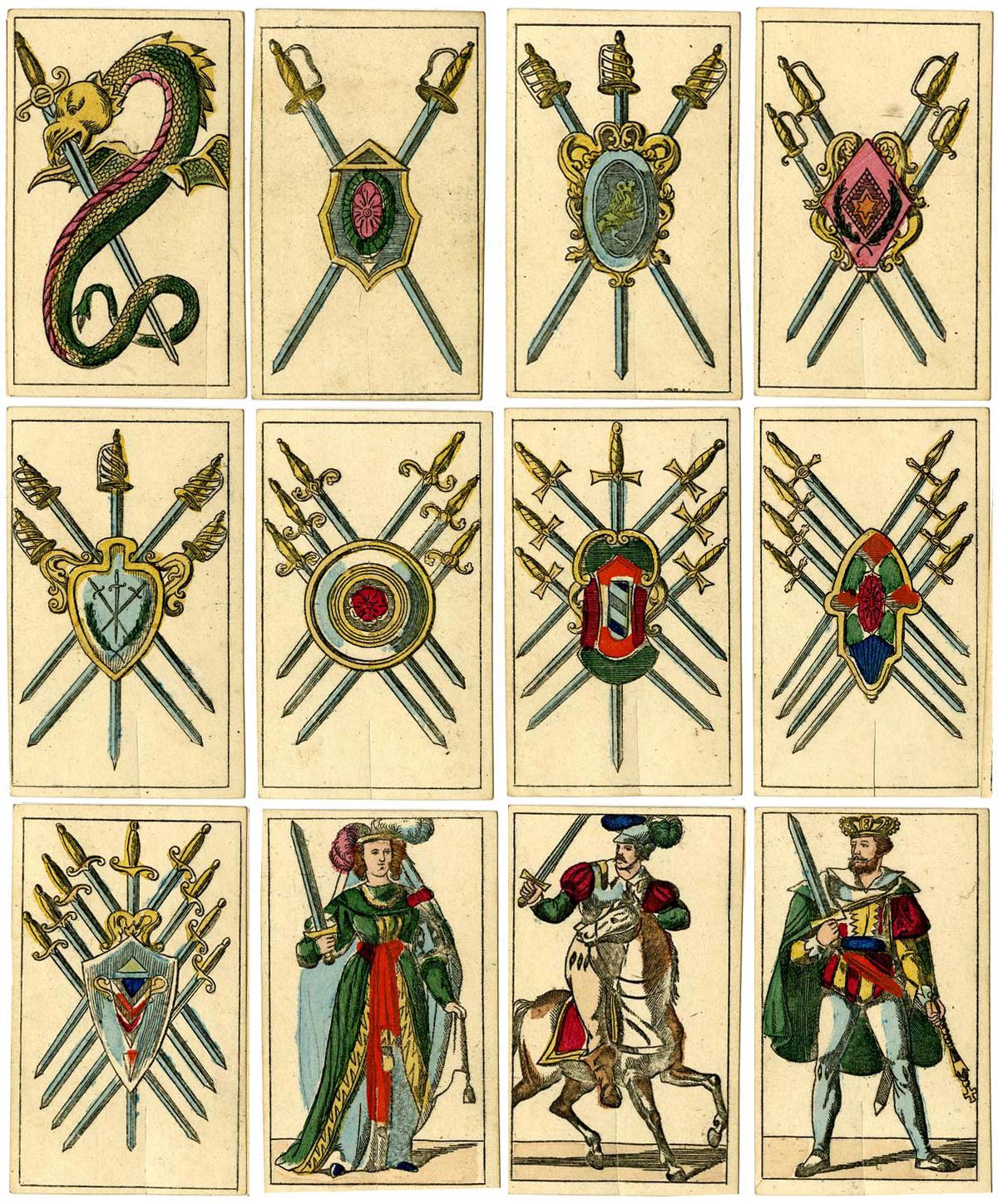
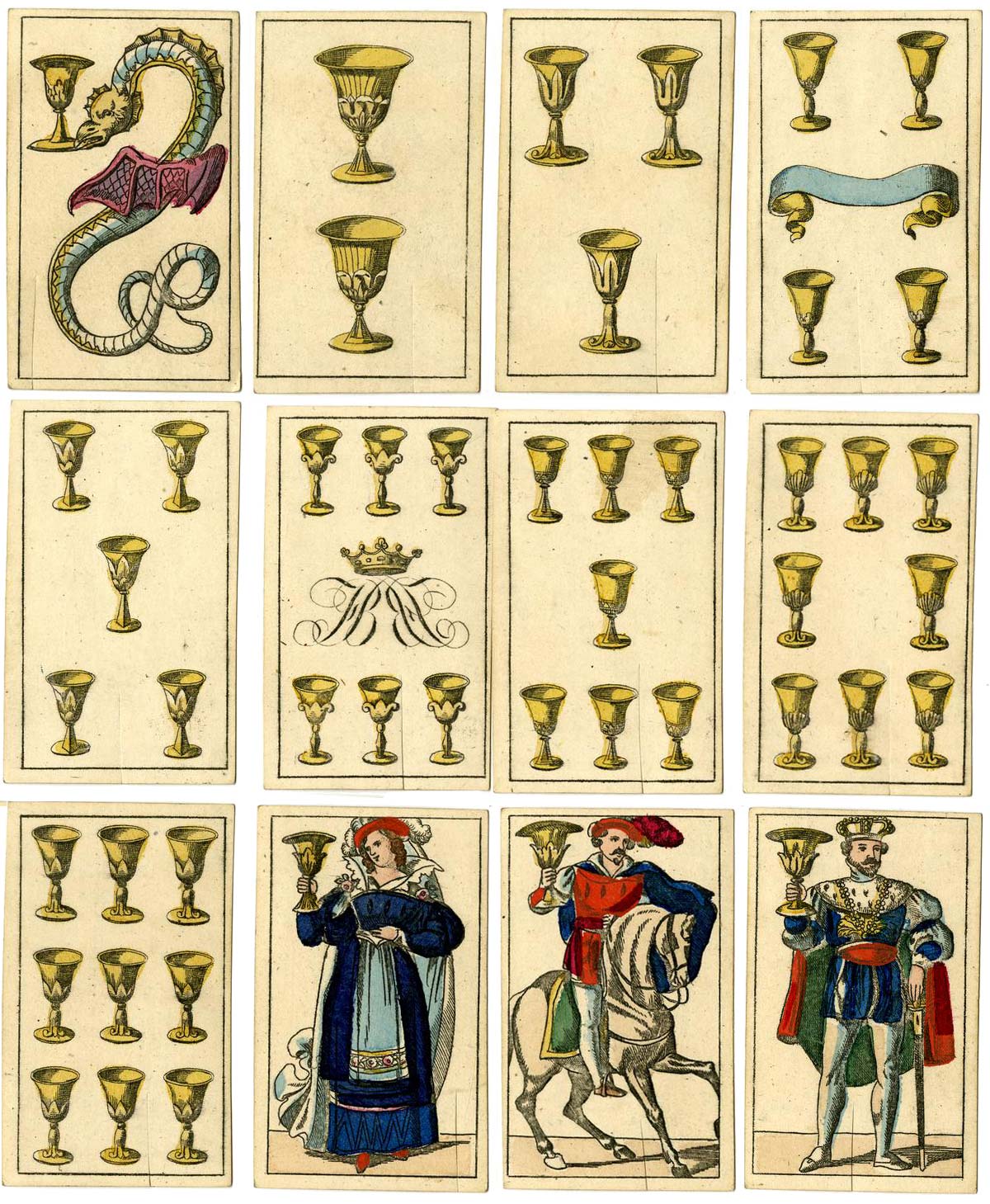
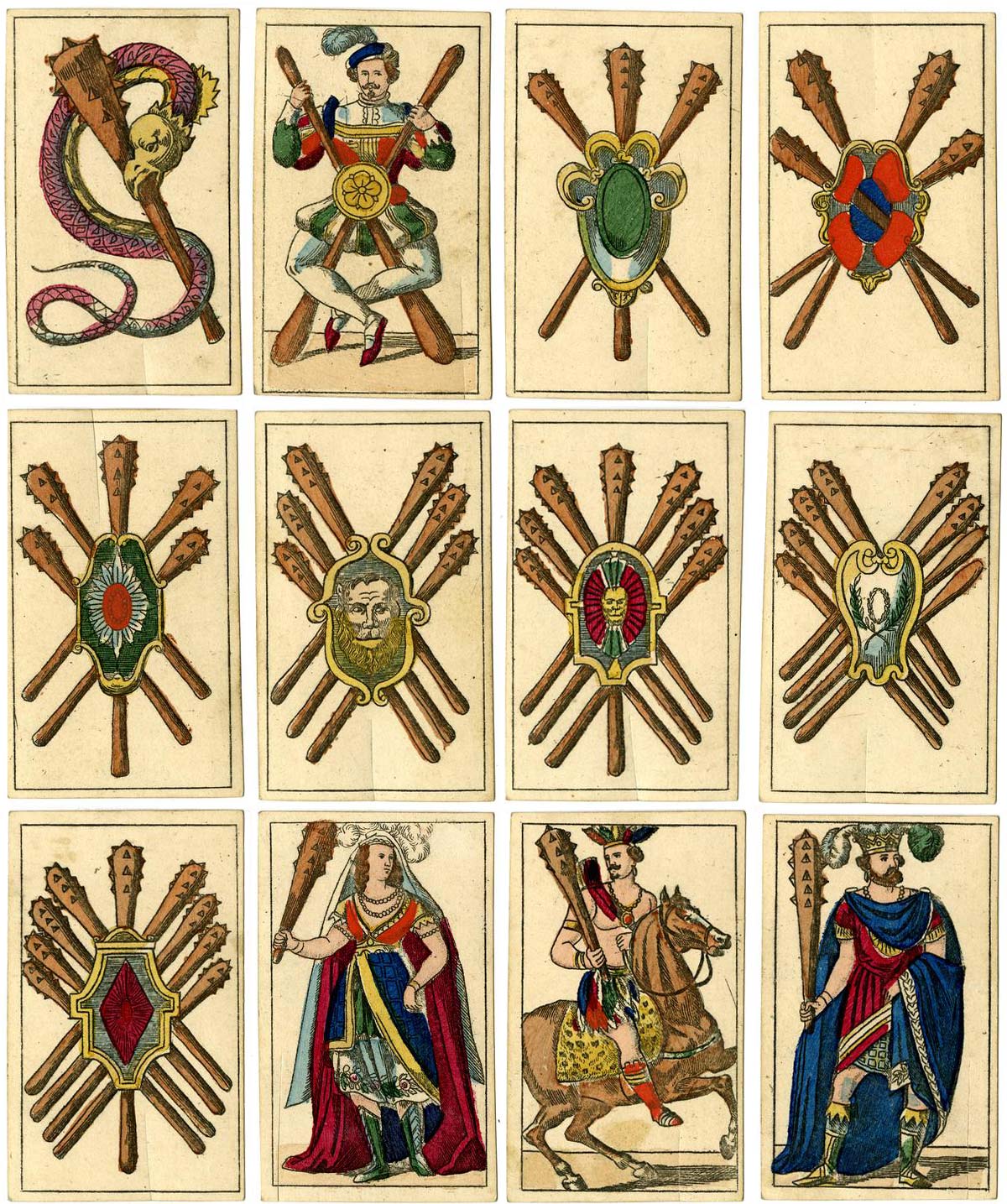
Above: Portuguese playing cards manufactured by Impressão Règia, Real Fábrica de Lisboa, c.1800-1830. 48 hand-coloured cards, backs printed with a design of small, deep blue dots running diagonally, 48x78 mm. © The Trustees of the British Museum
References
British Museum number 1850,0612.533-580►
Denning, Trevor: The Playing-Cards of Spain, Cygnus Arts, London, 1996, pp 43-46.
Dummett, Michael: The Game of Tarot: From Ferrara to Salt Lake City, Duckworth, 1980
Willshire, W. H.: A Descriptive Catalogue of Playing and Other Cards in the British Museum, Trustees of the British Museum, 1876, reprint 1975. (Spanish 22).

By Simon Wintle
Spain • Member since February 01, 1996
I am the founder of The World of Playing Cards (est. 1996), a website dedicated to the history, artistry and cultural significance of playing cards and tarot. Over the years I have researched various areas of the subject, acquired and traded collections and contributed as a committee member of the IPCS and graphics editor of The Playing-Card journal. Having lived in Chile, England, Wales, and now Spain, these experiences have shaped my work and passion for playing cards. Amongst my achievements is producing a limited-edition replica of a 17th-century English pack using woodblocks and stencils—a labour of love. Today, the World of Playing Cards is a global collaborative project, with my son Adam serving as the technical driving force behind its development. His innovative efforts have helped shape the site into the thriving hub it is today. You are warmly invited to become a contributor and share your enthusiasm.

Activity for Portuguese pattern by Real Fábrica
Sign in to comment or save this article.

Related Articles

Portuguese Playing Cards
The Real Fábrica de Cartas de Jogar was founded in 1769, by Royal Charter of King José, under the ma...
Most Popular
Our top articles from the past 60 days


