


Tarot Baraja Egipcia
Curious Tarot with Egyptian-style trumps issued by Franco Mora Ruiz from Mexico.
Several cultures and influences have been combined in this curious Tarot pack from Mexico which carries the name of Franco Mora Ruiz on the leaflet. The trump cards betray Egyptian influence but also have letters from the English and Hebrew alphabets and suggested meanings in Spanish down one side. They do not have traditional titles. The minor cards have miniature English and Italo-Spanish cards, Zodiac signs, Egyptian elements, chess pieces, etc., with suggested meanings on up to four sides. Knights for the English cards and queens for the Italo-Spanish cards have had to be invented and do not really match the other courts. These minor cards all have grey backgrounds, while the trumps are more colourful. An image of a sphinx can be found on the reverse (double-ended), on the wrapper and on the box. Stamped on the box are the words “HECHO EN MEXICO BY GRAN MAGO “FATY” • See the box
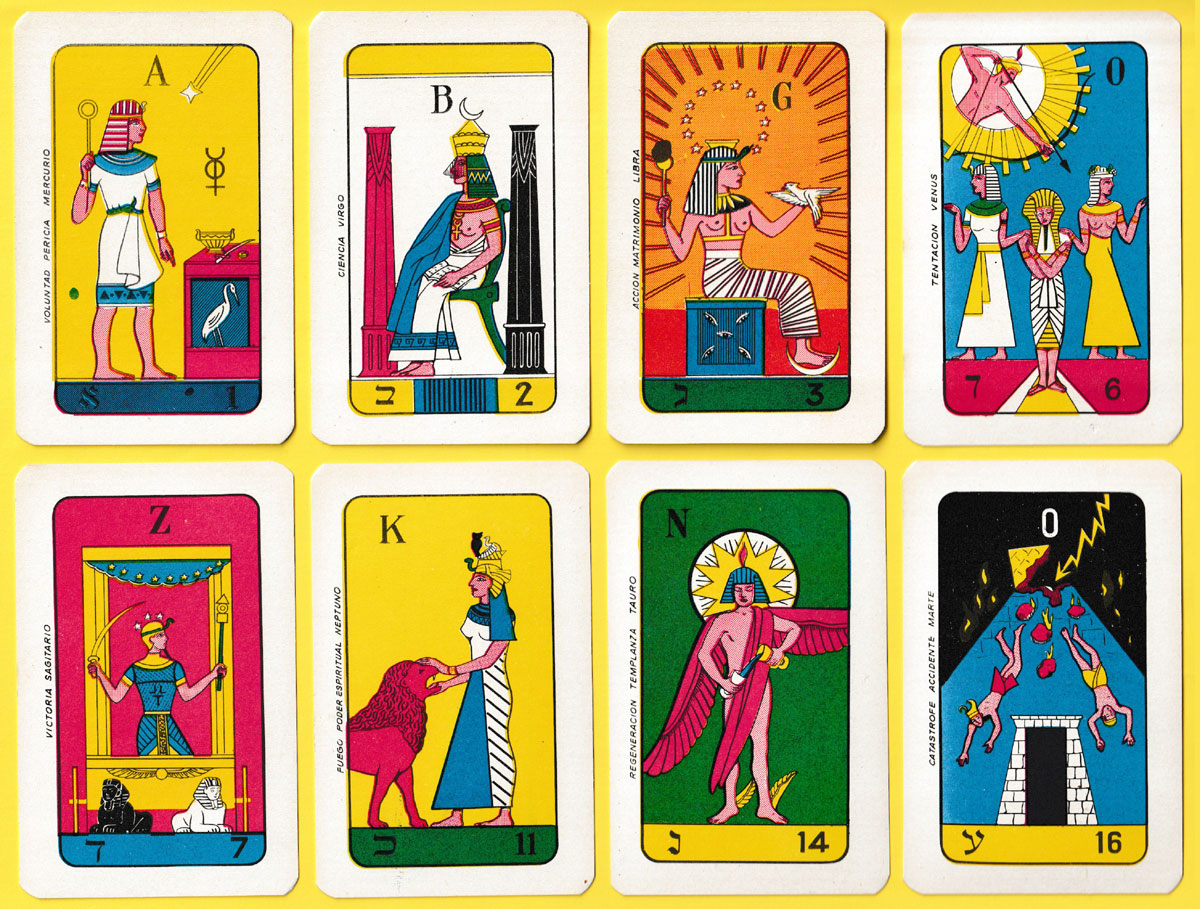
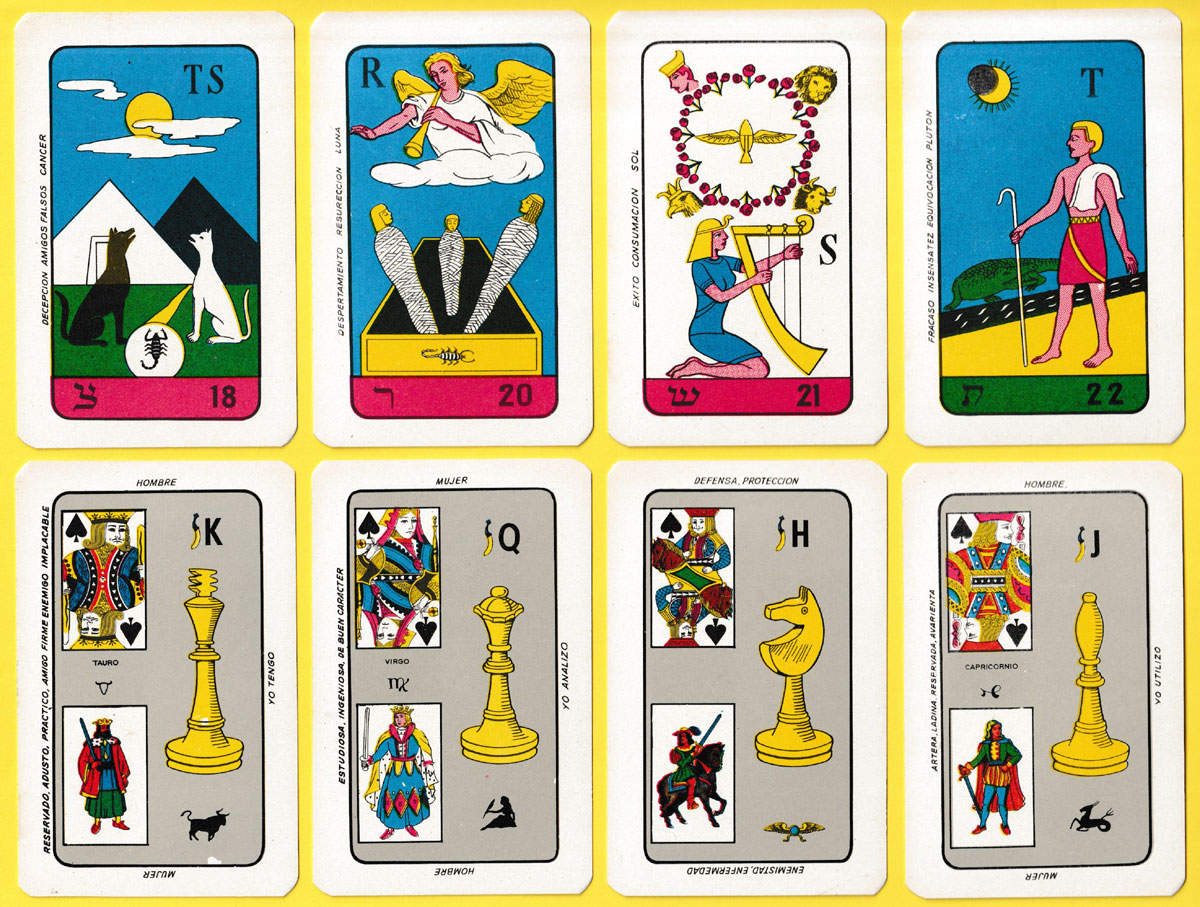
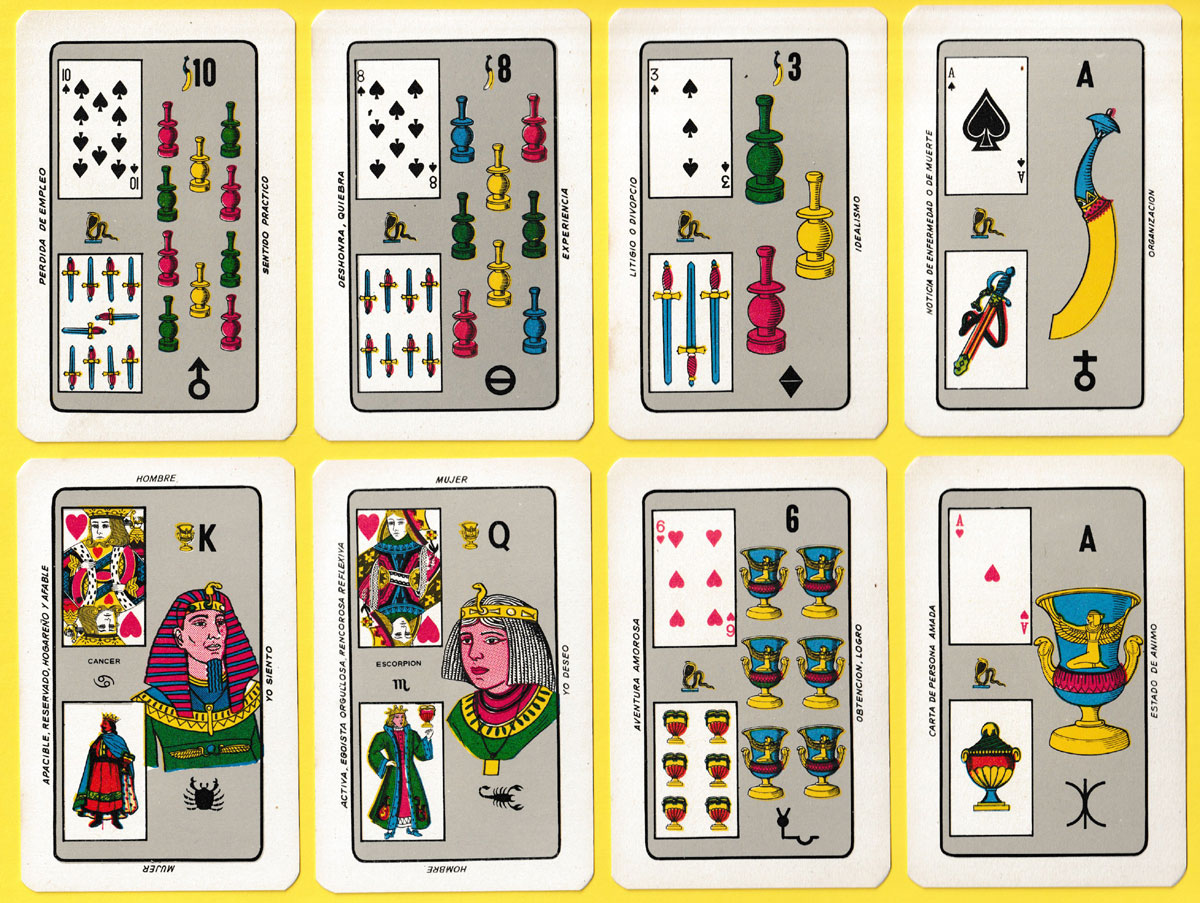
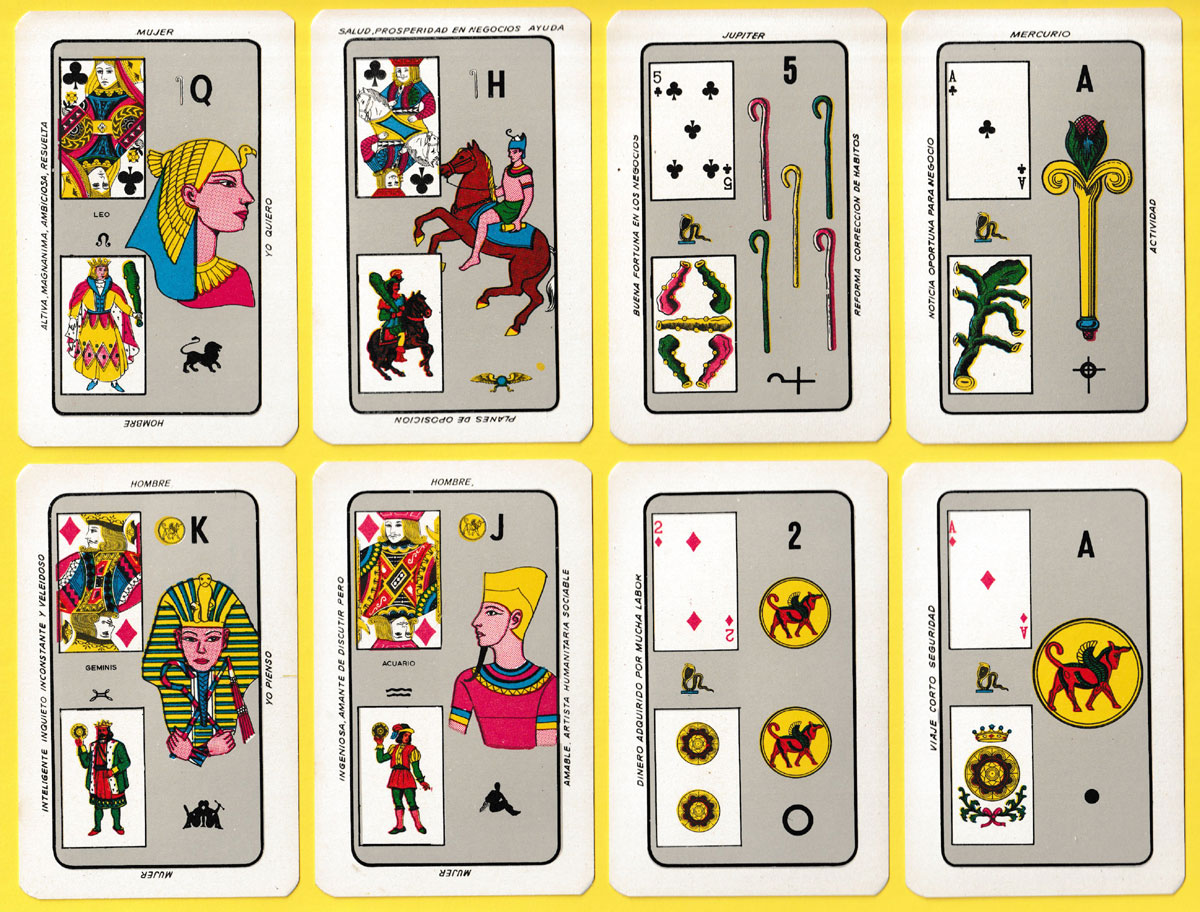
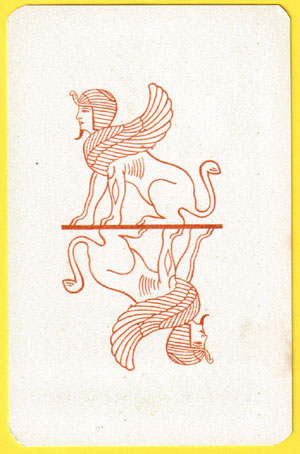
Above: Tarot Baraja Egipcia published by Franco Mora Ruiz, Mexico, c1975. Made in Mexico by Gran Mago “Faty”. 78 cards + 2 blank cards + leaflet in Spanish, in wrapper + tuck box. Size: 62 x 96 mm.
It's curious that the stamp on the box seems to mix Spanish and English ("HECHO EN MEXICO BY ...."). Closer inspection shows that many other foreign elements are mixed together in the pack. For instance, the leaflet authored by Franco Mora Ruiz explains that to aid the beginner suggested interpretations are printed around the sides of the cards. But for the more advanced or proficient occultist there is also a wide range of kabbalistic and other equivalences including chess pieces, zodiac signs, English and Spanish-suited cards, Hebrew letters, etc. interspersed within the designs in order to create more layers of meaning. The author notes that "the Major Arcana retain their originality, providing ample scope for the study of the Kabbalah" presumably so that this creative fusion of symbolic systems enriches the tarot experience. After describing a number of ways to spread the cards, the author concludes by saying "Having lived a good past is having a good present and a victorious future" and wishes success in using the pack. The pack is a good example of a resurgence of Egyptian-themed tarot decks in the 1970s which mixed esoteric and occult symbols with alternative spiritualities and which coincided with the rise of the New Age movement. The so-called 'Egyptian tarot' derives from the earlier 18th century writings of Eliphas Levi, Court de Gébelin and others, which in the 1970s saw a revival of interest and commercial output.
Reference
Kaplan, Stuart R. The Encyclopedia of Tarot, Vol. I. New York, NY, USA: U.S. Games Systems, Inc.; 1978. p.236.

By Roddy Somerville
France • Member since May 31, 2022
Roddy started collecting stamps on his 8th birthday. In 1977 he joined the newly formed playing-card department at Stanley Gibbons in London before setting up his own business in Edinburgh four years later. His collecting interests include playing cards, postcards, stamps (especially playing cards on stamps) and sugar wrappers. He is a Past President of the Scottish Philatelic Society, a former Chairman of the IPCS, a Past Master of the Worshipful Company of Makers of Playing Cards and Curator of the WCMPC’s collection of playing cards. He lives near Toulouse in France.

Activity for Tarot Baraja Egipcia
Sign in to comment or save this article.

Related Articles
Martin Sharp’s Psychedelic Tarot
Psychedelic Tarot by Martin Sharp issued in poster form with an issue of OZ magazine.
Murder of Crows Tarot
Corrado Roi’s 2020 tarot pack presents a dark, watchful world of crows and ritual figures.
Tarot de Valverde de la Vera
A series of 24 surrealist engravings by Mexican artist Claudio Favier in which archetypal Tarot alle...
Morgan-Greer Tarot
Based on the knowledge, wisdom and interpretation of Paul Foster Case and Arthur Edward Waite.
The Parisian Tarot
The “Parisian Tarot”, early 1600s, with imagery and design synthesizing several influences.
Jeu de Tarot Astérix
A French Tarot game pack with Astérix and friends on all the trump cards.
The Place of the Fool
This paper considers three questions relating to the Fool-card in the tarot-pack.
Egyptian Tarot
Egyptian Tarot inspired by ancient Egyptian art, mythology, and iconography, published by Naipes La ...
V. F. Solesio Tarot
V. F. Solesio Tarot, Genoa, mid-late 19th century.
Rolla Nordic Tarot
Rolla Nordic Tarot was drawn by Paul Mathison.
Rider Waite Tarot - details compared
After the first edition of the Rider-Waite tarot in 1909 four further editions were published till a...
Rider Waite Tarot early editions
Rider Waite Tarot early editions
Insight Institute Tarot
During the late 1940s and 1950s The Insight Institute, of New Malden in Surrey, ran correspondence c...
Shipman’s Guide: early card-packs and the Arcana
In late medieval Europe, among the various forms of card-sets that were tried, two were apparently f...
Michael Scot's rebus figure of "Juppiter" as prototype for the tarot pack's "Magus”/”Bateleur”
A precursor for the 'Bateleur'/'Magus' included in the major arcana of our tarot pack.
XV Century Italian Playing Cards
Cards from a pack of an early form of north Italian playing cards, with the swords back-to-back and ...
Tarocco Milanesi by Lamperti (Milan) c.1850
Tarocco Milanesi by Lamperti (Milan) c.1850
Hand-Painted Tarocchi Cards
Hand-painted Tarocchi cards sometimes known as ‘Charles VI tarot’, North Italy, 1475-1500.
Jason Ennis Tarot Cards
Jason Ennis was a self trained artist interested in man's nature, his powers and abilities.
English Tarot Cards
The game of tarot was not widely accepted in England until the 1870s when a number of English occult...
Most Popular
Our top articles from the past 60 days


