


Le Jeu Des Fortifications
An innovation from the time of Louis XIV by Gilles de la Boissière.
“The Game of Fortifications” is the English translation of the title of the game, created by Gilles Jodelet de La Boissière as royal engineer to King Louis XIV. He collaborated on the texts with the architect François Blondel. The oldest known edition comes from Paris by the printer Mariette (Pierre II?) in 1668 (1663?).
In its basic form, it is a paper print of the game board of a special variant of the Royal Game of the Goose. In France, the principle of the game was innovated into a pedagogical tool with various thematic focuses. The oldest known adaptation should be the “Jeu Chronologique” by Mariette (Pierre I) from 1638, whose purpose was to teach history. At the same time, Instructive and Educational Playing Cards by Jean Desmarests and others were also being developed in parallel.
The advanced version of this game by M. de La Boissière deals with the construction of fortress fortifications of that time. In the dice game, it guides the player from the basic definition of geometric principles to the advanced defensive elements of bastion fortresses. The final field of the game contains the floor plan of the completed fortress. The game board also contains game instructions and a name index of the terms used.


Above: Le Jeu Des Fortifications designed by Gilles de la Boissière and manufactured by Jean Mariette, Paris, 1691.

An interesting innovation is the addition of a miniature card in the upper right-hand corner of each playing card. After cutting the game board, a regular 52-card deck is created, which can also be used for a card game. The miniature card also contains the sequence number of each field, and when all the cards are spread out on the table, the possibility of using it for a dice game is preserved.
The same solution is also repeated in “Das Spiel der Hoffnung” (The Game of Hope), a game of chance designed by Johann Kaspar Hechtel of Nuremberg circa 1799, from which the deck of Fortune Telling cards called Petite Lenormand subsequently developed.
The game model was very successful, with various language versions being published in Western Europe over the next hundred years. The colour version is exceptional, most of the time it is a single-colour print. The British Museum holds several versions of this game from later editions and in different languages. These are complete printed sheets for a dice game, but also cut-up versions suitable for a card game.
The online store for historical prints AbeBooks offers a book Le Jeu des fortifications from around 1710, with individual cards glued in. If the book was ever used for a game, it could be considered a prototype for a future gamebook. www.abebooks.com/Jeu-fortifications►

Le Jeu De La Guerre
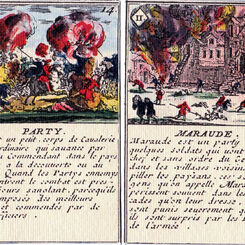
As further proof of the success of this solution, we can mention another game by Gilles de la Boissière. The same basic scheme is used in the game Le Jeu De La Guerre from 1698. The “Game of War” looks at the issue of war from the opposite side and guides the player through the process of conquering a fortress. According to legend, the game was created for the education of the son of Louis XIV. A significant advance is the solution of the card indexes in the upper left corner. Readability has also been improved by replacing the miniature with a symbol of the card suit with a Roman numeral. De la Boissière anticipates the solution of “Dexter indexes” more →
References
Wikipedia : Gilles Jodelet de La Boissière►
British Museum : Gilles de la Boissière►
By Marek Brejcha
Czech Republic • Member since June 13, 2024
My relationship with cards grew from playing to collecting and transformed into publishing as well. I am part of the team at Counter Clockwise, a small company that publishes traditional card games.

Activity for Le Jeu Des Fortifications
Sign in to comment or save this article.

Related Articles
US Army Aircraft Recognition Cards
Air defense combined with gameplay.
Les Chevaliers de la Toison d’Or
Medieval manuscript art at its finest.
French Revolutionary cards by Pinaut
Seven cards from a French Revolutionary pack by Pinaut featuring characters from classical antiquity...
English Pattern by B.P. Grimaud
Standard English pattern published by B.P. Grimaud with engraving by F. Simon, c.1880.
Why our playing-cards look the way they do
Analysis of early playing card designs: origins, suit differences, standardization, technological ad...
The Parisian Tarot
The “Parisian Tarot”, early 1600s, with imagery and design synthesizing several influences.
Paris pattern for WWII troops
Wartime edition of standard designs with fewer colours, a special back design and an overprint.
Pierre Roiné Aluette
Archaic form of Aluette published by Pierre Roiné, Nantes, c.1785.
Ergomia
Complete re-design of traditional pack and a tarot deck into what the publishers considered to be er...
Le Jeu de la Guerre
Facsimile of “Le Jeu de la Guerre” designed by Gilles de la Boissière in 1698.
Atouts de la Vie
“Atouts de la Vie” wartime card game created by Madame Lucien Willemetz, c.1940.
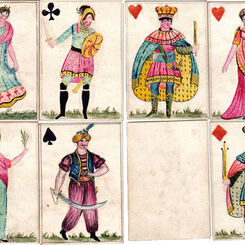
Prisoners of War
Hand-made playing cards by French prisoners of war in Porchester Castle, Hampshire, c.1796.
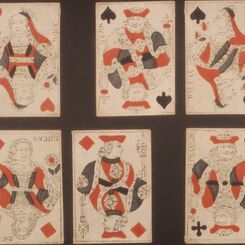
64: The descendants of the French regional patterns: 2
A continuation oF the development of the off-spring of the Paris patterns and a few examples of how ...
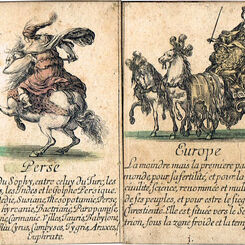
Jeu de la Géographie
“Jeu de Géographie” educational playing cards etched by Stefano Della Bella and published in c.1644....
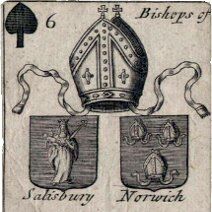
Arms of English Peers
The Arms of English Peers playing cards were first published in 1686. Heraldry, or a knowledge of th...
Kriegs-Spiel by Peter Schencken, Amsterdam
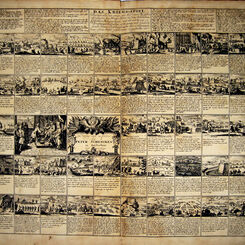
Peter Schencken of Amsterdam copied the "Jeu de la Guerre" or "Das Kriegs-Spiel" (with German captio...
Suicide King
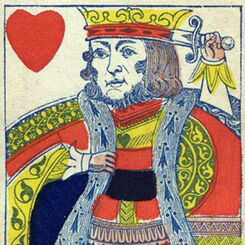
The King of Hearts, holding a sword behind his head, is sometimes nicknamed the “Suicide King”. He c...
Triplicate No.18
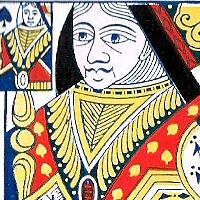
Dougherty first secured a patent for “Triplicates” in 1876, a novel type of indices with a miniature...
Lyon Pattern type iii
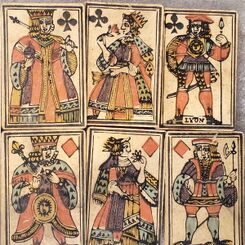
This pattern was used in various parts of eastern France but was ultimately replaced by the official...
Paris Pattern
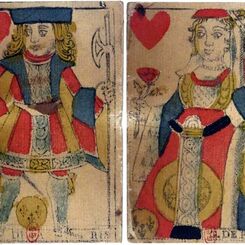
The Paris pattern was established as such around the middle of the seventeenth century (based, perha...
Most Popular
Our top articles from the past 60 days


